Friction
Neil Trivedi
Teacher

Contents
Friction
Friction is a force that acts between two surfaces in contact with each other and it opposes motion or the tendency for motion.
Let’s consider three situations involving an object on a rough horizontal surface. In each diagram, represents friction.
Situation : We apply a push force of N to an object and the object doesn’t move.

Since the object is at rest, the frictional force must balance the push force. In other words, the object is in equilibrium. So, N.
Situation : We apply a push force of N and the object is on the verge of slipping (moving).

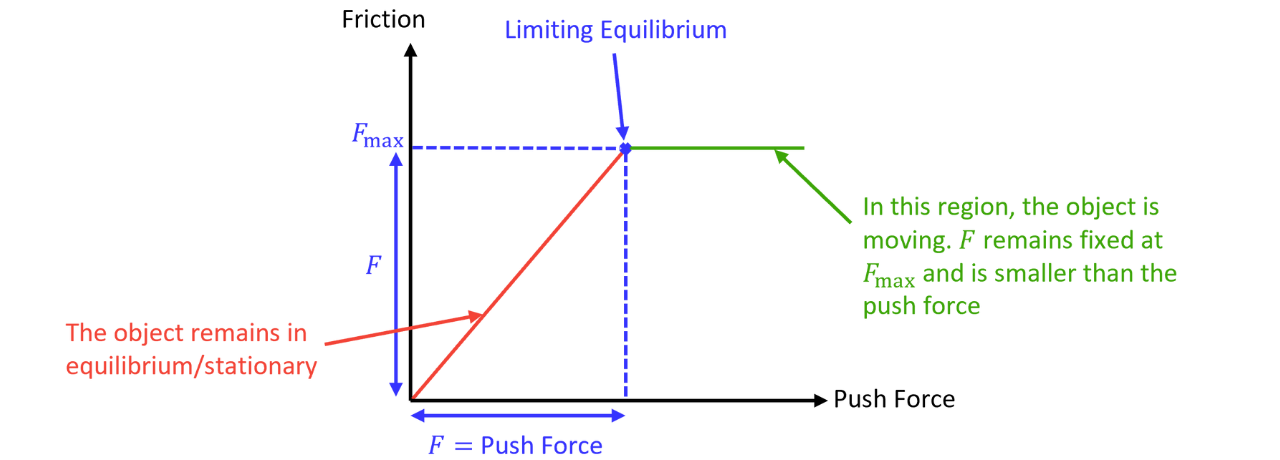
This situation is known as limiting equilibrium. Here, the frictional force has reached its maximum possible value, denoted by , which is N, and if we increase the push force, the object will move.
Situation : We apply a marginally greater push force than in situation , such as N.

In this situation, the object now moves, and the frictional force remains at N. Once the object is moving, the frictional force is equal to and no longer increases with the push force.
To summarise the three situations, the graph below shows how the frictional force varies with the push force.
There are two factors that affect friction:
1) The material of the surface, represented by the coefficient of friction, .
2) The normal reaction force, .
The maximum possible value of the frictional force is given by
This occurs when the object is on the point of moving (in limiting equilibrium) or when the object is moving.
When an object is in equilibrium (including at the point of moving), the frictional force satisfies
In plain English: Friction will match any push force up until a certain point and then it remains the same.
Example 1:
A box of mass kg is to be pulled across a rough horizontal floor by a rope inclined at to the floor. The coefficient of friction between the box and floor is . Find the tension in the string when the box is at the point of moving.
Step 1: Draw a force diagram.
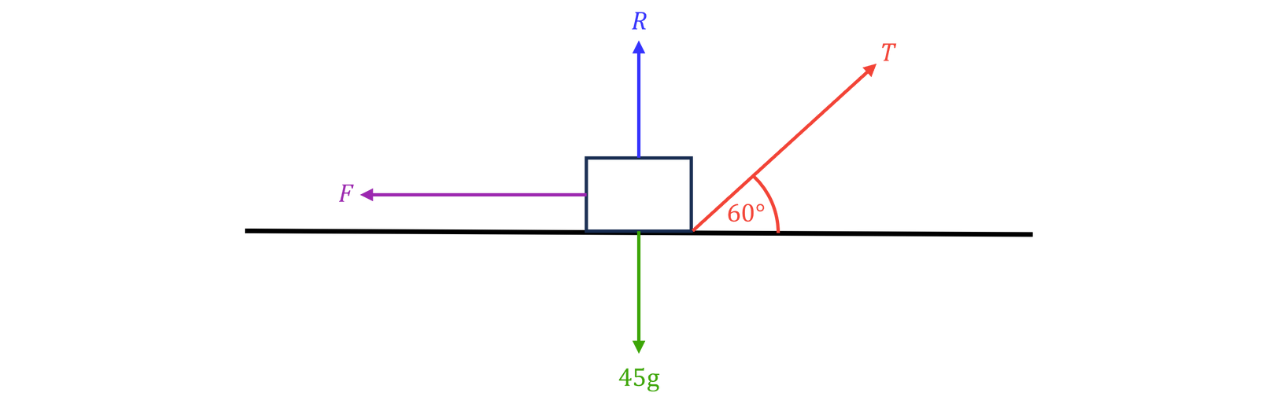
The question tells us that the box is on the point of moving so it is in limiting equilibrium. This means that the frictional force is the maximum possible value, which is equal to , where
as stated in the question. Also, we need to ensure that all forces are pointing parallel and perpendicular to the surface, so we need to resolve .
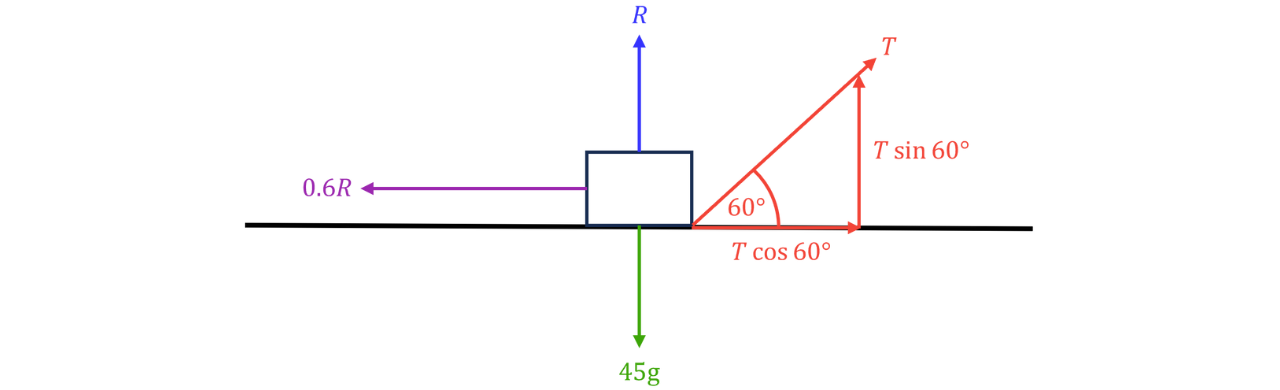
Since the box is in limiting equilibrium and hence not moving, the downward forces acting on the box are equal to the upward forces, and the leftward forces are equal to the rightward forces.
Step 2: Equate the upward/downward forces and the leftward/rightward forces, forming two equations which we will then solve simultaneously.
Our two equations will be
Up down:
Left right:
Step 3: Solve for .
We want to solve for , so we need to eliminate to get an equation in terms of only.
Rearranging for by subtracting on both sides,
Rearranging for by multiplying both sides by .
Substituting equation into equation ,
Expanding the brackets,
Bringing all terms to the LHS,
Factorising out ,
Dividing both sides by to obtain ,
N sf
No answer provided.
Slopes
Remember that friction always opposes the direction of motion. So, we must read the question and see if the particle is at the point of slipping up or down the plane.
Consider a particle of mass kg at rest on a rough inclined plane. Here, the frictional force acts to prevent the block from sliding down the plane, as shown in the diagram below.
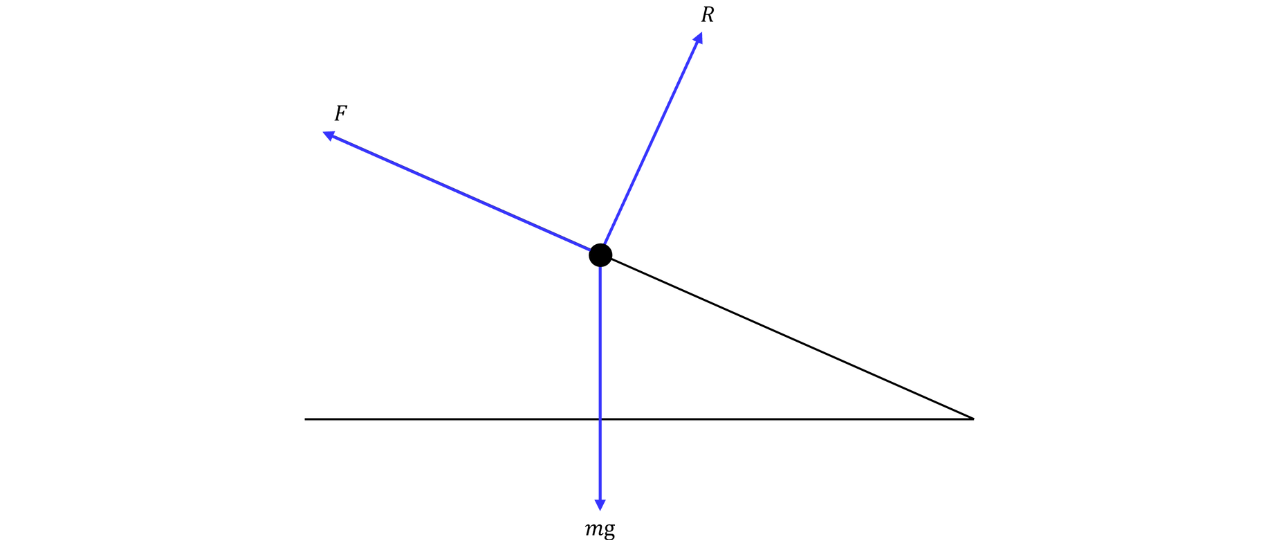
Now, consider a particle of mass kg at rest on a rough inclined plane. A force is being applied up the plane, causing the object to be at a point of slipping up the plane. Hence, friction will oppose the potential upward motion by facing down the plane, as shown in the diagram below.
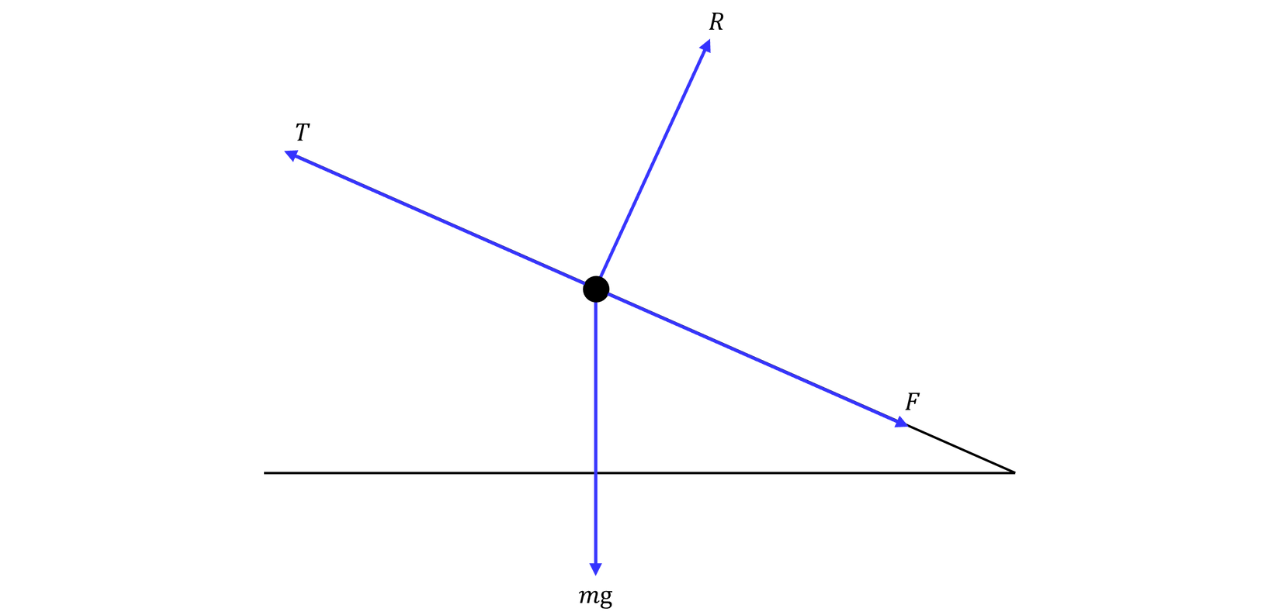
Example 2:
A particle of weight N is held by a rope, in limiting equilibrium on a fixed rough inclined plane. The rope is modelled as a light inextensible string and lies in a vertical plane containing a line of greatest slope.
The incline of the rope to the plane is at an angle , where . The plane is at an angle of to the horizontal, as shown in the figure below. When the tension in the rope is N, the particle is at the point of slipping up the plane.
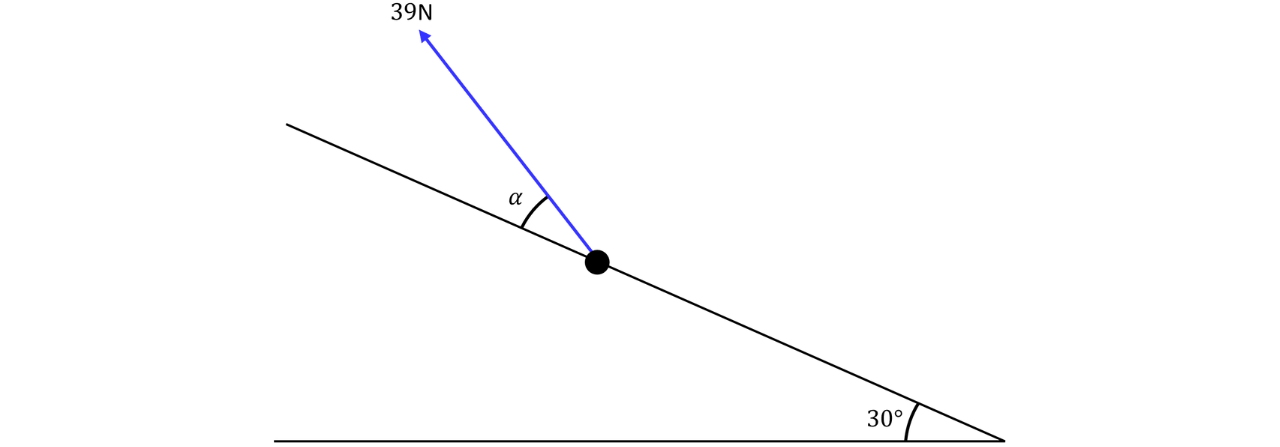
Calculate the value of the coefficient of friction between the box and the plane. Leave your answer correct to decimal places.
Step 1: Annotate the diagram by adding any new forces as described in the question and then resolving all forces.
The question tells us that the particle is at the point of slipping up the plane, so it is in limiting equilibrium. This means that the frictional force is pointing down the plane and it is the maximum possible value, which is equal to .
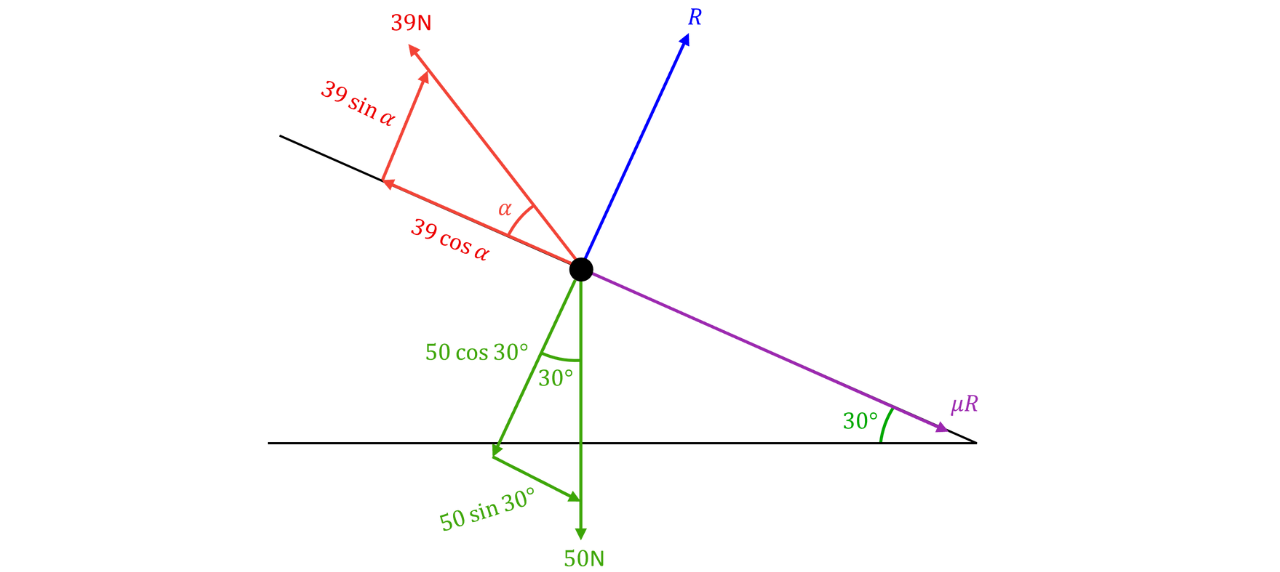
The weight of N acts vertically downward, while the plane is inclined at to the horizontal. We resolve it into components that are parallel and perpendicular to the plane and the angle between the N force and its perpendicular component is equal to the angle of the incline, which is . For more information on this, please refer to our Resolving Forces study note.
Step 2: Equate the forces pointing up the plane/down the plane and the forces pointing into the plane/out of the plane, forming two equations which we will solve simultaneously.
Our two equations will be
Up the plane down the plane:
Out the plane into of the plane:
Using , we form a right-angled triangle with the opposite being and the adjacent being and we use Pythagoras’s theorem to find the hypotenuse and hence, find and .
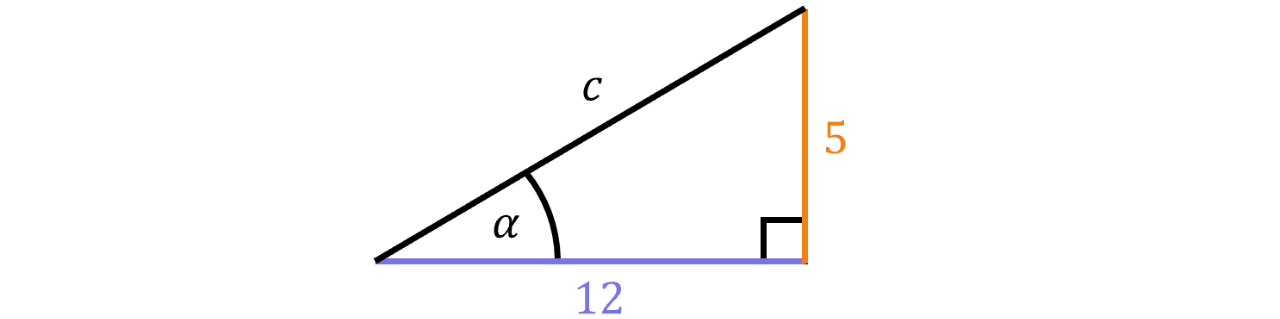
The hypotenuse is and using this, we will find that and .
Hence,
Up the plane down the plane:
Out the plane into of the plane:
Step 3: Solve for .
We want to solve for , so we need to eliminate to get an equation in terms of only.
Rearranging equation for by subtracting on both sides,
N
Substituting into equation ,
Subtracting from both sides and then dividing by to obtain .
sf
No answer provided.
Challenging Question