Length contraction
Brook Edgar & Hannah Shuter
Teachers


Contents
Explainer Video
Length contraction
A sprinter and a referee compare two 30 cm rulers to confirm they’re identical.
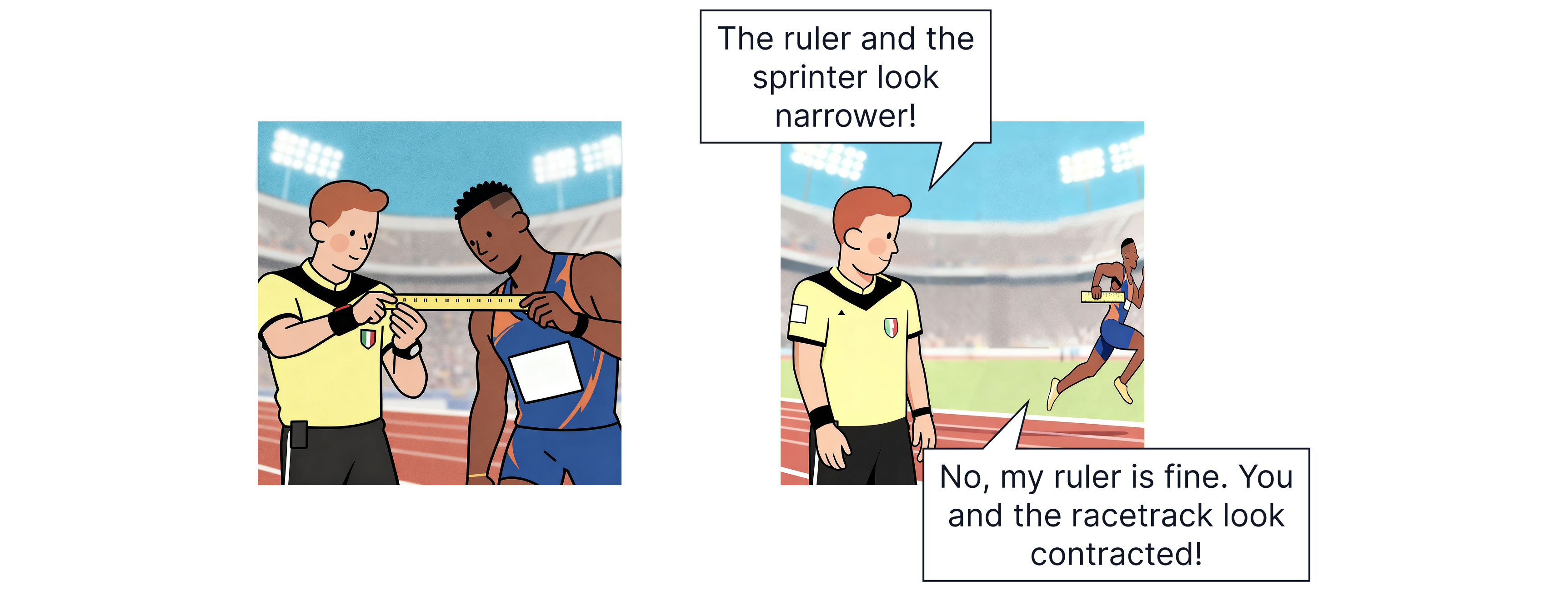
The sprinter then runs at 0.90c holding the ruler pointing in the direction of motion.
The referee says: “To me, the ruler and the sprinter look narrower in the direction they’re running (contracted along the track).”
The sprinter disagrees. From the sprinter’s point of view, their own ruler is normal length. Instead, the sprinter says the referee, the rulers, the whole stadium and even the track look shorter because the stadium is moving past at 0.90c in the opposite direction.
Key idea: length contraction only happens parallel to the direction of motion (objects don’t get shorter sideways/upwards).
Length contraction equation:
where is the Lorentz factor, a useful number to determine first when doing calculations:
Formula:
Definitions:
• proper length (measured in the frame where the object is at rest)
• observed length (measured by an observer who sees the object moving at speed v)
Example calculation: train carriage moving near the speed of light
A train carriage has a proper length = 14.0 m (measured by a passenger). The train passes a station at v = 0.92c.
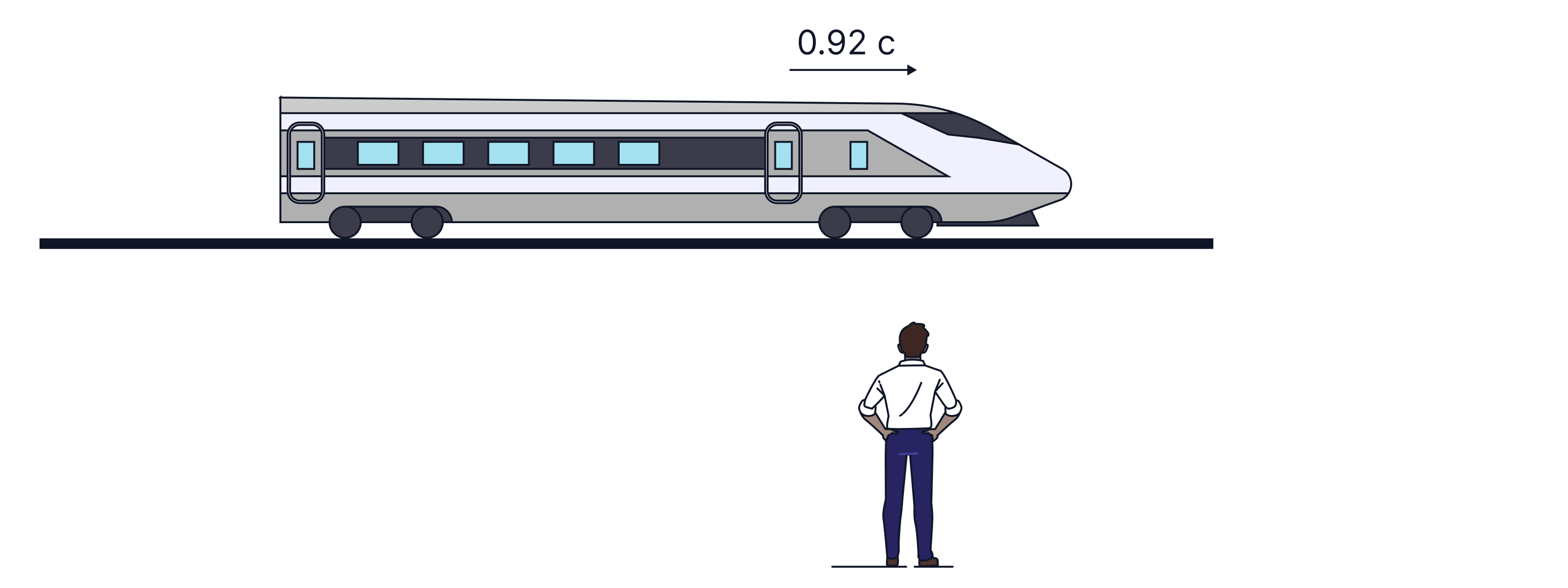
Find the length of the carriage measured by the platform observer.
Step 1: Calculate the Lorentz factor
Step 2: Decide which length is proper
The carriage is at rest in the train frame, so is the proper length.
Step 3: Apply length contraction
Answer: passenger measures 14.0 m, platform observer measures 5.49 m (contracted along motion).
Proper length and observed length (examples)
Proper length is measured in the frame where the object is at rest. Observed length is measured by an observer
who sees that object moving.
Quick examples (pairs):
Ruler held by sprinter:
Proper length : sprinter measures their ruler (30 cm).
Observed length : referee measures the moving ruler (shorter).100 m track:
Proper length : referee measures the track (100 m).
Observed length : sprinter measures the moving track (shorter).Spaceship length:
Proper length : astronaut measures the ship.
Observed length : planet observer measures the ship passing (shorter).Distance between detectors:
Proper length : lab measures detector separation.
Observed length : particle measures the detector separation (shorter).Length of a beam of particles:
Proper length : beam frame measures its own length.
Observed length : detector frame measures the moving beam (shorter).
Evidence for length contraction: cosmic particles reaching the ground
What evidence is there that length contraction is real? We can test relativity using unstable particles from cosmic rays. Classically, many should decay before reaching a lower detector. Special relativity explains the extra survivors.
This time we explain it using length contraction: in the particle’s frame, the distance to the lower detector is shorter, so the particle reaches it sooner and more survive.

Two detectors are separated by = 1.6 km (lab). Muons travel at v = 0.995c. Muon half-life at rest is μ
.
Prediction without special relativity (no length contraction)
Step 1: Travel time in the lab frame
Step 2: Expected fraction reaching detector 2
Expected percentage reaching the second detector .
Prediction including length contraction (muon frame)
Step 1: Lorentz factor
Step 2: Contracted distance in the muon frame
Step 3: Time to reach detector 2 in the muon frame
Step 4: New expected fraction reaching detector 2
Conclusion: in the muon frame the detector separation is shorter, so many more survive to reach the lower detector.
Worked Example:

A space station is 5 light years away from earth in the Earth’s frame of reference. A spaceship travels at v = 0.88c.
Calculate the distance between earth and space station according to the spaceship.
Calculate the travel time according to (i) an observer on the planet and (ii) someone on the spaceship.
Answer:
Step 1: Lorentz factor
Step 2: Decide which length is proper
The earth and space stationary are at rest in the Earth’s frame, so is the proper length.
Step 3: Contracted distance in the spaceship frame
Step 4: Time according to the observer on Earth.
Step 5: Time according to someone on the spaceship (spaceship frame)
Spaceship distance ; time on Earth’s clocks ; time on spaceship clocks .
Worked Example:
A proton beam travels at . A detector (at rest in the lab) measures the beam length as .
Find the beam’s proper length (beam frame), and the time for the beam to pass the detector (lab frame).

Answer:
Step 1: Lorentz factor
Step 2: Decide which length is proper
The detector sees the beam moving, so is the observed length . The beam’s proper length is .
Step 3: Find proper length
Step 4: Time to pass the detector (lab frame)
Practice Questions
A spaceship has proper length . It passes an observer at . Calculate its length measured by the observer.

-> Check out Hannah's video explanation for more help.
Answer:
Two particle detectors are separated by . They detect cosmic particles travelling at . Their half-life at rest is . What percentage reaches the second detector?
-> Check out Hannah's video explanation for more help.
Answer: