Mass-energy
Brook Edgar & Hannah Shuter
Teachers


Explainer Video
Mass and Energy
In classical (Newtonian) mechanics, kinetic energy is: .
As a particle’s kinetic energy increases, this equation predicts its speed keeps increasing without limit. That implies a particle could eventually have , which contradicts special relativity (and experiments).
So at speeds close to the speed of light, Newton’s KE equation is no longer accurate.
Rest mass , rest-mass energy, kinetic energy and total energy.
Rest mass (m₀) is the mass of an object measured in the frame where the object is at rest. Even when an object is not moving, it has rest energy: . This is the energy “stored” in mass (mass–energy equivalence).
If the object has other forms of energy too we can calculate the total energy using the equation .
where the Lorentz factor is .
(Equivalently: , where is the “relativistic mass” form.)
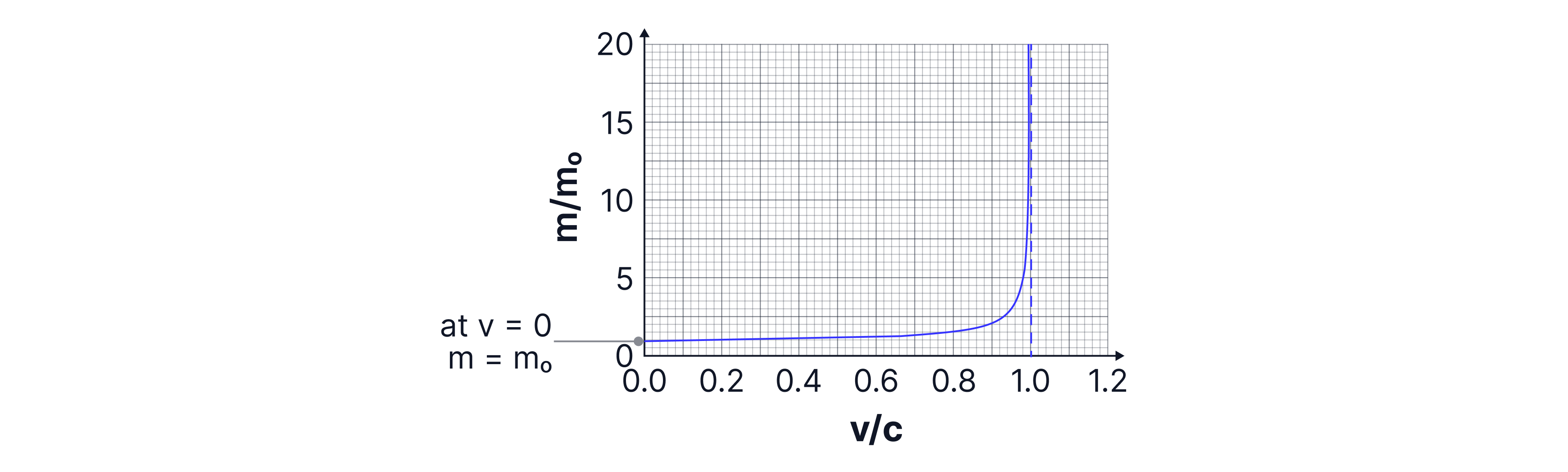
• At low speeds: (ratio )
• As (asymptote)
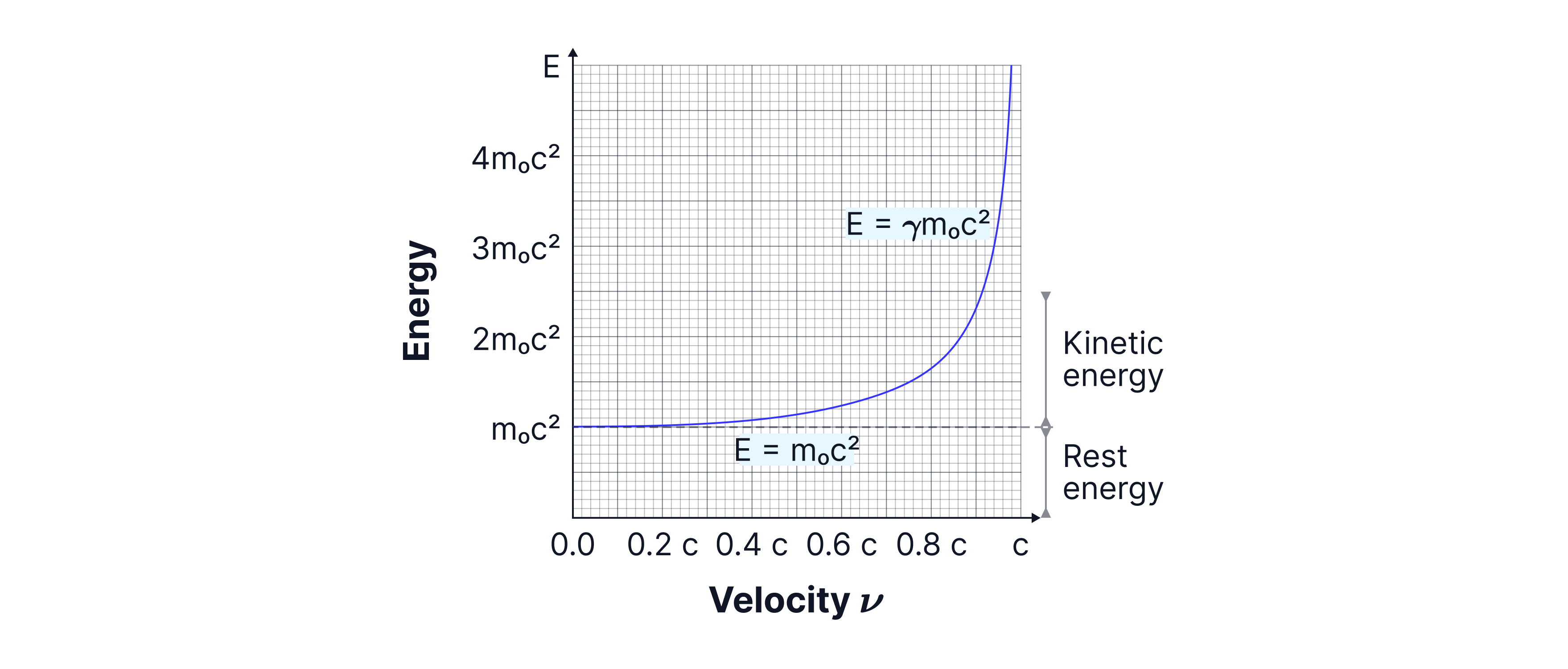
• At low speeds: .
• As (asymptote)
Worked Example:
A proton travels at . Its rest mass is .
Find:
1. rest energy
2. total energy
3. kinetic energy
Answer:
Step 1: Lorentz factor
Step 2: Rest energy
Step 3: Total energy
Step 4: Kinetic energy
Evidence: Bertozzi’s experiment
Bertozzi (1962) accelerated bunches of electrons to high energies and measured:
their speed using time-of-flight (electrons pass two points a known distance apart; time measured using pulses on an oscilloscope)
their kinetic energy by letting them hit an aluminium target and measuring the temperature rise (calorimetry)
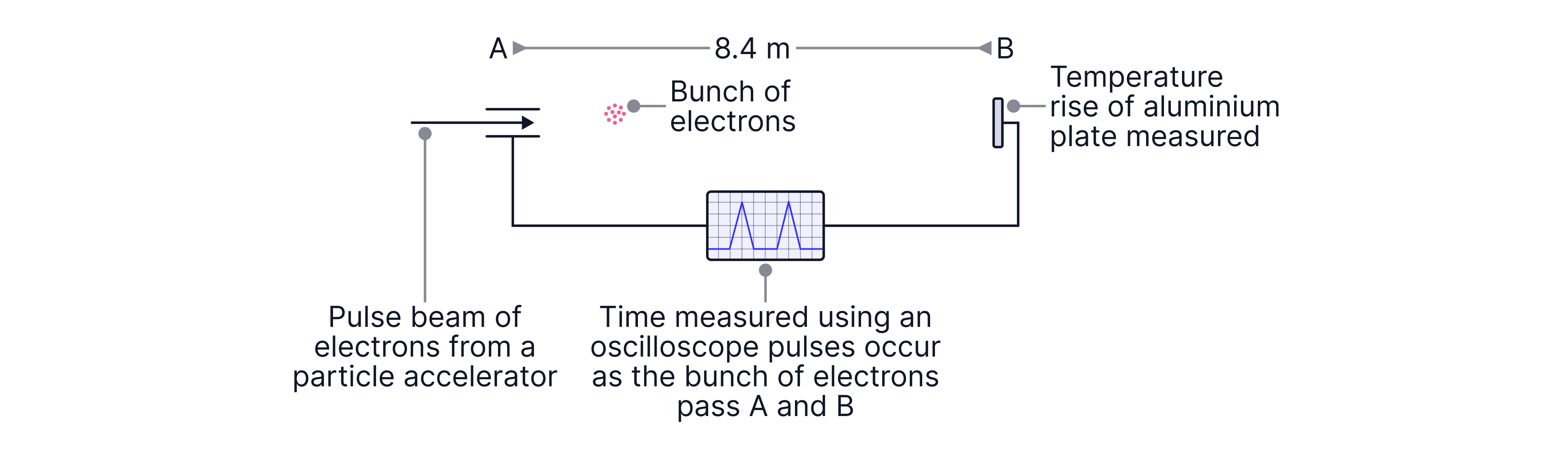
Using the specific heat capacity equation we can find the per electron (from heating):
Formula:
Bertozzi compared the data he collected to Newtonian and relativistic .
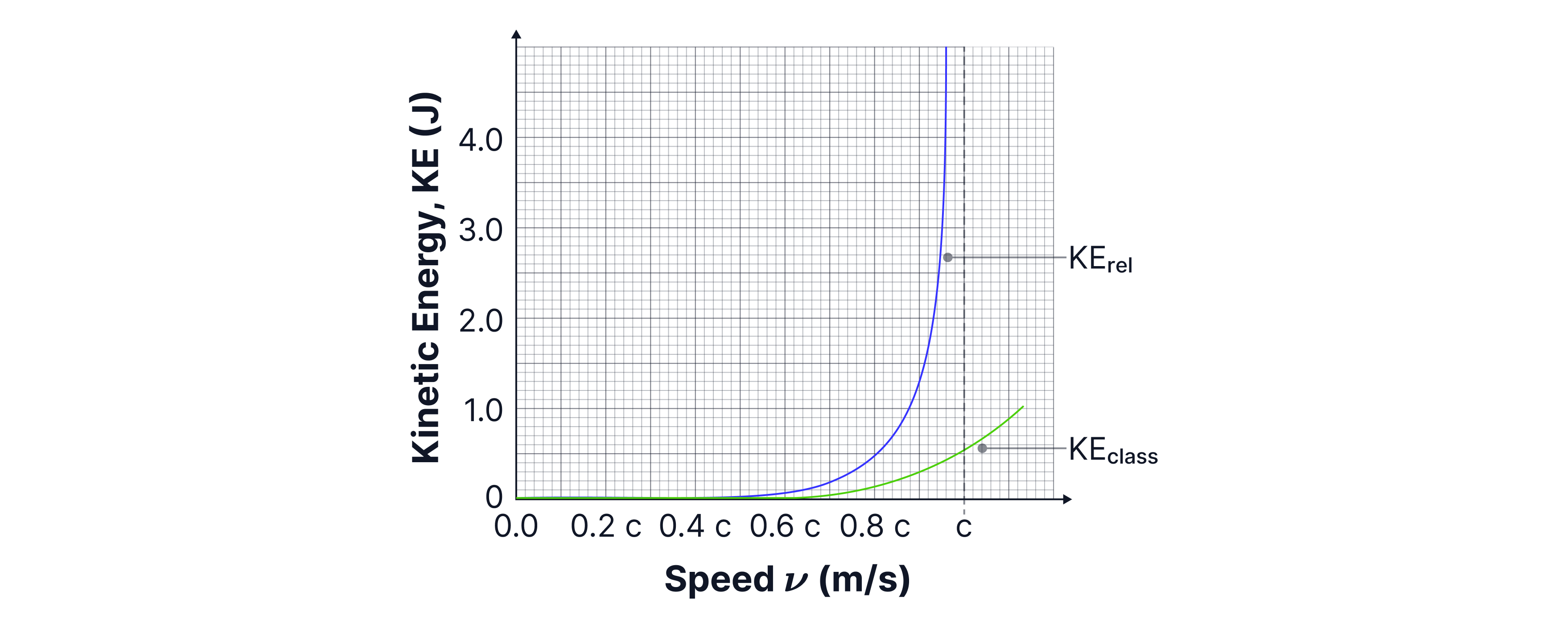
Why is reaching v = c impossible?
From : as .
That means .
So you would need infinite energy to reach . Therefore, no material object can reach or exceed the speed of light.
Worked Example:
A particle is accelerated to a very high speed. An observer measures its mass and finds it is five times larger than
the rest mass of the same particle (i.e. compared with the mass measured when the particle is at rest).
Find its speed as a fraction of .
Find its kinetic energy at this speed (in terms of , and also for an electron).
Answer:
Step 1: Interpret the statement
If the measured mass is five times the rest mass, then , so (because ).
Step 2: Find v
Step 3: Kinetic energy
If the particle is an electron ():
Worked Example:
Outline the experiment that shows is not suitable at speeds approaching .
Answer:
Use a high voltage (particle accelerator) to accelerate electrons to high kinetic energies.
Measure the speed using time-of-flight: electrons pass two points a known distance apart, producing pulses that are displayed on an oscilloscope, giving the travel time.
Fire the same bunch of electrons into an aluminium target and measure the temperature rise of the target. Use calorimetry to estimate kinetic energy (energy transferred to thermal energy).
Repeat the above steps using a different accelerating voltage so the electrons have a different kinetic energy and speed.
Plot a graph of (from heating) against speed (from time-of-flight).
Compare the trend to Newtonian prediction () and relativistic prediction (): Newtonian suggests speeds could exceed , but the data shows speeds approach c and the relativistic model matches the data obtained from the experiment.
Worked Example:
Explain why it is impossible for an object with rest mass to reach the speed of light in free space.
Answer:
Lorentz factor:
Total energy: .
Kinetic energy: .
Infinite energy is not physically achievable → cannot reach .
Practice Questions
A particle has rest mass and moves at . Compare Newtonian kinetic energy with relativistic kinetic energy.
-> Check out Brook's video explanation for more help.
Answer:
How did they prove that breaks as .
-> Check out Brook's video explanation for more help.
Answer:
Newtonian physics implied that as the kinetic energy increases, the speed increases and will eventually approach the speed of light.
Bertozzi fired electrons at an aluminium plate to see if this held true.
He found the kinetic energy of the electrons independently by measuring the temperature rise of the aluminium target (calorimetry)
He knew the speed of the electrons by measuring their time-of-flight between two points (known distance by measured time using oscilloscope pulses).
He found that the measured speeds approached but did not exceed it. As the Newtonian model implied at high , this experiment showed that the relativistic prediction matches the data not the Newtonian model.