Special Relativity
Brook Edgar & Hannah Shuter
Teachers


Contents
Explainer Video
Inertial Frames of reference
A frame of reference is the viewpoint you use to measure position, time and motion. It is essentially a coordinate system tied to an observer (for example: “the platform frame” or “the train frame”). In everyday life we often say “the train is moving”, but equally you could say “the platform is moving backwards” – motion depends on the chosen frame.
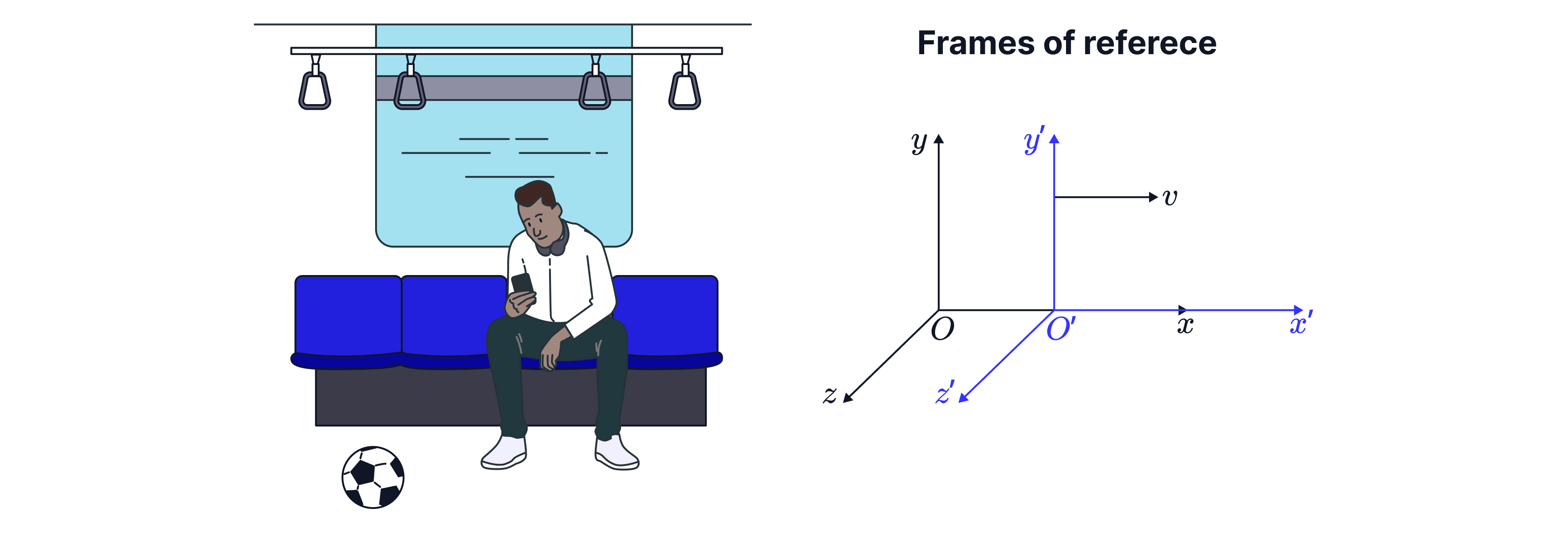
Thought experiment (train with blinds down):
Imagine a person inside a train who falls asleep with the blinds down. When they wake up, they some do experiments inside the carriage (drop a ball, swing a pendulum, bounce a ball off the wall). If the train is moving at a steady speed in a straight line, all the results look normal and there is no experiment they can do to prove they are “really moving”. This is called an inertial frame of reference.
An inertial frame of reference is a frame moving at constant velocity (including ). In an inertial frame, Newton’s first law appears to work normally: if the resultant force on an object is zero, it stays at rest or moves in a straight line at constant velocity.
If the train speeds up, slows down, or turns a corner, the passenger can detect that they are not in an inertial frame because ‘fictitious forces’ seem to appear (for example, you feel pushed backwards when the train accelerates and the ball on the ground will start rolling without any apparent force on it).
We will only work with inertial frames of reference in this topic.
Classical Mechanics- Galilean transformation
In classical mechanics, speeds add (or subtract) between inertial frames. If object A moves at speed u towards object B which is moving at v then the relative speed will be , (i.e. Object A will see object B coming towards it at , which is faster). If object A and object B move at the same speed and direction the speeds subtract to give a relative speed of .
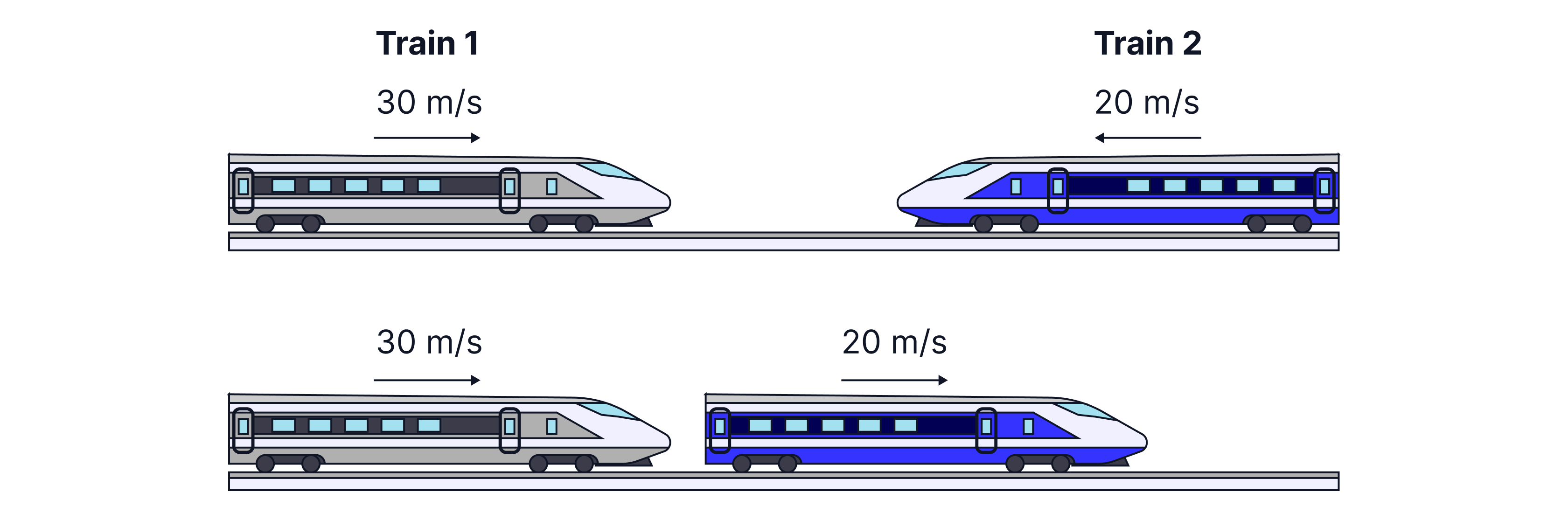
If Train 1 moves right at and Train 2 moves left at , each train measures the other approaching at . That seems obvious because you ‘add’ the speeds.
Same direction example: If Train 1 moves right at and Train 2 moves right at , then Train 1 measures Train 2 moving backwards at ().
The ether and absolute motion
By the mid-1800s, interference and diffraction showed that light behaves as a wave. Most physicists therefore expected light waves to need a medium, just like sound needs air. The proposed medium was the (luminiferous) ether: a fixed ‘background’ filling all space. The Earth was thought to move through this either.

If the ether existed, light should travel at speed c relative to the ether. So an observer moving through the ether might measure different light speeds depending on direction. In other words, physicists thought if a train was going towards a beam of light, a person on the train would see the light approach at a speed greater than .
The Michelson–Morley (MM) experiment: searching for absolute motion
Michelson and Morley designed an interferometer to compare the travel time of two light beams at right angles. A beam splitter (semi-silvered glass block) sends half the light along one arm and half along the perpendicular arm. Each beam reflects from a mirror and returns to recombine at the beam splitter, producing an interference pattern at a viewing telescope.
A plane glass block is placed in one path to ensure equal optical path lengths through glass. Without it, the beam going upward would pass through more glass than the other, creating a built-in phase difference.
Prediction: If the apparatus is moving through the ether, the beam travelling parallel to motion of the apparatus through the ether should take a longer compared with the beam travelling perpendicular to it. That would produce a phase difference and shift the interference fringes.
Key test: Rotate the apparatus by 90° at different times in the year as the earth moves around the sun. If the ether exists, the roles of the two arms swap, so the fringe pattern should shift as the apparatus is rotated.
What they found: no fringe shift (a null result). This strongly suggested there is no detectable ether and therefore no ‘absolute rest frame’ for light. The speed of light is the same for all observers irrespective of their velocity.
Worked Example:
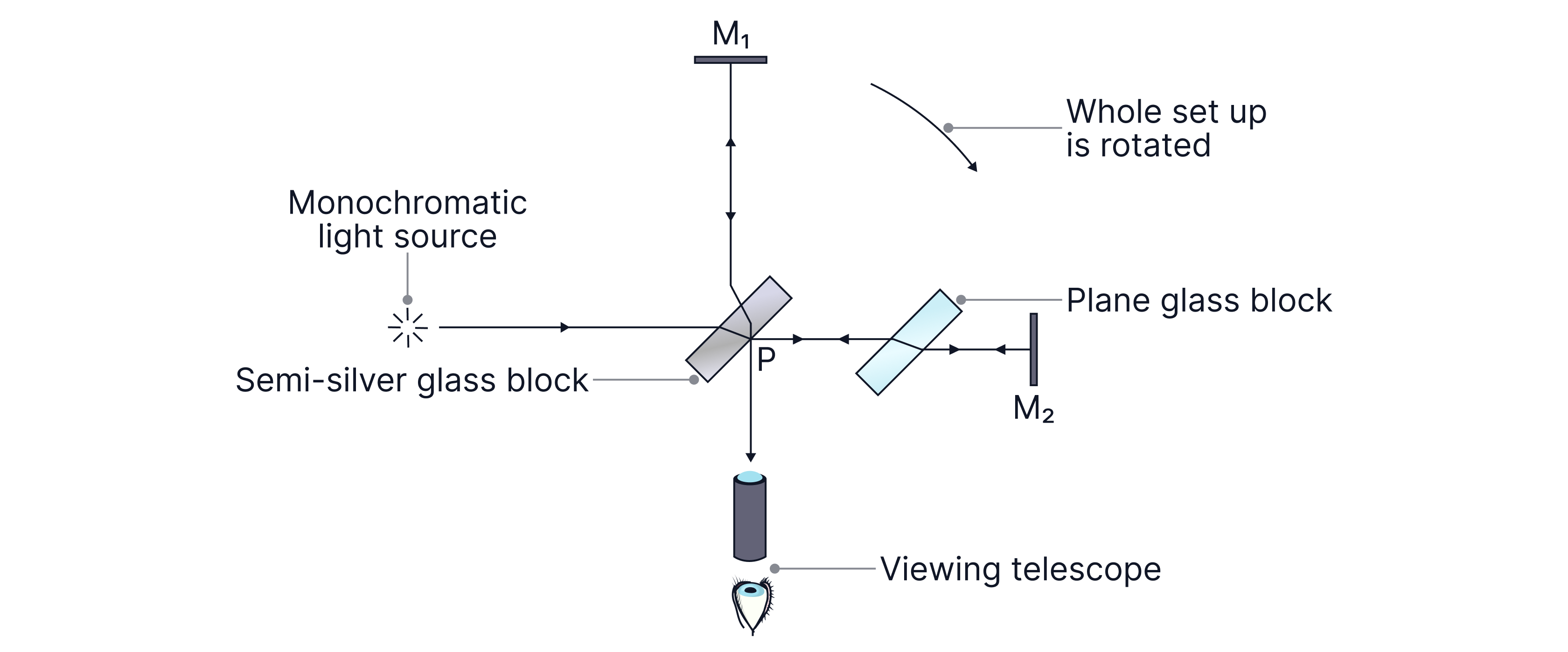
The diagram shows the interferometer used by Michelson-Morley in their experiment. Explain why this experiment is considered a turning point in physics. In your answer, refer to the ether hypothesis, the expected result, the null result, and the consequence for physics.
Answer:
The ether was proposed as the medium for light waves and a fixed background for ‘absolute motion’.
• Due to the motion of the Earth through the ether, the speed of light along the arms of the interferometer would vary. (i.e making light speed direction-dependent)
• It was expected light moving parallel to the direction of the earth motion through the ether would take longer to arrive at the viewing telescope.
• It was expected that rotating the set up by more than would cause a fringe shift on rotation.
• No fringe shift was observed (null result), so the experiment did not detect any ether wind.
• Conclusion: there is no evidence for a ether / absolute rest frame, and light speed in free space is invariant (i.e. not affected by source/observer motion)
• This pushed physicists towards new ideas; Einstein’s special relativity change the way we think about space and time in order to explain the invariance of .
Special Relativity (SR)
Einstein (1905) resolved the problem by starting from two postulates:
• Postulate 1: The laws of physics have the same form in all inertial frames of reference.
• Postulate 2: The speed of light in free space (vacuum), , is invariant for all observers.
The first postulate basically says that there is no experiment we can do to determine if we’re in a inertial frame of reference that is moving with respect to some “truly stationary” frame of reference.
The second postulate says that even if you run towards a beam of light (or run away from it), it will still approach you at c. This is consistent with Maxwell’s equations which predict electromagnetic waves that travel in free space at . This value depends only on fundamental constants, not on the motion of the source or observer. Einstein took this seriously: if the equations are true in one inertial frame, they must be true in all inertial frames.
This is strange at first. In everyday life, if you run towards something, you expect its speed relative to you to be higher. But for light, every inertial observer still measures the same value . The solution to this problem has two parts 1) time dilation and 2) length contraction (next sections of the topic).
Worked Example:
Three reference frames are described below
A: spacecraft coasting in deep space at constant velocity in a straight line.
B: A car increasing its speed on a straight road.
C: A train travelling at constant speed but going around a curved track.
Which one is an inertial frame of reference? Explain your answer.
State the postulate about the invariance of the speed of light, and then state the other postulate of special relativity.
Answer:
Frame A is inertial because it has constant velocity in a straight line (no acceleration, resultant force can be zero).
Frame B is non-inertial because it is accelerating (changing speed), so fictitious forces may be required to describe motion.
Frame C is non-inertial because changing direction means there is acceleration (centripetal acceleration), even if speed is constant.
Invariance of light speed: The speed of light in free space (vacuum) is the same () for all inertial observers, regardless of source/observer motion.
Other postulate: The laws of physics have the same form in all inertial frames of reference.
Practice Questions
If you run at a beam if light at does it come towards you faster?
-> Check out Brook's video explanation for more help.
Answer:
They still measure . The Michelson–Morley experiment found no fringe shift (null result), implying no ether and supporting invariance of c.
Why can a person in a train not determine if the train is moving?
-> Check out Brook's video explanation for more help.
Answer:
All internal experiments give the same results as if the passenger were at rest because the frame has no acceleration; Newton’s laws hold without needing fictitious forces. This is an inertial frame of reference.