Le Chatelier's Principle (HT only)
Dr. Davinder Bhachu
Teacher

What Is Le Chatelier’s Principle?
Core idea:
When a reversible reaction is at equilibrium and you alter the conditions, the reaction mixture adjusts itself to reduce the impact of the change. Think of it as the system “pushing back” to keep things balanced.
Why this matters:
By understanding these adjustments, chemists can choose conditions that favour the formation of the desired product — improving yield in industrial and laboratory reactions.
Temperature and Equilibrium Shifts
Reversible reactions release heat in one direction (exothermic) and absorb heat in the other (endothermic).
Key Rules:
Increasing temperature: The system favours the endothermic direction because it absorbs the added heat.
Decreasing temperature: The system favours the exothermic direction to replace the lost heat.
Worked Example
Consider the reversible conversion between nitrogen dioxide and dinitrogen tetroxide:
The forward reaction (forming N₂O₄) is exothermic.
The reverse reaction (forming NO₂) is endothermic.
If the temperature is increased:
→ The system shifts in the endothermic direction to the NO₂ side.
→ Brown colour intensifies (NO₂ is brown).
If the temperature is decreased:
→ The system shifts in the exothermic direction to the N₂O₄ side (exothermic).
→ Gas mixture becomes paler.
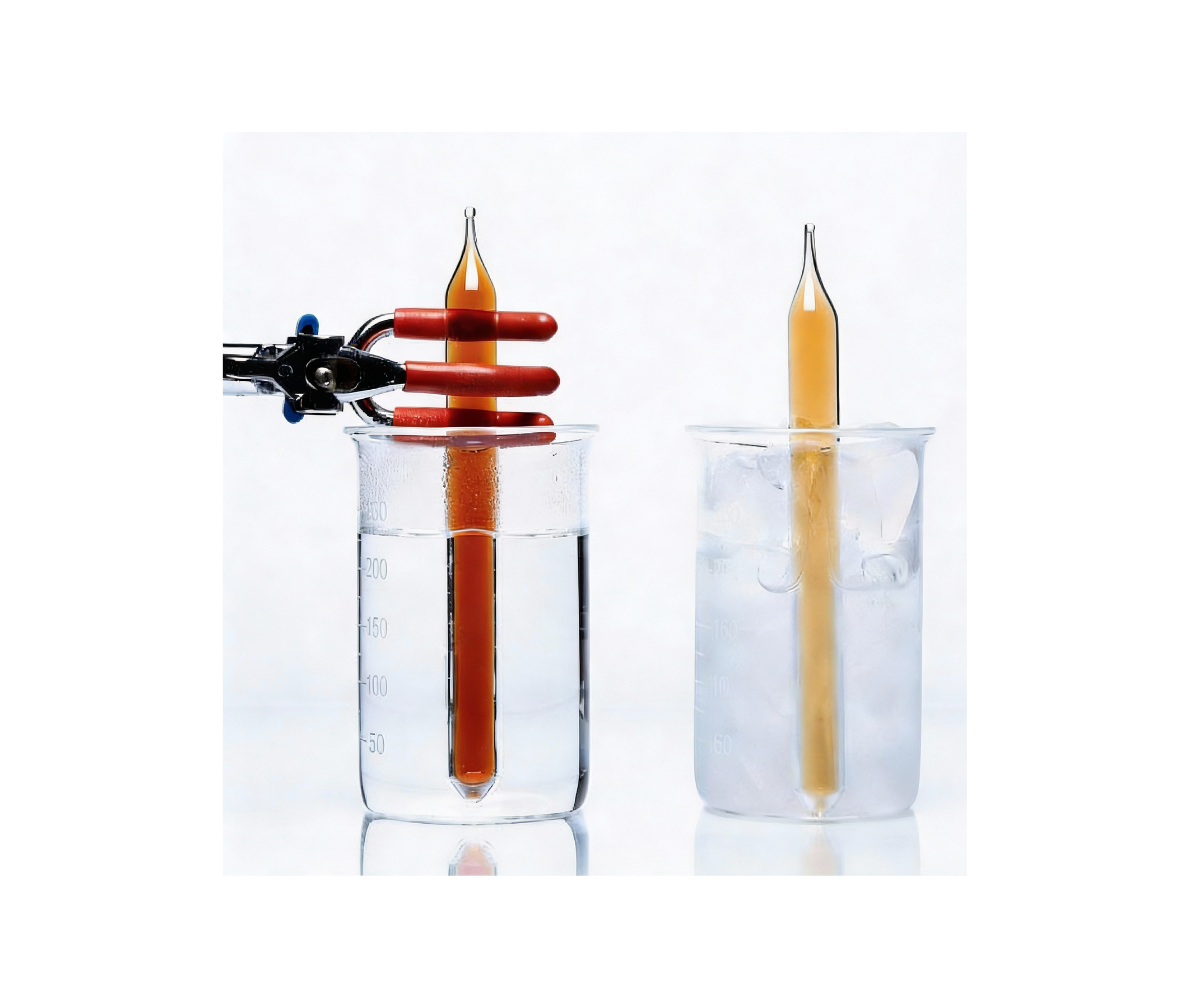
No answer provided.
Pressure and Gaseous Equilibria
Pressure changes only matter when gas molecules are involved.
Key Rules
Increasing pressure: Favours the side with fewer gas particles.
Decreasing pressure: Favours the side with more gas particles.
If the gas molecules are the same on both sides, then pressure has no effect.
Worked Example 1
Left-hand side: 2 gas molecules
Right-hand side: 2 gas molecules
Increasing pressure:
→ No overall shift (equal number of gas particles).
Decreasing pressure:
→ No change for the same reason.
No answer provided.
Worked Example 2
Left: 1 gas molecule
Right: 2 gas molecules
Higher pressure: favours left (forms more )
Lower pressure: favours right (more )
No answer provided.
Concentration Changes
Changing the amount of either reactants or products removes the system from equilibrium. It will respond by shifting to oppose the change and re-establish balance.
Key Rules
Increasing reactant concentration: Drives reaction forward to consume the added reactants.
Increasing product concentration: Pushes reaction backward to remove excess product.
Decreasing reactant or product: Shifts toward the side you removed to replace what was lost.
Worked Example
The esterification equilibrium:
Adding more ethanol:
→ drives the reaction to the right and more ethyl ethanoate forms.
Removing water as it forms:
→ Strongly drives reaction to the right and more ethyl ethanoate forms (Le Chatelier’s principle in real industrial use).
No answer provided.
Industrial Relevance
Industrial chemists rarely choose conditions that maximise yield alone. They must also consider:
Rate of reaction
Energy costs
Equipment limitations
Safety
Thus, they often use compromise conditions.
Example:
In ammonia production (Haber process), low temperature gives high yield but slow rate; high pressure gives good yield but is expensive and dangerous. Industry uses a balance between both.
No answer provided.
Practice Questions
1. Hydrogen iodide equilibrium
Hydrogen iodide decomposes reversibly into hydrogen and iodine.
The forward reaction is endothermic:
1. Define a closed system.
A closed system is one where no substances can enter or leave, although energy transfer is still possible.
2. Describe what occurs when this reaction reaches dynamic equilibrium.
At dynamic equilibrium, the forward and reverse reactions occur at equal rates so the concentrations of all substances remain constant.
3. Predict the effect of increasing temperature on the equilibrium yield of iodine. Explain your answer.
i. Increasing temperature increases the yield of iodine.
ii. The forward reaction is endothermic, so adding heat favours the direction that absorbs heat, shifting equilibrium to the right and producing more H₂ and I₂.
4. Predict the effect of increasing pressure on the equilibrium yield of hydrogen. Explain your answer.
i. Increasing pressure decreases the yield of hydrogen.
ii. Left side: 2 moles of gas (HI).
Right side: 2 moles (H₂ + I₂).
Total gas moles are equal, so pressure has no effect on equilibrium position.
Therefore, the yield of hydrogen remains unchanged.
2. Equilibrium table
For each equilibrium below, indicate how the position shifts when temperature or pressure is increased.
(Do not complete the table; the answers are provided later.)
Equilibrium | Forward reaction energy change | Effect of ↑ Temperature | Effect of ↑ Pressure |
A: | Exothermic | ? | ? |
B: | Endothermic | ? | ? |
C: | Endothermic | ? | ? |
D: | Exothermic | ? | ? |
E: | Exothermic | ? | ? |
Equilibrium | Energy change (forward) | ↑ Temperature | Reasoning | ↑ Pressure | Reasoning |
A: X+Y⇌XY | Exothermic | Moves left | Favours endothermic reverse | Moves right | Fewer gas moles on right |
B: 2M⇌M2 | Endothermic | Moves right | Favours endothermic forward | Moves left | Fewer moles on left |
C: Z⇌Z+Q | Endothermic | Moves right | Endothermic direction produces Q | Moves left | Lower moles on left (1 vs 2) |
D: R2⇌2R | Exothermic | Moves left | Reverse is endothermic | Moves left | Fewer gas moles on left |
E: P+2Q⇌PQ2 | Exothermic | Moves left | Opposes added heat | Moves right | Fewer gas moles on right |
3. Decomposition of nitrogen pentoxide
Nitrogen pentoxide breaks down reversibly into nitrogen dioxide and oxygen gas.
The forward reaction is exothermic:
Predict the effect of increasing temperature on the equilibrium yield of oxygen. Explain your answer.
i. Increasing temperature decreases the yield of oxygen.
ii. The forward reaction is exothermic, so adding heat favours the reverse (endothermic) direction, reducing O₂ production.
Predict the effect of increasing pressure on the equilibrium yield of nitrogen dioxide. Explain your answer.
i. Increasing pressure decreases the yield of nitrogen dioxide.
ii. Left side: 2 moles of gas.
Right side: 5 moles of gas.
Higher pressure favours the side with fewer gas molecules → shifts left → less NO₂.
4. Cobalt chloride equilibrium
Aqueous cobalt(II) chloride forms a pink complex with water and a blue complex with chloride ions:
The forward reaction (towards blue) is endothermic.
If concentrated hydrochloric acid is added, does the mixture become more pink or more blue? Explain your answer.
Adding concentrated hydrochloric acid increases chloride ion concentration, pushing equilibrium right toward the blue complex. The mixture becomes more blue.
If the mixture is cooled, does the colour become more pink or more blue? Explain your answer.
Cooling removes heat from the system. Since the forward (blue-forming) direction is endothermic, cooling favours the pink side. The mixture becomes more pink.