Reduce, Reuse, Recycle And Life Cycle Assessments
Emmanuel Opoku
Teacher

Contents
Recycling And Life Cycle Assessments (LCAs)
The Importance of Using Resources Wisely
- Humans rely on natural resources for food, warmth, transport, and shelter.
- Many are finite - they will run out (e.g. crude oil, metals).
- Reusing and recycling reduces the use of limited resources and helps protect the environment.
- Extraction and processing of raw materials can be unsustainable so Life Cycle Assessments are used to help us make better, more informed choices.
Reuse And Recycling
Why It Matters
- Reusing and recycling materials helps save energy and reduce pollution.
- Metals, glass, plastics, and building materials can often be reused or reprocessed into new products.
- Recycling prevents landfill waste and conserves raw materials.
Advantages of Recycling
- Reduces acid rain and air pollution.
- Conserves metal ore reserves.
- Saves energy used in extraction.
- Less mining and quarrying damage.
- Creates local employment.
Disadvantages of Recycling
Sorting and separating materials can be expensive.
Requires transport, adding to CO₂ emissions.
Some materials (like mixed plastics) are difficult to recycle.
Recycling Metals
|
Metal |
Source |
Method |
Energy Saved vs. Extraction |
|---|---|---|---|
|
Iron & Steel |
Scrap steel |
Re-melt in blast furnace |
70–75% |
|
Aluminium |
Scrap cans |
Melt and recast |
95% |
|
Copper |
Scrap wiring |
Purify by electrolysis |
80–85% |
Reusing Glass
- Glass bottles can be washed and reused.
- Others/broken glass can be crushed, melted and reformed into new glass products.
- Saves energy and raw materials like sand (raw material for making glass).
Recycling Plastic
- Plastics can be melted down and remoulded into new products such as bottles, clothing fibres, or benches.
- Recycling reduces landfill waste and saves energy and crude oil, the raw material used to make new plastics.
- Different types of plastic must be sorted and cleaned before recycling (not all plastics are recyclable), which can make the process more difficult and costly.
Life Cycle Assessments (LCAs)
What is an LCA?
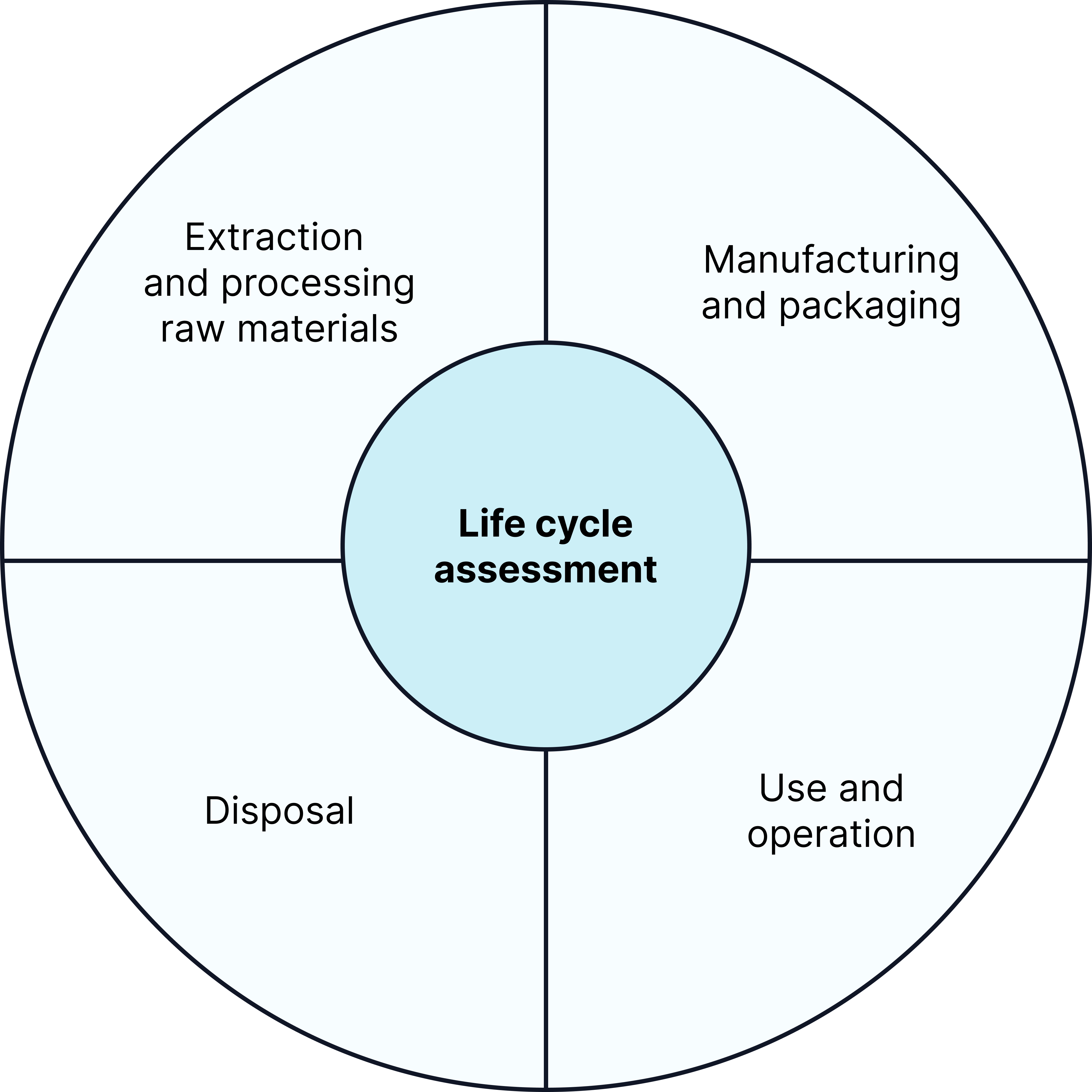
A Life Cycle Assessment measures the environmental impact of a product at each stage of its life:
1. Extracting and processing raw materials
– Mining and refining metals (e.g. drilling for oil, digging up quarries, etc.)
– Energy usage, waste and pollution.
2. Manufacturing and packaging
– Energy-intensive, release of harmful gases.
3. Use and operation
– Energy used during the product’s lifetime.
4. Disposal
– Consider landfill pollution, recycling, or incineration; transport adds emissions.
LCAs are not always objective
- Some impacts (like energy use) are easy to measure.
- Others (like visual pollution or ecosystem damage) are more difficult.
- Selective LCAs are biased and may focus on data that favours a company’s product - e.g. in advertising.
Example: Comparing Plastic and Paper Bags
|
LCA Stage |
Plastic Bag |
Paper Bag |
|---|---|---|
|
Raw Materials |
Crude oil (finite) |
Wood (renewable) |
|
Manufacture |
High energy use; by-products reused |
Uses lots of water and energy |
|
Use |
Can be reused several times |
Usually single-use |
|
Disposal |
Non-biodegradable; landfill pollution |
Biodegradable; recyclable |
Plastic bags last longer and their by-products can be reused; however, they contribute significantly to landfill pollution. Paper bags, however, are biodegradable and are made from renewable sources; however, they can only be used once.
No answer provided.
Check Your Understanding
Recall
a) State the four main stages of a Life Cycle Assessment.
Answer:
a) Extraction, manufacturing, use, and disposal
b) Why is extracting raw materials often unsustainable?
Answer:
b) Uses energy, destroys habitats, and produces pollution
c) Give one advantage and one disadvantage of recycling metals.
Answer:
c) Advantage: Conserves metal ores and energy. Disadvantage: Costly collection and transport
d) What is meant by sustainable development?
Answer:
d) Meeting current needs without harming supply for future generations and harming the environment
Apply
e) Explain why reusing glass bottles is better for the environment than making new ones.
Answer:
e) Reusing glass avoids mining raw materials and reduces energy used in melting new glass
f) Suggest one way chemists help improve sustainability in manufacturing.
Answer:
f) By using catalysts and renewable raw materials to lower emissions.
Challenge (HT Only)
h) Evaluate which type of shopping bag is more sustainable: plastic or paper.
Use data and your knowledge of energy use, raw materials, and disposal.
|
Property |
Plastic Bag |
Paper Bag |
|---|---|---|
|
Raw material |
Crude oil (finite) |
Wood (renewable) |
|
Energy to produce (MJ/kg) |
35 |
55 |
|
Reuse potential |
High (can be reused 3–5 times) |
Low (single-use) |
|
Biodegradability |
No |
Yes |
|
Carbon footprint (kg CO₂/kg) |
2.5 |
3.0 |
Answer:
g) Evaluation (4 marks):
- Paper bags are made from renewable wood but need more energy and water to produce and have a shorter lifespan.
- Plastic bags come from finite crude oil but can be reused several times and use less energy overall.
- Although paper is biodegradable, the overall environmental impact is lower for reusable plastic bags when used multiple times.
- Possible Conclusions: Plastic bags are more sustainable if reused/paper is better if litter and biodegradability are the main concerns.
More Practice
Try to answer the practice question from the TikTok video on your own, then watch the video to see how well you did!