Introduction to Index Rules
Neil Trivedi
Teacher

Introduction to Index Rules
Index rules are used to simplify expressions involving powers.
Here’s an example of a number that’s raised to a power. This is known as the index form.
This is known as the power or exponent.
This tells us how many of the base are being
multiplied together.
This is known as our base.
It is the number that’s being
multiplied repeatedly.
So, means .
Important note: does not mean . It means multiplying nine s together.
Rule
Meaning: When we multiply two numbers with the same base, we add the powers.
Let’s take for example. Applying the rule,
We can expand each term to show that this rule works.
That’s eight s being multiplied together so
This matches our answer from when we applied the rule.
Rule
Meaning: When we divide two numbers with the same base, we subtract the powers.
Let’s take for example. Applying the rule,
Let’s check and show why this rule works. First, we rewrite as a fraction.
Expanding both the numerator and denominator and cancel as many s in the numerator with the same number of s in the denominator. Remember, cancelling means they divide to give .
On the right hand side, we are left with which equals and hence matches our answer from when we applied the rule.
Rule
Meaning: When a number with a power inside a bracket is raised to another power, we multiply the powers.
Let's take for example. Applying the rule,
Let’s check and show why this rule works. We can expand . Here, we are multiplying four lots of together.
Using the index rule, which states that , to simplify the right hand side,
This matches our answer from when we applied the rule.
Index Rules
Rule
Rule
Rule
Example 1:
Simplify the following:
a)
Single Step: Apply the rule which states that .
b)
Single Step: Apply the rule which states that .
c)
Single Step: Apply the rule which states that .
Remember, subtracting a negative gives a positive, so the indices add.
d)
Step 1: Simplify the expression inside the bracket.
First, we must consider BIDMAS, which tells us to address what’s inside the bracket first. So, we apply the rule which states that to simplify the expression inside the bracket.
Step 2: Apply the rule which states that .
e)
Step 1: Simplify the numerator.
There are invisible brackets around the numerator and denominator so we should simplify them first. In this case, only the numerator needs simplifying. To simplify the numerator, we apply the rule which states that . The and are constants and are multiplied separately from the index rule.
Step 2: We apply the rule which states that .
Here is a problem-solving question which involves our index rules.
Example 2:
Find an expression for the area of the following rectilinear shape.

Step 1: Split the rectilinear shape into two rectangles and identify the lengths that we need to use to work out the area.
To find the area of a rectilinear shape, it is helpful to divide it into simpler rectangles. Here, we draw a straight line to split it into two rectangles, labelled and .
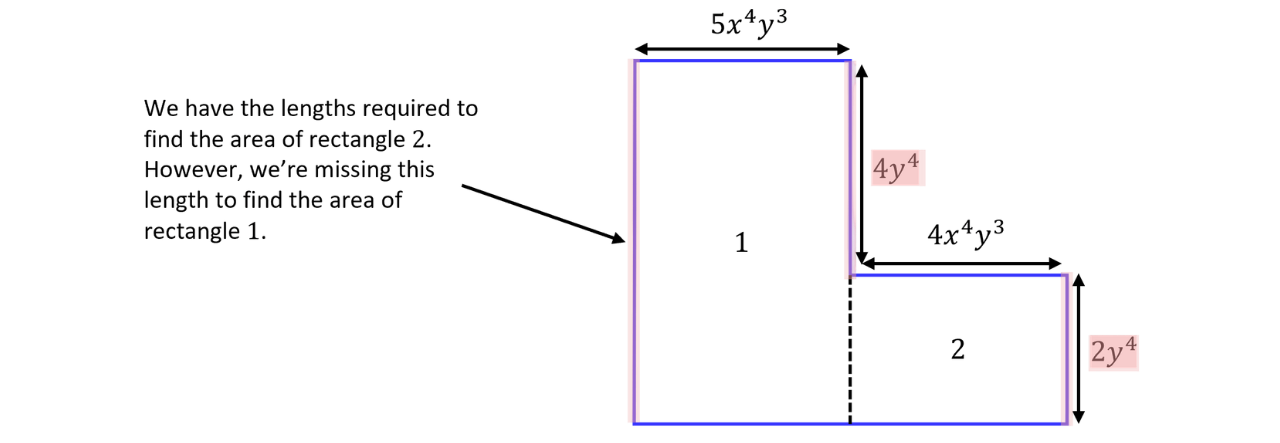
To find the missing length of rectangle , we sum the two vertical lengths, and .
So, we have
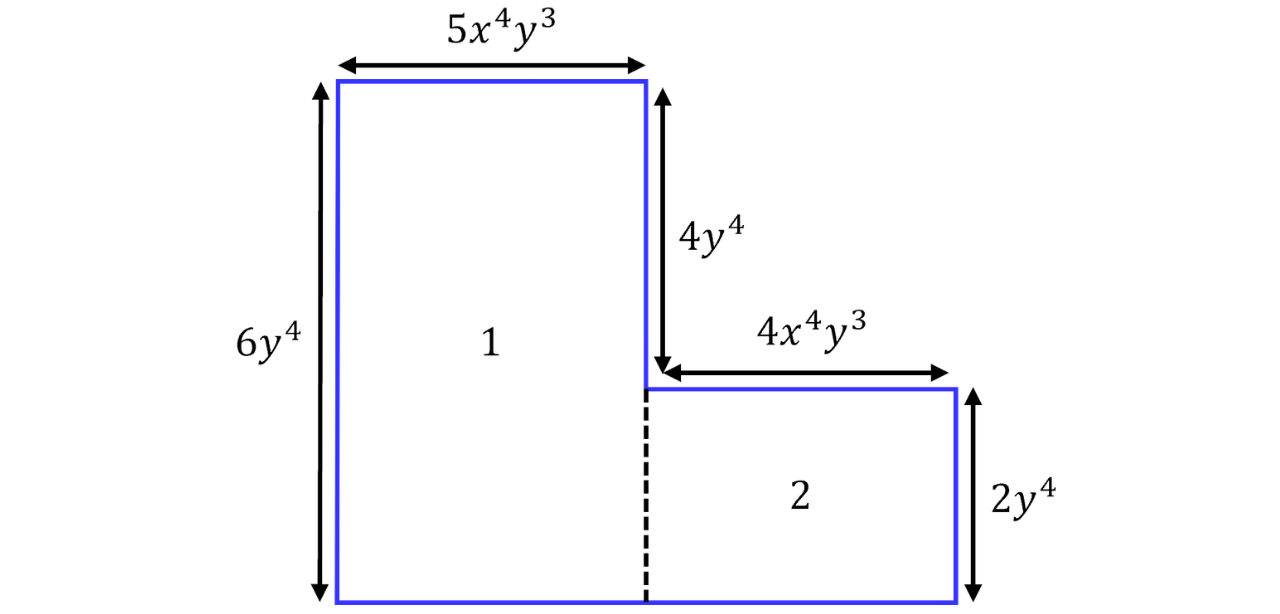
Step 2: Find the area of both rectangles.
For rectangle , we have lengths and . We multiply these lengths to find the area. Here, we use the index rule which states that . Remember that the index rules can only be applied to numbers with the same base, so we treat the numbers with a base of separately from the numbers with a base of . The constants are also multiplied separately.
So, the area is
For rectangle , we have lengths and . Again, we apply the index rule which states that . As before, the numbers with a base of are treated separately from numbers with a base of , and the constants are multiplied separately.
So, the area is
Step 3: Find the total area of the rectilinear shape.
To find the total area, we just add the areas of the two rectangles.
Therefore, the total area of the rectilinear shape is .
Practice Questions