Negative and Fractional Indices
Neil Trivedi
Teacher

Zero and Negative Indices
Previously, we covered the basic index rules. They are:
Rule
Rule
Rule
In this note, we cover some new index rules that involve zero, negative and fractional indices.
When we deal with a power of , we cannot think of it as “multiplying lots of the base by itself”. We can say the same for when we have a power of or any other negative number (how can you multiply lots of a number?) We will use division to derive the rules for zero and negative indices.
For example, let’s start with and then divide by several times. To note, and when dividing by , we will be subtracting from the power each time.
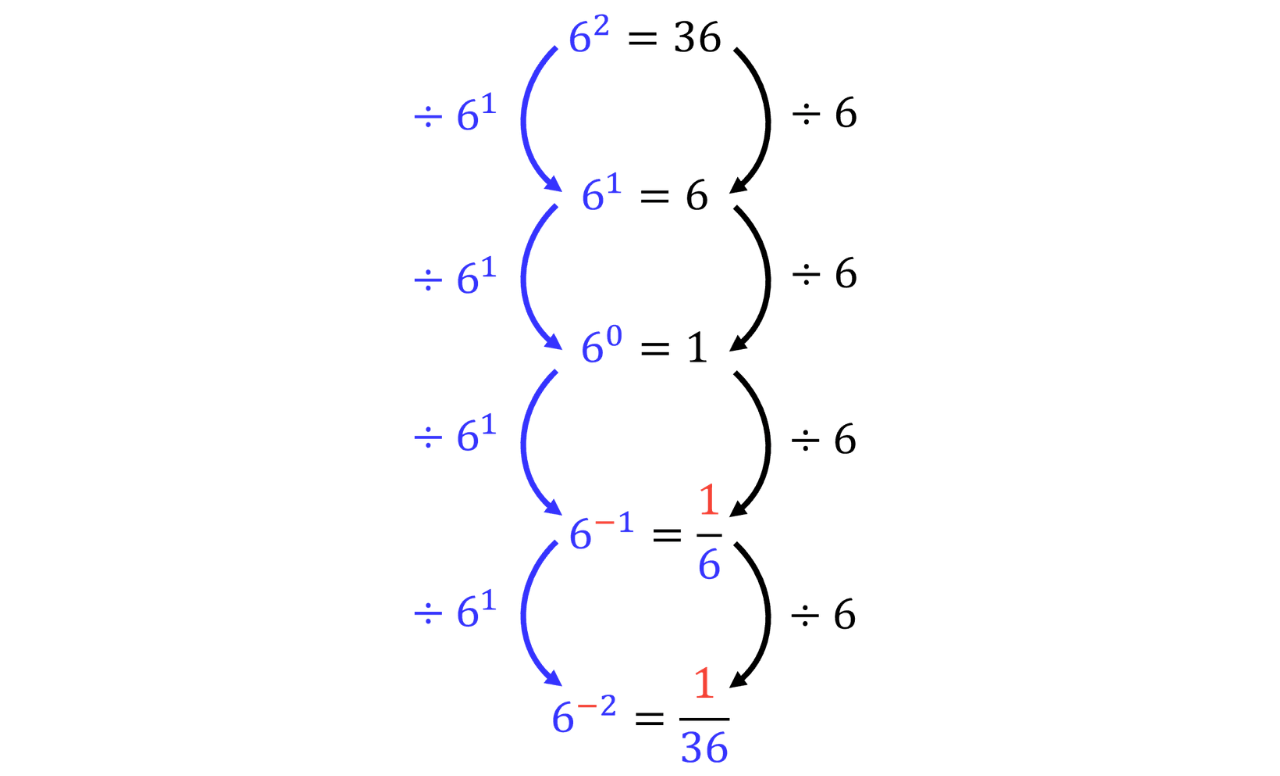
From the pattern above, each time we divide by , the power decreases by . When we reach , we get . So, in general,
(where cannot equal )
Continuing the pattern, we get . To generalise this,
One more step gives . So, in general,
Key idea: A negative power means we take the reciprocal. Reciprocal just means to switch the numerator and denominator so with , we can write as which reciprocates to , hence the result . Therefore, It is important to note that a negative power does not make the number negative. For example,
Rule (where cannot equal )
Rule
This can be generalised to
Rule
Note: If the base is a fraction, the negative index flips the fraction.
Example 1:
Evaluate:
a)
Single Step: Apply the rule which states that .
b)
Single Step: Apply the rule which states that .
c)
Step 1: Apply the rule which states that , which means to reciprocate the base (switch the numerator and denominator).
Step 2: We have a fraction in a bracket raised to a power which means we distribute that power to the numerator and denominator.
Step 3: Evaluate the fraction.
d)
Single Step: Apply the index rules to simplify.
For the first term, we reciprocate and then distribute the power of to the numerator and denominator.
For the second term, we reciprocate the base and cube it as per the rule which states that .
Multiplying the numbers we obtain, we get
e) Simplify .
Single Step: Apply the index rules to simplify.
For the first term, we distribute the power of to the numerator and denominator.
For the second term, we reciprocate and then distribute the power of to the numerator and denominator.
So,
We now combine the terms. When dividing by fractions, we keep the first fraction the same, flip the second fraction and then change the sign from division to multiplication.
Using the rule which states that to simplify both the numerator and the denominator,
Example 2:
Let and .
If and , find the values of and .
Step 1: Solve for .
We have two equations
We solve for by dividing equation by equation .
Dividing both sides by ,
Step 2: Substitute this value into the equation and solve for .
Here, we are saying that is being raised to an unknown power which gives us . The power is . This is because with , we reciprocate the base and then square it as per the rule which states that . We get
Therefore,
Step 3: Find the value of .
We use one of the equations, that is in terms of and , where we substitute and rearrange to solve for . Let's use the equation
Substituting ,
Dividing both sides by , which is equivalent to multiplying both sides by , we get
Step 4: Substitute this value of into the equation and solve for .
Here, we are saying that is being raised to an unknown power , which gives . We know that so
Hence, and .
Fractional Indices
Fractional indices are another way of writing roots as well as roots combined with powers. They are written in the form:
represents how many of the base we are multiplying together.
represents which root we're taking.
We can show why this is true by considering the meaning of . To get a proper understanding of this, we need to think about what power we can raise to, so we don’t have a fractional power anymore.
We can write this as where is a number which would cancel the . Using the index rule which states that , we have
Now, we just have to decide which value of will cancel the through multiplication. This would be as . So,
This shows that is the number and expression which, when squared, gives . This must mean that raising to the power of is the inverse operation to squaring, which means it is square rooting. Therefore,
We can generalise this to the root:
We can extend this to . Let's take and raise both sides to the power . We get
On the left-hand side, we apply the index rule which states that to get
Rule
Rule
Example 3:
Evaluate:
a)
Single Step: Apply the rule which states that .
Note: Here, we are finding the principal root, so our answer is always positive.
b)
Single Step: Apply the rule which states that .
c)
Single Step: Apply the rule which states that .
Distributing the square root to the numerator and denominator,
Distributing the power of to the numerator and denominator,
d)
Single Step: Apply the index rules to simplify.
First, we apply the rule which states that and a negative power will lead to the base being reciprocated.
Next, we apply the rule which states that .
Distributing the cube root to the numerator and denominator,
Distributing the power of to the numerator and denominator,
Example 4:
Find in the following equation.
Step 1: Rewrite the right-hand side of the equation so that each term has a base of .
We rewrite using the rule which states that . This gives us .
For , we rewrite the root as a power of as per the rule which states that .
So,
Step 2: Use the index rule which states that to simplify the right-hand side and then solve for .
Here, we add the powers on the right-hand side.
Equating the powers on both sides,
Challenging Questions