Fixed Point Iteration
Neil Trivedi
Teacher

Iterative Formulae
An iterative formula is a formula that uses one term to generate the next term.
For example,
This tells us two things:
means that the first term is
The formula means:
“To find the next term, double the current term and then add
So, if
To find (the second term), we substitute (the current term) into the formula.
To find we substitute (the new current term) into the formula.
To find we substitute into the formula.
So, the first four terms are and
For an iterative formula,
means the current term
means the next term
and
is our general iterative formula where is any expression in terms of
Example 1:
A sequence is generated using the following formula:
Find the first four terms of the sequence.
Step 1: Identify the first term.
We are told that
So, the first term is
Step 2: Use the formula to find the next term.
The formula is
Which means “to find the next term, multiply the current term by and then subract
To find we substitute
Step 3: Repeat the process.
To find we substitute
To find we substitute
Therefore, the first four terms are
Important note: Follow these steps on the calculator to complete the above iterations much faster,
1) Press and then
2) Type in the iterative formula but where you see use the ANS button which in this case looks like ANS
3) Keep pressing
Keep doing this for the required number of iterations. Scroll down to NeilDoesMaths’ YouTube video to see him completing this process in a tougher iteration question.
Roots of Equations
A root of an equation is a value of that makes
Graphically, a root is where the graph crosses or touches the axis.
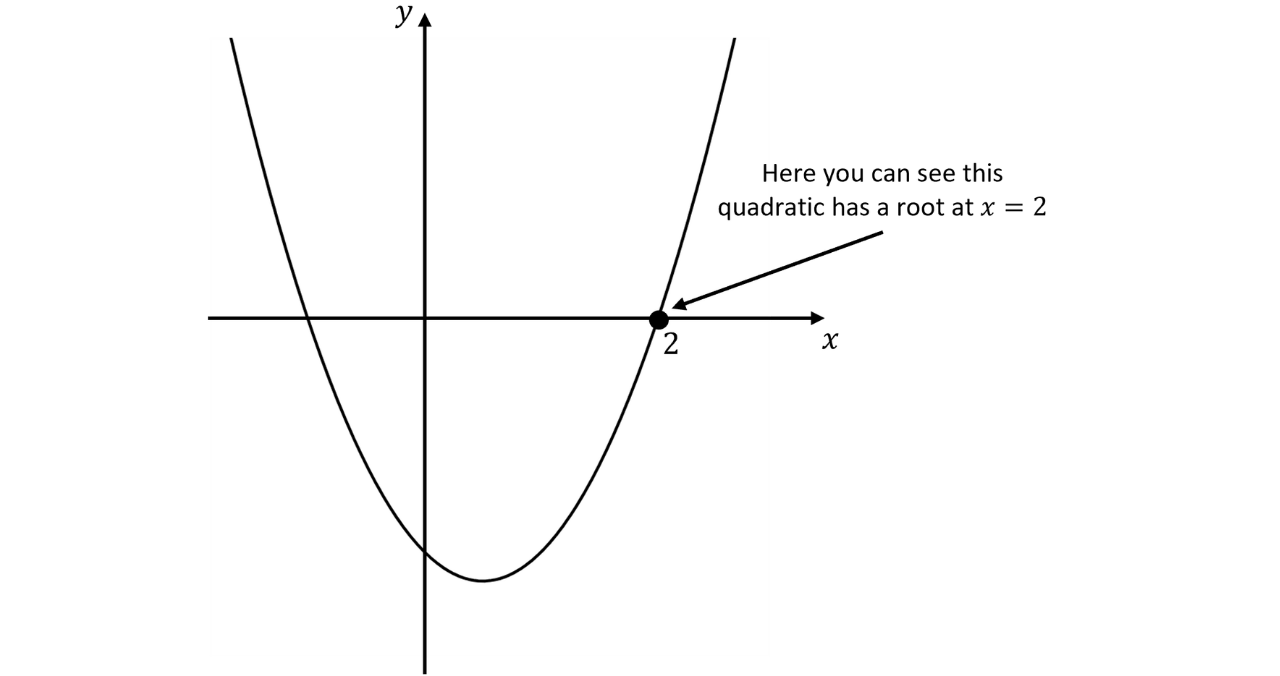
For example, if then is a root of the equation This is saying that if you substitute into the equation of the quadratic above, it will give you
Some equations can be solved exactly. For example, many quadratics can be solved by factorising, completing the square or using the quadratic formula.
However, some equations are difficult or impossible to solve neatly using GCSE methods. For these, we often find an approximate solution instead. Fixed point iteration is one method for finding approximate solutions.
Showing that a Root Lies in an Interval
Suppose we want to show that has a root between two values and
If and have opposite signs, then the function has gone from negative to positive, or from positive to negative. If the graph is continuous, this means the graph must have crossed the axis somewhere between and
At GCSE, the functions we use in these questions are usually continuous. For example, polynomials such as are continuous.
At GCSE, we do not need to study continuity in detail. For this topic, it is enough to think of a continuous graph as a graph that can be drawn without lifting your pen off the page.
If we take another look at our quadratic from above where was our root, we can see that the quadratic is negative (below the axis) when and positive (above the axis) at which indicates that some value in-between and gives us In this case, we already know it is at
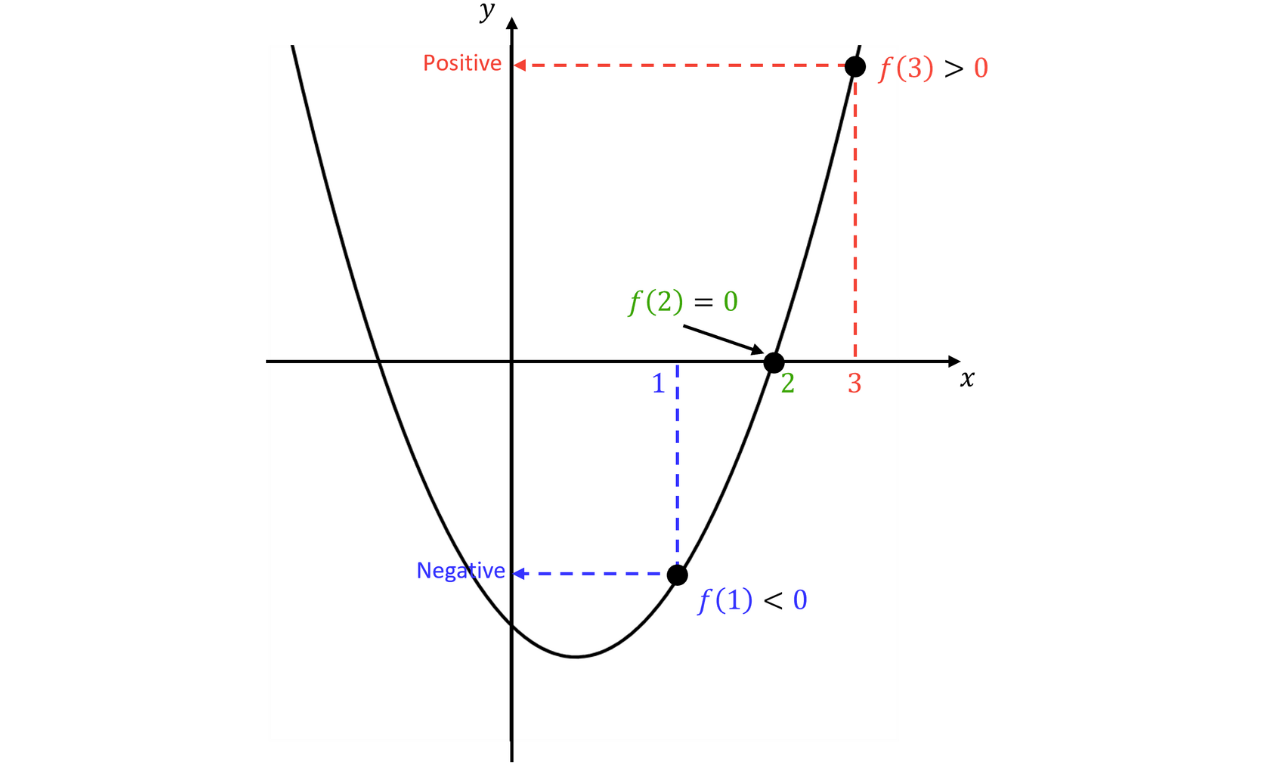
To show that has a root between and
1) Show that and have opposite signs.
2) Then, state that is continuous, and therefore, there is a root between and
Example 2:
Show that the equation
has a root between and
Step 1: Define the function.
Let
We want to show that has a root between and
Step 2: Substitute the lower bound.
Substitute
So,
Step 3: Substitute the upper bound.
Substitute
So,
Step 4: Conclude using change of sign.
Since and there is a change in sign. Also, is continuous. Therefore, the equation has a root between and
To show that a root is correct to decimal places, check the upper and lower bounds of
We do this because we must consider all the values that round to our root correct to decimal places.
For example, to show that correct to decimal place, check the lower bound and the upper bound
If there is a change in sign between these two values, and is continuous, then the root is correct to decimal place.
Fixed Point Iteraton
So far, in this note, we have learned how to locate the interval in which a root lies within a given interval provided there is a change in sign and that our function is continuous. Fixed point iteration is a method used to find the approximate root to that function.
Suppose we want to solve
Instead of solving the equation directly, we rearrange it into the form We do this because we are trying to solve for after all. It is just that here, does not equal a single number, but it is equal to a function.
Then, we write this as an iterative formula:
This allows us to start with an initial value and repeatedly substitute the answer back into the formula (like we did in Example 1).
For example, if
and we are given then we substitute to find
Then we substitute to find and so on.
Note: In some iterative sequences, the first term is labelled In fixed point iteration, the starting value is often labelled This just means the value we start with before finding
In fixed point iteration, as we continue to compute further iterations we hope that the values get closer and closer to a fixed point. This fixed point gives us an approximate solution to the original equation.
Graphically, the approximate root to is represented by the intersection of the lines and
In fixed point iteration:
is rearranged into the form
Then we write the iterative formula as
The solution to is the same as the solution to
In Example 2 we proved that the equation has a root between and Let's continue the question to find a root correct to decimal places.
Example 3:
The equation has a root between and
a) Show that the equation can be rearranged into the form
Step 1: Start with the original equation.
Since the rearranged form has a cube root in it, it is clear we are rearranging for in
Step 2: Rearrange to make the subject.
Add to both sides.
Step 3: Take the cube root of both sides.
Therefore, the equation can be rearranged into the form
b) Use the iterative formula to find the root correct to decimal places.
Step 1: Write down the iterative formula and starting value.
The iterative formula is starting at
Step 2: Substitute to find
Step 3: Repeat the process using each previous answer until we find consecutive iterations that round to the same value to decimal places.
To find substitute
Continuing this process,
Both and round to to decimal places. Therefore, the root is correct to decimal places.
Note: remember you can follow the steps after Example 1 to use your calculator and the ANS button to compute these iterations much faster.
c) Verify that your answer is correct to decimal places.
Step 1: Identify the lower and upper bounds of our root
To find the lower and upper bound, we first rewrite as
Then, we subtract and add to the last two digits.
For the lower bound:
Subtract from these digits
Therefore, the lower bound is
For the upper bound:
Add to these digits
Therefore, the upper bound is
For more practice on this, see our Error Intervals Study Note.
Step 2: Substitute the lower bound and upper bound and find a change in sign.
Let
Substituting our lower and upper bounds,
Step 3: Conclude using the change in sign.
Since there is a change in sign between the lower bound and the upper bound, and is continuous, the root is correct to decimal places.
Practice Question