Similar Shapes
Neil Trivedi
Teacher

Contents
What Are Similar Shapes?
Two shapes are similar if they are exactly the same shape but a different size. In other words, one shape is an enlargement of the other.
When two shapes are similar:
All pairs of corresponding angles are equal.
All pairs of corresponding sides are in the same ratio.
The number that every length is multiplied by in the enlargement is called the scale factor.
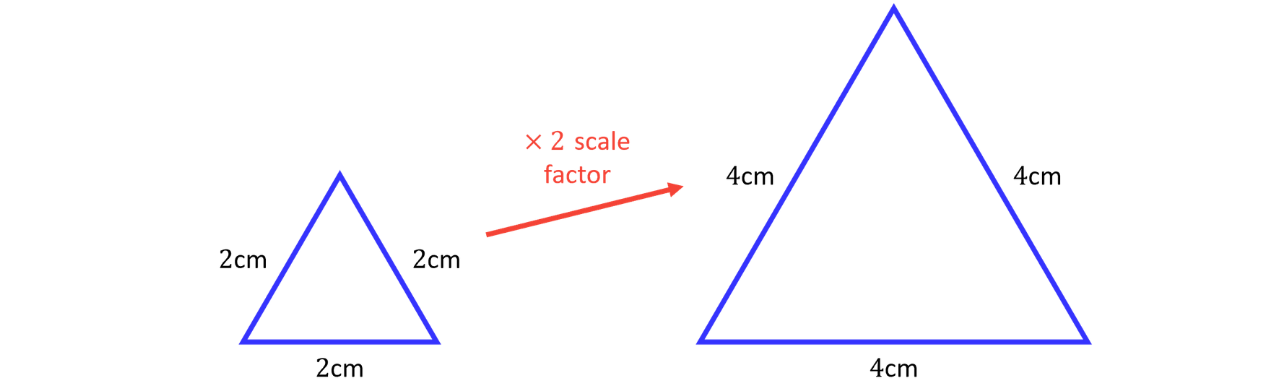
the diagram above, every side of the smaller equilateral triangle is multiplied by to produce the larger equilateral triangle, so the scale factor of the enlargement is
Notice that the angles have not changed: enlarging a shape changes its lengths but not its angles (in this case all angles are ).
Scale Factor
To find the scale factor of an enlargement, divide a length on the new shape by the corresponding length on the original shape:
Generally speaking, we like to use the scale factor that takes us from the smaller shape to the larger one so we may think of the formula like this:
Example 1:
The two quadrilaterals below are similar. Find the values of and
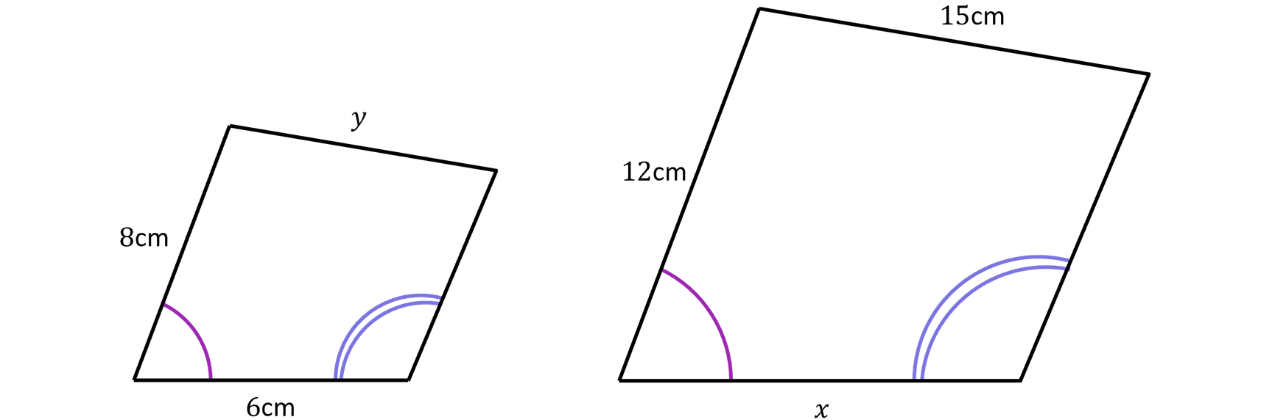
Step 1: Find the scale factor.
The cm side and the cm side are a pair of corresponding sides.
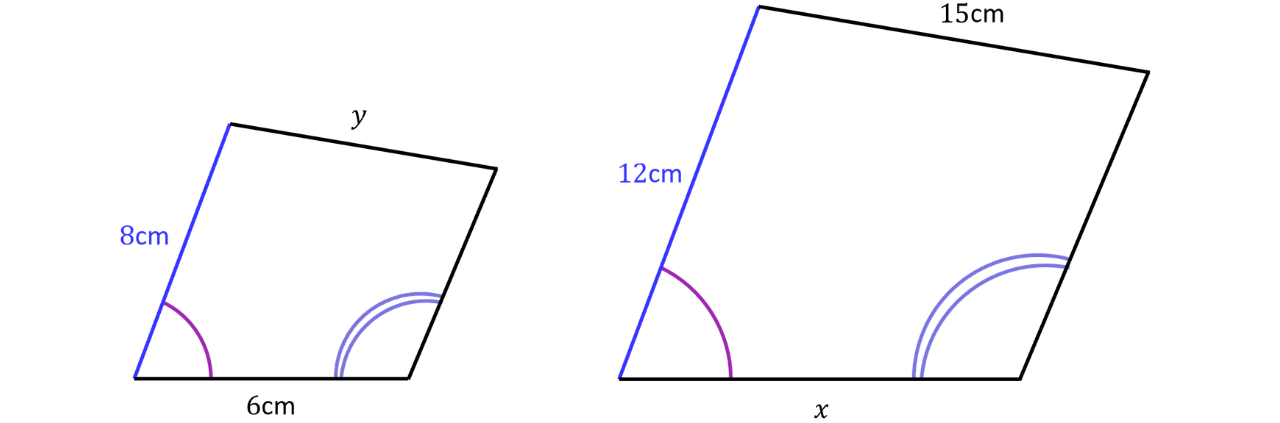
We will find the scale factor that takes us from the smaller shape to the larger one.
Step 2: Find
corresponds to the cm side. Since is on the larger shape, we multiply by the scale factor.
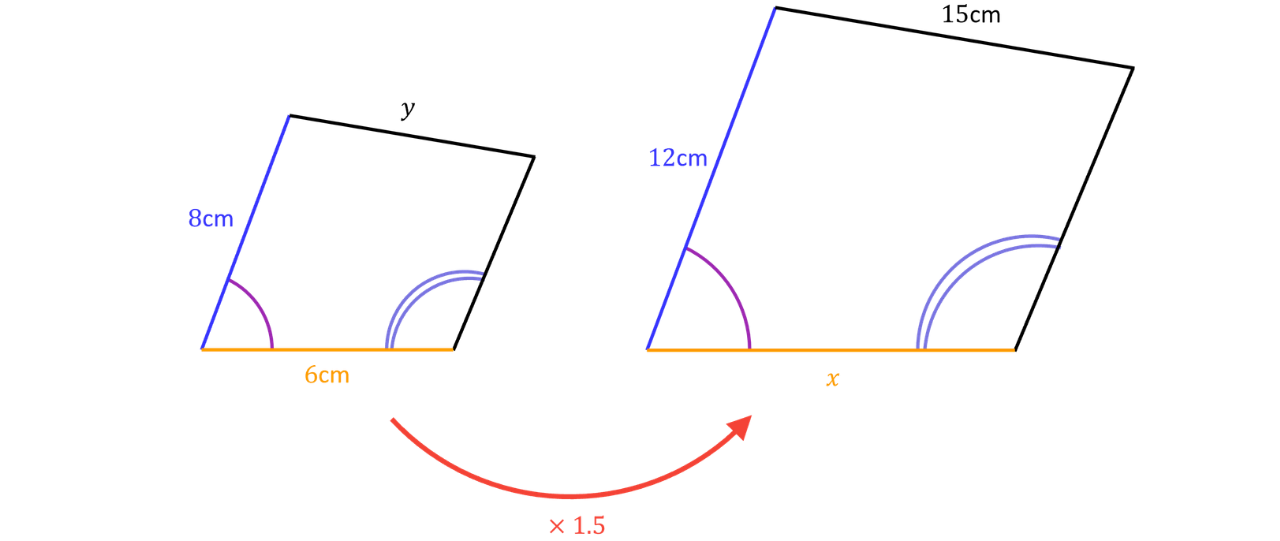
cm
Step 3: Find
corresponds to the cm side. Since is on the smaller shape, we divide by the scale factor.
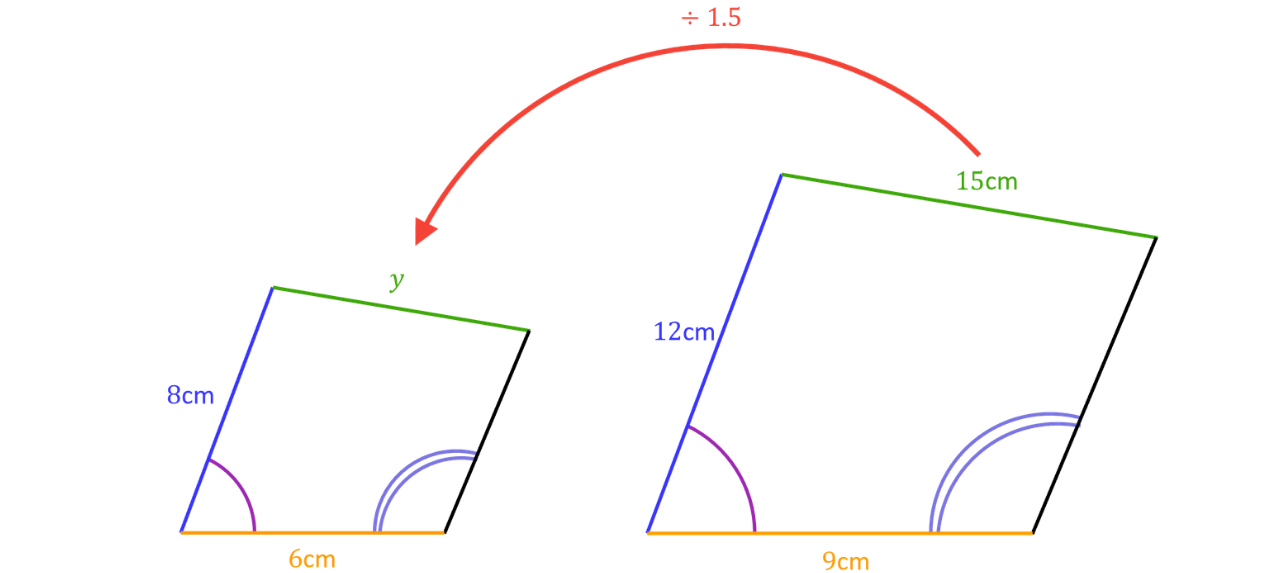
cm
Similar Triangles and Parallel Lines
A very common exam question hides two similar triangles inside a single diagram. This usually happens when a line is drawn across a triangle, parallel to one of its sides.
Example 2:
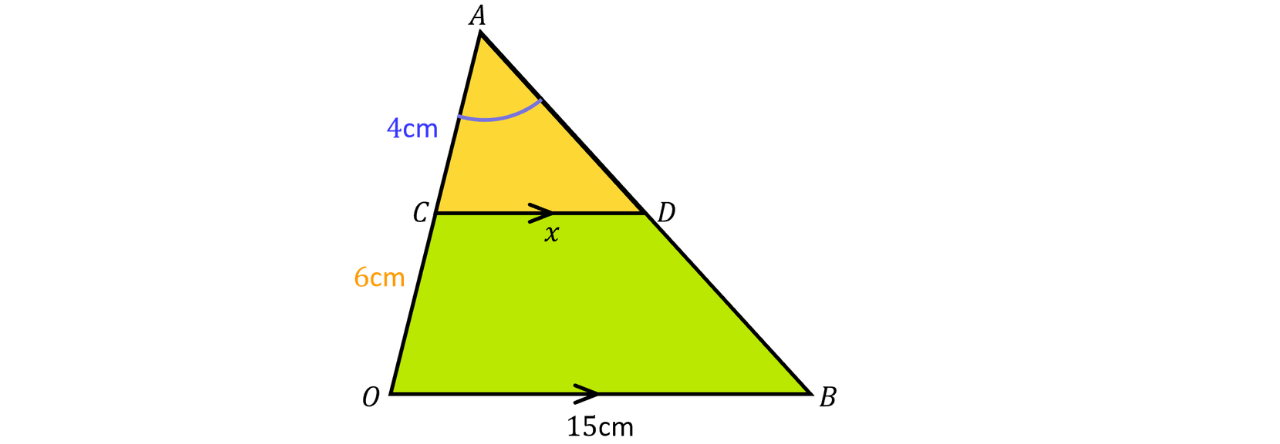
In the diagram below, is parallel to Find the length of
Step 1: Separate the two triangles.
The parallel line creates two similar triangles: the small triangle and the large triangle
The reason is that if a line is drawn across triangle parallel to the side then:
The angle at is shared by both triangles.
Angle angle and angle angle because corresponding angles on parallel lines are equal.
Therefore, all three pairs of angles are equal, so triangle and triangle are similar. It helps to redraw them side by side.
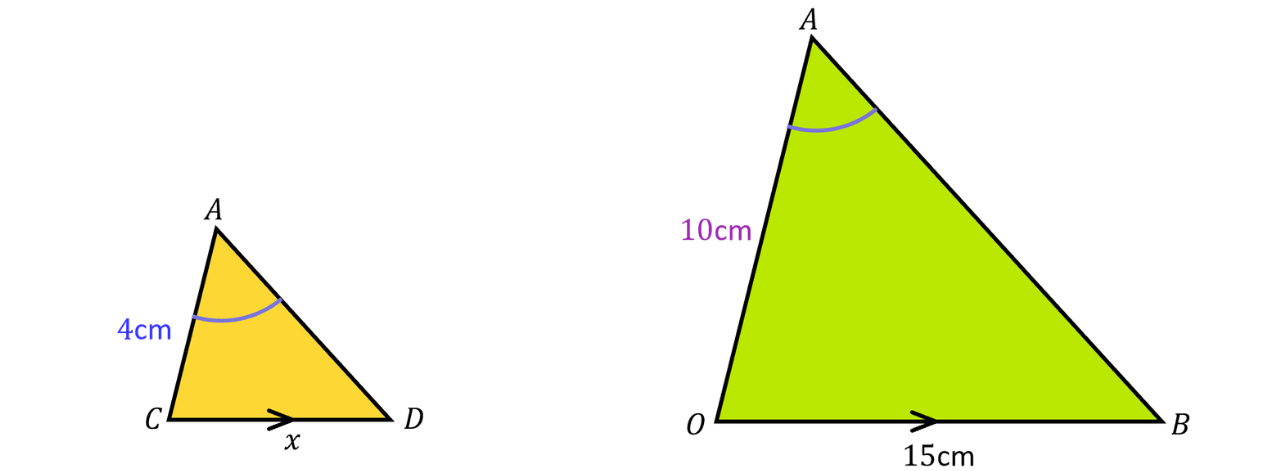
Take care with the side of the large triangle: it is the whole length from to so
cm
Step 2: Find the scale factor between the two triangles.
and are corresponding sides, so
Step 3: Find
corresponds to Since is on the smaller triangle, we divide by the scale factor.
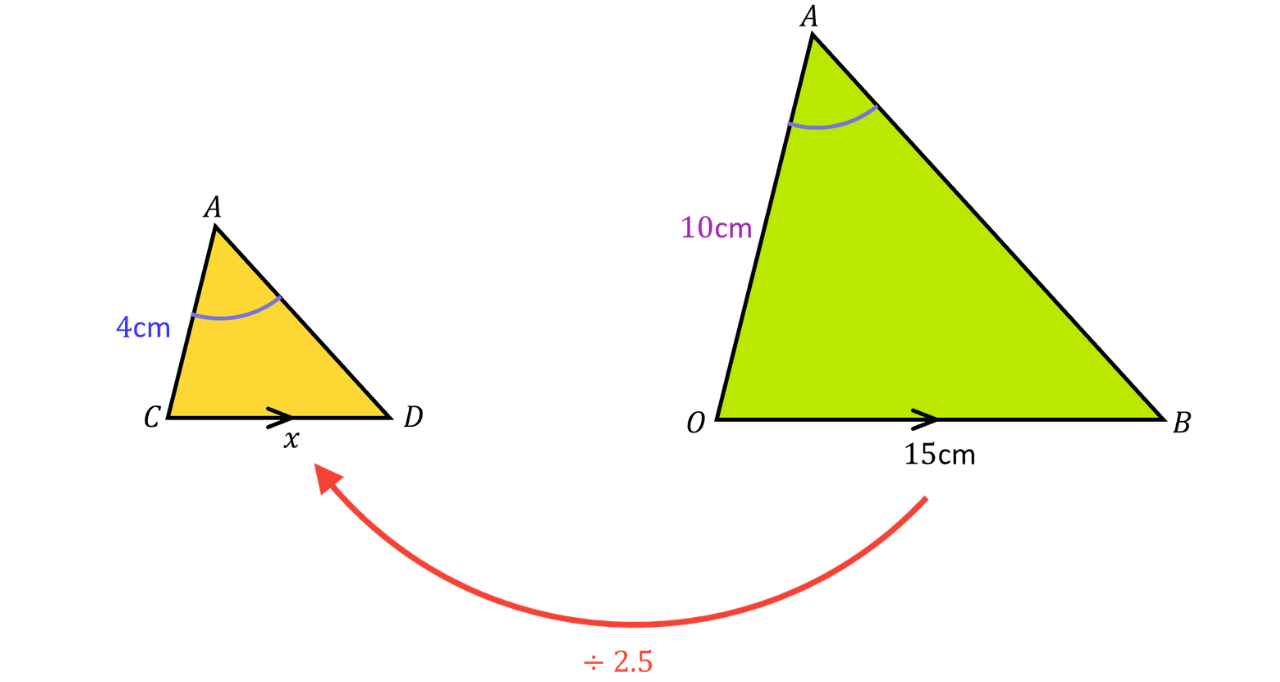
cm
Note: The most common mistake in this type of question is to use cm instead of the full length cm. The sides of the large triangle are and so always add the two parts of the side together first.
Example 3:
In the diagram below, is parallel to Find the value of
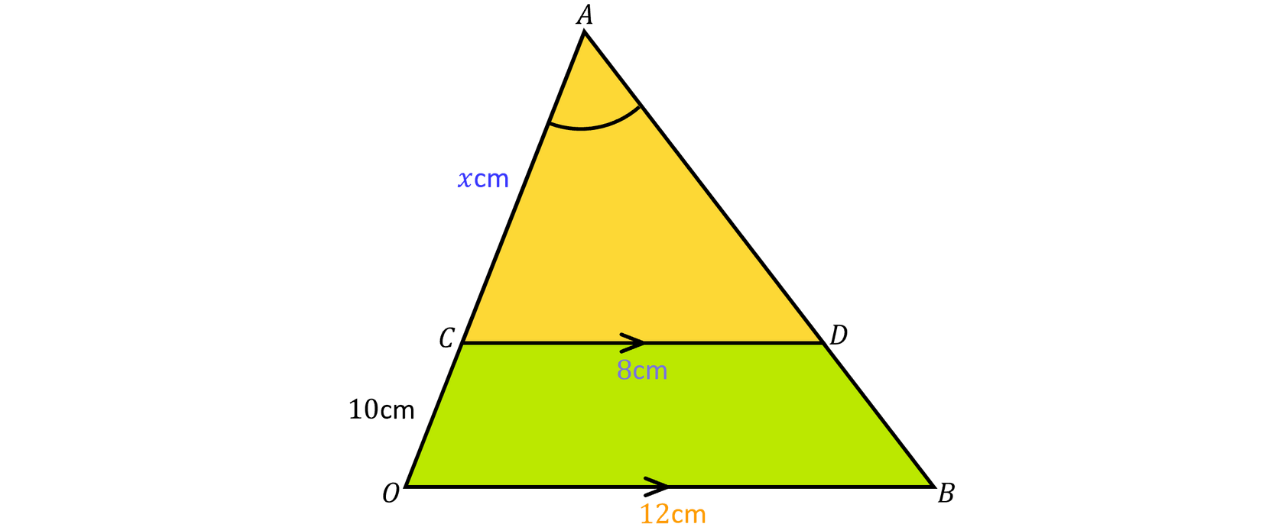
Step 1: Redraw the triangles side by side and find the scale factor.
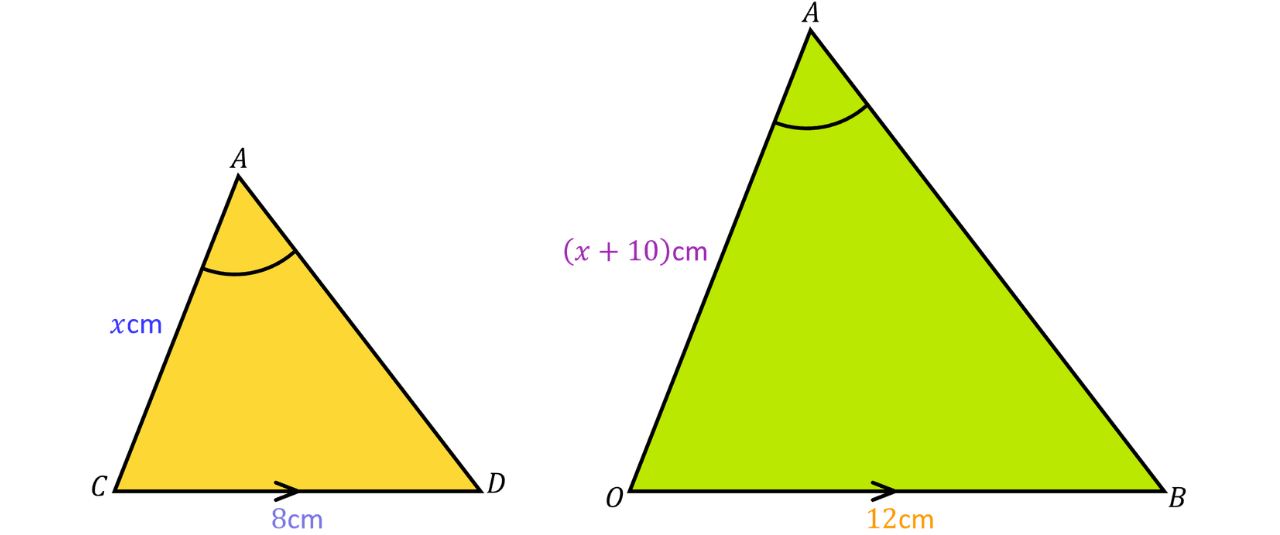
and are corresponding sides, so
Step 2: Set up an equation using the corresponding sides containing
Since there are unknowns in both triangles, it does not matter whether we multiply or divide by the scale factor. It is only important that we do it in the correct order. In this case, multiplying to go from the smaller to the larger triangle gives an equation that is much easier to solve algebraically.
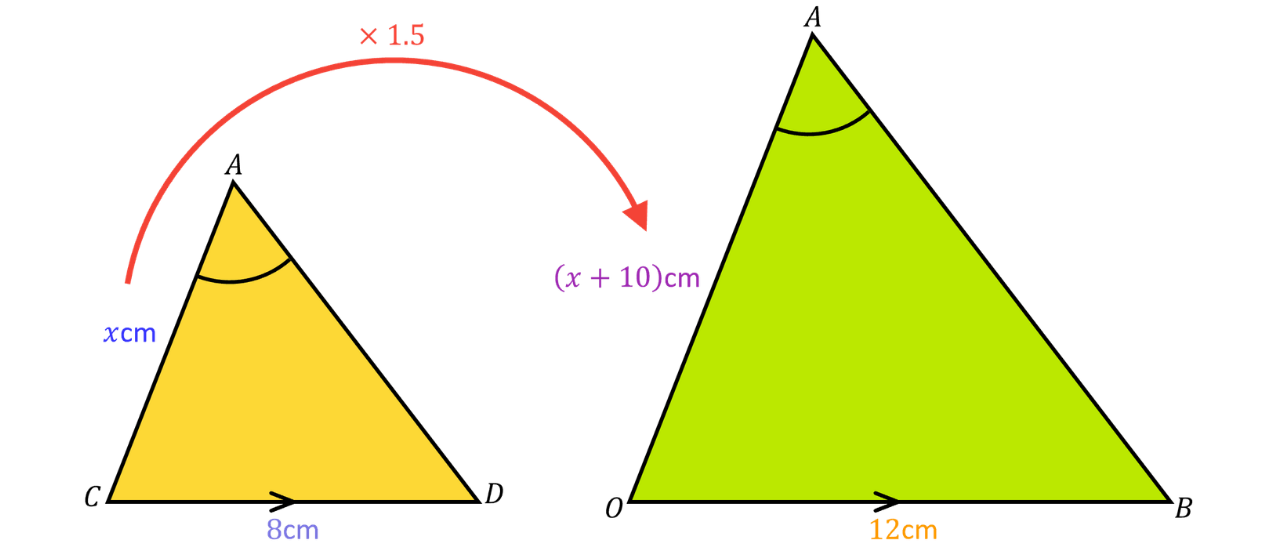
Subtracting from both sides,
Multiply both sides by or divide both sides by to get rid of the coefficient of
Alternative method: For this method, we can look at the corresponding sides as being in the same ratio.
This method allows us to bypass finding the scale factor explicitly. This is very helpful when tougher questions involve lengths that are all unknown. Let’s look at the triangles again:
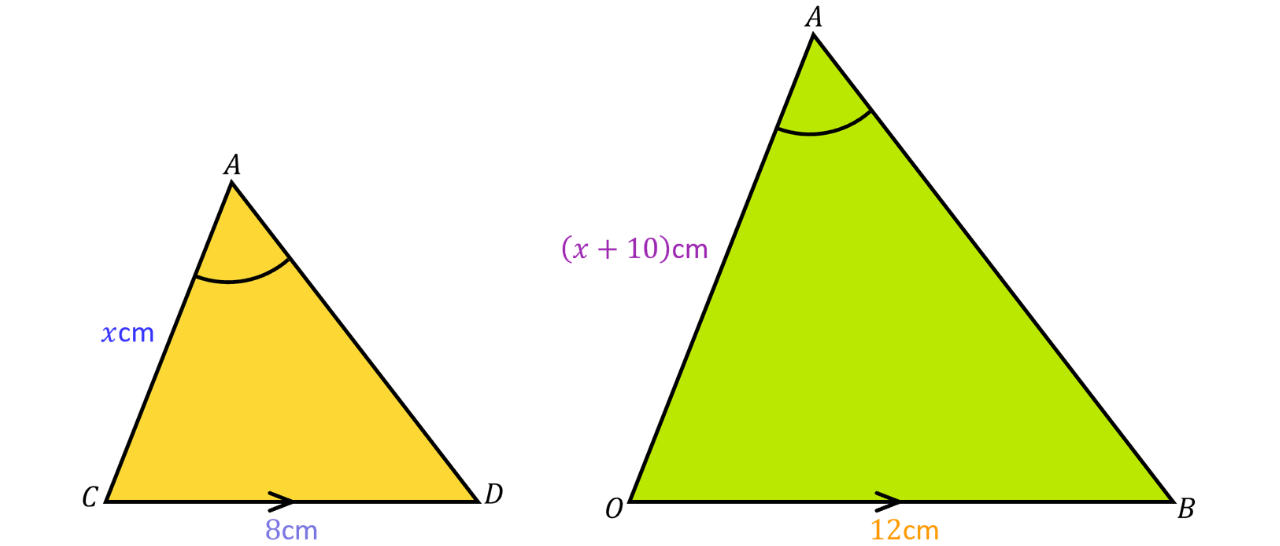
We will use the same idea, that the scale factor is the larger length divided by the shorter length, but now we write it for both pairs of corresponding sides and equate them.
corresponds to and corresponds to Therefore:
Multiply both sides by to clear the fractions (see our note on Solving with Algebraic Fractions for more practice on this).
Expanding the brackets,
Subtracting from both sides,
There is a second way that parallel lines can create similar triangles. Here, instead of one triangle sitting inside the other, the two triangles can meet at a single point between the parallel lines.
Example 4:
In the diagram below, is parallel to The straight lines and cross at the point Find the missing lengths and
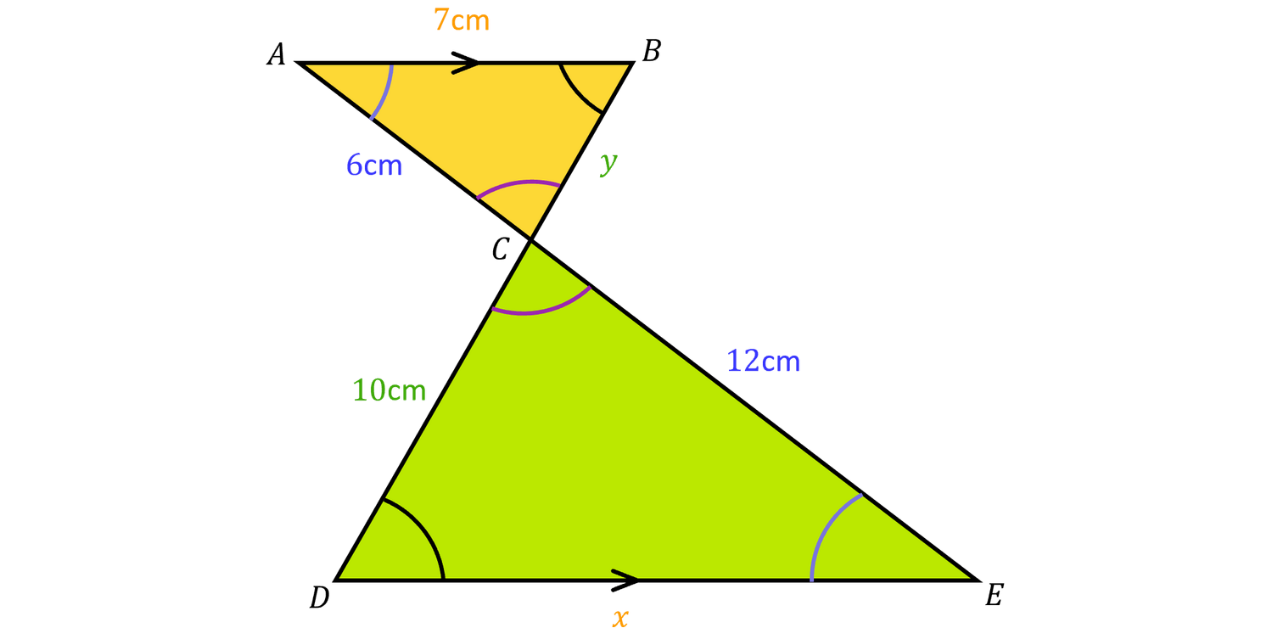
Step 1: Separate the two triangles.
Triangle and triangle are similar. Here’s why:
Angle angle because vertically opposite angles are equal.
Angle angle and angle angle because alternate angles on parallel lines are equal.
All three pairs of angles are equal, so triangle and triangle are similar. The second triangle is upside down, so it helps to rotate it and redraw the two triangles side by side, pointing the same way.
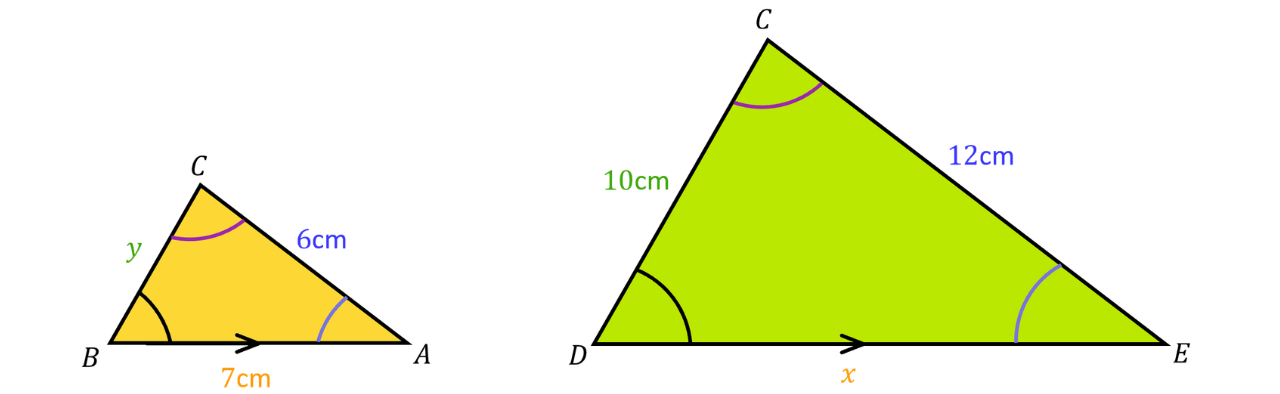
Note: Take care when matching the sides. This is because, in the original diagram, the triangles point in opposite directions, so the corresponding sides do not sit on the same side of the diagram.
The safest approach is to follow the straight lines through and lie along the same straight line, so corresponds to Similarly, corresponds to and corresponds to
Step 2: Find the scale factor between the two triangles.
and are corresponding sides, so
Step 3: Find the missing length
corresponds to (the length ). Since is on the larger triangle, we multiply by the scale factor.
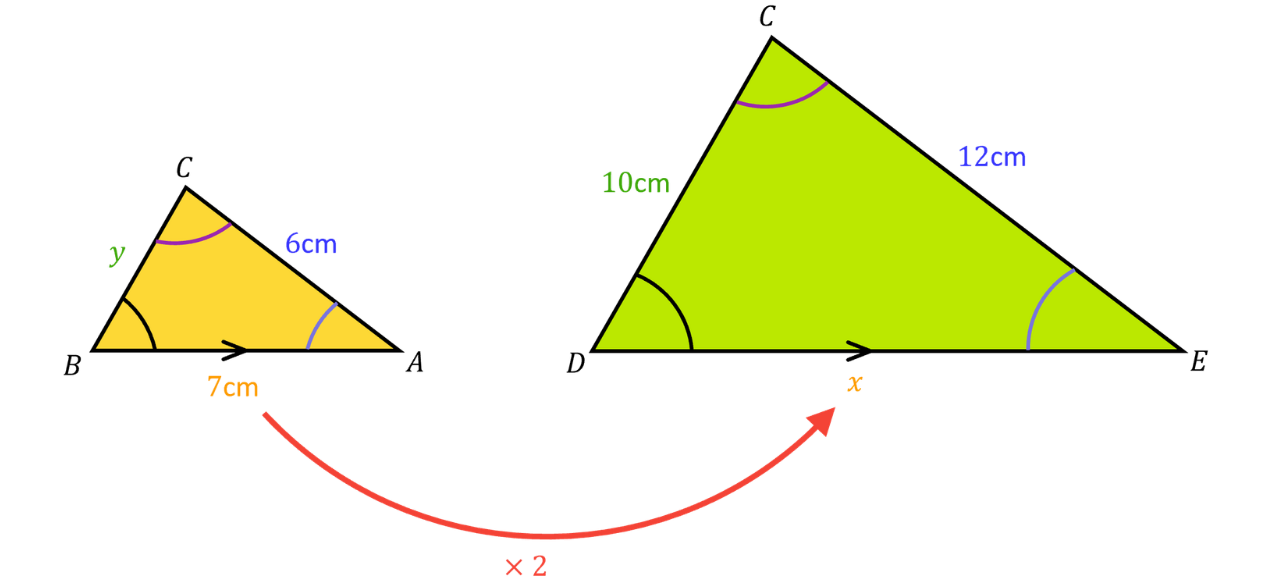
cm
Step 4: Find the missing length
BC (the length ) corresponds to Since is on the smaller triangle, we divide by the scale factor.
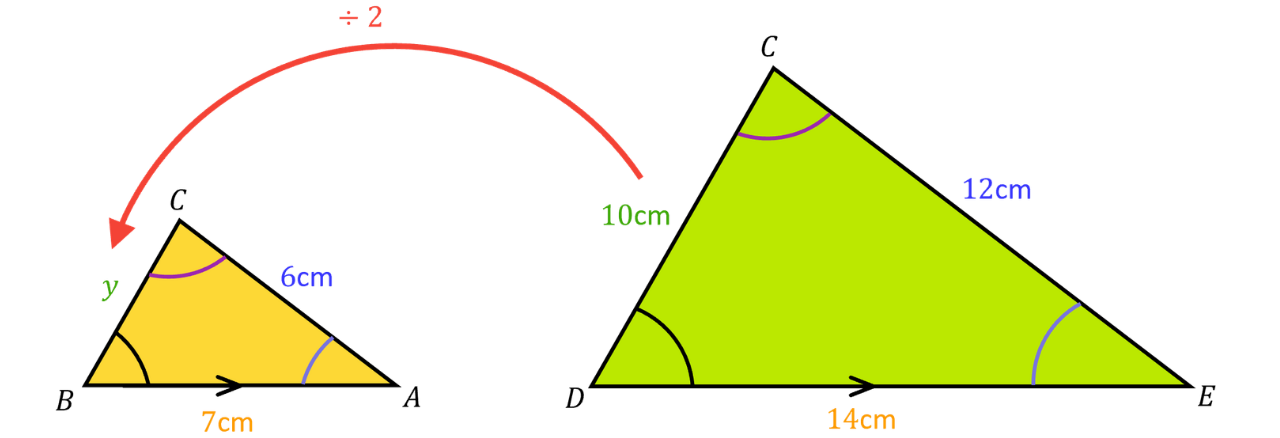
cm
Note: The most common mistake in this question is to pair with (and hence, pair with ) because they sit on the same side of the diagram. Corresponding sides always follow the straight lines through
Area and Volume Scale Factors
So far, we have only used scale factors to enlarge lengths. We now look at what happens to the area and the volume of a shape when it is enlarged. Consider a cm by cm rectangle enlarged by a scale factor of
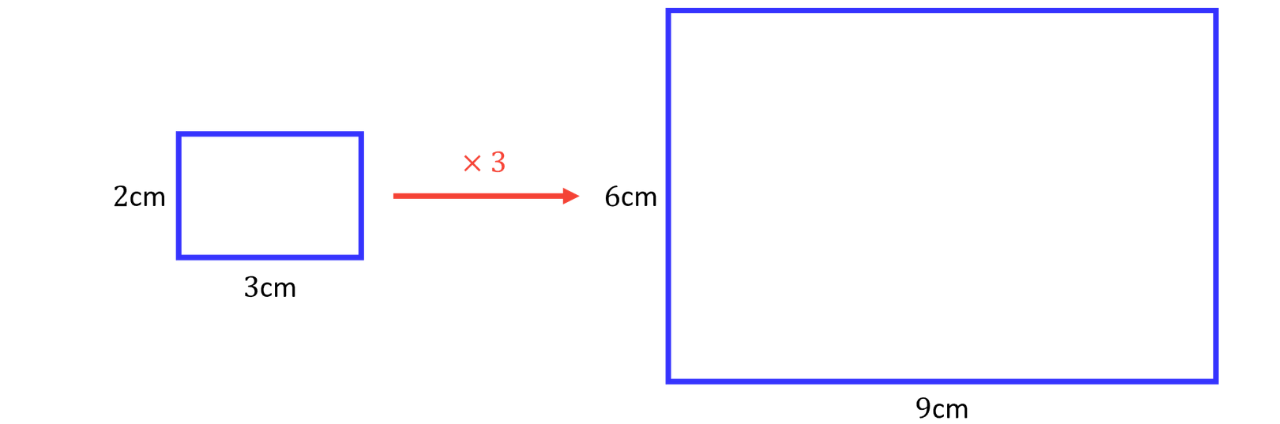
Area of small rectangle cm²
Area of large rectangle cm²
The area has gone from cm² to cm², so it has been multiplied by Notice that , the square of the scale factor, even though the lengths were only multiplied by
Now consider a cube of side cm enlarged by a scale factor of
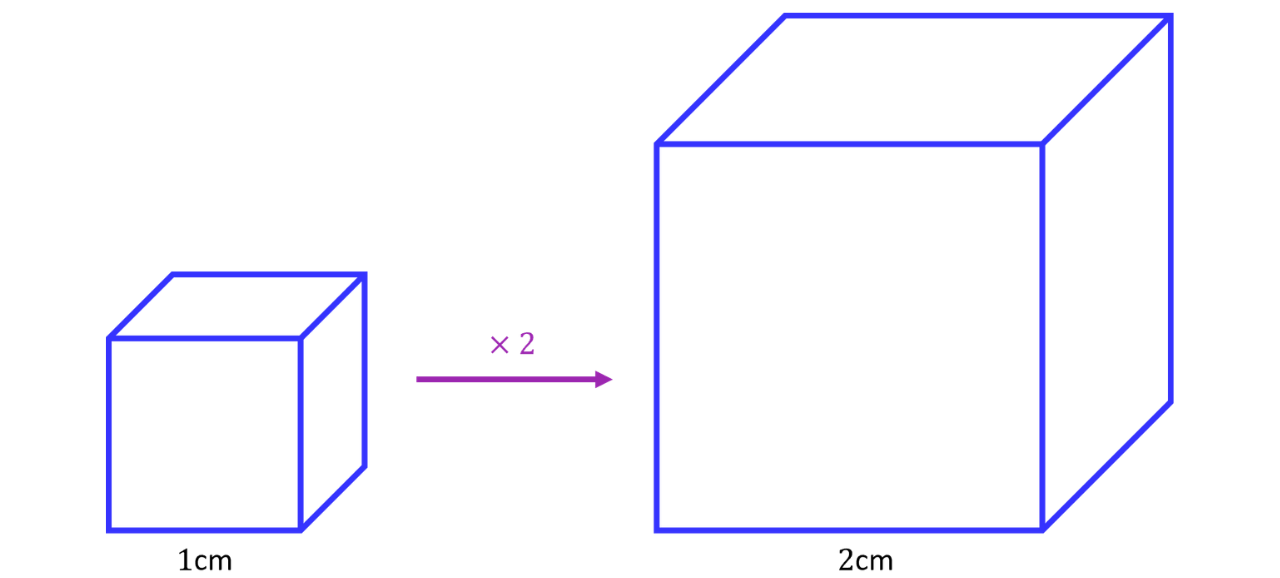
Volume of small cube cm³
Volume of large cube cm³
The volume has been multiplied by and the cube of the scale factor. This is no coincidence: it happens in every enlargement.
Length, Area and Volume Scale Factors
When a shape is enlarged by a scale factor
Lengths are multiplied by
The area is multiplied by
The volume is multiplied by
It often helps to organise this type of question in a table, with one row for length, one for area and one for volume:

The squaring and cubing only ever apply to the length scale factor To get back to the length scale factor from an area scale factor, take the square root; from a volume scale factor, take the cube root.
Example 5:
Shape is enlarged to produce shape The area of shape is cm² and the area of shape is cm². Shape has a length of cm. Find the corresponding length on shape
Step 1: Input all information into a table.
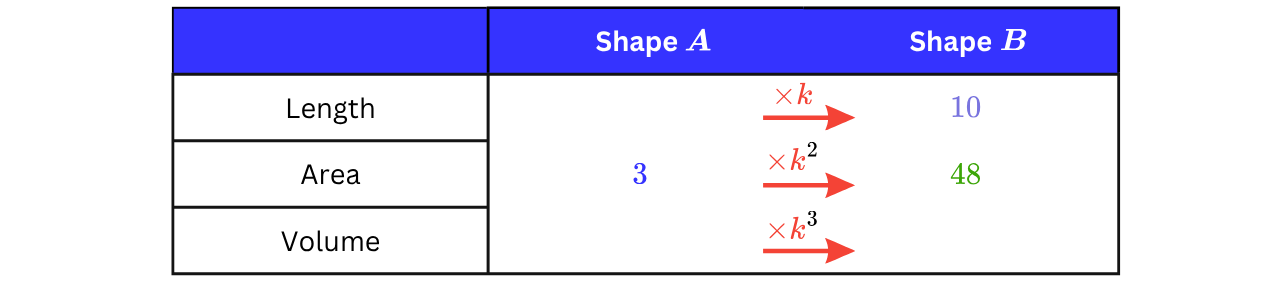
Step 2: Find the area scale factor.
Only the corresponding areas are given, so we must find that scale factor first.
Step 3: Find the length scale factor,
The area scale factor is To find we take the square root.
Square rooting both sides,
Step 4: Divide to find the length on shape
Shape A is the smaller shape, so we divide by the length scale factor.
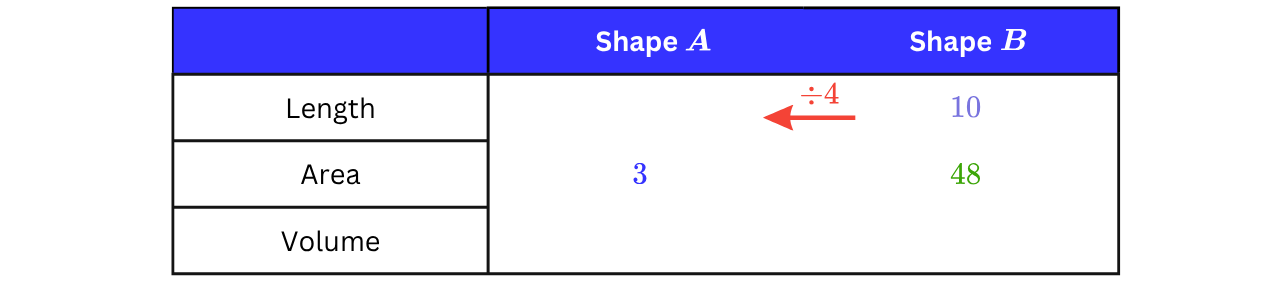
Length on cm
Example 6:
The two cuboids below are mathematically similar. The volume of cuboid A is cm³ and the volume of cuboid is cm³. The surface area of cuboid is cm². Find the surface area of cuboid
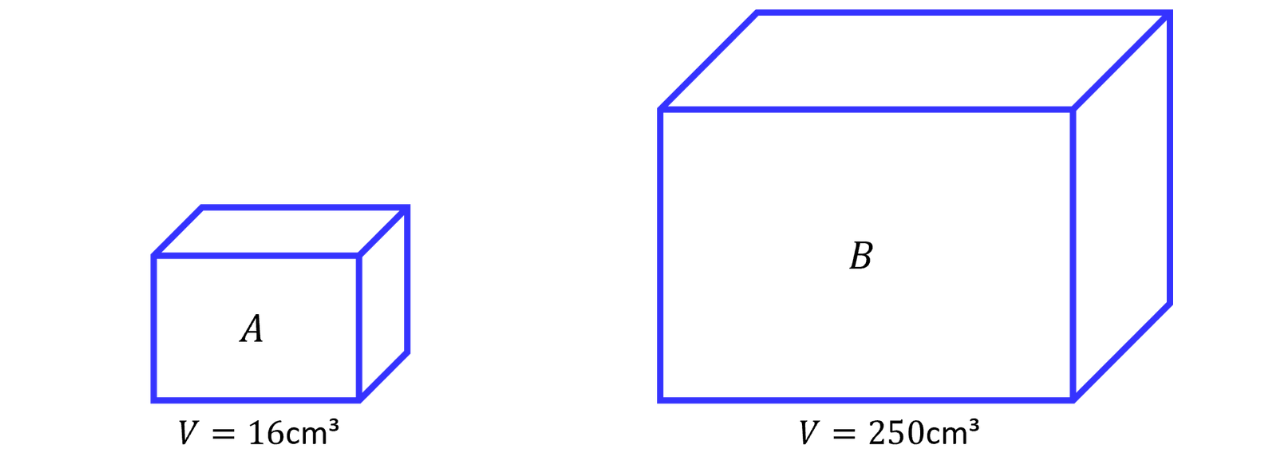
Step 1: Input all information into a table.
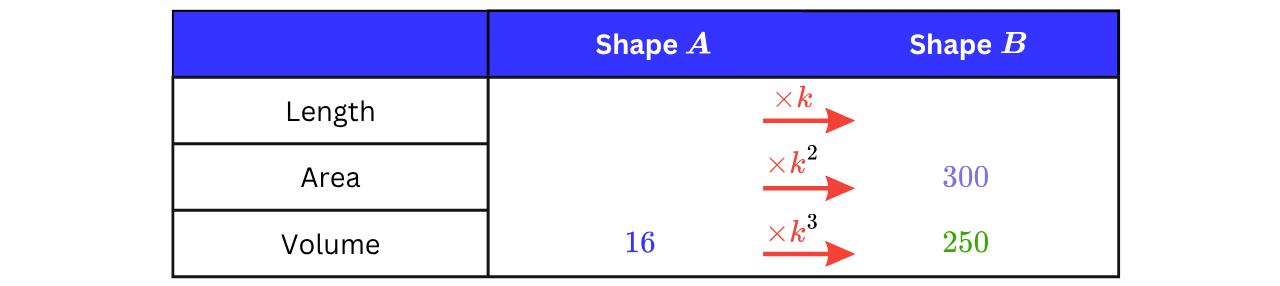
Step 2: Find the volume scale factor.
Only the corresponding volumes are given, so we must find that scale factor first.
Step 3: Find the length scale factor.
The volume scale factor is To find we take the cube root.
Cube rooting both sides,
Step 4: Find the area scale factor.
The area scale factor is so we square our value of
Step 5: Divide to find the surface area of cuboid
Cuboid is the smaller cuboid, so we divide by the area scale factor.
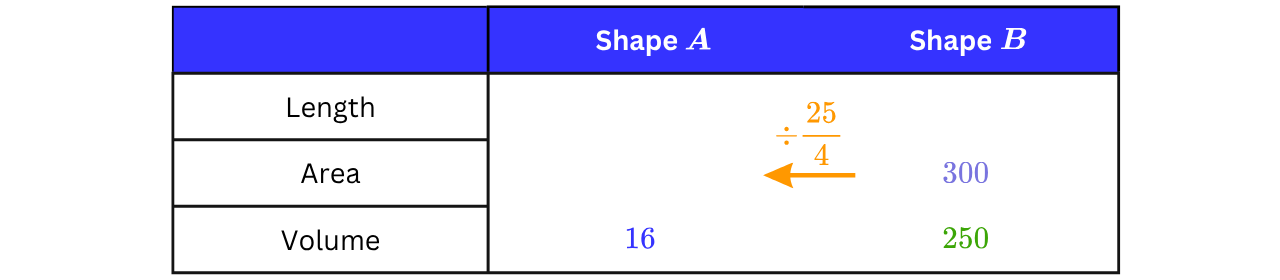
Surface area of cm²
Practice Question