Calculating means and anomolus results
Brook Edgar & Hannah Shuter
Teachers


Explainer Video
Calculating Means
If we wanted to know the typical height of a ten-year-old, we would not measure the height of a single child, because that child could be taller or shorter than most kids. We would therefore measure the heights of many ten-year-olds and find the mean (average) height.
In a scientific experiment to calculate the mean, we add up all the values we recorded (the heights of, say, five kids) and divide by the total number of measurements/times we carried out the experiment (divide by five, since we repeated the experiment with five different kids).
Formula:
For example, if we recorded the heights of five different kids and got, , , , and , to calculate the mean height, we add the numbers together and divide by five.
The mean height of a ten-year-old is , as all other numbers are recorded as whole numbers, with no decimal places.
To make our results more accurate, we should have repeated the experiment with more kids, say 100 kids rather than five, as the five kids we sampled may all have been tall for their age. The more times we repeat an experiment, the more reliable our results become. If a result is accurate, it is very close to the true (actual) value. For example, if I were throwing darts at a dartboard and got close to the bullseye, my throws would be very accurate.
Sometimes in exams, they can give you the mean and ask you to calculate the missing value.
For example, when a student investigated the relationship between current and pd in a bulb, they set the pd to and recorded the current through the bulb three different times. In the results table below, we can see that the mean current she calculated was , but the current she recorded the third time is missing. To calculate the missing result, we need to reverse the steps to calculate a mean.

To calculate the missing result, we need to do the opposite of dividing by three to get rid of the three from the bottom of the right-hand side of the equation, as multiplying and dividing by the same number is the same as cancelling it out, and what we do to one side of the equation, we must do to the other.
The missing third measurement, , is therefore, .
Remember: When recording results in a table, all numbers need to be recorded to the same number of decimal places. That is why in the table above, the first measurement is recorded as 0.10 and not 0.1 to match the 2dp of all other data.
Worked Example:
The table shows current measurements. One measurement is missing.
The mean of the recorded measurements is .
Find the missing measurement.

Answer:
We know the mean but need to work backwards to figure out the missing fifth result, which we let be the unknown term, .
To calculate the missing result, we need to do the opposite of dividing by to get rid of the from the bottom of the right-hand side. To do this, we need to multiply both sides by .
The missing measurement, , is therefore, .
*Be sure to check that the units of your final result match the units in the question.
Anomalous results
Sometimes, when we are taking measurements, we can record a value incorrectly because something went wrong during the recording, such as becoming distracted or experiencing a problem with our equipment.
For example, when recording the heights of the five kids earlier, one kid may have been wearing higher shoes than another, or one kid may have been slouching. This affects our results and makes them less accurate. We call these wrong result anomalies, and they are usually easy to spot when we record lots of measurements - they stick out from the other numbers, as they are either much bigger or smaller than the rest. We ignore these numbers from our results. This is why repeating experiments makes results more reliable, as we can spot the anomalies and ignore them from our results.
Let's say that when recording the five kids' heights earlier, we got the results: , , , and . We can clearly see that something is wrong with the recorded height of , as it is much smaller than the others (the kid was likely slouching). This is an anomalous result, so we ignore it in our results. Instead of calculating the mean from five results, we calculate it from four.
The mean height of a ten-year-old is - as all of the other results were recorded as whole numbers with no decimal places.
Worked Example:
Dario measured his cat's mass by holding it on a mass balance on 4 different days. He got the results below:

Identify the anomalous result and calculate the mean mass of his cat.
Answer:
All results are three-point something except for the third result. This is the anomalous result. It looks wrong as it is much smaller than the other results (the cat may have had a paw off the scale, on the ground).
2.1 kg is the anolalous result.
When calculating the mean, we ignore this result -> we calculate the mean of three results, not four.
Worked Example:
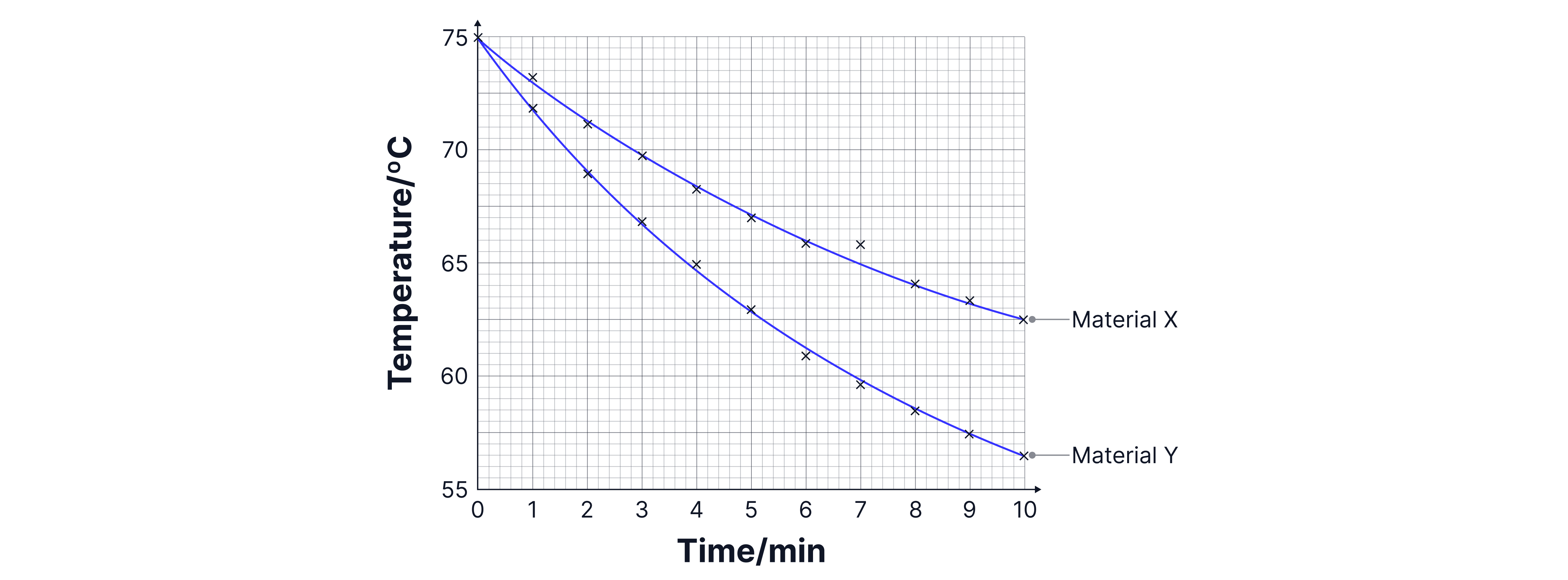
A student recorded the temperature of two different materials as they cooled. They plotted the results in the table below. Identify the anomalous result by drawing a ring around it.
Answer:
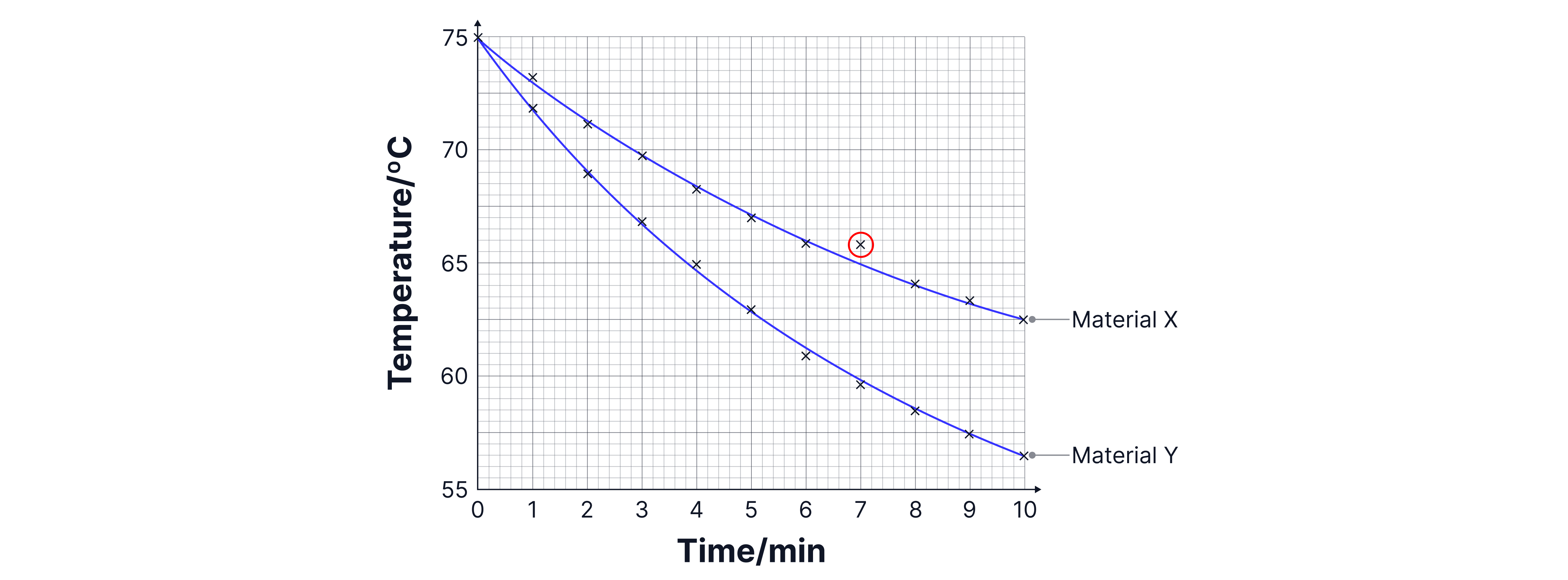
The temperature recorded at seven minutes for 'Material X' is the anomalous result as it does not fit the pattern of the other numbers, and it was ignored from the results when plotting the line of best fit.
Practice Questions
A student measures the extension of a spring three times for a force. The results are shown below:
Extension
Identify the anomalous result.
Explain why this result is anomalous.
Calculate the mean extension.
-> Check out Hannah's video explanation for more help.
Answer:
It is much larger than the other results (the spring may have been deformed).
A student measures the time taken for a trolley to travel down a ramp. The times recorded are shown below:
Time
Identify the anomalous reading and give a reason.
Calculate the mean time using all valid results.
Suggest one possible cause of the anomalous reading.
-> Check out Hannah's video explanation for more help.
Answer:
Anomalous value: , because it is noticeably higher than the rest.
Reaction-time error of the student causing the stop button on the timer to be pressed late or the student may have been distracted.