Directly proportional relationships
Brook Edgar & Hannah Shuter
Teachers


Contents
Explainer Video
Line of best fit
When plotting data on a graph, we can add a line of best fit to identify any trends in the data.
A line of best fit is a line that follows the general trend of the data. It can be a straight line or a curve. It should pass through most points in your graph. If there are six data points, either they should all pass through the line of best fit, or there should be at least three points on either side of the line of best fit. Anomalous results should be ignored when plotting a line of best fit.
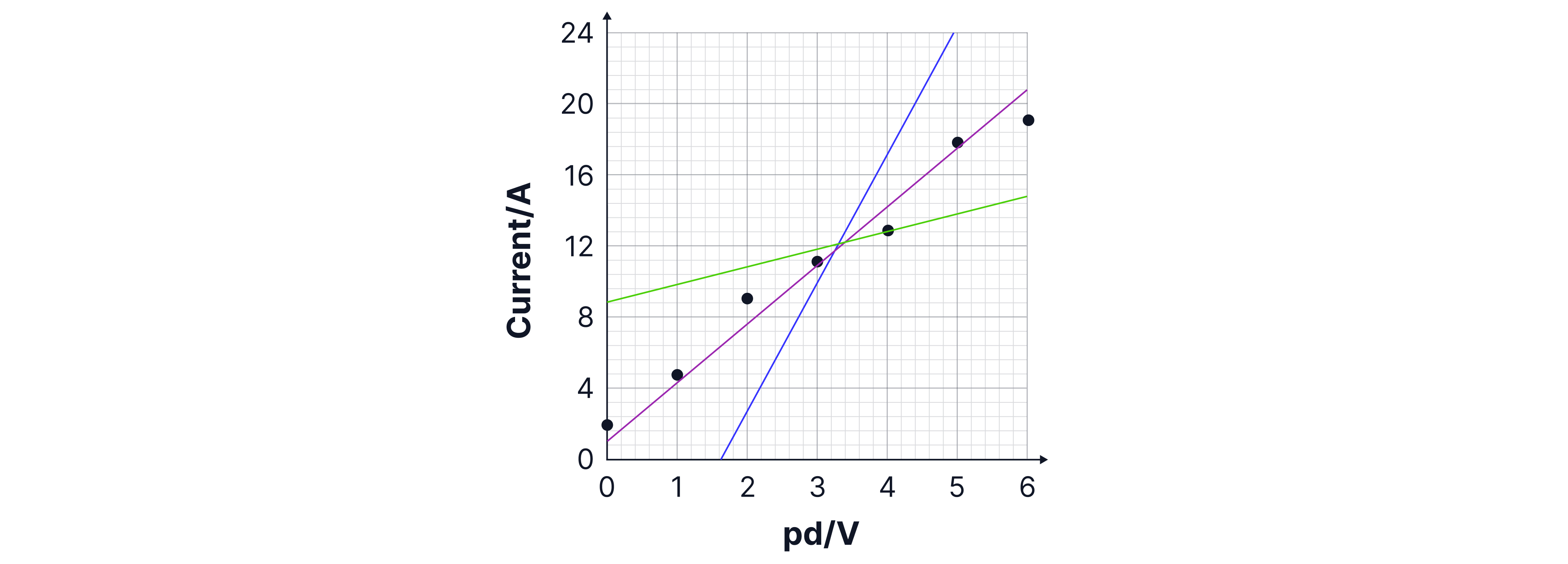
For example, we can see below when plotting the line of best fit through the data of current against pd that the anomalous result at is ignored. There are then four points that the line of best fit should pass through - either the line passes through all four points, or there is an equal number of points on either side.

Remember: When plotting lines of best fit, use a sharp pencil (and a ruler if it is a straight line) and ensure your line extends through the entire graph.
Worked Example:
Looking at the data recorded below, identify the correct line of best fit.
Answer:
Purple line, as it shows the trend in the data. The line of best fit passes through or is close to four data points, with one on the left-hand side and two on the right-hand side, just slightly off. The blue line is too steep, so it doesn't match the data, and the green line is too shallow.
Graphs
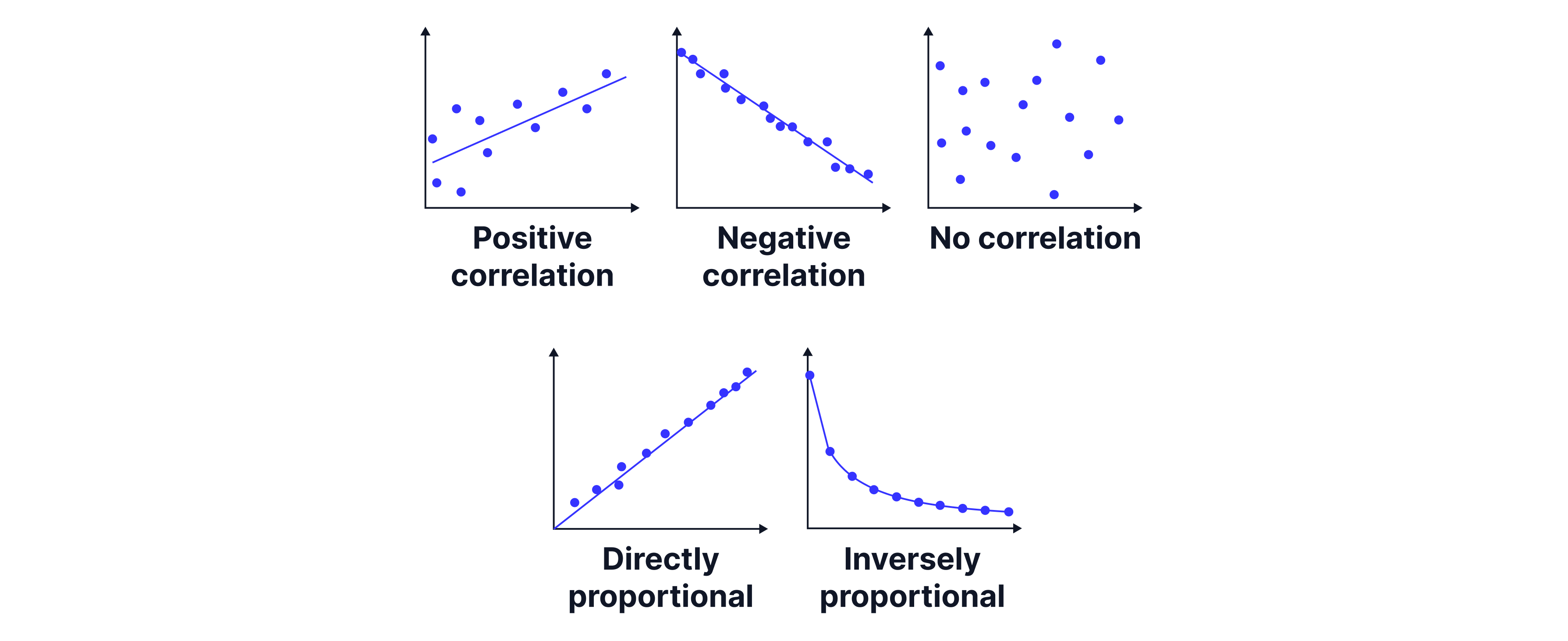
Once the line of best fit is drawn, we can make conclusions about the data. The different types of graphs that you may encounter in science are shown below:
Directly and inversely proportional
You need to be able to identify a directly proportional relationship in both graph form and from data in tables.
We know that force and extension are directly proportional (up until the limit of proportionality) from learning about Hooke's law, . We can identify this relationship on a graph by seeing a straight line that passes through the origin .

We can see from the graph and the corresponding table that the data was plotted from, that as the force is doubled from to , the extension doubles from to . As the force increases from to , the extension also increases by a factor of , from to . Whatever factor the x-value is multiplied by, the y-value is multiplied by the same factor.

An alternative way to prove that a relationship is directly proportional is to look at the ratio of the numbers to see if it is a constant. For example, in the data above, if we divide all of the extension numbers by the corresponding force numbers that caused that extension, we get a constant.
An inversely proportional relationship is the opposite. Whatever factor the x -value is multiplied by the y- factor is divided by that same factor.

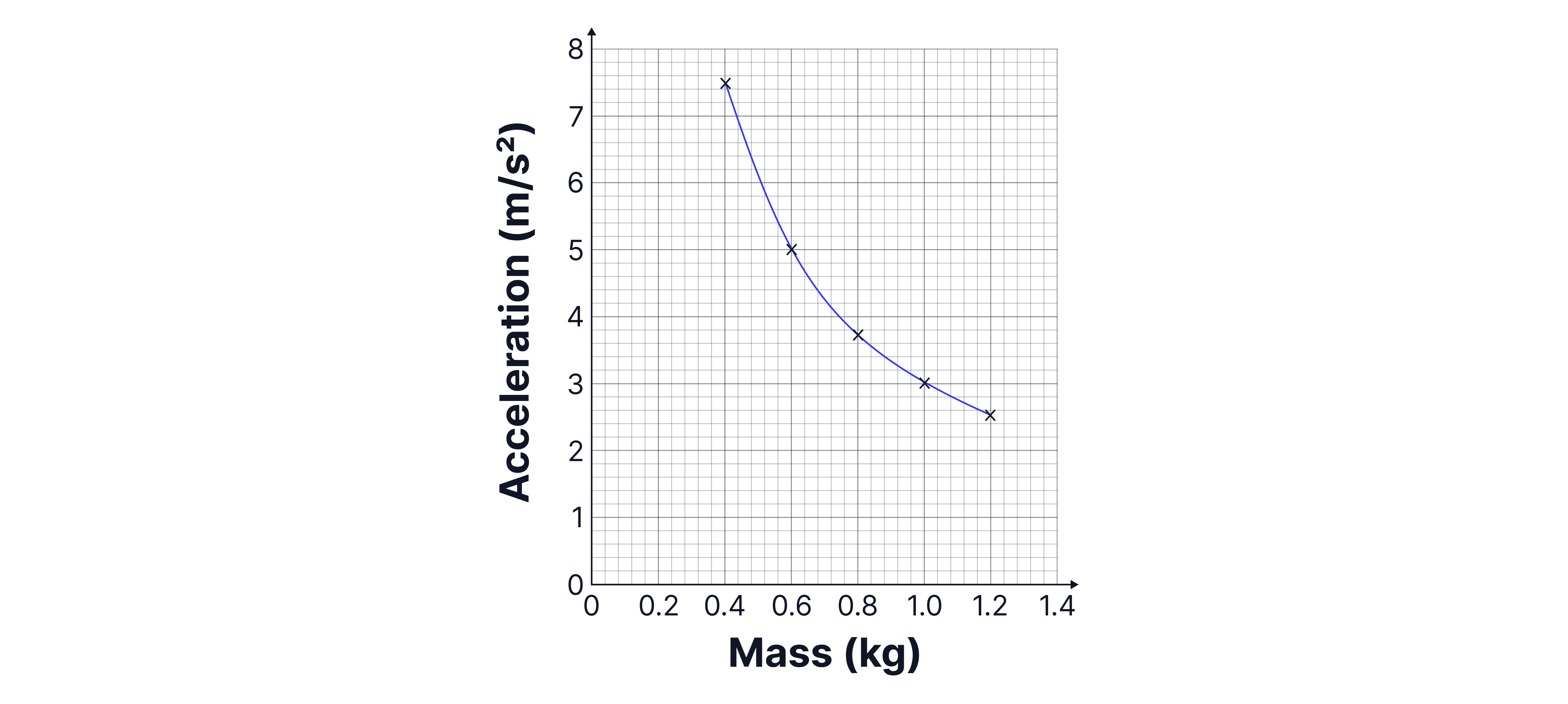
We can see from the table above that mass and acceleration are inversely proportional. When the mass is doubled from to the acceleration is halved from to and when the mass is multiplied by three, the acceleration is divided by three. On a graph, this looks like a descending curve.
Worked Example:
Ohm's law tells us that current and potential difference are directly proportional, . Knowing this, complete the table of data below.

Answer:
Directly proportional means that whatever factor one value is multiplied by, the other value is multiplied by the same factor.
As pd is multiplied by four from , the current must then also be multiplied by four from .
The missing data point is therefore .
Practice Questions
A student investigates how the extension of a spring depends on the force applied. The results are shown below.
State whether extension is directly proportional to force.
Use the data to justify your answer.
State how a graph of extension against force would show this relationship.
-> Check out Hannah's video explanation for more help.
Answer:
Yes
As the force is doubled from 1->2, the extension is doubled from 1.9->3.8. Also, the ratio, extension ÷ force, is constant ->
It would be a straight line through the origin.
A student investigates the current through a resistor for different potential differences (p.d.).
Use the data to determine whether the relationship is directly proportional. Show working.
The student plots a graph. Suggest one reason why the plotted points might not lie exactly on the ideal straight line.
-> Check out Hannah's video explanation for more help.
Answer:
Ratio is constant, so current is directly proportional to voltage.
They may have forgotten to turn the switch on and off between readings, which would cause the wires to overheat and affect the results of the experiment.