Resolution of Equipment
Brook Edgar & Hannah Shuter
Teachers


Explainer Video
Resolution
If we needed to measure the thickness of a piece of paper, we would not just measure the thickness of a single piece, as this would be very hard to do using a ruler, since it is so thin. We would be better instead to measure the thickness of, say, sheets of paper and divide the answer by to get the thickness of one sheet. This is due to the ruler's resolution.
Resolution is the smallest measurable value on a piece of equipment -> the smallest number that can be read on the piece of equipment. It tells us how good a piece of equipment is. The lower the number that the equipment can read, the more precise the equipment is, and thus the reading will be. Imagine a ruler where the lowest value it can record is . The resolution of the ruler is . A single sheet of paper has a thickness of roughly , which a ruler is unable to read as it is much smaller than , the smallest value the ruler can record. But 100 sheets of paper would have a thickness of 100 mm = 10 cm, which can be read by a ruler.
Look at the image of the mass balance below, which shows the reading of 14.8 g.

The resolution of the scale is , as this is the lowest value that the scale can read. This means the reading could be anywhere between , as the scale only reads to 1 dp. These are called the upper and lower bounds of the reading. The difference between and is , so it can be written that the scale gives us a reading of . This is called the uncertainty in the measurement -> how much our recorded value might be off the actual value by. Here the final result might be off by , so the uncertainity is .
The resolution is the lowest number the device can read.
The equipment's resolution tells us the uncertainty in our reading.
The lower the equipment's resolution, the more precise our reading will be.
Look at the image of the analogue voltmeter below, giving a reading of 4.8 V.

The resolution of the voltmeter is , as this is the lowest value that the device can read. We can see this as from there are five markers, so each marker represents .
Worked Example:
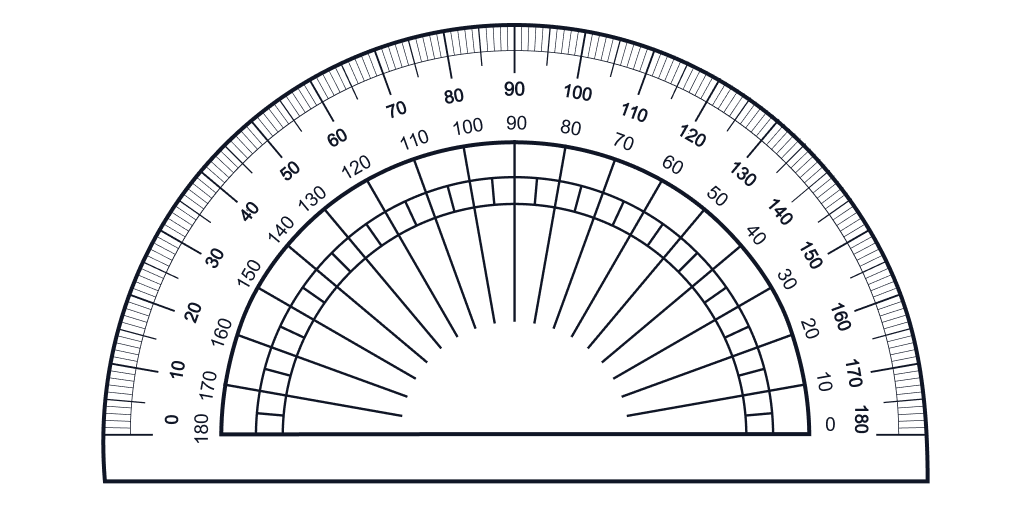
A student measures the angle of refraction of a ray of light in a glass block using a protractor three times. They recorded the results as, , , . Explain why the student should not have used the protractor shown to make these measurements.
Answer:
The resolution of the protractor is . This is the lowest value that the protractor can read, so it can not record the value as this is a more precise reading than the protractor can read. The protractor shown cannot read to a value of dp.
Worked Example:
A measuring cylinder is used to measure the volume of water. The reading is shown below:

State the volume to be recorded and the resolution of the equipment.
Answer:
Between there are five markers. Each marker then represents . The resolution of the measuring cylinder is (the smallest value that can be recorded) and the reading shown is .
*Remember when recording values from a measuring cylinder, you need to read from the bottom of the meniscus (the bottom of the curved part of the liquid).
Absolute Uncertainity
We just learned that the equipment's resolution equals the uncertainty of the reading, which is the lowest value a piece of equipment can read and tells us how off our measurement may be.
However, when you are given a table of results or if a reading has been repeated many times, the uncertainty will be half of the range of results.
For example, in the experiment below, which examines how force and acceleration are related, the force acting through the string (tension) is determined from the force exerted by the mass hanging off the edge of the table, and the trolley's acceleration was recorded three times.

The recorded results for acceleration were:
The uncertainty in the results (how off our results may be from the actual value) is half of the range.
Worked Example:
A pupil wanted to investigate the reflection of light using a mirror. The ray box has a bulb inside, with a slit at the front that produces a narrow beam of light that can be directed at the mirror.
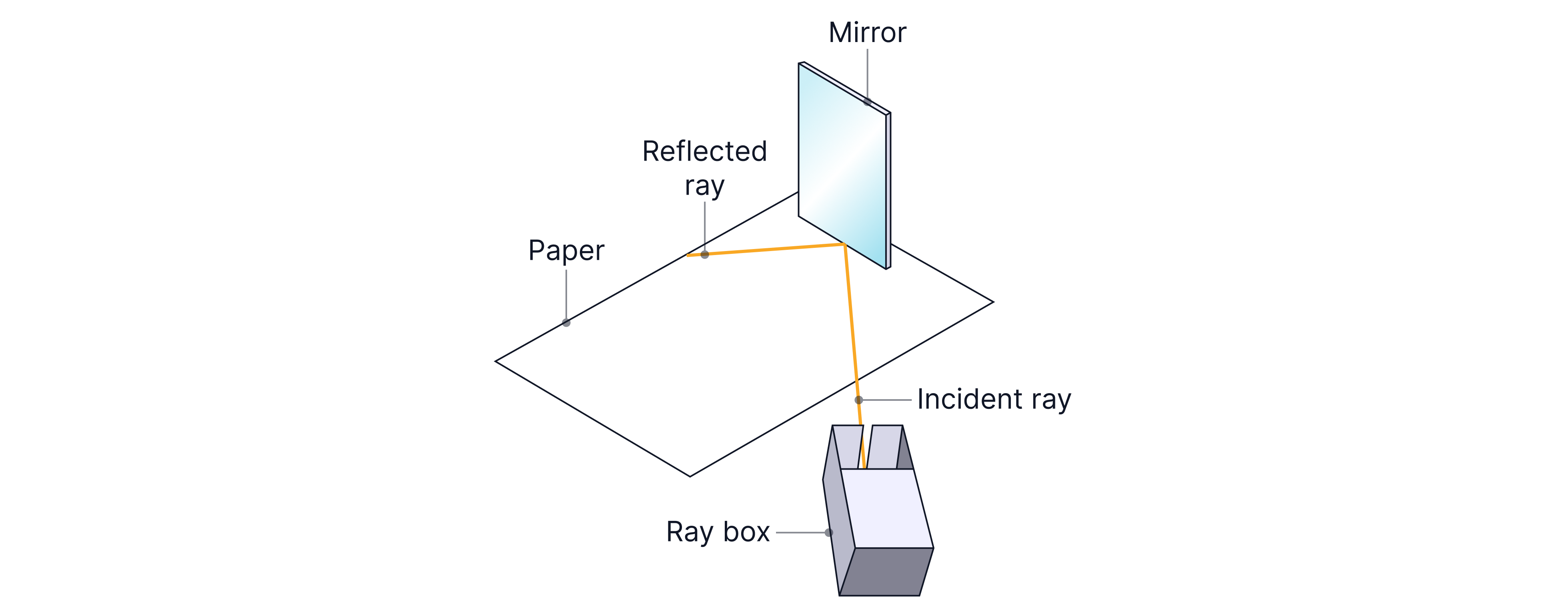
They changed the angle of incidence (between the incident ray and the normal) and recorded the angle of reflection (between the reflected ray and the normal) four different times for each angle of incidence using a protractor. The results are shown below:

State the uncertainty in the angle of reflection when the angle of incidence is degrees.
Answer:
For , the forth row of results, the biggest reading of reflection is and the smallest reading is . The uncertainty is half of the range of results. The range of results is .
Practice Questions
A student uses a thermometer marked in intervals to measure the temperature rise of water being heated. The temperature increases from to .
State the resolution of the thermometer.
Explain why this thermometer is not suitable for accurately measuring small temperature changes in this experiment.
Suggest a more suitable piece of equipment and state its typical resolution.
-> Check out Hannah's video explanation for more help.
Answer:
The resolution is only . This means the thermometer cannot detect changes smaller than that, so the measurement is not precise enough.
A digital thermometer with a resolution of .
A student measures the extension of a spring using two different rulers.
Ruler A: marked in divisions.
Ruler B: marked in divisions.
The true extension of the spring is .
State the resolution of Ruler A and Ruler B.
Explain which ruler is more suitable for measuring the extension and why.
-> Check out Hannah's video explanation for more help.
Answer:
Ruler A: . Ruler B: .
Ruler B is more suitable. Its smaller resolution () can detect smaller changes, giving a more precise extension measurement.