Change in Momentum
(Triple Only)
Brook Edgar & Hannah Shuter
Teachers


Explainer Video
Changes in Momentum
When an object has a change in momentum, it is caused by a force acting on the object for a period of time. The bigger the force, or the longer it acts, the bigger the change in momentum.
We can combine Newton's Second Law () and the acceleration equation () to give us an equation about force and change in momentum:
Formula:
This equation means that for the same change in momentum:
If you increase the time (), the force applied () decreases
This is the entire principle behind safety features in vehicles and sports equipment.
Example: If a skier of mass is skiing down a mountain at and crashes into a snow drift, coming to a stop, we can work out the force that acts on their head:
Lets say they come to rest over seconds.
But if it took them seconds to stop as they used a crash helmet.
From the maths, we can see that for the same change in momentum, using the helmet increases the time taken to come to rest, significantly reducing the force acting on them.
Worked Example:
A cyclist of mass is travelling in a straight line at . The cyclist accelerates and reaches a speed of in the same direction.
Calculate the change in momentum of the cyclist.
The cyclist accelerates to in .
Calculate the average force applied by the cyclist
Answer:
Worked Example:
A football of mass is travelling at towards a wall. It rebounds straight back at .
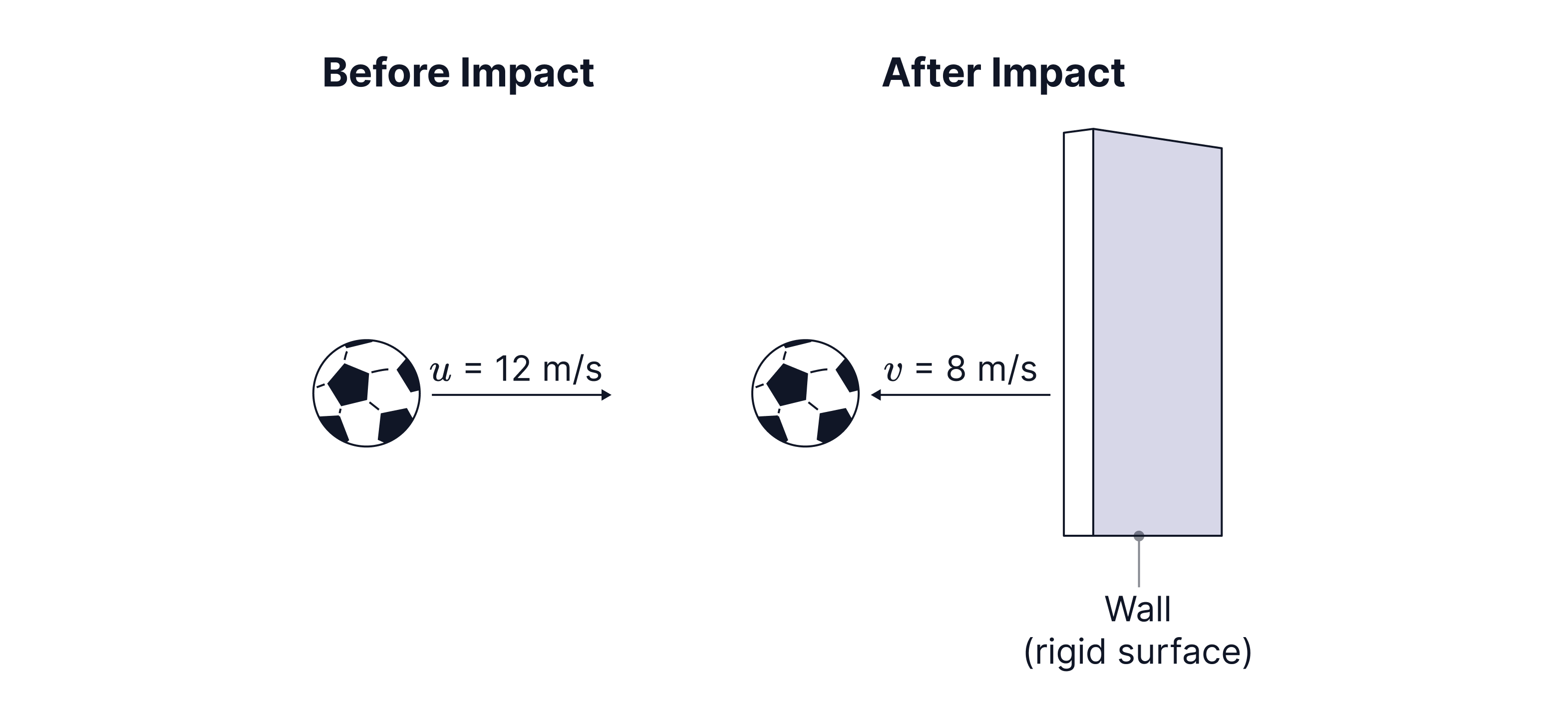
Calculate the change in momentum of the football.
The football is in contact with the wall for .
Calculate the force exerted on the football by the wall.
Answer:
The football rebounds from the wall, so its velocity after will be in the opposite direction. As velocity is a vector the velocity after will be as objects travelling to the left have negative signs.
Teacher Tip: Don't forget to convert your units. Time in question two was given in milliseconds. There are .
Safety Features
All safety features work on the same principle: increasing the time over which a collision occurs to significantly reduce the impact force.
Let's think about a car crash. Your momentum changes from a very high value, due to the speed you were travelling at, to zero (when stopped). Your change in momentum is a fixed value; however, if we can change the time over which this change occurs, we can change the force acting.
Scenario A: You hit a solid concrete wall with no airbag
Time to come to a stop: around
Force: very large, resulting in multiple serious injuries
Scenario B: You hit a concrete wall, but your airbag deploys
Time to stop: increased to around ( times longer than without the airbag)
Force: times smaller than in scenario 1.
How Each Safety Feature Increases Time
Cars include a number of safety features that make use of increasing the time taken for the same change in momentum, to reduce the force acting, as illustrated below:
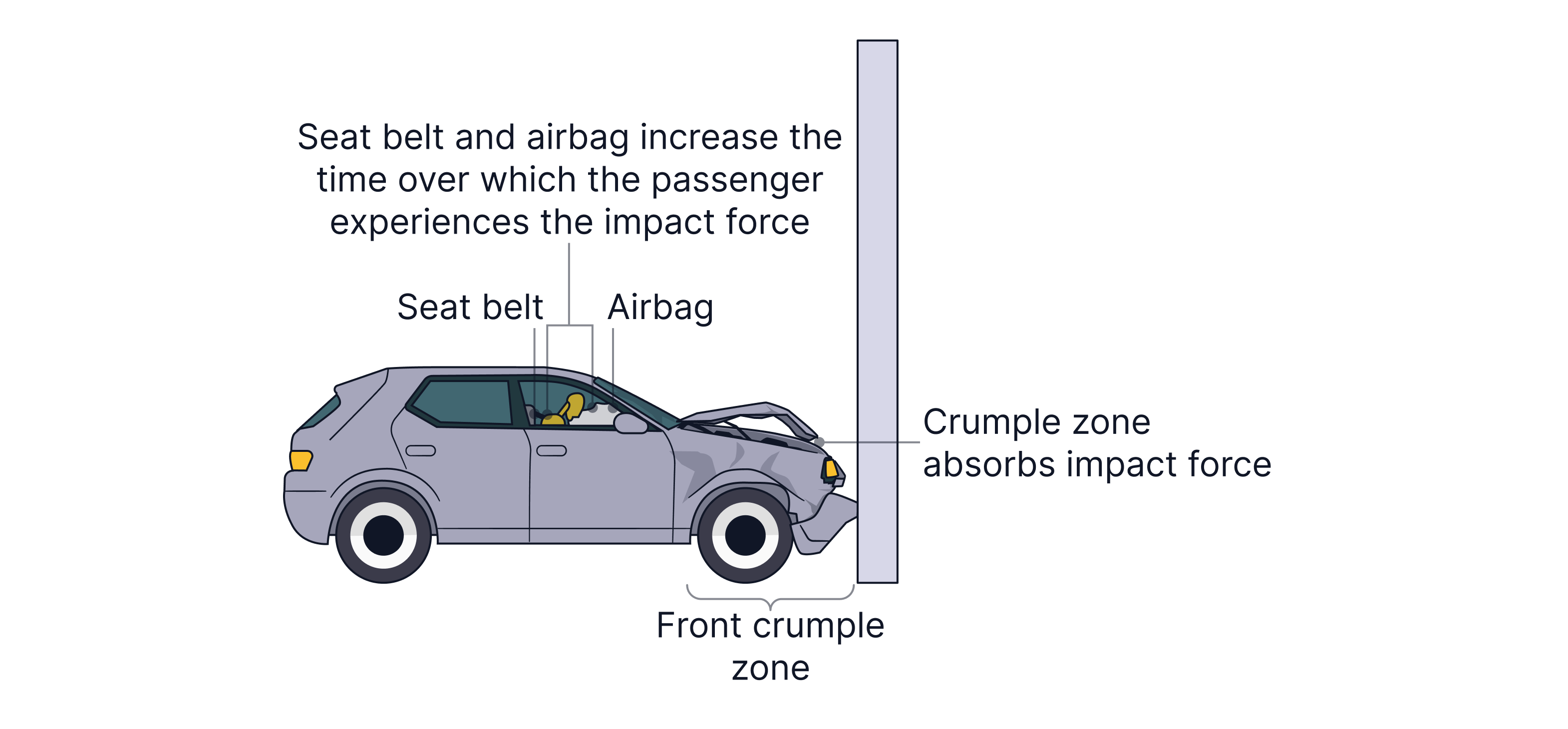
Airbags: When your head hits an airbag instead of a hard dashboard or steering wheel, it increases the time it takes for you to come to a complete stop, as it will take time for the airbag to compress when your head hits it. The airbag increases the , for the same change in momentum, so the decreases. This results in much lower damage to your skull and brain.
Seatbelts: Modern seatbelts are designed to stretch slightly during a crash. They don't stretch loads, but even a small amount of stretch can increase the time over which you decelerate. If a seatbelt can increase your time to stop from say to , this increase in time means the force on your chest will be smaller for the same change in momentum. Without this stretch, the seatbelt would cause serious injuries.
Crumple zones: These are sections at the front and rear of a car designed to crumple and deform in a controlled way during a crash. If there were no crumple zone when the car hits a wall, it would stop quickly. With the crumple zone, as it takes time for the car to collapse, it would take longer to come to a rest. The crumple zone increases the , for the same change in momentum, which reduces the force on the passengers significantly.
Other scenarios which use increased time to decrease force include:
Crash mats in gyms: When a gymnast lands on a thick crash mat, they sink into it, increasing the time it takes to come to a complete stop. This increase in time can make the difference between a safe landing and broken bones.
Cycle helmets: The foam inside a helmet compresses when you hit your head. This compression takes time, increasing the time your skull takes to come to rest compared to hitting the road directly, thereby decreasing the force on your skull.
Cushioned playground surfaces: Soft rubber surfaces or bark chippings compress when a child falls on them, increasing the time it takes for them to stop. This turns a potentially serious injury into a minor bump.
Worked Example:
A car of mass is travelling at . The driver applies the brakes and the car comes to rest in .
Calculate the change in momentum of the car.
Calculate the average force applied by the brakes.
Explain why increasing the time taken for the car to stop reduces the force on the passengers.
Answer:
When the car stops, its momentum changes from a large value to zero.
If the time taken to stop is increased, the change in momentum happens over a longer time. Since:
a longer stopping time results in a smaller force.
This means the force acting on the passengers is reduced, making injuries less likely.
Worked Example:
A car is involved in a collision and comes to a stop very quickly. The car has crumple zones and airbags.
Explain how these safety features reduce the force on the passengers during the collision.
Answer:
When the car crashes, its momentum changes rapidly from a large value to zero. This change in momentum is the same with or without safety features.
Crumple zones and airbags increase the time taken for the car and passengers to come to rest. This reduces the rate of change of momentum, and therefore decreases the force.
This smaller force reduces the risk of serious injury.
Practice Questions
A hockey puck is hit by a stick. Its velocity increases from to in
Calculate the change in momentum of the puck.
Calculate the force exerted on the puck.
-> Check out Hannah's video explanation for more help.
Answer:
A crumple zone in a car increases the collision time when a driver is brought from to rest. The crumple zone extends the stopping time to .
Calculate the change in momentum of the driver.
Calculate the force acting on the driver.
Explain why increasing the collision time reduces the risk of injury.
-> Check out Hannah's video explanation for more help.
Answer:
Increasing collision time reduces the force for the same change in momentum, lowering risk of injury.