Conservation of Momentum
Brook Edgar & Hannah Shuter
Teachers


Explainer Video
Momentum
Momentum is a property that all moving objects have - it depends on both how heavy the object is and how fast it's going.
Formula:
Remember that velocity is a vector (has magnitude and direction), so momentum also has direction. Momentum is a vector quantity also. If an object, like the lorry below, moves to the right, its momentum is positive. If it moves left, its momentum is negative.

The lorry above has a mass of . The lorry moving to the right is travelling at . We can calculate its momentum,
If the lorry moves to the left at the same speed, as its velocity is now , its momentum is .
Objects that are not moving have a momentum of .
Worked Example:
Calculate the momentum of a rock falling at .
Answer:
First, convert mass -> kg by dividing by
Then calculate the momentum using the equation below,
Worked Example:
An ice skater with a mass of is skating to the left with a velocity of . Calculate the momentum and state the direction.
Answer:
The velocity is to the left so we need to make it negative:
The momentum is to the left as the momentum is always in the same direction as the velocity.
Conservation of Momentum
In a closed system, the total momentum before an event equals the total momentum after the event. An "event" usually means a collision or explosion.
Conservation of Momentum:
A closed system means there are no external forces messing things up - like friction or air resistance. In real life, we often ignore these to make calculations simpler, or we do experiments on air tracks where friction is very small.
Momentum in Explosions
An explosion in Physics is any event where objects go from stationary to moving.

Example: Two ice skaters, girl A and B, are initially stationary and push off each other, causing them to move apart in opposite directions (this would count as an "explosion"). Girl A has a mass of and girl B has a mass of . If Girl B moves to the right at , we can calculate girl A's velocity using the law of conservation of momentum:
As the girls were stationary to start with, the total momentum before the event is . Therefore, the total momentum after the event is also , due to the conservation of momentum. This doesn't mean that the girls won't be moving, it just means that if we add their momentums together it will equal . For this to happen, one of the momentums will have to be negative - this means the girls will move in opposite directions.
The velocity is negative, telling us that girl B moves to the left. The negative sign tells us the direction.
Momentum in Collisions
Whether objects bounce off each other or stick together, the total momentum is always conserved.
Objects Sticking Together:
When two objects collide and stick together (like two cars crashing and becoming tangled), they move off together with a combined velocity.
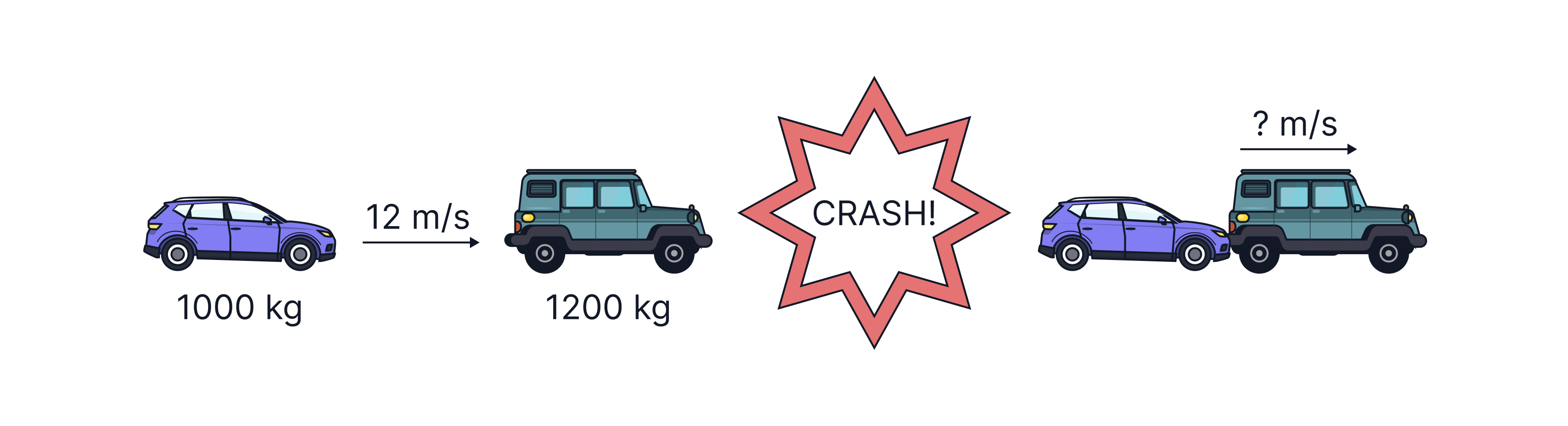
Example: A car with mass of skids on ice at a velocity of colliding with a stationary car of mass . They stick together and move off together. We can use conservation of momentum to calculate the speed of the cars after the collision.
Momentum of the moving car before the collision:
The car is stationary, so it has a momentum of before the collision.
The total momentum before the collision is , so the total momentum after the collision is .
Because the cars are stuck together, the combined mass is, ,
Objects Bouncing Apart:
Sometimes, when objects collide, they rebound from one another.
Example: On a pool table, the white ball, mass of , is moving at and collides with a stationary red ball, mass . After the collision the red ball moves off at . We can use conservation of momentum to calculate the white ball's speed after the collision.

The total momentum before the collision is the total of the momentum of the white ball and the red ball = . The momentum of the red ball before is zero as it is not moving, .
The total momentum before the collision is which equals the total momentum after the collision = ,
Worked Example:
Two cars collide head-on. Car X () is travelling right at before the collision and car Y () is travelling left at . They stick together after the collision and move off together. Calculate the velocity at which they move off together after the collision.

Answer:
First, we need to calculate the total momentum before the collision.
Don't forget that because the cars are travelling in different directions, one of the velocities is negative -> objects travelling to the left are usually given negative signs.
Total momentum before = total momentum after.
The cars stick together after the collision so the combined mass is ,
Worked Example:
Two carts are on a frictionless track. The silver cart () is moving to the right at . The green cart () is stationary. They collide and after the collision the green cart moves off at . Calculate the final velocity of the silver cart.

Answer:
First we need to calculate the total momentum before the collision. The total of teh momentum of the silver cart and the green cart, . Because the green cart is stationary, its momentum before is zero.
Total momentum before = total momentum after,
The velocity of the silver cart after is positive, telling us that it moves to the right at after the collision, in the same direction as the green cart.
Worked Example:
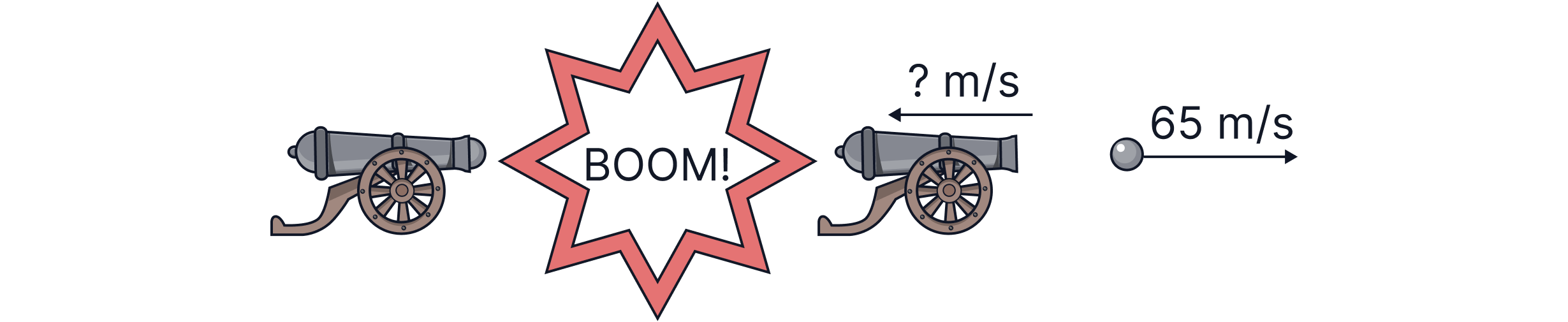
A cannon of mass fires a cannon ball of mass at a velocity of . Calculate the recoil velocity of the cannon.
Answer:
We know that the total momentum before the collision is as neither the cannon or cannonball are moving, so the total momentum after the collision must also be ,
The velocity of the cannon is negative, telling us that it moves in the opposite direction to the cannonball. If the cannonball moves forward, the cannon must be moving backwards, or to the left, as it has a negative sign. This is called recoil.
Practice Questions
Two stationary ice skaters push off each other on frictionless ice. Skater A (mass ) moves backwards at . Calculate the velocity of skater B (mass ) after the push.
-> Check out Hannah's video explanation for more help.
Answer:
A ball moving at to the right collides head-on with a ball moving at to the left. They stick together. Calculate their velocity after the collision.
-> Check out Hannah's video explanation for more help.
Answer: