Stopping Distances
Brook Edgar & Hannah Shuter
Teachers


Contents
Explainer Video
Stopping Distance
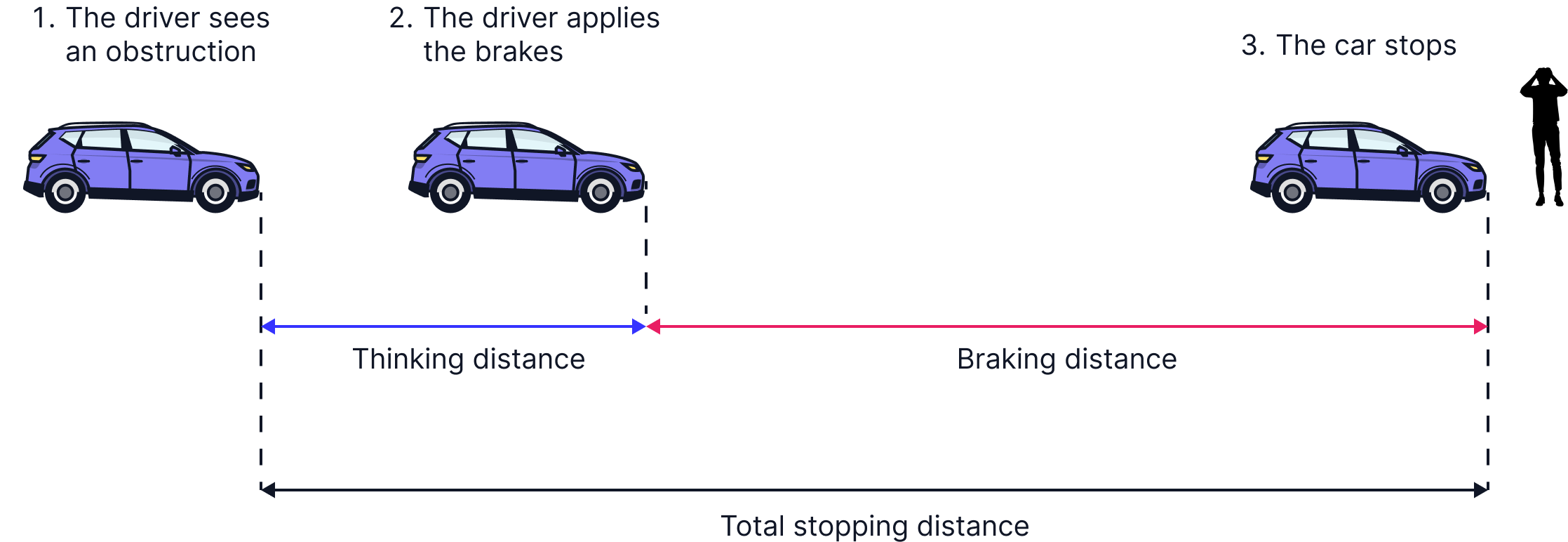
Stopping distance is the total distance a vehicle travels from the moment the driver sees a hazard until the vehicle comes to a complete stop.
The key thing to understand is that stopping distance is made up of two parts:
Let's break down what each of these means.
Thinking Distance
Thinking distance is the distance the car travels during the driver's reaction time. During this time, the car is still travelling at full speed because the brakes haven't been applied yet.
Think of it this way: you see a child run into the road, your brain processes this, decides you need to stop, and sends signals to your leg to move your foot to the brake. All of this takes time, and during that time, your car keeps moving at the same speed, so travels closer to the child.
We know that speed = distance time, which can be rearranged to, distance = speed time, which is written on our GCSE formula sheet as . Therefore:
If the car was travelling at , and the persons reaction time was ,
The car travels six metres before the brakes are even hit and the car begins to slow! This is a long distance, longer than the length of a room, which is why speed limits are reduced around schools.
Braking Distance
Braking distance is the distance the car travels from when the brakes are first applied until the car comes to a complete stop. During this time, the car is decelerating (slowing down). The car does not stop instantly when the brakes are applied; otherwise, you would fly out the window, so travels a short distance toward the child mentioned above while slowing down.
When you apply the brakes, friction between the brake pads and the wheels creates a force that opposes the car's motion. This friction force does work on the car, transferring kinetic energy from the car into thermal energy (heat) in the brakes. That's why brakes get hot when you use them.
If the car was travelling at as mentioned before, and decelerates at , we can calculate the braking distance using the equation .
Formula:
As the car comes to a complete stop, its final speed is , and as it is decelerating (slowing down) the acceleration is negative -> ,
The car travels before coming to a stop.
The total stopping distance of the car is then,
The car travels before coming to a complete stop from when the driver saw the child run onto the road. This is an extremely long distance, which is why driving at high speeds is dangerous.
Remember:
Thinking Distance: The distance a car travels during the driver's reaction time (before brakes are applied)
Braking Distance: The distance a car travels from when the brakes are applied to when it stops completely
Stopping Distance = thinking distance + braking distance
Worked Example:
A car of mass moving at decelerates and stops after .
Calculate the deceleration of the vehicle.
Estimate the braking force of the car.
Answer:
There are three equations to calculate acceleration, . The only equation we can use here is the acceleration equation that includes distance, the third equation, as we know the starting speed and the final speed.
Note: acceleration is negative as the object is not accelerating (getting faster), but decelerating (getting slower).
Note: the force is negative, as force is a vector, and the resultant force is opposing the direction of motion. The negative sign indicates the force is in the opposite direction to the car's motion.
Worked Example:
Calculate the stopping distance of the car using the graph below if initially travelling at .
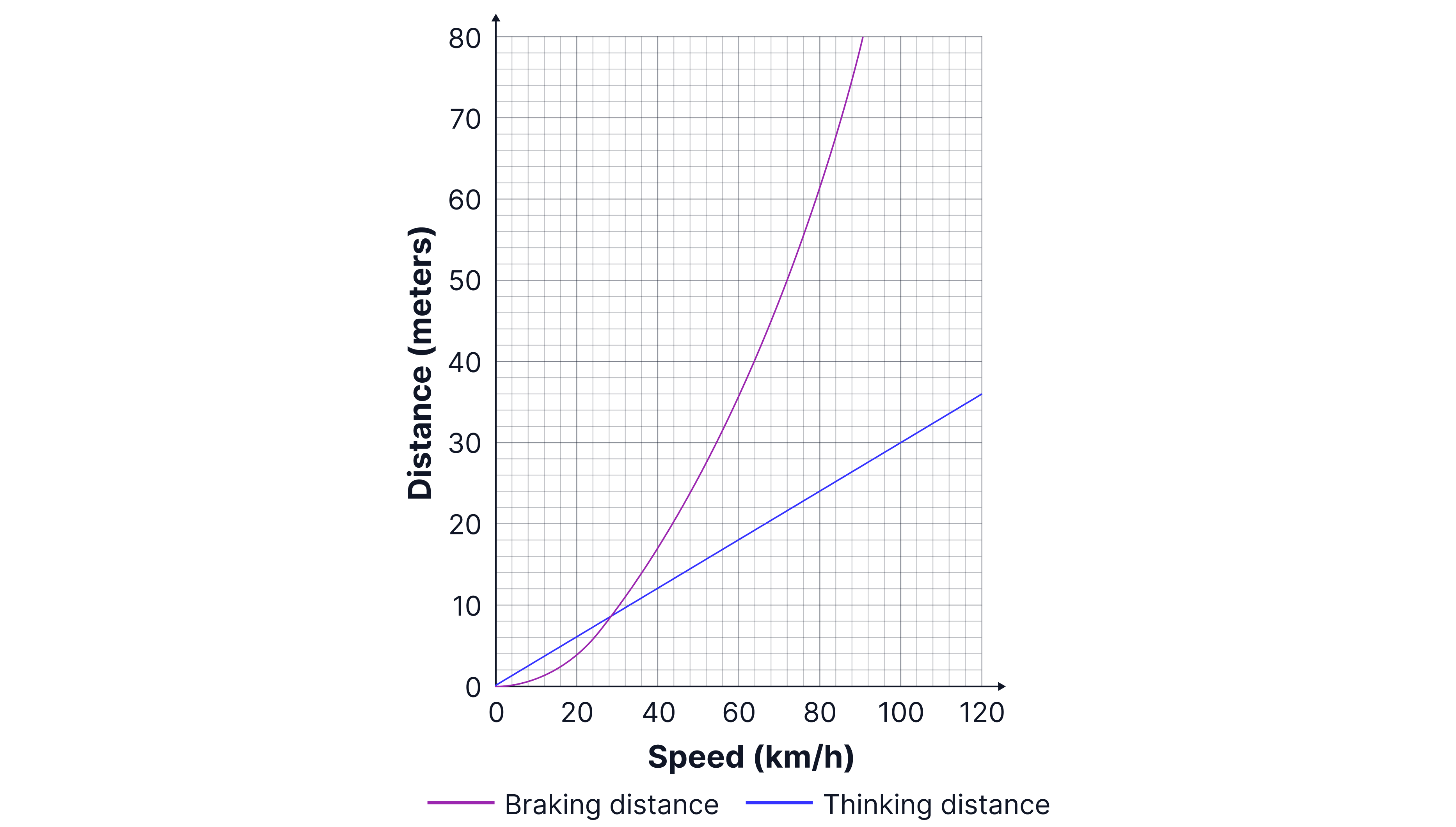
Answer:
Stopping distance = thinking distance + braking distance
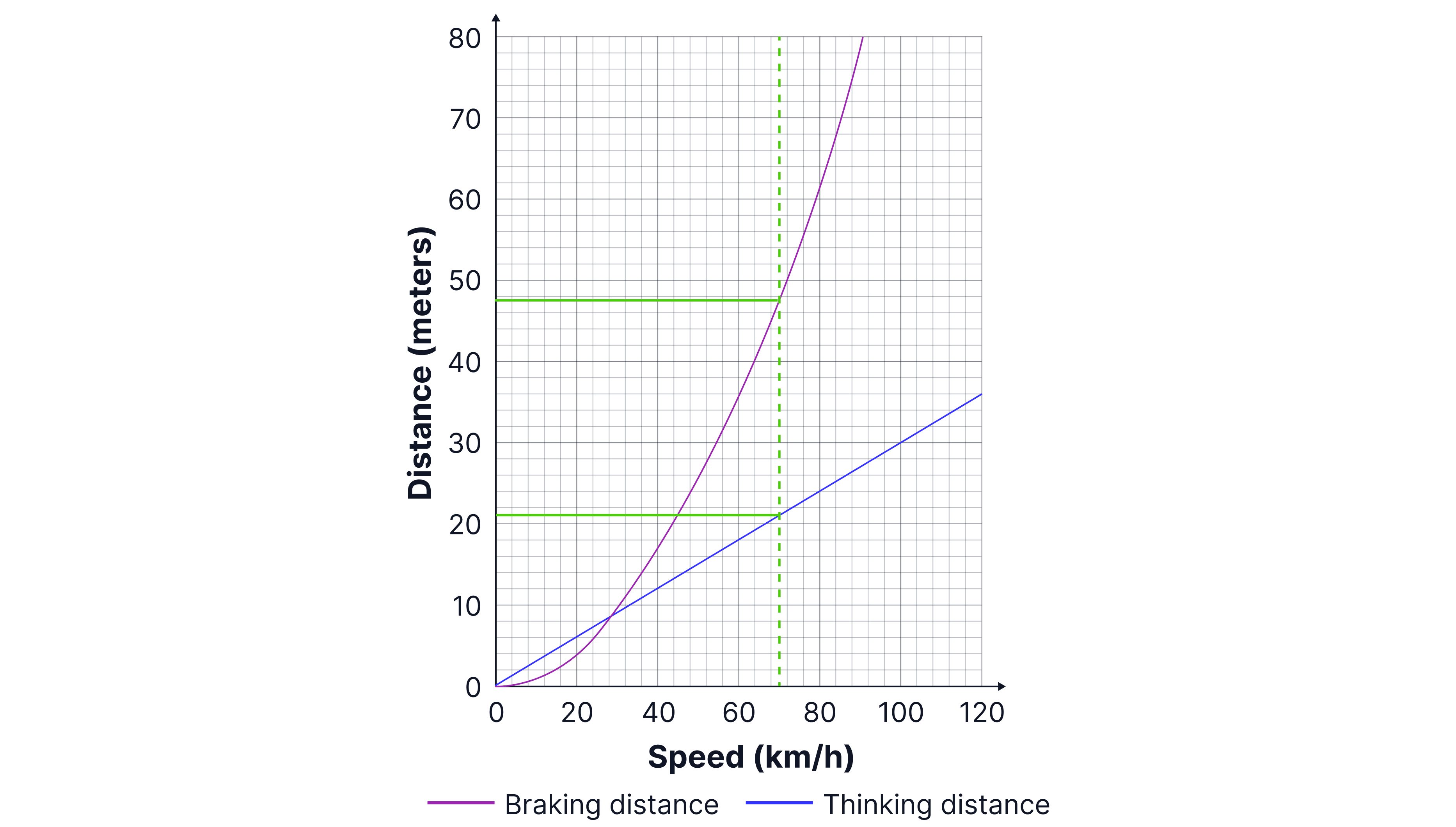
Find on the x-axis and draw a dotted line up at this value (shown by dotted green line above) use where it crosses the blue line to find the distance the car travels for the thinking distance, and the purple line to find the distance the car travels while braking.
Factors Affecting Stopping Distance
Factors that increase thinking distance:
Tiredness -> reduced reaction time (takes longer to respond)
Alcohol/drugs -> reduced reaction time
Distractions -> reduced reaction time
Speed -> higher speed means that you travel further for the same reaction time
Factors that increase braking distance:
Speed -> higher speed means the car travels further per second
Poor road conditions -> wet, icy roads have less friction, meaning it will take longer for the car to stop, resulting in significantly larger braking distances
Poor vehicle condition -> brakes or worn tyres means that it will take longer for the car to stop
Mass of vehicle -> heavier vehicles have more kinetic energy, , so more work done is required by friction to stop the car, resulting in larger braking distances for a given force ()
Road Safety
Understanding stopping distances has serious implications for road safety:
Drivers need to leave enough space between vehicles to account for their stopping distance at that speed. This is at least a second gap between you and the car in front.
In poor weather conditions (rain, ice, fog), stopping distances increase dramatically, so drivers should slow down and increase the gap to the vehicle in front.
Worn brakes or tyres are dangerous because they increase braking distance - you might not be able to stop in time to avoid a collision
Driving while tired, distracted, or under the influence of alcohol or drugs increases thinking distance, which means you travel further before you even start braking
The faster you're travelling, the worse all of these factors become, because both thinking and braking distances increase with speed
This is why speed limits exist and why they're lower in built-up areas, near schools, and in poor weather - to give drivers enough time and distance to stop safely if something unexpected happens.
Also, large decelerations can be dangerous for two main reasons. The brakes might overheat, or you might lose control of the car, causing it to skid
-> If you brake really hard (large deceleration), the brakes have to dissipate a huge amount of energy very quickly. This can cause them to overheat. When brakes overheat, they become less effective - this is called brake fade.
-> Very large braking forces can cause the wheels to lock up, especially on poor road surfaces. When the wheels lock, the tyres just skid along the road surface instead of rolling. Once you're skidding, you lose steering control - the car won't respond to turning the steering wheel because the tyres aren't gripping the road, they're just sliding.
Worked Example:
Speed affects the thinking distance and the braking distance of a car.
Explain the effect of two other factors on the braking distance of a car.
Answer:
Any two of the three points below:
poor condition of tyres or worn brakes causes decreased friction, resulting in longer braking distances
poor road surfaces, such as a wet or icy road, because there will be decreased friction between the car tyres and the road, resulting in increased braking distances
increased mass of car/passengers, which increases the kinetic energy of the car, so more work needs to be done to stop the car, resulting in increased stopping distances
Worked Example:
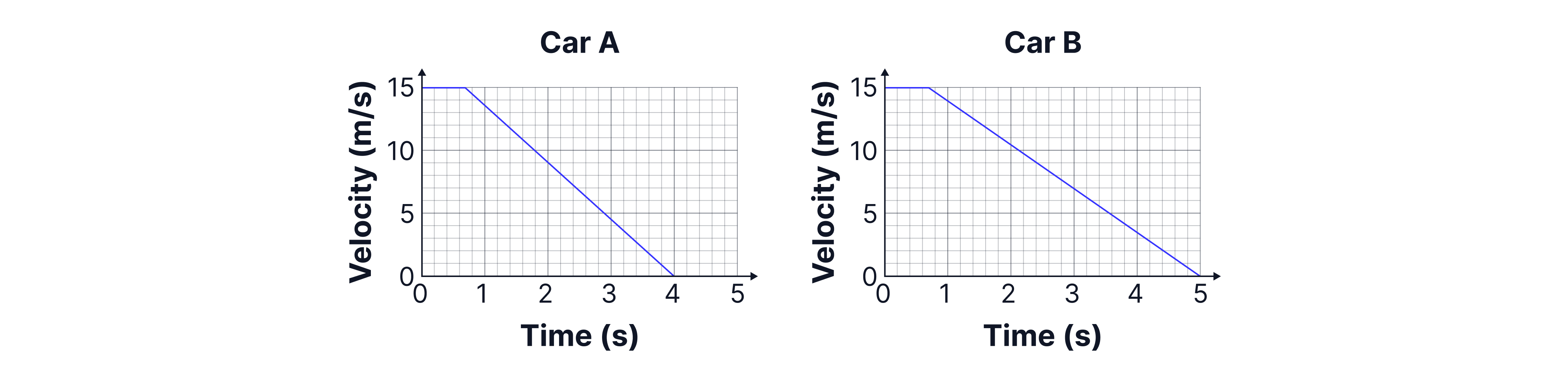
Both drivers of Cars A and B have reaction times of seconds. Calculate the stopping distances of both vehicles and thus suggest which car had a greater mass.
Answer:
stopping distance = thinking distance + braking distance
-> Thinking distance = speed x reaction time = (or area under v-t graph)
-> Braking distance for Car A = area under v-t graph =
-> Braking distance for Car B = area under v-t graph =
Stopping distance for Car A =
Stopping distance for Car B =
Car B has the greatest stopping distance so it must have a larger mass, as it will then have more kinetic energy, () so it will require more work done by friction to stop the car. Assuming the same braking force is applied, this is why a greater mass car will travel a further distance before stopping, ().
Teacher Tip: Remember that the area under a velocity-time graph gives the displacement or distance travelled in one direction.
Teacher Tip: You could find the braking distance of both cars in an alternative way -> calculate the gradient of the v-t graph to give acceleration, and use the equation, , knowing that the final speed is zero.
Worked Example:
Scientists investigated how the reaction time varies for drivers of different ages.
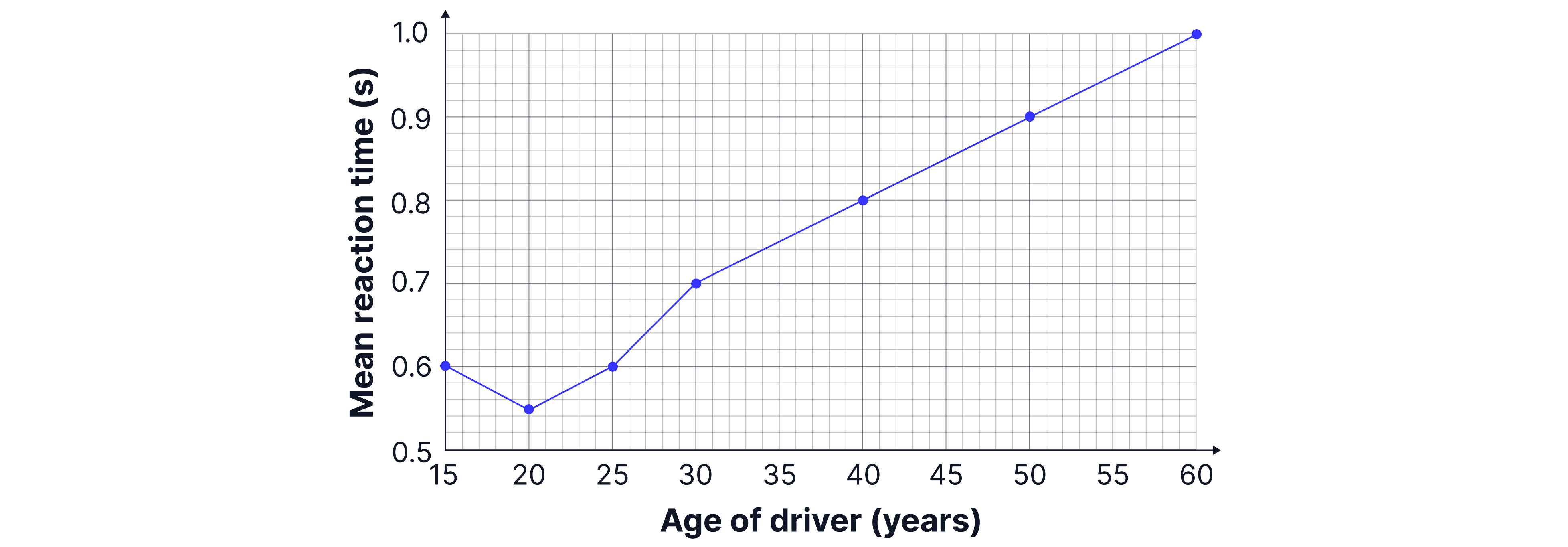
At what age did the drivers have the fastest mean reaction time?
What was the lowest mean reaction time?
When the brakes are applied, the kinetic energy of the car _______________ and the temperature of the brakes _______________.
A 30-year-old driver travelling at sees a red light and decides to hit the brakes, decelerating at a constant rate of . Using the graph and the information provided, calculate the stopping distance of the car.
Answer:
Twenty years of age has the fastest reaction time.
The lowest reaction time, at twenty years of age is .
When the brakes are applied, the kinetic energy of the car decreases, and the temperature of the brakes increases.
A 30-year-old has a reaction time of (found using the graph). Stopping distance = thinking distance + braking distance.
-> thinking distance = speed x reaction time =
-> braking distance is calculated using the initial speed, final speed, and deceleration, using the equation . Note, acceleration is negative as the car is not getting faster but slower.
Stopping distance =
Practice Questions
A car travels at . The driver’s reaction time is . The braking distance from this speed is .
Calculate the thinking distance.
Calculate the stopping distance.
Explain why the braking distance increases if the road is wet.
-> Check out Hannah's video explanation for more help.
Answer:
Less friction between the tyres and road surface. As a result, there is a smaller braking force and the car travels further before stopping.
The graph below shows how stopping distance varies with speed for a particular vehicle.
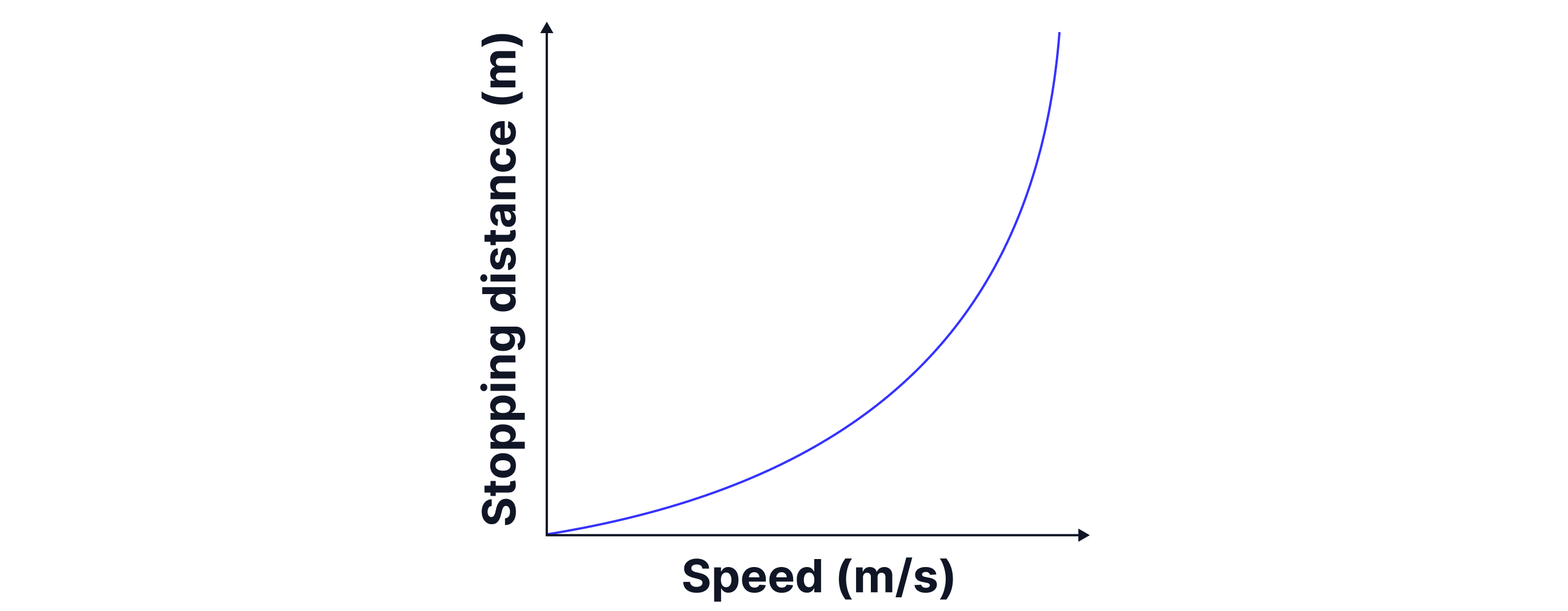
State the two components that make up the stopping distance.
Explain why the stopping distance increases more rapidly at higher speeds.
-> Check out Hannah's video explanation for more help.
Answer:
Thinking distance and braking distance
Braking distance increases with kinetic energy (and by extension, the square of speed ) because more work is required to be done by the brakes to remove this kinetic energy. Thinking distance also increases with speed, as thinking distance = speed x reaction time.