Reaction Time
Brook Edgar & Hannah Shuter
Teachers


Contents
Explainer Video
Reaction Time
Reaction time is the time it takes for a person to respond to a stimulus (a change enivronment). It's the delay between something happening (like seeing a hazard) and you actually reacting to it (like hitting the brakes on a car). Think of it as the processing time your brain needs to detect something, decide what to do, and then send signals to your muscles to act.
Reaction times vary from person to person, but the typical range from .
Several factors can increase your reaction time. If your reaction time has increased, it means you will take longer to respond to a change. Your reaction time is slower.
Tiredness/Fatigue: When you're tired, your brain processes information more slowly, so it takes longer to react. This is why there are many advertisements and road signs discouraging drivers from driving while tired, as the risk of an accident increases.
Drugs and Alcohol: These substances affect your nervous system and slow down your brain's ability to process information and send signals to your muscles. Even small amounts can significantly increase reaction time. This is why drink-driving is so dangerous! Some prescribed drugs/medications can cause drowsiness or affect concentration, slowing down your reaction time. This is why they will advise you not to drive while taking them.
Distractions: Anything that diverts your attention (using a phone, talking to passengers, adjusting the radio, eating) means you're not fully focused on the road. Your brain has to switch attention before it can process the hazard and react. Your reaction time is slower.
Old Age: Reaction times generally get slower as people age.
The Ruler Drop Test
This is a simple practical method you could do to measure reaction time.
Method:
Person A holds a ruler vertically, with the zero end at the bottom.
Person B places their thumb and finger on either side of the ruler, level with the zero mark, but not touching it.
Person A drops the ruler without warning.
Person B catches the ruler as quickly as possible when they see it start to fall.
Record the measurement on the ruler where Person B caught it - this distance tells you information about their reaction time*.
Repeat the test several times and calculate a mean to improve reliability.

*The further the ruler falls before being caught, the slower the person's reaction time.
Worked Example:
A pupil holds a 30 cm ruler then let’s go. The second pupil closes her hand as soon as she sees it drop, stopping the ruler. The further the ruler falls before being stopped, the slower her reaction time.
The pupil dropping the ruler always holds the ruler at the same distance above the other’s hand. What type of variable is this?
Describe how we could adapt this experiment to see if listening to music affects reaction time.
Answer:
Control variable
To test if listening to music affects reaction time:
First, measure reaction time by measuring where the second pupil catches the ruler without music (control/baseline) - repeat three times
Then measure reaction time by measuring where the second pupil catches the ruler while listening to music - repeat three times
Compare the mean reaction times
If the mean reaction time increases with music, it suggests music is a distraction that increases reaction time.
Reaction time while driving
Reaction time is crucial when driving because it determines your thinking distance -> how far the car travels before you hit the brakes. If you are driving at a constant speed of and see a cat run across the road, your car is still moving during the time it takes you to react and actually hit the brakes. If you have a reaction time of , your car is moving at a constant speed of for seconds, before it starts to slow down when you actually hit the brake.
Calculating Thinking Distance
This is just the equation from the data sheet, where time is the reaction time.
More on this on the Stopping Distances page, up next.
Practice Questions
A class uses the ruler-drop method to measure reaction time.
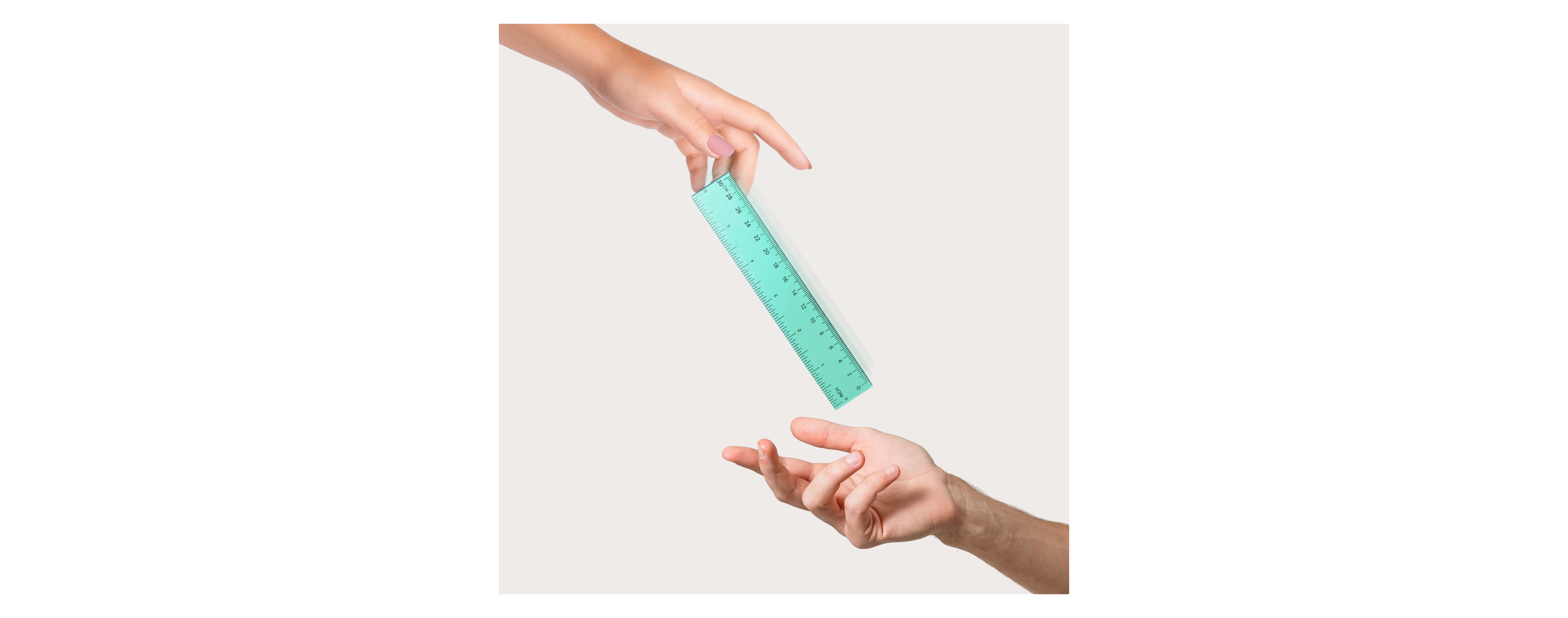
In this method, one student holds a ruler vertically with the zero at the bottom. A second student places their thumb and first finger just below the zero mark. Without warning, the first student releases the ruler and the second student closes their fingers to catch it. The distance the ruler falls is recorded.
Explain how this method can be used to measure reaction time.
State the typical range of human reaction times.
-> Check out Brook's video explanation for more help.
Answer:
Distance fallen on the ruler is used to calculate the time it takes for the student to react. The bigger the distance before the ruler is caught, the longer the reaction time.
Any number between to is accepted, for example, seconds.
A driver is travelling at a constant speed of . Her reaction time is . Calculate the thinking distance of the car.
-> Check out Brook's video explanation for more help.
Answer: