Expanding Universe
(Triple Only)
Brook Edgar & Hannah Shuter
Teachers


Explainer Video
Big Bang Theory
The Big Bang theory suggests that the universe originated from a very small, hot, and dense region that expanded quickly. Space, matter, and time were all created in the Big Bang. If the Big Bang occurred, radiation should be left over from it. Think of a hot oven cooling down. We can still feel the heat coming off it -> IR radiation. The radiation doesn’t come from an explosion but from the oven being hot in the first place.
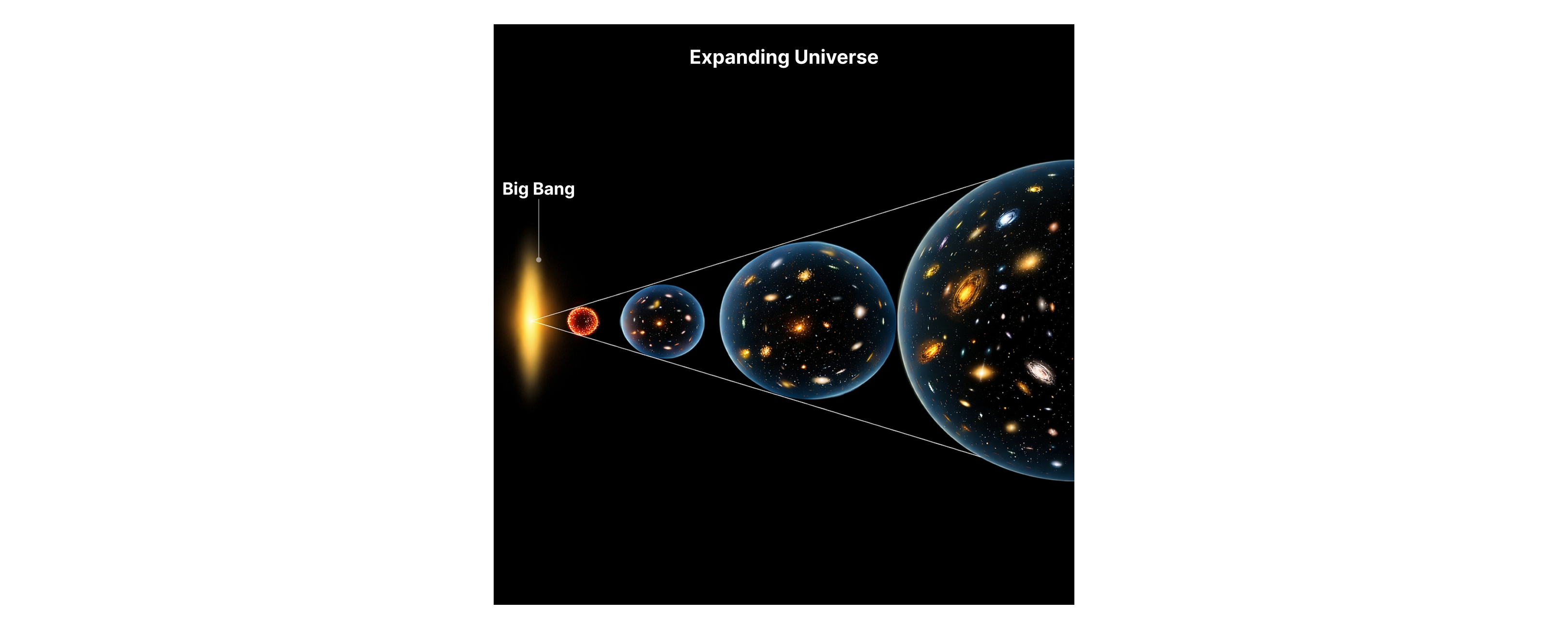
If we can detect the predicted leftover radiation, it will be evidence for the Big Bang. Penzias and Wilson were awarded a Nobel Prize in physics for the discovery of this radiation. They noticed a persistent microwave signal coming from all directions in space. This signal was unexpected, and they thought there might be a problem, even cleaning pigeon poop off the antenna in case it was the cause. However, even after cleaning, the signal remained, so they realised it was a cosmic signal. This signal is known as the CMBR -> cosmic microwave background radiation, as the radiation lies in the microwave region of the EM spectrum.

It is important to note that the CMBR is not radiation from a Big Bang explosion but rather radiation left over from a hot early universe. The wavelength has increased due to redshift (see below) as the universe expanded.
Redshift
Edwin Hubble was an astronomer (a scientist who studies the universe) who observed that light coming from distant galaxies was shifted towards the red end of the spectrum. This means that the light has shifted to longer wavelengths, as red is the longest wavelength of visible light.
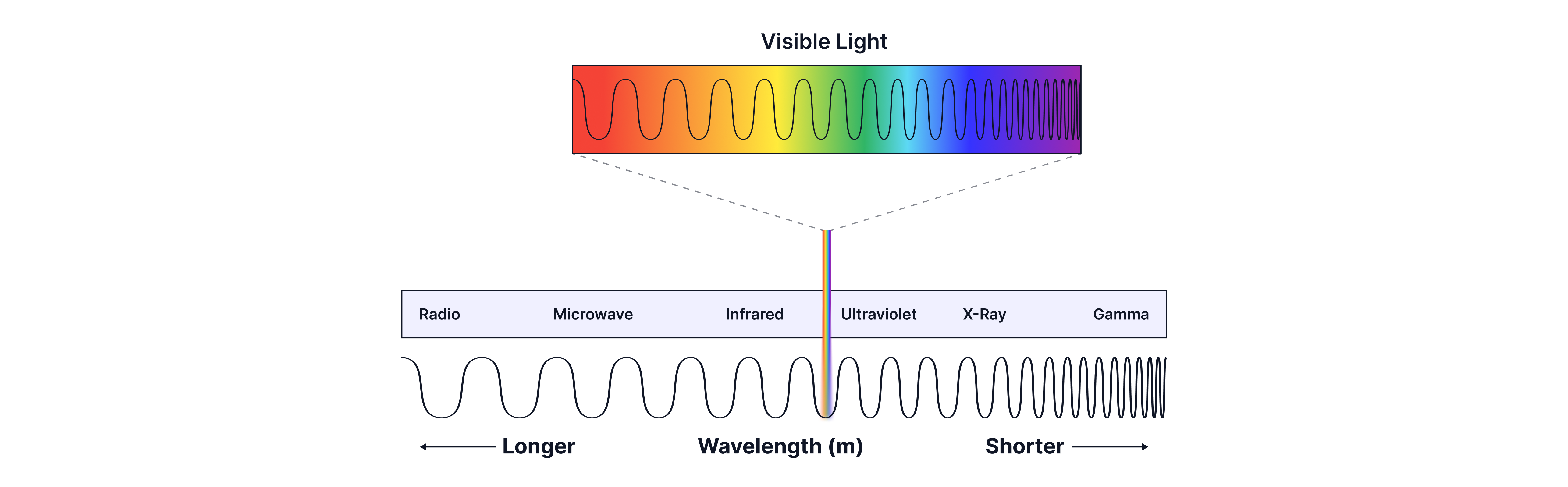
This is now known as cosmological redshift. It tells us that the universe is expanding.
If the universe was not expanding, the distance between a distant galaxy (where light is emitted from) and us remains the same, therefore the wavelength of light remains the same. But as the universe expands, the distance between us and the distant object increases; the light then has further to travel, so its wavelength is stretched. The wavelength increases to longer wavelengths -> it has been redshifted. It does not mean that the light is red, but that the wavelength of the light has increased. It was also observed that the further away a galaxy is, the more redshifted the light is. Showing that objects further away from us are travelling away from us faster -> further proof of the Big Bang.
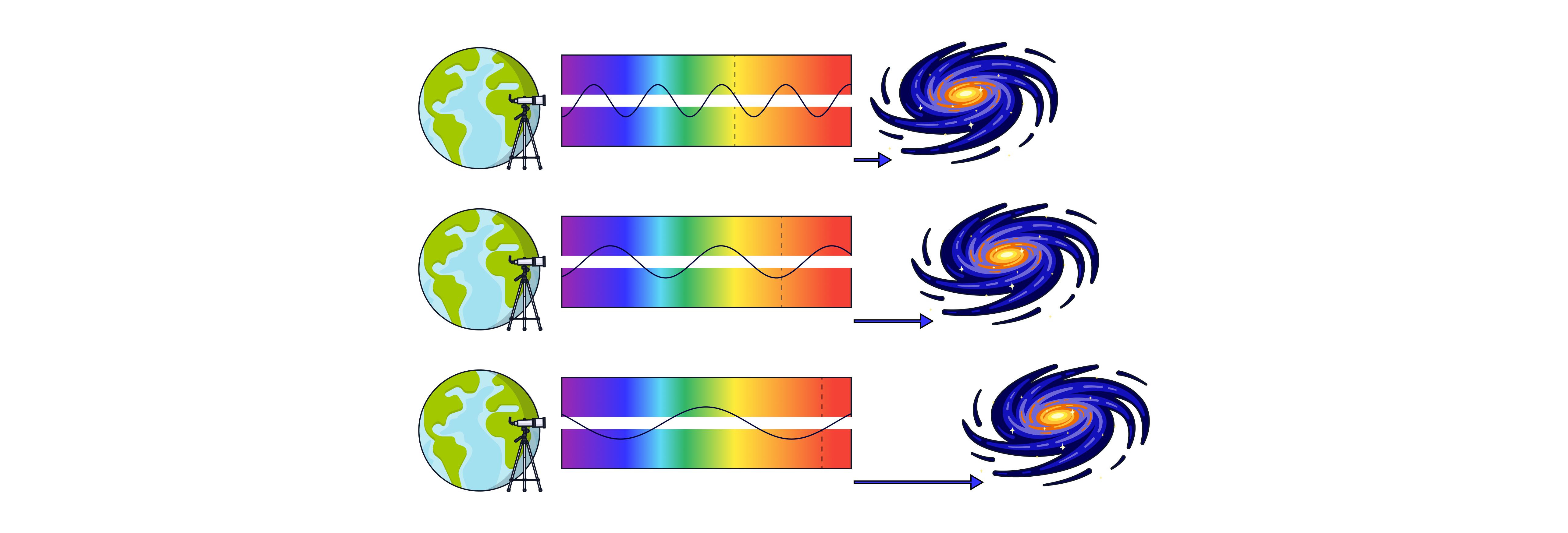
Most objects in the universe are redshifted - they are moving away from us, but there are some objects in the universe where the light is blueshifted. For example, light from the Andromeda Galaxy, the closest large galaxy to our Galaxy (the Milky Way), is blueshifted. This means that the Andromeda Galaxy is moving towards us, as the distance between us and the galaxy has decreased since the light was first emitted, so the wavelength of light is squished into a smaller distance. The light's wavelength has decreased, and since blue light has the shortest wavelength in the visible spectrum, we say the light is blueshifted.

Light from supernovae, distant stars that explode, is dimmer than we expect given their distances. This suggests that these exploding stars are further away than previously thought, suggesting that the universe is not expanding at a uniform rate but is accelerating. This led to the introduction of dark energy - a mysterious form of energy thought to be driving this expansion.
Worked Example:
The spectra from stars and galaxies show dark lines at specific wavelengths.
What can you conclude about the two galaxies shown?

Answer:
The light from both galaxies is shifted to longer wavelengths than that from the Sun, so the light is redshifted. This tells us that both galaxies are moving away from us. The light from galaxy A is more redshifted than the light from galaxy B, so galaxy A is further away than galaxy B and is travelling faster away from us.
Blackbody
The Sun can be modelled as a blackbody. A perfect blackbody is an object that absorbs all of the radiation that falls on it; it does not reflect or transmit any.
A perfect absorber is also a perfect emitter. Remember that black objects are the best absorbers and emitters of IR radiation, and shiny white objects are the best reflectors. All objects absorb and emit radiation, but the hotter the object is, the more IR it emits. The temperature of a body is related to the balance between the radiation it absorbs and the radiation it emits.
The Sun emits all wavelengths of light across the electromagnetic spectrum. The Earth's atmosphere blocks the most harmful radiation, such as gamma rays, but allows others, like visible light, to pass through so we can see.
Short-wavelength infrared (IR) radiation from the Sun passes through the atmosphere, is absorbed by the Earth's surface, and is then re-emitted as longer-wavelength IR radiation back into space. Carbon dioxide () in the atmosphere absorbs some of this reflected IR radiation and re-emits it back toward the Earth, keeping the planet warm enough to support life. This process is similar to a greenhouse, where glass traps heat: the glass absorbs and re-emits IR radiation back inside, keeping the greenhouse warmer.
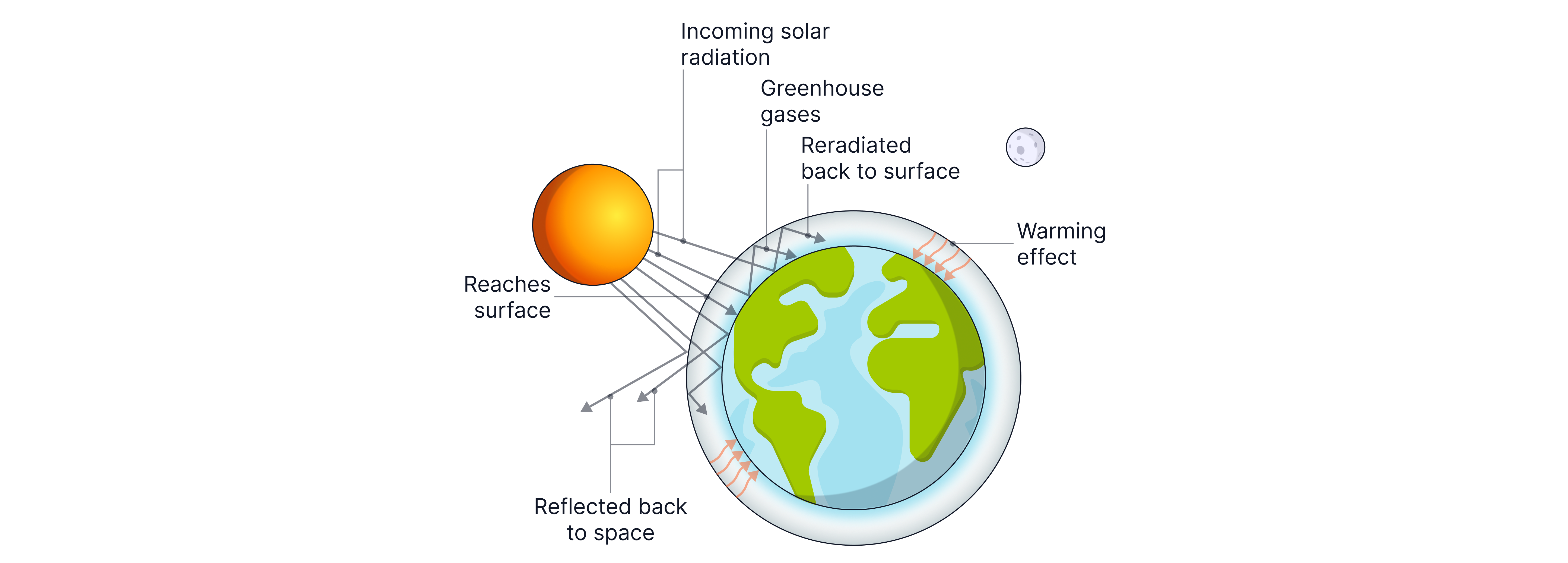
The problem is that levels have increased over the years due to human activities, such as the burning of fossil fuels in cars and machinery. This means more IR radiation is trapped than being emitted, and Earth's temperature is rising. The consequences of this include melting polar ice caps, rising sea levels, and climate change affecting us and animal migration patterns. This phenomenon is known as global warming.
Worked Eaxmple:
Describe how the rate of emission of IR compares between the Sun and the Earth.
Answer:
The Sun has a greater rate of emission of IR than the Earth as it is at a higher temperature.
Practice Questions
Explain how red-shift provides evidence for the Big Bang model.
-> Check out Brook's video explanation for more help.
Answer:
Redshift is an increase in the observed wavelength of light from a source, suggesting it is moving away from us.
Redshift shows almost all galaxies around us are moving away from us.
Reversing this motion suggests the universe started from a very small, dense, hot region.
Astronomers studying supernovae in distant galaxies have found that those galaxies have a higher redshift than expected. Suggest why scientists think dark energy exists.
-> Check out Brook's video explanation for more help.
Answer:
Distant galaxies show larger redshifts than we expected, meaning they are receding faster than we thought.
This pattern indicates that space itself is stretching, so the universe is expanding at an accelerating rate
Something must be driving this acceleration
A new, unknown form of energy (dark energy) is proposed to account for this