Fission and Fusion
(Triple Only)
Brook Edgar & Hannah Shuter
Teachers


Explainer Video
Nuclear Fission
Nuclear fission occurs when a large, unstable nucleus (usually uranium or plutonium) splits into two smaller nuclei, called fission fragments or daughter nuclei. This process also releases two or three neutrons and a large amount of energy (often energy is released as gamma rays).
Fission rarely happens on its own. It is normally induced (made to happen) when an unstable nucleus absorbs a neutron, making it so unstable that it splits. Below we can see that when absorbs a neutron, its mass increases by one, becoming which then splits into two lighter nuclei and three neutrons.

The neutrons released can then be absorbed by other nearby unstable nuclei, causing them to split as well. This is called a chain reaction. If the chain reaction is not controlled, the number of fission events increases rapidly, leading to a nuclear explosion. In a nuclear reactor, control rods absorb excess neutrons to keep the chain reaction steady.
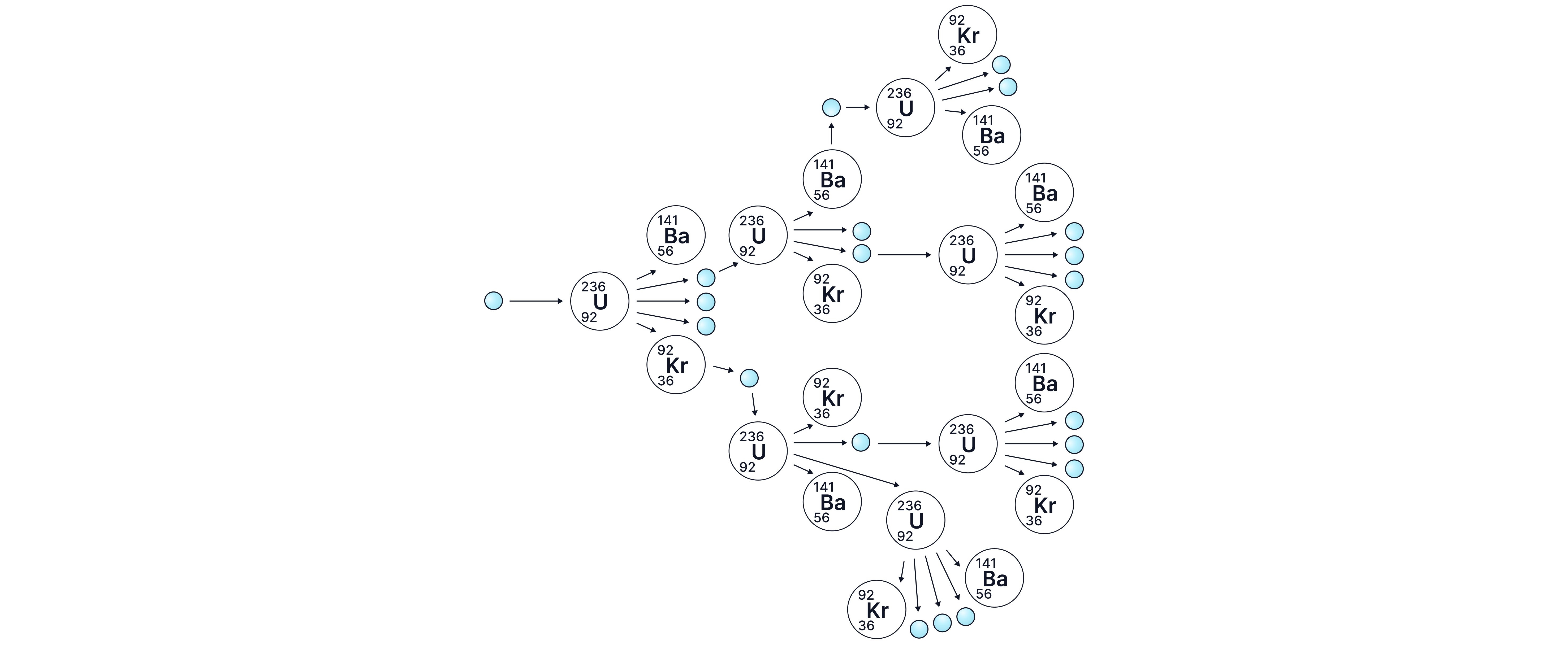
A lot of the released energy comes out as kinetic energy of the daughter nuclei. They move quickly and collide often, increasing the thermal energy in a nuclear reactor. In a nuclear power station, this energy is used to heat water, producing steam that spins turbines, which then drives a generator to produce electricity.
Advantages of nuclear fission include:
No carbon dioxide is produced in the nuclear reaction, so it does not contribute to global warming during operation.
Very large amounts of energy can be generated from small amounts of fuel. Much more energy is released per kilogram of fuel than in fossil fuel power stations.
Reliable power, capable of supplying consistent energy and responding to changes in demand.
Disadvantages of nuclear fission include:
Very expensive to build (commission) and dismantle (decommission) nuclear power stations.
The daughter nuclei are radioactive, and this nuclear waste remains hazardous for long periods and must be stored safely, buried deep underground.
Accidents, while rare, can have serious environmental and health impacts.
Worked Example:
Describe how nuclear fission in uranium leads to the generation of electricity in a nuclear power station. Refer to the kinetic energy of the products and how it is used.
Answer:
When an unstable uranium nucleus absorbs a neutron, it becomes more unstable and splits into two daughter nuclei, releasing neutrons and gamma radiation. The daughter nuclei and neutrons have high kinetic energy, which is transferred to the surroundings as thermal energy. This thermal energy heats water to produce steam, which spins turbines connected to a generator, producing electricity.
Worked Example:
A student learns that nuclear fission releases two or three neutrons.
Explain how this leads to a chain reaction.
Describe what would happen if the chain reaction were not controlled.
Answers:
The neutrons released in fission can be absorbed by other unstable nuclei, causing them to split. This repeated process is a chain reaction.
If the chain reaction was not controlled, the number of fission events would increase rapidly, releasing huge amounts of energy and potentially causing a nuclear explosion.
Nuclear Fusion
Nuclear fusion is the process that powers stars, including our Sun. In fusion, two light nuclei join (fuse) together to form a heavier nucleus. In the Sun, for example, hydrogen nuclei fuse to form helium.

When fusion happens, the mass of the new, larger nucleus is slightly less than the total mass of the original nuclei. This “missing” mass has been converted into energy. This is why fusion releases very large amounts of energy, much more energy per kilogram of fuel than nuclear fission.
However, fusion is extremely difficult to achieve on Earth. Both nuclei are positively charged (due to the protons inside the nucleus), so they repel each other. To overcome this repulsion, fusion requires very high temperatures and pressures, like those found in the cores of stars. These conditions are hard to create and maintain in a reactor on Earth.
Although scientists are researching fusion as a future energy source, we cannot yet use nuclear fusion as a practical fuel on Earth.
Summary
Feature | Nuclear Fission | Nuclear Fusion |
What happens | A large, unstable nucleus (uranium or plutonium) splits into two smaller nuclei, releasing neutrons and energy. | Two lighter nuclei fuse together to form a heavier nucleus, releasing energy. |
Where it occurs naturally | Does not occur naturally; induced using a neutron in reactors or nuclear bombs. | Occurs naturally in stars, including the Sun. |
Energy released | Large amount of energy. | Much more energy per kg of fuel than fission. |
Conditions required | Due to the gamma rays emitted, the reactor should be shielded in lead or concrete with control rods to prevent a chain reaction from occurring. | Requires extremely high temperatures and pressures to overcome repulsion between positive nuclei. |
Current use on Earth | Used in nuclear power stations and in nuclear bombs. | Not yet used as a practical energy source - still experimental. |
Products | Radioactive daughter nuclei (nuclear waste) and neutrons. | No radioactive waste (but neutrons can be released). |
Environmental impact | No CO₂ from the reaction, but produces long-lived radioactive waste. | No CO₂ and minimal radioactive waste. |
Worked Example:
Describe what happens during nuclear fusion.
Explain why nuclear fusion releases energy.
Answer:
Light nuclei join to form a heavier nucleus with some mass converted to energy; fusion occurs in stars such as the Sun.
The mass of the larger fused nucleus is less than the total mass of the original nuclei, and this “missing” mass is converted into energy.
Worked Example:
Nuclear fusion releases more energy per kilogram of fuel than nuclear fission, yet fusion is not currently used in power stations on Earth. Explain why.
Answer:
Both nuclei in fusion are positively charged and repel each other.
Fusion requires extremely high temperatures and pressures to overcome this repulsion.
These conditions occur naturally in stars but are very difficult and costly to achieve and maintain on Earth.
Fusion reactors are still experimental and not yet able to produce energy reliably for practical use.
Practice Questions
The process of nuclear fission is used in nuclear power stations.
The figure below shows the process of nuclear fission
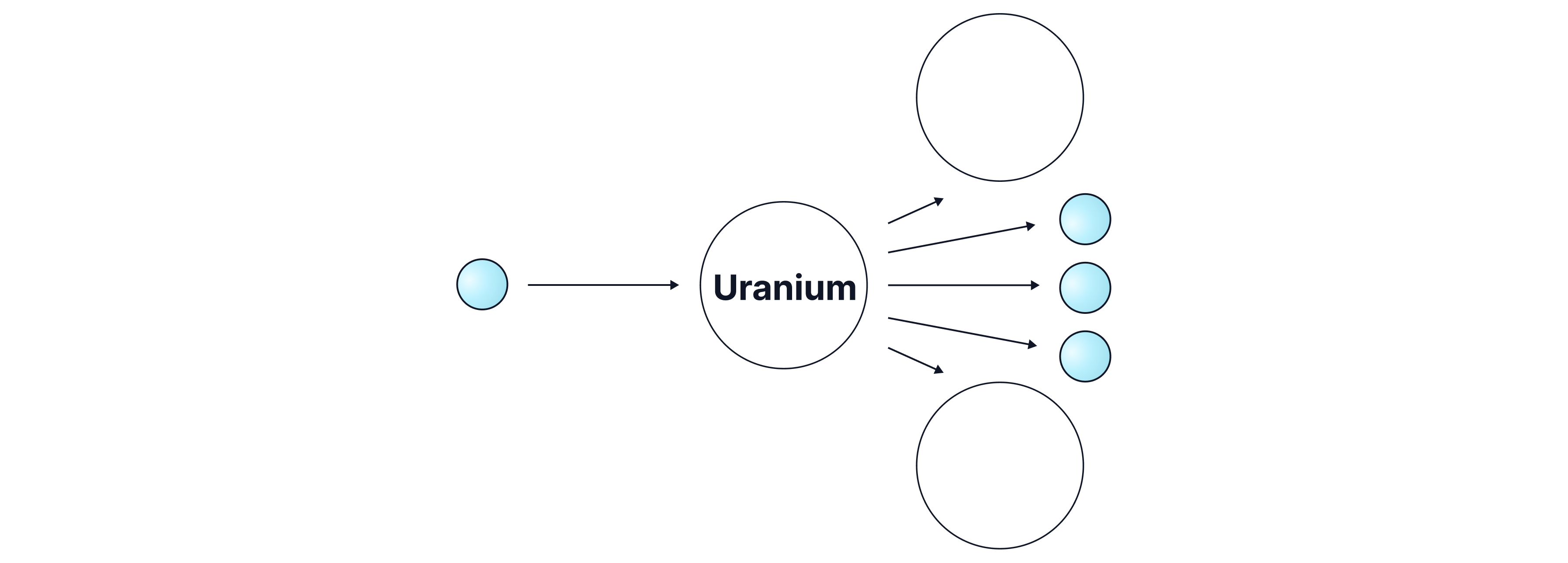
Complete the sentences:
In nuclear power stations, energy is released from uranium _________________________.
The uranium in the above figure splits into two parts and releases three __________________.
The process of nuclear fission releases electromagnetic radiation in the form of _______________________ rays.
-> Check out Brook's video explanation for more help.
Answer:
nuclei, neutrons, gamma
A neutron is absorbed by a large unstable uranium nucleus, causing it to undergo nuclear fission.
State what happens to the uranium nucleus immediately after absorbing the neutron.
Explain how a chain reaction can occur in a fission process.
In a nuclear reactor, fission must be controlled. Explain why.
-> Check out Hannah's video explanation for more help.
Answer:
It becomes unstable and splits into two smaller nuclei.
The neutrons released by one fission event can be absorbed by other nuclei, causing them to undergo further fission.
If uncontrolled, the number of fission reactions increases rapidly. This would release dangerous amounts of energy, similar to a nuclear explosion.