Background Radiation and Uses of Radiation
Brook Edgar & Hannah Shuter
Teachers


Explainer Video
Background Radiation
Background radiation is all around us, coming from a variety of natural and artificial sources, including:
Rocks and soil
Radon gas
Cosmic rays
Nuclear waste
Medical procedures, such as X-rays and CT scans
Although background radiation is always present, the levels we typically encounter are low and not harmful. However, certain professions, such as airline pilots and cabin crew, are exposed to higher levels because they spend long periods at high altitudes where cosmic radiation is stronger. Their radiation dose is monitored with dosimeters/film badges, and if their exposure exceeds a set annual limit, they are not permitted to fly for the remainder of the year.
Radiation dose is measured in sieverts (). Because one sievert is a very large dose, everyday exposures are usually expressed in millisieverts (). In the UK, the average background radiation dose is (millisieverts) per year = per year. You do not need to remember this for the exam.
Worked Example:
The average background radiation dose in the UK is per year.
A cabin crew member receives in a year due to increased exposure from cosmic rays at high altitude.
How many times more radiation does the cabin crew member receive compared to the UK average?
Answer:
We need to divide the cabin crew dose by the average background dose:
The cabin crew member receives times more radiation than the average person in the UK.
Worked Example:
An airline pilot receives a radiation dose of in one year. Convert this dose into sieverts.
Answer:
We need to divide by to convert millisieverts into sieverts:
Uses of Radiation
We use radioactive isotopes (different atoms of the same element, with different numbers of neutrons) for a range of uses, especially in medicine. We particularly use them for:
exploration of internal organs (radioactive tracers)
control or destruction of unwanted tissue (radiotherapy)
Radioactive Tracers
Radiation can be used to see inside the body and diagnose medical problems. One common method is the use of gamma rays in a technique called medical imaging.
A patient is given a radioactive tracer, usually by swallowing, injection, or inhalation. This tracer emits gamma radiation, which can pass out of the body due to its high penetration and be detected by a gamma camera. The amount of radiation emitted from different parts of the body indicates how the tracer is moving or accumulating in organs.
Doctors use these images to check how well organs are working, to spot blockages, or to detect tumours. Gamma rays are used because they are very penetrating but only weakly ionising. The image below shows where most gamma rays are emitted, highlighting these regions in different colours.

Radioactive tracers must be chosen carefully. If the half-life is too long, the radioactive isotope will remain in the patient’s body for a long time, exposing the patient to an unnecessarily high radiation dose. However, if the half-life is too short, the isotope may decay before useful images can be taken. Therefore, medical tracers typically use isotopes with a short half-life: long enough to produce clear results, but short enough that the patient does not stay radioactive for longer than necessary.
Radiotherapy
Radiation can deliver large amounts of energy to cells, causing damage that can kill them. This property is useful in medicine, where radiation is used to destroy unwanted or harmful cells, such as cancerous tumours. This treatment is known as radiotherapy.
External radiotherapy - A machine outside the body directs beams of gamma rays or X-rays at the tumour. The radioactive source used in the machine needs a long half-life, so it does not need frequent replacement and can provide a steady, reliable output.

Internal radiotherapy - A small radioactive source is placed inside the body, close to or within the tumour. Here, an isotope with a short half-life is used so that it delivers a high dose to the cancer cells but becomes inactive quickly. This reduces the risk of damaging nearby healthy tissue and lowers the patient’s overall radiation exposure.
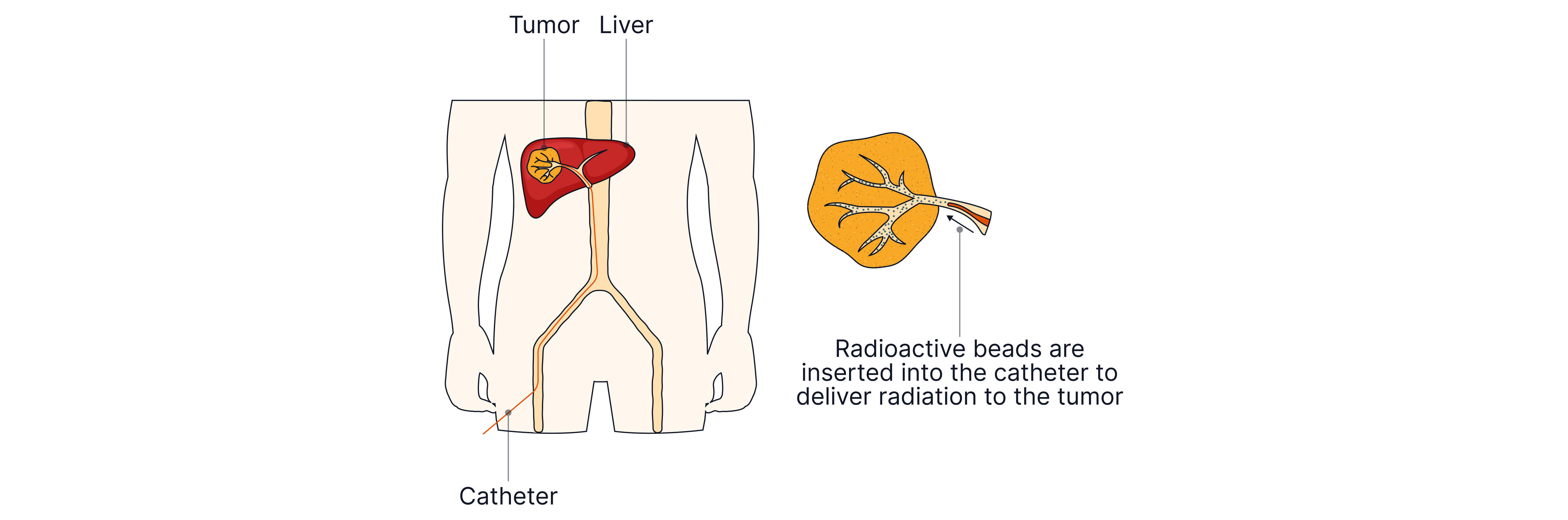
Both radioactive tracers and radiotherapy carry the risk of damaging nearby healthy cells, because ionising radiation can cause mutations or cell death. In some cases, this could even lead to secondary health problems. For this reason, these techniques are only used when the benefits outweigh the risks, and doses are kept as low as possible while still providing useful medical information or effective treatment.
Worked Example:
A hospital is choosing between two isotopes for use as a radioactive tracer:
Isotope A has a half-life of hours.
Isotope B has a half-life of days.
Which isotope is more suitable for medical imaging inside the body? Explain your answer.
Answer:
Isotope A is more suitable because its short half-life minimises the patient’s radiation exposure while still allowing time for effective imaging.
Worked Example:
A patient needs radiotherapy to treat a tumour. The doctor must decide whether to use external radiotherapy or internal radiotherapy.
Explain which method would use a radioactive source with a long half-life.
Answer:
External radiotherapy uses a long half-life isotope, so that the source inside the machine does not have to be replaced often and will produce a stable radiation output. Internal radiotherapy does not use a long half-life, as this exposes the patient to radiation for a long time, increasing the risk to the patient.
Practice Questions
Gamma radiation is commonly used as a medical tracer to show the function of internal organs.
State one property of gamma radiation that makes it suitable for use as a medical tracer.
Explain why alpha radiation cannot be used as a medical tracer.
State one factor doctors must consider when choosing an isotope for tracer use.
-> Check out Hannah's video explanation for more help.
Answer:
It is highly penetrating, so it can easily pass out of the body and be detected.
Alpha radiation has a very short range and cannot get through paper, so it cannot escape the body to reach an external detector. It is also highly ionising and would cause too much damage inside the body, such as cell mutations leading to cancer.
It should have a short half-life so the patient is not exposed to radiation for long.
A hospital uses radiation to treat cancerous tumours.
State the type of radiation most commonly used in radiotherapy.
Explain why this type of radiation is suitable for destroying tumour cells.
Describe one risk associated with using radiation to treat cancer.
-> Check out Hannah's video explanation for more help.
Answer:
Gamma radiation.
Gamma radiation is highly penetrating, allowing it to reach tumours deep inside the body. It carries enough energy to damage or kill cancer cells by ionising their DNA.
Healthy cells may also be damaged, increasing the risk of side effects or secondary cancers.