Generator effect/induced potential
(Triple Only)
Brook Edgar & Hannah Shuter
Teachers


Contents
Explainer Video
Generators
We use generators to generate electricity.
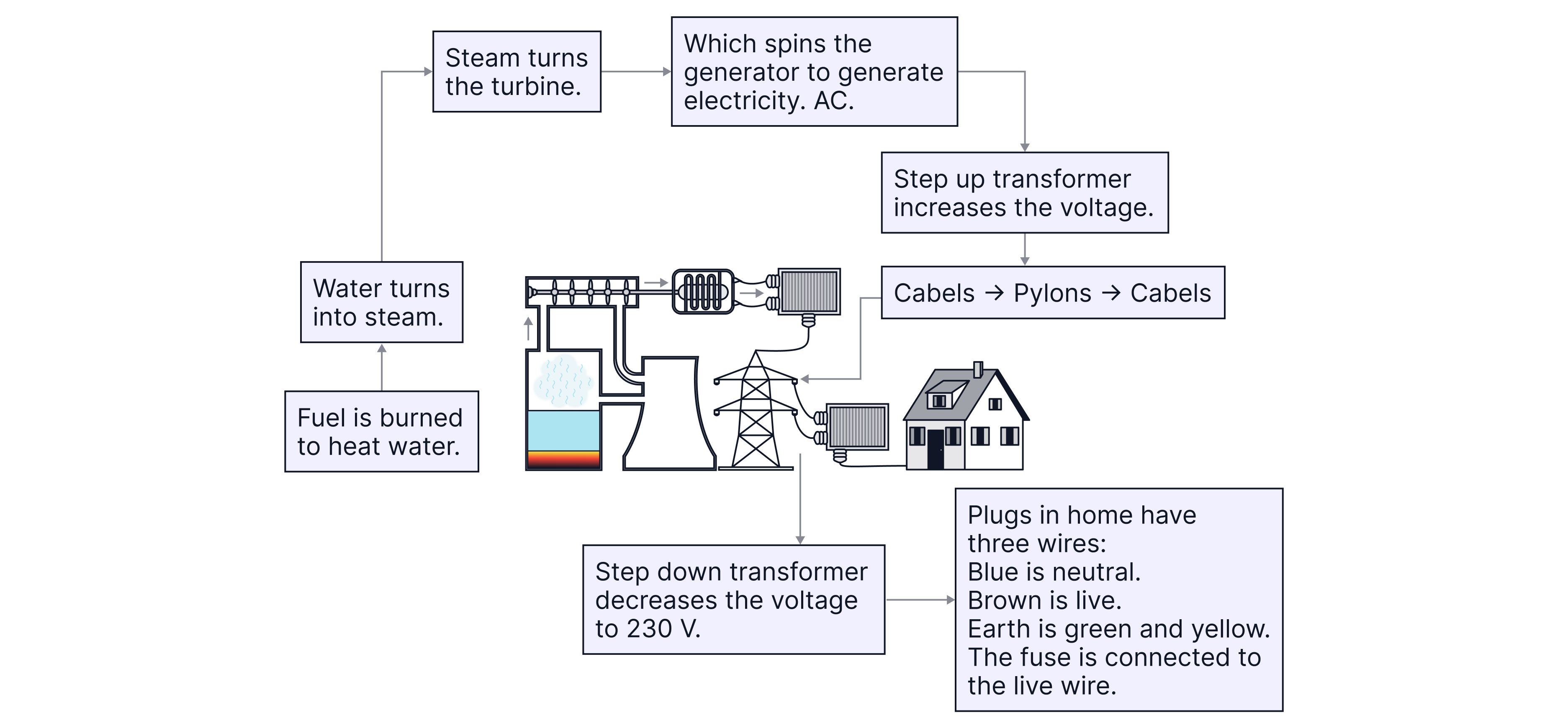
We previously learned about them in the context of energy, as they are used in power stations. As a reminder, the diagram below depicts a fossil-fuel power station that burns fuels such as natural gas. The heat from burning fuel is used to produce steam from water, which is then used to spin a turbine connected to a generator, producing electricity that is transmitted via cables nationwide to homes.
Generators operate when the rotating turbine causes a magnet inside the generator to rotate. The magnet is surrounded by a coil of wire. The magnet's magnetic field passes through the conductor (the coil of wire), inducing a potential difference between its ends. When the circuit is complete, current flows (more on this below).
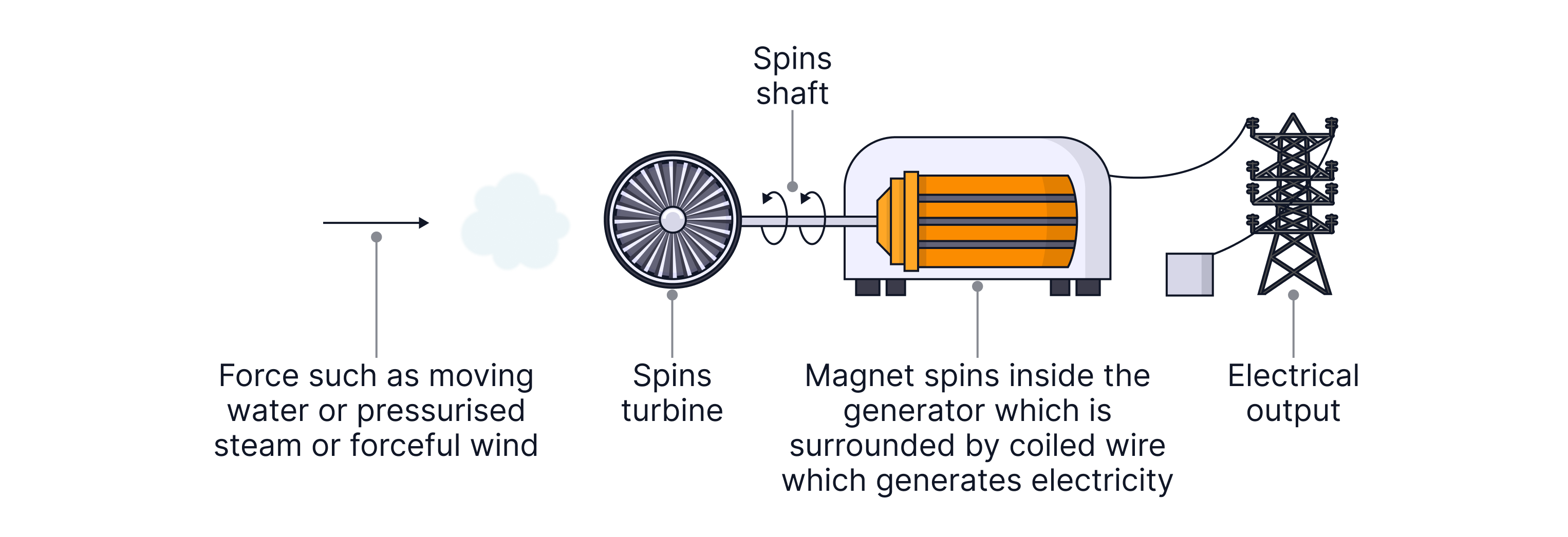
Remember: This is also how wind turbines, hydroelectric power stations and nuclear power stations work. Either the wind turns a turbine connected to a generator, or the downward-flowing water turns a turbine connected to a generator, or the steam produced in a nuclear power station by fission turns a turbine connected to a generator to generate electricity.
Generator Effect
In the motor effect, we learned that a current-carrying coil of wire placed in a magnetic field experiences a force that moves it. The opposite is true for the generator effect -> a coil of wire made to move through a magnetic field gets a potential difference induced across its ends, causing current to flow if the circuit is complete.
Motor effect -> current-carrying wire -> placed in a magnetic field -> force/moves
Generator effect -> moving coil of wire -> placed in a magnetic field -> pd induced (current if circuit is complete)
It does not matter whether the coil of wire moves or the magnet moves; as long as the magnetic field lines from the magnet cross the conductor, a potential difference is induced (we get a current if the circuit is complete). This is known as the generator effect. It has many applications, including the use in power stations to generate electricity.
Alternator
The pd induced is alternating -> the pd changes direction, as shown below:
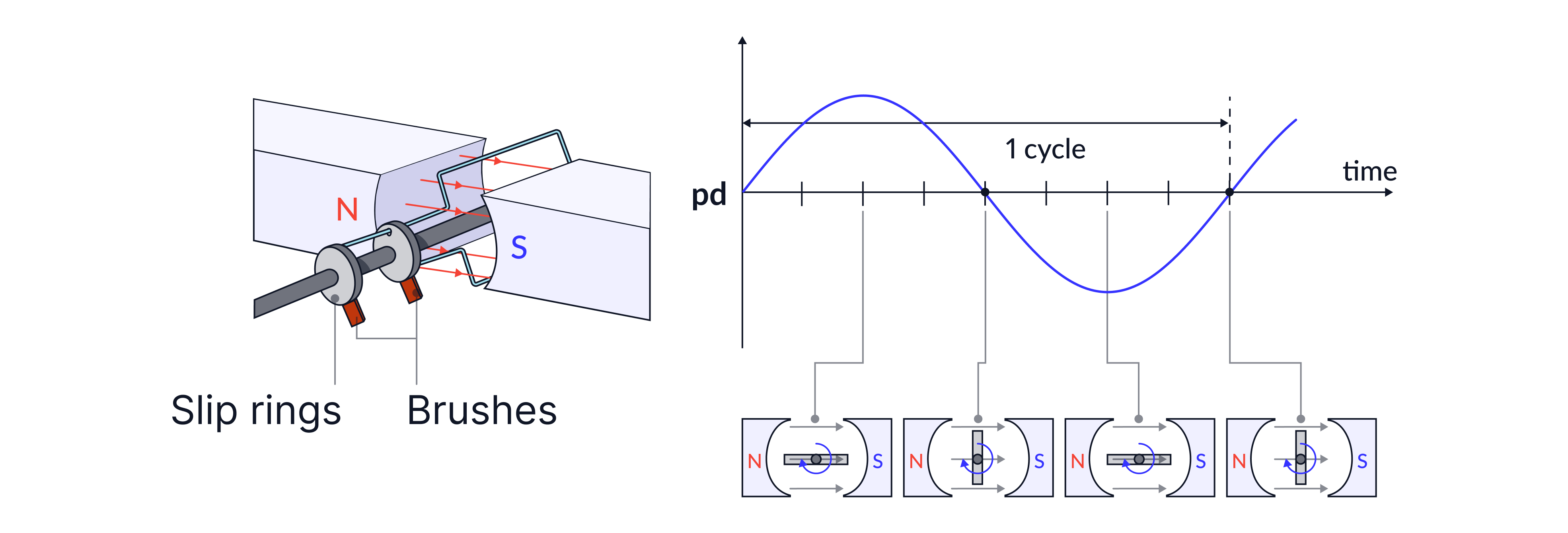
As the rotating wire cuts through the magnetic field lines of the permanent magnet, a potential difference is induced between its ends. First in one direction, then in the other, as the wire rotates through . Most devices in our homes operate on AC (alternating current), so this is very useful.
Dynamo
However, direct current (DC) is sometimes required. A Dynamo uses the generator effect to produce DC. As the coil rotates, it is connected to a split-ring commutator that changes connections every half-turn; instead of an AC output that reverses direction, the split-ring commutator gives a DC output that travels in the same direction.
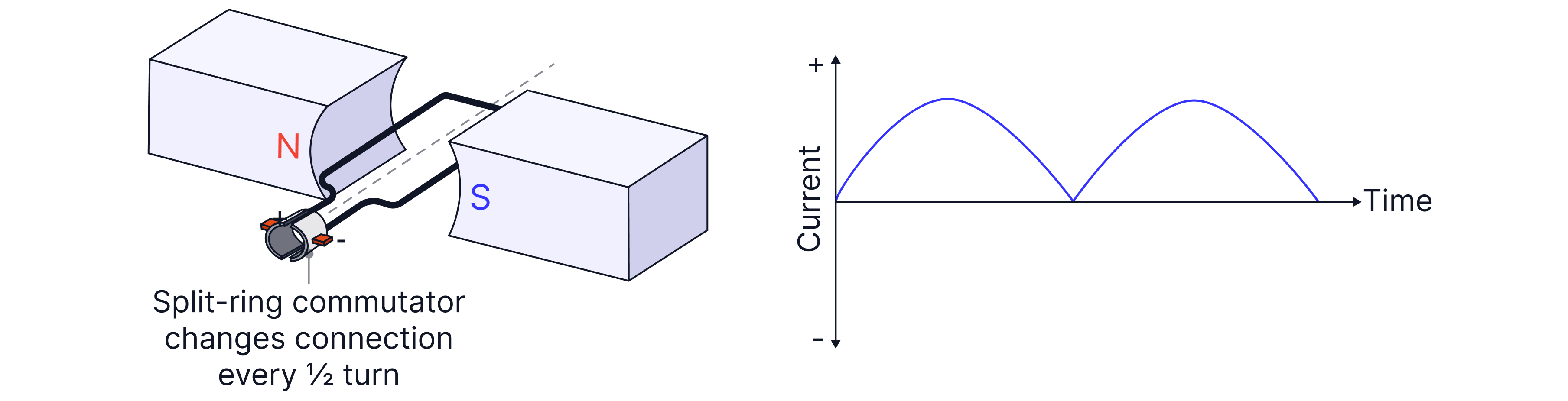
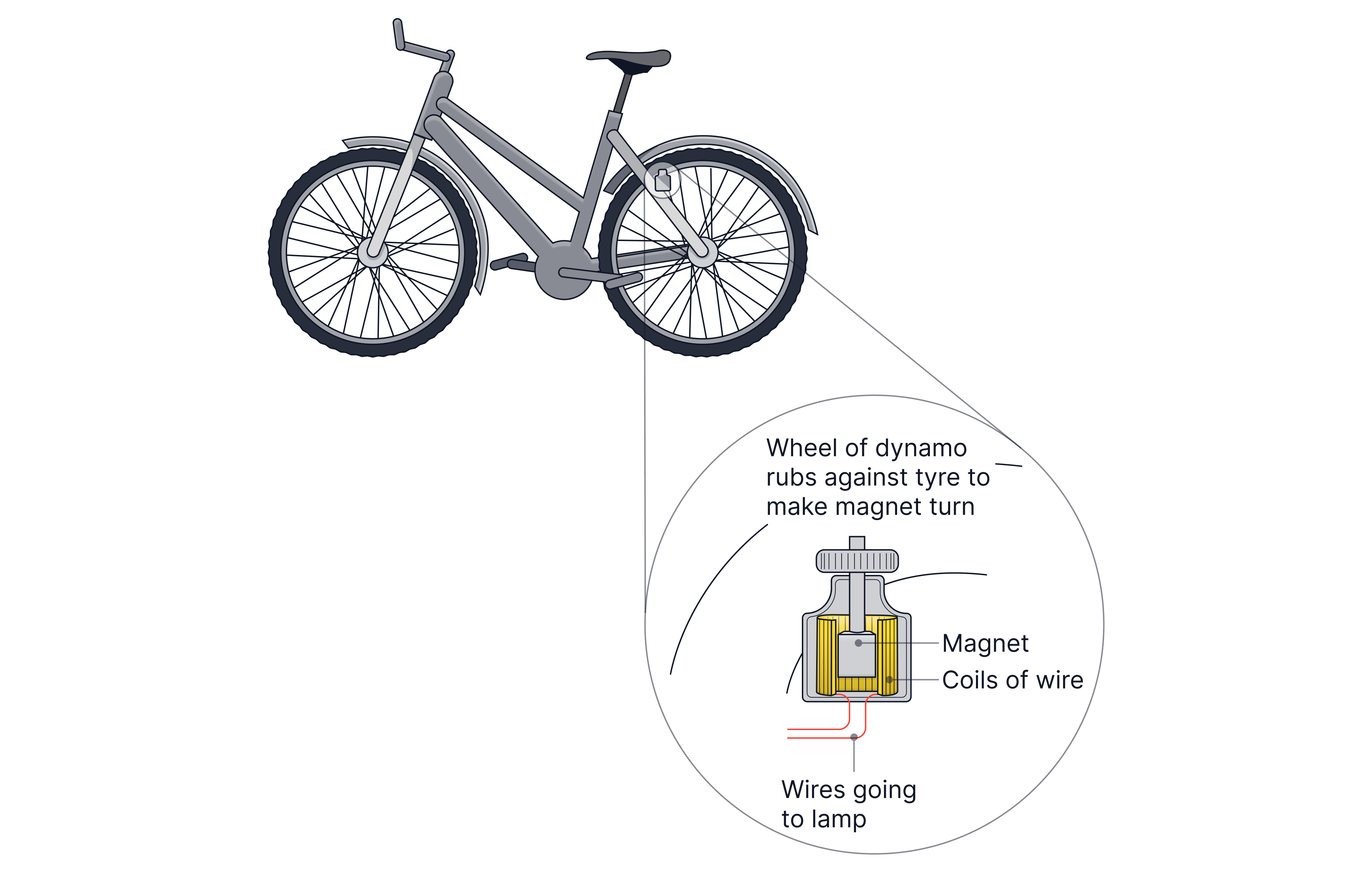
Bicycles use dynamos to power the lights on your bike. They use the bicycle's rotating wheel to rotate a magnet that is surrounded by a coil of wire. A pd is induced in the coil of wire that powers the lights.
We can increase the size of the pd induced by using a stronger magnet, moving the magnet faster, or using more turns of wire on the coil.
Energy is not free
Electricity is not generated from nothing; we must do work to generate it.
If we can generate electricity in a coil of wire by moving a magnet through the coil, work must be done. If the north pole of a magnet is pushed into the coil of wire, a pd is induced in the coil and as the circuit is complete the now current-carrying coil of wire generates its own magnetic field to oppose this change. The coil of wire creates a magnetic field with a north pole at the end of the coil facing the incoming magnet, repelling it and opposing its motion. Work must then be done to push the magnet into the coil.

We can see the same applies below. When a magnet is pulled out of a coil of wire, a pd is induced in the wire, and the coil generates a magnetic field as current flows through it to oppose the change. If the north pole of the magnet is moved out, the coil generates a magnetic field with a south pole at that end, attracting the magnet back -> to oppose its motion. Work must then be done to pull the magnet out of the coil.

Worked Example:

As the bar magnet is moved into the coil of wire, what happens in the coil?
Now that current flows in the wire, what does the wire generate?
State what type of pole the coil will have at the side facing the incoming magnet.
Answer:
A pd is induced in the coil as the magnetic field lines of the magnet cross the conductor. Because the coil of wire is a complete loop, a current is induced, causing the ammeter to register a reading.
When current flows in a wire, a magnetic field is produced around the wire.
To oppose the incoming north pole of the magnet, the coil will generate a magnetic field with a north pole at the end facing the magnet to repel it.
Worked Example:
A dynamo is used to generate an electric current in a lamp.
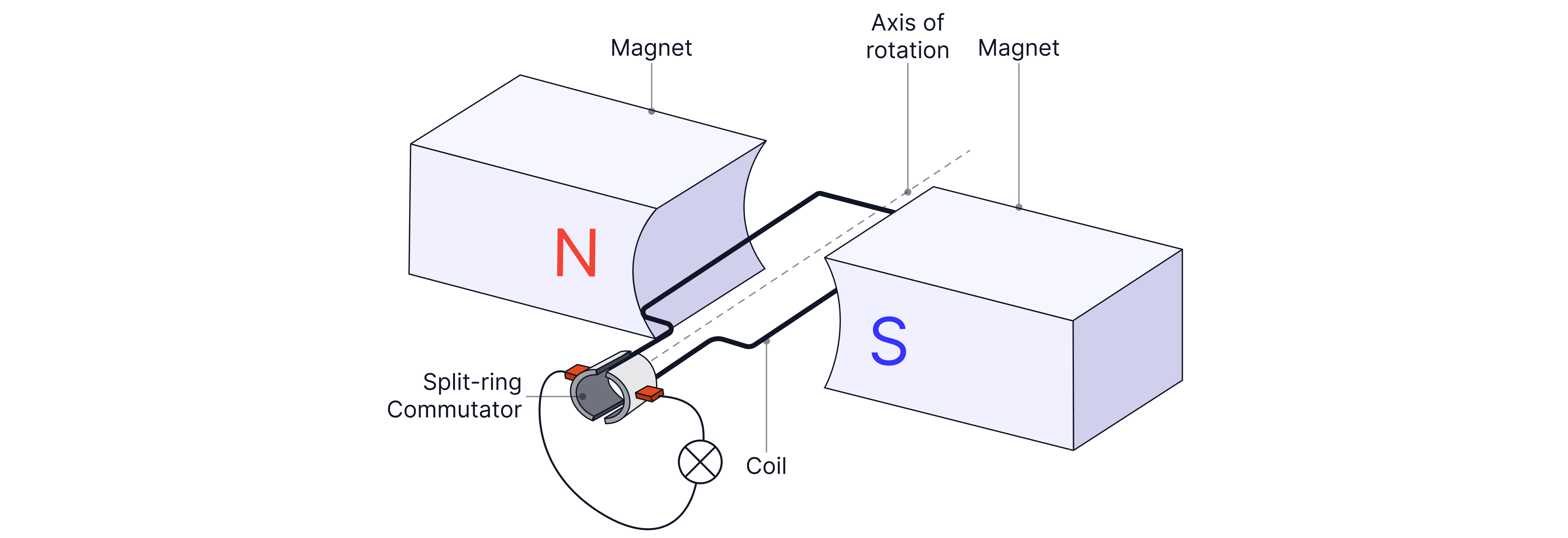
Explain why a direct current is induced in the coil.
Explain why the coil is easier to turn when the lamp is disconnected.
Answer:
As the coil moves through the magnetic field, a potential difference is induced across it. As there is a complete circuit, a current flows through the wire powering the lamp. The split-ring commutator changes connection every half turn to keep the current flowing in the same direction.
When current flows through the wires, a magnetic field is created around the wires; this magnetic field opposes the movement of the coil. If the lamp is disconnected, there is no current, and thus no magnetic field to oppose the coil's rotation.
Practice Questions
A conductor moves in a magnetic field and a p.d. is induced across its ends.
State two factors that affect the size of the induced potential difference produced by the generator effect.
The conductor is part of a complete circuit. Explain why the induced current acts to oppose the motion of the conductor.
-> Check out Hannah's video explanation for more help.
Answer:
If we change the strength of the magnetic field or if we change the speed of movement or the number of turns in the coil (any one).
Induced current produces its own magnetic field. This magnetic field opposes the change that caused it.
Describe how the generator effect is different from the motor effect.
-> Check out Brook's video explanation for more help.
Answer:
The generator effect uses moving parts to generate electricity.
The motor effect uses electricity to exert a force on a wire, causing it to move.
The generator effect uses a moving magnetic field around a conductor to induce a potential difference acorss it ends.
The motor effect uses a magnetic field to exert a force on a loop of current-carrying wire, causing it to spin.