Motor Effect
Brook Edgar & Hannah Shuter
Teachers


Contents
Explainer Video
Fleming's Left-Hand Rule
We already know that when current flows through a wire, a magnetic field is produced around the wire. When that wire is placed between the poles of a permanent magnet, the two magnetic fields cross each other, creating a force on the wire.
The direction of the force on the wire can be found using Fleming's left-hand rule. You stick your thumb up on your left hand, point your first finger out like you are pointing a gun and then stick your second finger out at right angles to your first finger, as shown below.

thumb = direction of force
first finger/index finger = direction of magnetic field (N -> S)
second finger = direction of current (conventional current, + -> -)
We can use Fleming's left-hand rule to determine the direction of the force on the wire shown below. Remember, in exams, your paper will be on your desk flat, so be sure to keep this in mind and ensure your screen is flat on your desk when trying these questions; otherwise, you will get different answers. If your screen is down flat on the table your first finger on our left hand should be pointing to the right, from the north pole to the south pole, and our second finger should be pointing down the page (to the bottom of the page), as the current is going this way (from the positive terminal of the battery to the negative), resulting in your thumb pointing upwards/out of the screen/out of the page in your exam.

Worked Example:
Looking at the image below, state the direction of force on the wire.

Answer:
With the screen flat on your desk, your first finger on our left hand should be pointing to the left, from the north pole to the south pole, and our second finger should be pointing down the page, as the current is going this way (from the positive terminal of the battery, the longer side, to the negative), resulting in your thumb pointing towards the ground. This direction is into the page in your exam.
Worked Example:
Looking at the image below, state the direction of force on the wire.

Answer:
Your first finger on our left hand should be pointing from the north pole to the south pole, and our second finger should be pointing to the right, as the current is going this way, resulting in your thumb pointing down, as shown below.

Calculating Force on a Current-Carrying Wire
We can calculate the size of this force on the wire, as well as its direction, using the equation below.
Formula:
Magnetic Flux Density
Magnetic Flux Density is measured in Teslas (). It is a measure of the strength of a magnetic field. The more magnetic field lines passing through an area, the stronger the magnetic field.

Current
The current flowing through a wire is measured in amps using an ammeter.
As an example if a current of flows through a wire of length that is placed between the poles of a permanent magnet with strength we can calculate the force on the wire using the equation, .
Worked Example:
A current carrying wire of length with a current of flowing through it is placed in a magnetic field with a flux density of . Calculate the force on the wire.
Answer:
Don't forget your unit conversions!
Teacher Tip: Remember a millipede has legs so there are inside Therefore there are .
Worked Example:
Calculate the magnetic flux density when:
Force =
Wire length =
Current =
Answer:
Convert values to the correct units!
Simplify the equation and rearrange to find B.
Worked Example:
A copper bar, length , mass , carries of current. Calculate the minimum value of flux density of the magnetic field in which it should be placed if its weight is to be supported by the magnetic force. Use .
Answer:
Here they are pulling on knowledge from other topics. We know to find the magnetic flux density, we use the equation, .
First we fill in what we know,
To find , the magnetic flux density, we need to know the force on the wire. In the question, we are given the mass of the wire and the value of g. We know that the only equation with these two terms in it is, . We can therefore calculate the wire's weight, which equals the upward force on the wire due to the magnetic field in which it is placed. Since it is not moving, the forces are balanced.
Now we can use this force in our first equation,
Motor Effect
We learned that when a wire has current flowing through it, it produces a magnetic field, and when this wire is placed between the poles of a permanent magnet, the magnetic field lines cross, producing a force on the wire whose direction can be found using Fleming's left-hand rule.
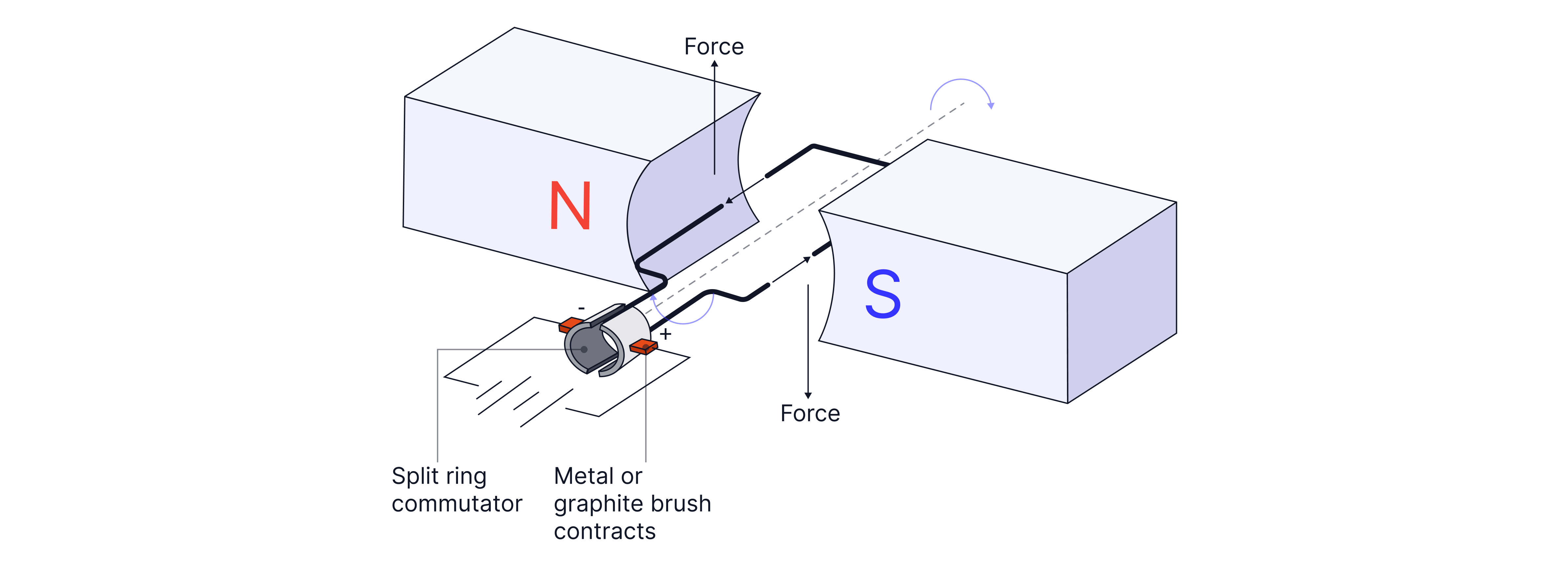
When the wire is in a loop, as shown in the image below, current flows in opposite directions on opposite sides of the loop. Fleming’s left-hand rule shows us that there is then an opposite force on each side of the wire, thus causing the wire to rotate/spin. The wire, however, will only spin halfway, so to ensure the wire rotates the full way, the split-ring commutator switches the connection every half-turn, reversing the current. This is known as the motor effect and has numerous applications, including in blenders and hairdryers.
Practice Questions
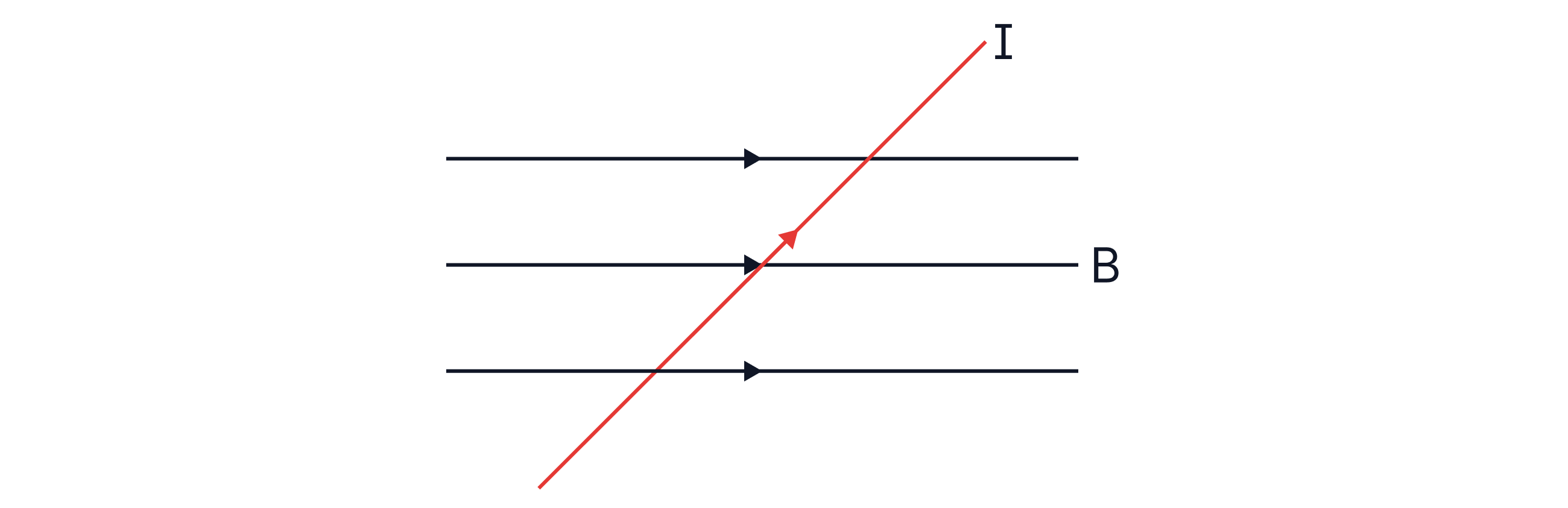
A straight wire carrying a current is placed at to a uniform magnetic field, causing the motor effect.
State what is meant by the motor effect.
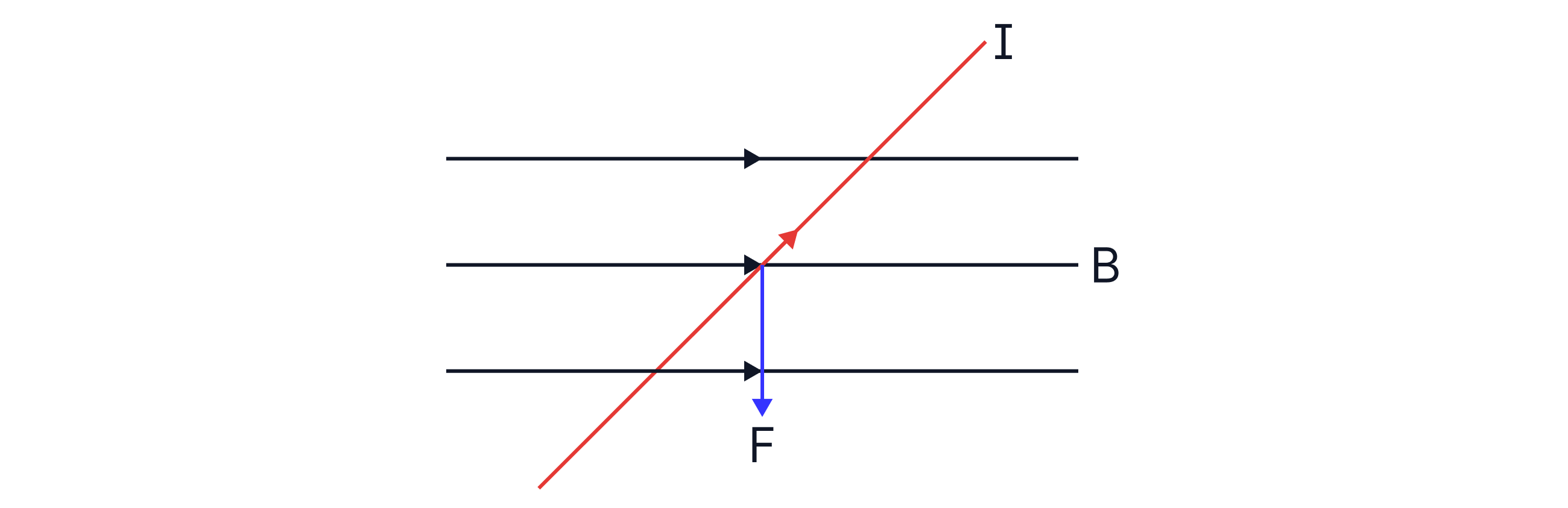
Add an arrow to the diagram to show the direction of the force on the wire using Fleming’s left-hand rule.
State two factors that increase the size of the force on the conductor.
-> Check out Hannah's video explanation for more help.
Answer:
Force produced when a current-carrying conductor is placed in a magnetic field.
Any 2 answers of:
Increasing current.
Increasing magnetic flux density / use a stronger magnet
Increasing length of wire in the field
A student investigates how the orientation of a conductor affects the motor effect.
The student rotates the wire gradually from being perpendicular to the magnetic field to being parallel to it. Explain how and why the force on the wire changes.
The wire is again placed at to the field. The force on the wire is measured to be when the magnetic flux density is and the current is . Calculate the length of the wire in the magnetic field.
-> Check out Hannah's video explanation for more help.
Answer:
Maximum force when the wire is at to the field. The force decreases as the angle reduces and becomes zero when the wire is parallel to the field because applies only when the components are perpendicular to each other.
A coil in a permanent magnetic field can rotate due to the motor effect. Explain why when a current flows through the rectangular coil it rotates.
-> Check out Hannah's video explanation for more help.
Answer:
Current flowing in the coil produces a magnetic field.
The magnetic field around the coil interacts with the permanent magnet field.
Each side of the coil experiences equal but opposite forces because the current flows in opposite directions on each side.
The forces form a turning moment, causing rotation.