Reducing Energy Transfer in Buildings
Brook Edgar & Hannah Shuter
Teachers


Contents
Explainer Video
Insulation to reduce heat loss
The UK primarily relies on wind turbines and natural-gas-fired power stations to supply electricity to the national grid. Although wind turbines are a renewable energy resource that does not contribute to global warming, burning gas, a fossil fuel, releases harmful carbon dioxide into the atmosphere. This greenhouse gas contributes to global warming and, as we have already learned, leads to increased flooding due to melting ice caps and habitat destruction.
We use electricity every day, from heating our homes to charging our phones to using public transport. To help protect the environment, we should reduce our contribution to global warming by walking instead of driving and by turning off lights in the house when we are not in the room. We can also better insulate our homes to reduce heat loss, thereby reducing the need to turn on the heating, saving electricity. This has the added benefit of reducing electricity costs, thus saving us money.
Insulation is a material or method that slows the transfer of heat. For example, in winter we wear coats for insulation, to reduce heat loss from our bodies, so that we remain warmer for longer; our coat is made from an insulating material.
-> An insulator is a material that has low thermal conductivity. This means that it is very slow at conducting (transferring) heat.
Reminder: Conduction is a method of heat transfer in solids. When one end of the solid is heated, the atoms at that end gain kinetic energy and vibrate more. They then collide with their neighbouring atoms, transferring energy across the solid, causing each particle to vibrate more. In metals, such as a frying pan, heat is transferred by conduction more quickly than in non-metals, such as plastics, because metals have free electrons that can move through the structure, thereby conducting thermal energy faster. Metals are known as conductors; they have high thermal conductivity as they conduct heat quickly through their structure.
Insulating your home
Insulators are poor conductors they have low thermal conductivity. They transfer heat slowly. Insulators are non-metals, such as paper, plastic, air, and wood.
When insulating our homes to reduce heat loss, we want to use materials with low thermal conductivity so that heat transfers very slowly (we don't want heat to pass quickly from inside our houses to the outside).
There are several ways to insulate our homes. We can add loft insulation, replace our windows with double-glazed windows, install aluminium foil behind our radiators, and ensure our homes have cavity wall insulation.

Loft insulation
We can add insulation to the roofs of our houses to prevent heat loss through the roof as heat rises. Materials such as fibreglass or foam are added to the roof because they have low thermal conductivity, thereby slowing heat transfer.
Cavity walls
The spaces between the exterior walls of our houses can be filled with insulation, such as foam, to reduce the rate of energy transfer by conduction. Also, thicker walls slow the transfer of heat by conduction in our homes, just as a thicker coat on a cold day keeps you warmer for longer by slowing the transfer of heat from your body.
Double-glazed windows
Windows should be double-glazed. This means there are two glass panes separated by an air-filled gap. Air is an insulator, slowing down the rate of energy transfer from inside our houses to outside.
Aluminium foil behind the radiator
Heat is also transferred by radiation (waves). Silver shiny objects are good reflectors of radiation; therefore, if we place these behind our radiators, the heat is reflected back into the room, thereby keeping our houses warmer.
-> Energy Bills
Energy bills in the home are commonly written in kilowatt-hours, . A kilowatt-hour is a unit of energy, not power. It tells us the amount of energy transferred when a power of one kilowatt is used for one hour.
We have already learned that, , which can be rearranged to,
, energy transferred = power time
Worked Example:
A vacuum flask is a container designed to keep liquids hot. It consists of two layers of solid material separated by a vacuum, with the inner layer silver-coloured. Explain how this enables the drink to stay hotter for longer.
Answer:
The vacuum between the two solid layers reduces heat loss by conduction. A vacuum has low thermal conductivity because conduction occurs when atoms vibrate and collide, but a vacuum contains no air particles. There is nothing to collide with, and so thermal energy cannot pass through by conduction. The inner layer is silver because it reflects radiation back into the cup, thereby keeping the drink hotter for longer as heat is not lost by radiation.
Practice Questions
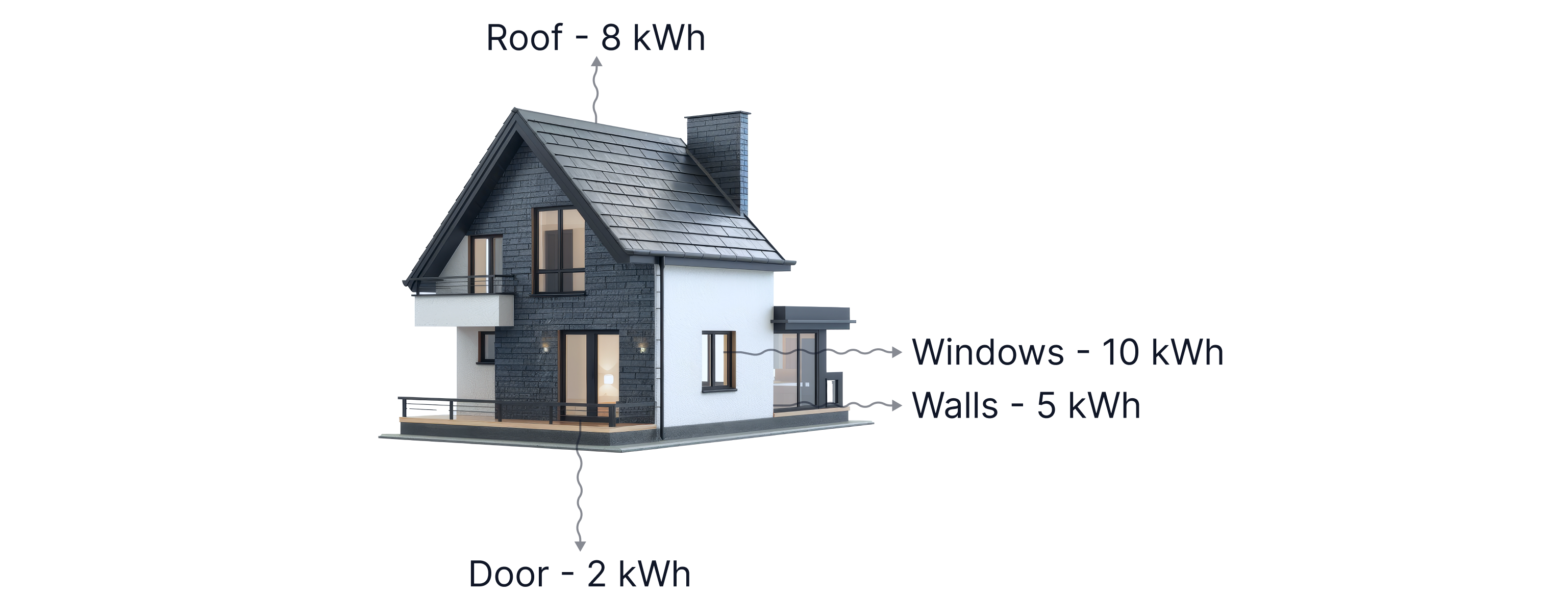
Describe 3 ways to make the house more energy efficient.
-> Check out Brook's video explanation for more help.
Answer:
Loft insulation, double-glazed windows, cavity wall insulation.
Air is a poor conductor because:
It is a conductor
Gas particles are far a part, so take along time to collide
Thermal energy is not transferred.
-> Check out Brook's video explanation for more help.
Answer:
B