Renewable Energy
Brook Edgar & Hannah Shuter
Teachers


Explainer Video
Renewable Energy Resources
As fossil fuels and nuclear fuels are non-renewable energy resources -> they are being used quicker than they can be replaced; they are finite resources, we need to look for alternative energy resources before they run out.
Renewable energy can be replenished as it is being used.
Renewable energy resources are:
Wind
Biofuel
Solar
Geothermal
Hydroelectritcity
Tides
Water Waves
Wind
Wind is used to rotate large blades on wind turbines, which in turn drive a generator to produce electricity. The UK uses wind turbines to supply electricity to the national grid and thus to all our homes. Wind is a renewable energy resource because it can be replaced as it is being used; we only need to wait until the next windy day, which is frequent in the UK. A significant advantage of wind turbines over fossil fuels is that they do not release greenhouse gases into the atmosphere. However, a disadvantage is that they are very noisy and unsightly (not pretty), so many people do not want them near their homes or in the countryside, ruining their view.

Biofuel
Biofuel is a renewable energy resource, as it can be replaced quickly, as biofuel comes from plants and animal waste (faeces/manure). These fuels are readily available because plants can be regrown and animals produce waste daily. The plant and animal waste is burned to heat water, creating steam that drives a turbine, which in turn powers a generator to produce electricity. There are buses in Bristol that run on the gas produced by human faeces! Biofuel is beneficial because it uses waste, but burning it produces carbon dioxide, a greenhouse gas, contributing to global warming.

Solar
Solar Panels use the Sun's thermal energy to heat water, which can be used in our homes for showers and taps. However, the most common type of solar panel is made of solar cells that use sunlight to knock electrons loose from atoms in the solar cell, creating free electrons. This flow of free electrons then creates an electric current. Solar power is a renewable energy resource, as it is sunny most days; however, it is more useful in countries that receive much more direct sunlight than the UK. It can be an unreliable energy resource in the UK as it is not always sunny.
Geothermal
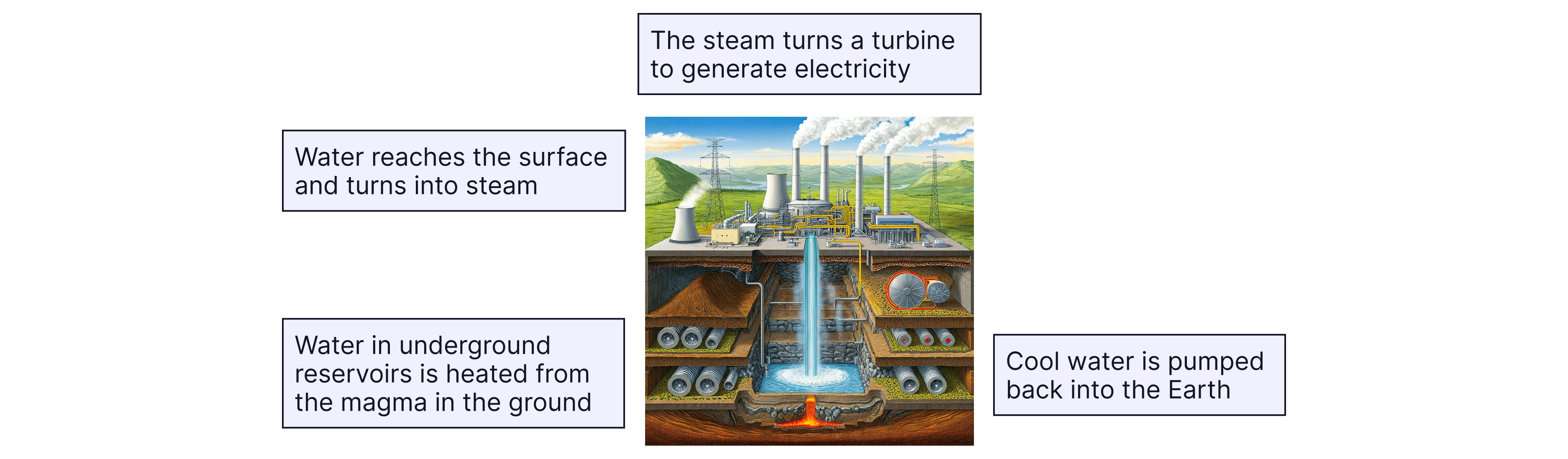
Geothermal energy uses the heat in the Earth's interior to heat water. Water is pumped underground to be heated by magma in underground reservoirs. The heated water turns into steam, which spins a turbine, converting thermal energy into kinetic energy. This drives a generator to generate electricity. This is a renewable energy resource, as we use magma in the Earth (when magma rises to the Earth's surface through volcanoes, it is called lava). This is a reliable energy resource, but a disadvantage is that geothermal power stations are expensive to construct and can be built only in specific locations.
Hydroelectricity
Hydroelectricity uses water stored high up in reservoirs by dams, which is then released to flow down and spin a turbine at the bottom that drives a generator to produce electricity. This is a renewable energy resource, as we use moving water to generate electricity. A disadvantage is that the dams can cause flooding and destroy habitats.

Tides
On Earth, we have high and low tides due to the Moon's gravitational pull. The high and low tides are used to spin underwater turbines that drive a generator to generate electricity. This is a renewable energy resource, as we use moving water to generate electricity. Tidal is a reliable energy resource, as tides occur naturally every day.
Water Waves
Special mechanical devices are placed in the ocean to use the energy from waves to spin a turbine that drives a generator to produce electricity. Waves are predictable and consistent, making them a renewable and reliable energy resource. However, the technology is expensive and can impact marine life.
Worked Example:
Identify the renewable energy resources from the list below,
wind, fossil fuels, solar, nuclear, tidal, biofuel
Answer:
Wind, solar, tidal and biofuel.
Fossil fuels, such as coal, oil and gas, are non-renewable as they take millions of years to form.
Nuclear fuel is non-renewable because it uses Uranium as the fuel, which is found naturally on Earth, but it is a finite resource; once it is all mined and used, there will be none left.
Worked Example:
Explain why the UK is unlikely to rely entirely on wind power to meet its energy needs, and suggest a resource that could be used to help meet the energy needs.
Answer:
Wind is an unreliable energy resource as it is not always windy, meaning that on some days wind turbines alone cannot meet the UK's electricity demand. The UK will likely use fossil-fuel power stations to meet the country's demand when wind generation is low.
Practice Questions
Complete the table:
-> Check out Brook's video explanation for more help.
Answer:
Describe and explain how the average solar power generation in the UK has changed.

-> Check out Brook's video explanation for more help.
Answer:
The average power generated by solar power in the UK has increased over the past years.
This could be due to more solar panels being built or that the solar panels being built have become more efficient over the years.
There are peaks in power output in the summer.
This is because it is sunnier in summer than in winter.