Introduction to Waves
Brook Edgar & Hannah Shuter
Teachers


Explainer Video
Waves
A wave transfers energy through space, not matter. In sound waves and water waves, particles vibrate, but they do so in a fixed position and do not move from one place to another. For example, when your teacher speaks, the air particles beside their mouth vibrate in a fixed position, and the air particles beside those vibrate, and so on, and this energy is carried across the room to your ears. It is not that an air particle beside your teacher's mouth shoots across the room and into your ear!
Sound travels fastest in solids, as the particles are closer together in solids, so when one particle vibrates, it causes the next particle to vibrate quickly, carrying the energy across the material quickly. This is why, in old movies, you can see that people put their ears on train tracks to hear if trains are coming because sound travels faster through the solid rail than air, so the train could be heard from further away.
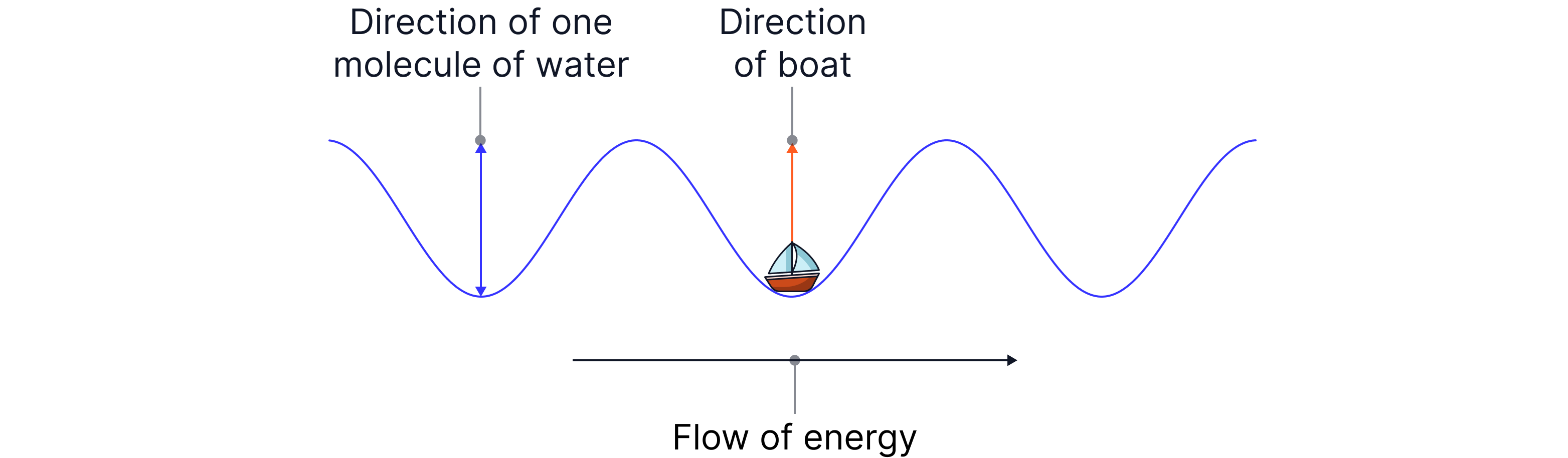
Another example of is when water waves pass under a boat. The water waves cause the boat to move up and down , not to move forward, with the wave. This shows that water particles move about a fixed position (up and down) rather than travelling along with the wave. The same goes for buoys floating in the ocean, we can see them move up and down , as the wave passes, but they do not move along , with the wave, or otherwise we would see loads of buoys washed up on the beach.
I
Worked Example:
A student thinks that when a loudspeaker plays music, air particles are travelling from the speaker plate directly into their ear. Explain why the student is incorrect.
Answer:
The vibrations from the loudspeaker are passed on to the surrounding air particles. These air particles collide with their neighbouring particles, transferring the energy but not the particles themselves.
Worked Example:
Explain why sound travels faster through solids than gases.
Answer:
Sound travels through materials by particles vibrating and passing these vibrations on to neighbouring particles. In solids, the particles are much closer together than in gases, so the vibrations are transferred more quickly between particles. This means sound waves travel faster in solids than in gases.
Longitudinal and Transverse Waves
Waves can be divided into two categories - longitudinal and transverse waves.
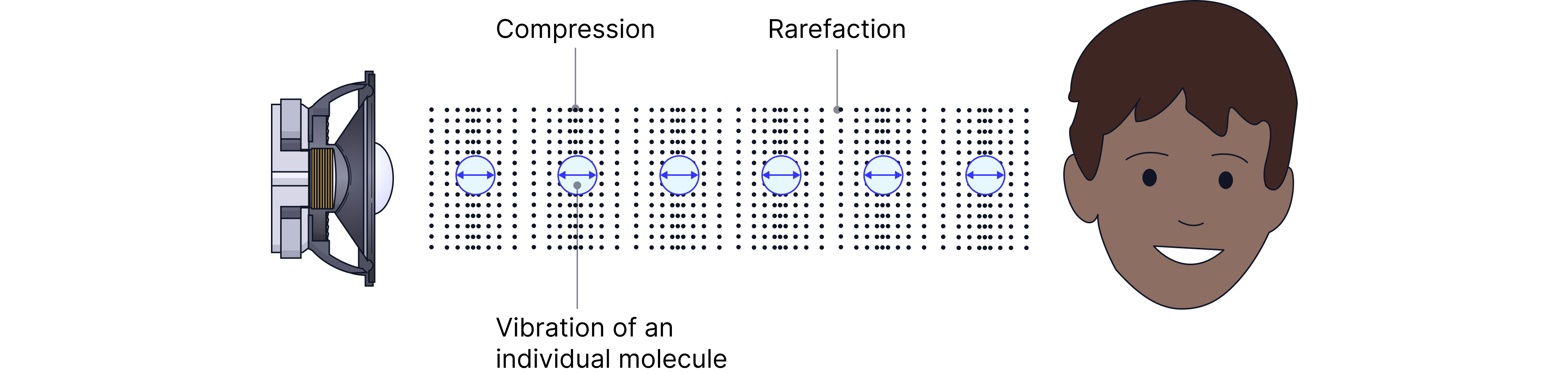
In longitudinal waves the vibrations are parallel to the direction that the wave is travelling. The vibrations/oscillations are parallel to the direction of energy transfer. A sound wave is a longitudinal wave. In the example below, you can see that the sound wave formed by the drum skin on the speaker vibrating is travelling from left to right , causing air particles next to it to vibrate left to right , in a parallel direction. They then collide with neighbouring air particles, causing them to vibrate left to right , and so on, transferring energy across the room to your ear, causing your eardrum to vibrate so that you can detect the sound.
Sound waves are also known as pressure waves, as they consist of regions of high particle density (particles are close together), known as compression and regions of low particle density (particles are far apart), known as rarefaction.

In transverse waves, the vibrations are perpendicular (at right angles) to the direction that the wave is travelling. Examples of transverse waves include water waves, waves on a rope and light. In the example below, you can see that the hand is moving up and down , but the wave on the rope is moving from left to right . These directions are at right angles to each other.

Worked Example:
When people cheer in a stadium, they raise their hands up and down while the cheer travels around the stadium from left to right.
Identify the type of wave this represents and explain your answer.
Answer:
This would be a transverse wave, as the vibrations (the hands going up in the air) are perpendicular to the direction of the wave travel (left to right).
Worked Example:
Describe the differences between a sound wave and a water wave with reference to the vibrations of the particles.
Answer:
A sound wave is a longitudinal wave, so the vibrations of the particles are parallel to the direction of the wave travel.
A water wave is a transverse wave, so the vibrations of the particles are perpendicular to the direction of the wave travel.
Practice Questions
Explain the difference between how particles move in transverse and longitudinal waves.
-> Check out Hannah's video explanation for more help.
Answer:
In transverse waves particles vibrate at right angles to the direction of energy transfer.
In longitudinal waves particles vibrate parallel to the direction of energy transfer.
A student drops a small piece of paper onto the surface of still water. Ripples move outwards, but the paper does not move with them.
What does this observation show about what waves transfer?
State one piece of evidence in the example that supports your answer.
-> Check out Hannah's video explanation for more help.
Waves transfer energy, not matter.
The paper stays in the same place even though the waves can be seen moving.