IR RP
Brook Edgar & Hannah Shuter
Teachers


Explainer Video
IR Radiation Required Practical
This core practical investigates how the amount of infrared radiation an object absorbs or emits depends on its surface colour.
Remember IR radiation is an EM wave. IR is used for cooking food and in heaters.
All objects emit ("give out") infrared (IR) radiation. Hotter objects emit more IR radiation than cooler objects. The surface also matters. Matt, black objects emit IR radiation at a faster rate than shiny, white objects.
All objects also absorb ("take in") IR radiation. Matt, black objects absorb IR radiation at a faster rate than shiny, white objects.
Matt black objects are the best absorbers and emitters of IR radiation
Shiny white objects are poor absorbers and emitters of IR radiation because they reflect it.
This is why, on a sunny day, if you wear black, you feel hotter as black clothes absorb IR radiation more from the Sun and emit it towards your body.
Practical 1.
To prove that black objects are the best emitters, we could set up the practical below, in which identical beakers with different coatings are filled with the same volume of hot water and observed to cool.
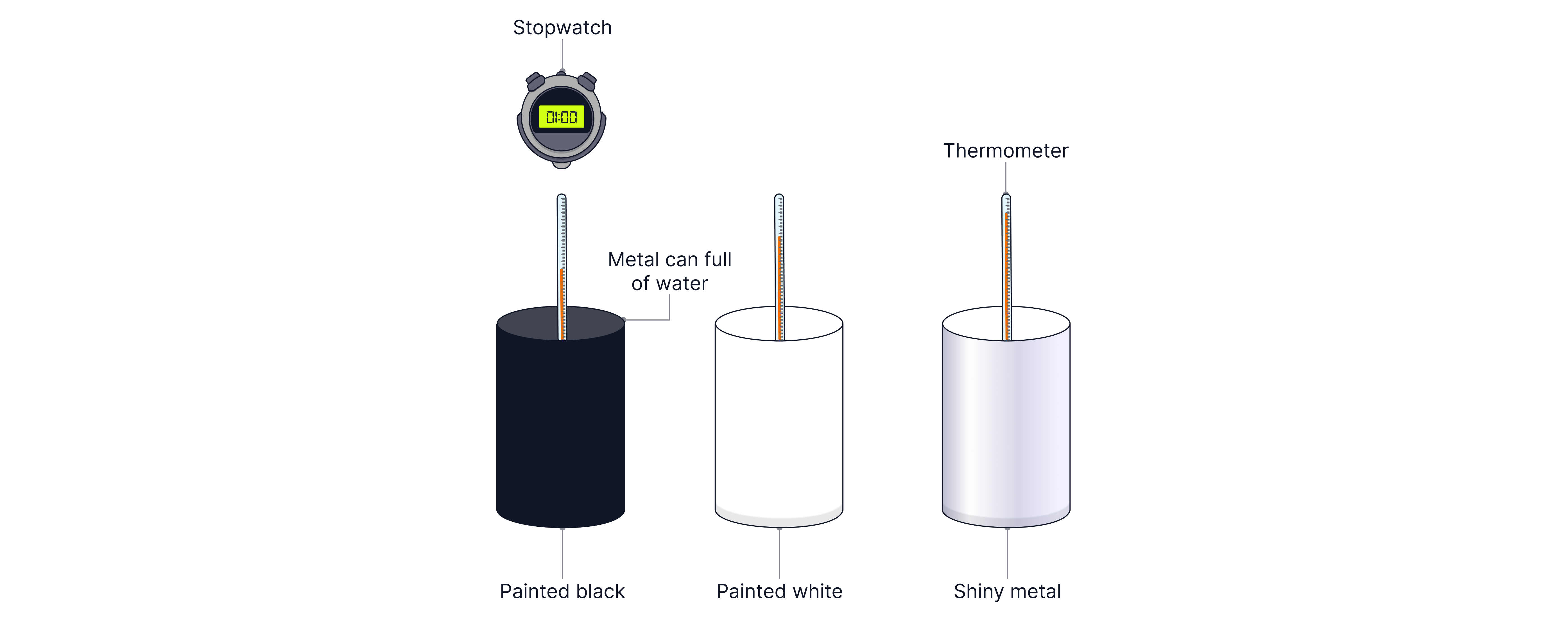
To determine which surface coating emits the most IR radiation, we should:
Measure the temperature of the water in the beakers, using a thermometer, after twenty minutes.
Calculate the temperature decrease for each beaker by subtracting the final temperature from the initial temperature.
The beaker with the greatest temperature drop will be the one emitting infrared radiation at the fastest rate -> we know this will be the one coated in black paint as black is the best absorber and emitter of IR radiation.
Practical 2.
Alternatively, a Leslie's cube, as shown below, could be used to determine which surface emits the most IR radiation. A Leslie cube is a hollow cube with each face painted a different colour. The cube is filled with hot water, and an IR detector is used to record the amount of IR emitted from each face.

As it is a cube, the surface area of each face has already been controlled, and all faces will be at the same initial temperature. When recording the IR radiation emitted from each face - the dependent variable, we must ensure the IR detector is placed the same distance away from each side of the cube when taking readings. This is because the farther the IR detector is from the surface, the less it records; the same way that the farther you are from a fire, the less heat you feel. This is something we need to control, as we can only change one thing in an experiment to ensure our results are valid. As we are changing the surface colour (independent variable), we must keep the distance between the face and the detector fixed.
-> We would expect that the most IR radiation will be emitted by the matt black surface as black objects are the best absorbers and emitters of IR radiation, and the least by the shiny silver surface.
Worked Example:
A student has a kettle and two flasks, one black and one silver. They want to investigate how the colour of a surface affects the rate at which the surface emits radiation. They predict that the black flask will emit more radiation than the silver coloured flask during of cooling.
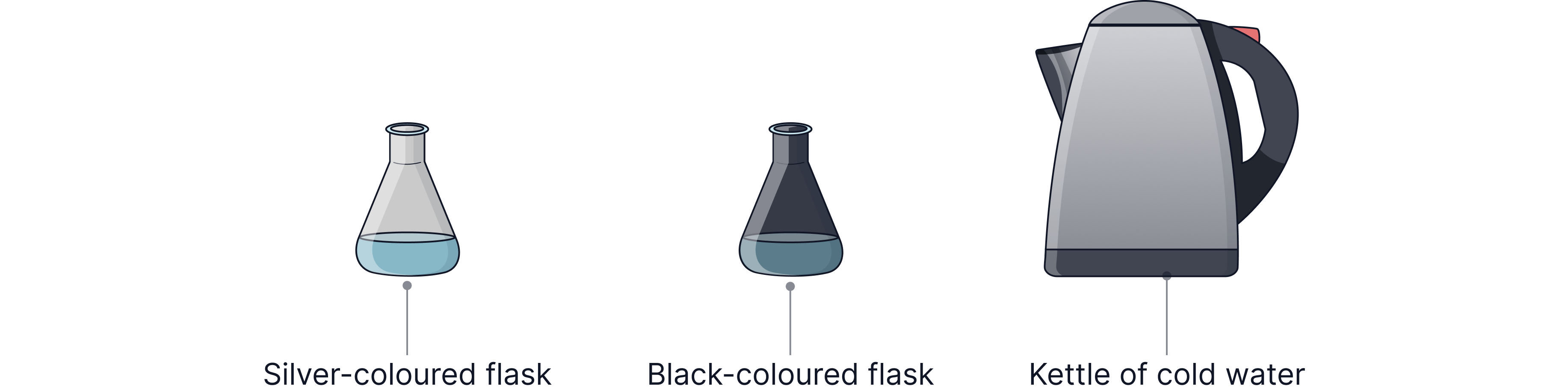
Describe a method to test this hypothesis.
Answer:
Boil the kettle, then fill both flasks with the same volume of water using a measuring cylinder.
Record the temperature of the water in both flasks after using a thermometer.
The flask that contains the liquid that has dropped in temperature the most, the one at the lower temperature, will be the flask that emits IR radiation at a faster rate.
Repeat the investigation and calculate a mean to improve reliability.
-> I predict that the liquid in the black-coloured flask will have dropped in temperature more as black surfaces are the best absorbers and emitters of IR radiation.
Worked Example:
Two identical metal plates are initially at the same temperature.
One has a matt black surface.
One has a shiny, silver surface.
The plates are placed in front of an infrared heater and left for the same amount of time as shown in the diagram below:

Which plate will have the greater temperature increase?
Explain your answer.
State one variable that must be kept the same to ensure the investigation is fair.
Answer:
The matt black plate.
Matt black surfaces are better absorbers and emitters of infrared radiation than shiny, silver surfaces. The Dull black plate absorbs infrared radiation from the heater more quickly and emits it to the thermometer more quickly, causing the thermometer to rise more.
Distance from the heater or surface area of the plates.
Practice Questions
A student wants to compare the amount of infrared radiation emitted by different materials. They propose to fill test tubes with hot water, wrap them in different materials, and measure their temperature every minute.
State the independent and dependent variables in this investigation.
Suggest one control variable
-> Check out Hannah's video explanation for more help.
Answer:
Independent variable type of material wrapping the test tube
Dependent variable temperature of the water
Volume of water/starting temperature of the water
A student uses a Leslie cube filled with hot water to investigate how different surfaces emit infrared radiation. The faces of the cube are matt black, shiny black, matt silver and shiny silver. An IR detector is placed the same distance from each face.
Explain why the detector must be kept the same distance from each face when taking readings.
The student finds that the matt black surface gives the highest detector reading and the shiny silver surface gives the lowest. Explain these results in terms of IR emission.
-> Check out Hannah's video explanation for more help.
Answer:
Because the type of surface should be the only thing that is changing. Only one variable can be changed in an experiment to make it valid. Two things cannot be changed.
The matt black surface emits IR radiation faster than the shiny silver surface.