IR Radiation and Temperature
(Triple Only)
Brook Edgar & Hannah Shuter
Teachers


Explainer Video
Infrared Radiation
All objects emit infrared radiation (IR). Hotter objects emit ("give out") more infrared radiation per second than colder objects. IR is an EM wave. The Sun emits IR waves, we know this as we can feel it as heat on our skin, when our skin absorbs it.
Black, dull (matt) objects are the best absorbers of infrared radiation; this is why, if we wear black clothes on a sunny day, we feel hotter, as the black clothes absorb the IR from the Sun and emit it to our bodies. Black objects are the best absorbers and emitters of IR radiation.
White, shiny surfaces are poor absorbers and emitters of IR radiation because they are good reflectors. This is why, in winter, to keep your house warm, you should put aluminium foil behind the radiators to reflect the IR radiation/heat from the radiators back into the room.
Black bodies
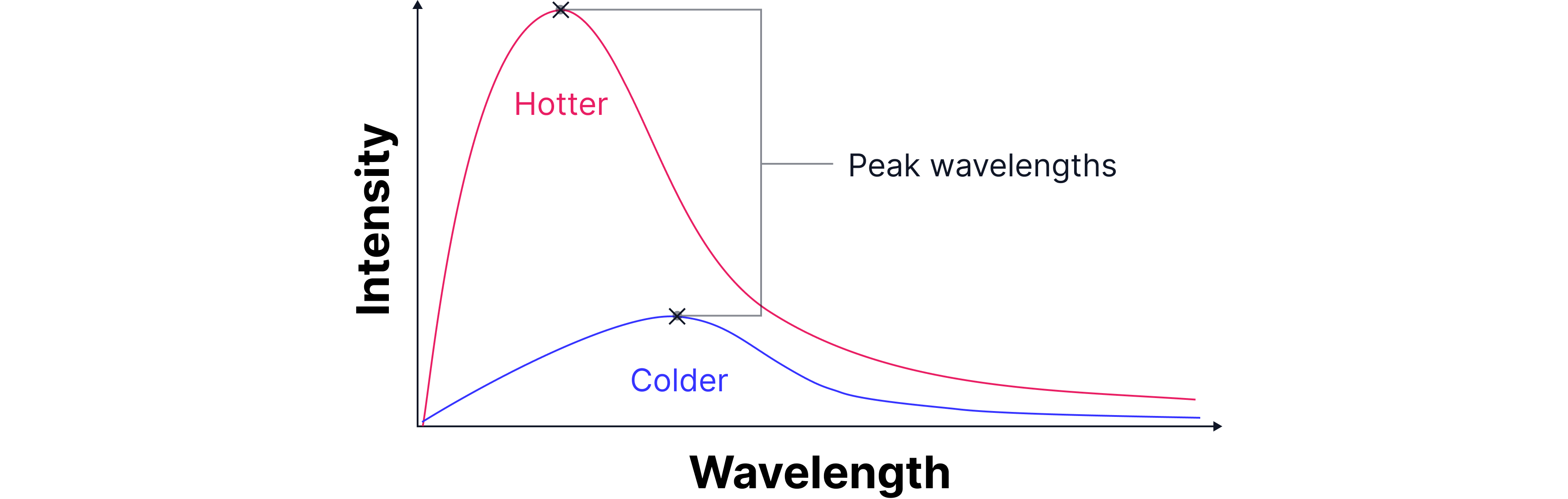
A perfect black body absorbs all infrared radiation incident upon it, they do not reflect or transmit any. A perfect absorber is also a perfect emitter. A black body, therefore, emits all radiation, but the amount it emits (intensity) at certain wavelengths depends on its temperature. A hotter object emits more energy per second - a higher intensity, and the peak wavelength emitted is lower, as shown in the diagram below. Remember, shorter wavelengths have more energy.
Temperature
If an object is at a constant temperature, it emits infrared radiation at the same rate at which it absorbs it.
If an object is heating up, it is because it is absorbing infrared radiation at a greater rate than it is emitting it.
If an object is cooling down, it is because it is emitting infrared radiation at a greater rate than it is absorbing it.
The Earth is heating up because it is absorbing more IR than it is emitting. This is known as global warming.
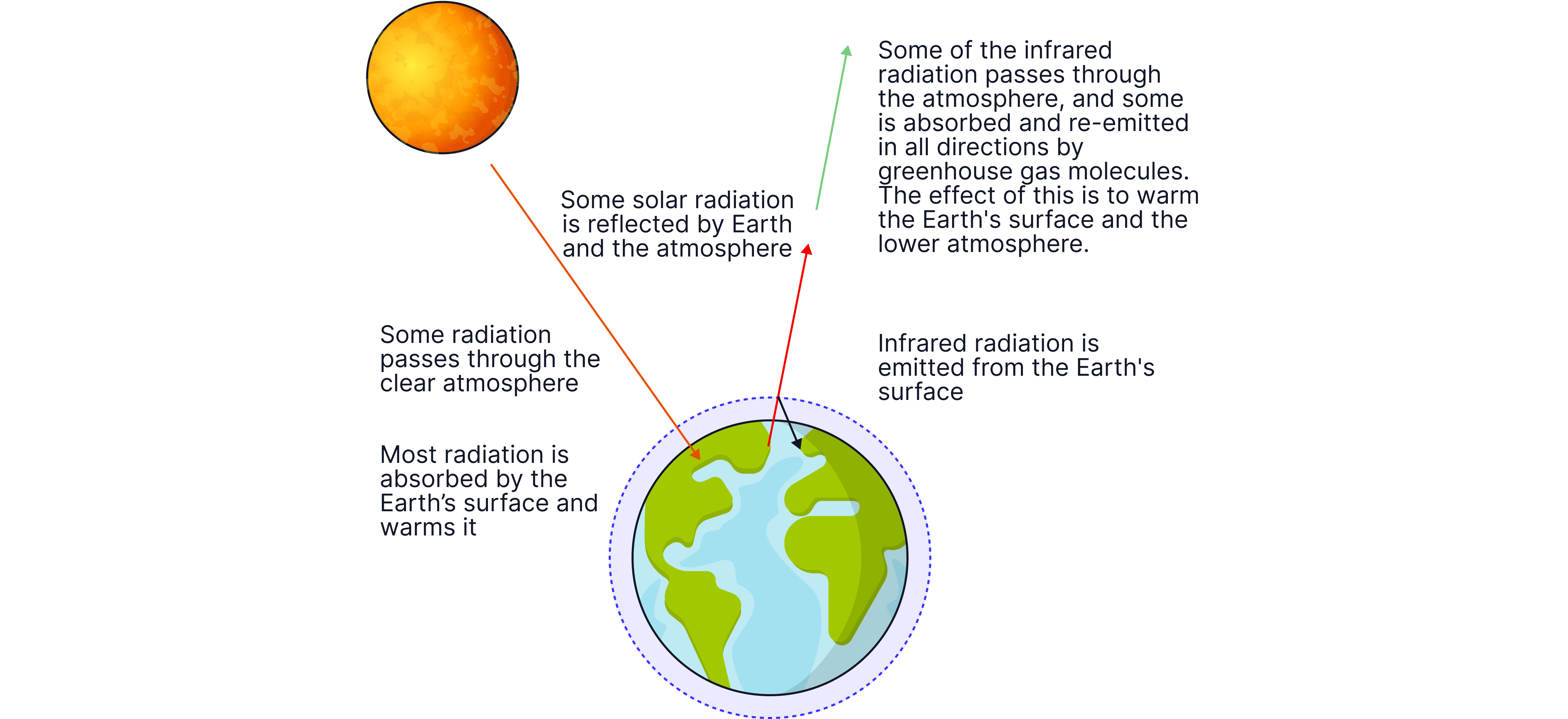
If the Earth’s temperature were to remain constant, it must absorb infrared radiation from the Sun at the same rate as it emits infrared radiation back into space. However, over recent years, the amount of greenhouse gases (such as carbon dioxide) in the atmosphere has increased. These greenhouse gases absorb infrared radiation emitted by the Earth, so instead of this IR radiation passing back out into space, it is absorbed and re-emitted back towards the Earth, causing the Earth's temperature to rise. As a result, the Earth absorbs infrared radiation at a faster rate than it emits it, causing an increase in the Earth’s average temperature.
Worked Example:
A metal plate is painted matt black on one side and shiny white on the other.
Which side will be the best absorber of infrared radiation? Explain your answer.
Which side will be the best emitter of infrared radiation?
Answer:
The matt black side is the best absorber of infrared radiation. Black, matt surfaces absorb more infrared radiation than white, shiny surfaces.
The matt black side is also the best emitter of infrared radiation.
Worked Example:
Explain, with reference to infrared radiation, how greenhouse gases cause global warming.
Answer:
All objects, including the Earth, emit infrared radiation. Greenhouse gases, such as carbon dioxide, absorb infrared radiation emitted by the Earth. They then re-emit this infrared radiation in all directions, including back towards the Earth’s surface. This means the Earth absorbs infrared radiation at a faster rate than it emits it, causing the temperature of the Earth to increase, leading to global warming.
Practice Questions
A metal plate is heated. Explain why its temperature increases.
-> Check out Brook's video explanation for more help.
Answer:
The plate absorbs infrared radiation at a faster rate than it is emitted.
A black metal sphere is left in sunlight. After a while its temperature stops increasing. Explain why the temperature eventually becomes constant.
-> Check out Brook's video explanation for more help.
Answer:
Temperature increases as it absorbs more IR than it emits
Eventually, it reaches the same temperature as its surroundings
It now absorbs IR at the same rate as it emits IR.