Law of Conservation of Energy
Brook Edgar & Hannah Shuter
Teachers


Explainer Video
Conservation of Energy
Energy cannot be created or destroyed, only transferred from one form to another. In physics problems, we need to be able to calculate the energy stored in one form and use this to calculate the unknown variable in another energy store equation.
Below are some key equations you need to memorise as they are used throughout physics. They are given in the formula booklet, but to answer harder problems, you need a bank of equations in your head so you know where to start. We have already learned them all individually in this topic.
Kinetic Energy is the energy an object has due to its motion.
Formula:
Elastic Potential Energy is the energy stored in a stretched or compressed object.
Formula:
Gravitational potential energy is the energy stored due to an object's position above the ground.
Formula:
Work done is the energy transferred when a force moves an object in the same direction.
Formula:
We use the law of conservation of energy every day without realising it. For example, at a theme park, I know that the taller roller coaster will be scarier as it will go faster at the bottom.

You may not have thought about this in terms of physics vocabulary, but we now know that a taller roller coaster has more gravitational potential energy than a smaller one, as it is higher above the surface of the Earth. It will then go faster at the bottom as this gravitational potential energy is converted into kinetic energy as it starts to move.
A tall roller coaster starts above the ground. Let's say that one day the total mass of the ride and the people inside is . We can calculate the speed of the ride at the bottom of the drop, using, (on Earth).
First, we calculate the gravitational potential energy as we have the mass and height of the ride.
Next, we use our conservation of energy law to know that as the roller coaster starts to fall, its gravitational potential energy decreases as it gets closer to the ground, and its kinetic energy increases as it starts to go faster.
Gravitational potential energy Kinetic energy
At the bottom of the fall, the roller coaster will have no gravitational potential energy and lots of kinetic energy. All of the of gravitational potential energy is transferred into of kinetic energy.
We can now find the final speed of the roller coaster, as we have the total energy and mass.
We then need to get rid of the '' from the RHS. To get rid of something from an equation, we do its opposite. The opposite of multiplying is dividing, and what we do to one side, we must do to the other.
However, we are not done yet; we have only found !
To get , the speed, we need to do the opposite of squaring, which is square rooting.
The speed of the roller coaster at the bottom is .
This is a maximum speed, as in reality, not all of the gravitational potential energy will be transferred into kinetic energy, as some will get wasted as heat due to friction between the tyres and the track and due to air resistance. Some energy is dissipated.
Remember: In past pages we have gone through in detail how to calculate the different stores of energy. Go back to these pages if you are struggling with the maths here.
Worked Example:
A child, mass , travels down a slide that is in height. Use .

Calculate:
How much gravitational potential energy they had at the top of the slide.
How much kinetic energy they have at the bottom of the slide.
How fast they are going at the bottom of the slide.
Answer:
Teacher Tip: In question , in the line of maths, to get rid of from the RHS of the equation, we have to do the opposite of multiplying, which is dividing, and what we do to one side we have to do to the other. In the last step we have to remember to square root the final answer in order to just get , the speed. Please go back to the kinetic energy page if you are having problems with this maths.
Worked Example:
A spring-loaded toy of mass has a spring constant and is compressed by . It is released and flies straight upwards. How high does it go? Use .

Answer:
Here, we are told the spring is compressed and then released. We know that the energy transfer is from elastic potential energy to gravitational potential energy.
We can calculate the elastic potential energy as we have the spring constant and the extension (change in length).
Be careful, the change in length here is given in centimeters so we need to convert to metres first (remember ).
We assume that all of elastic energy is transferred into of gravitational potential energy due to the law of conservation of energy.
The toy shoots up metres in height, .
Challange Question
Worked Example
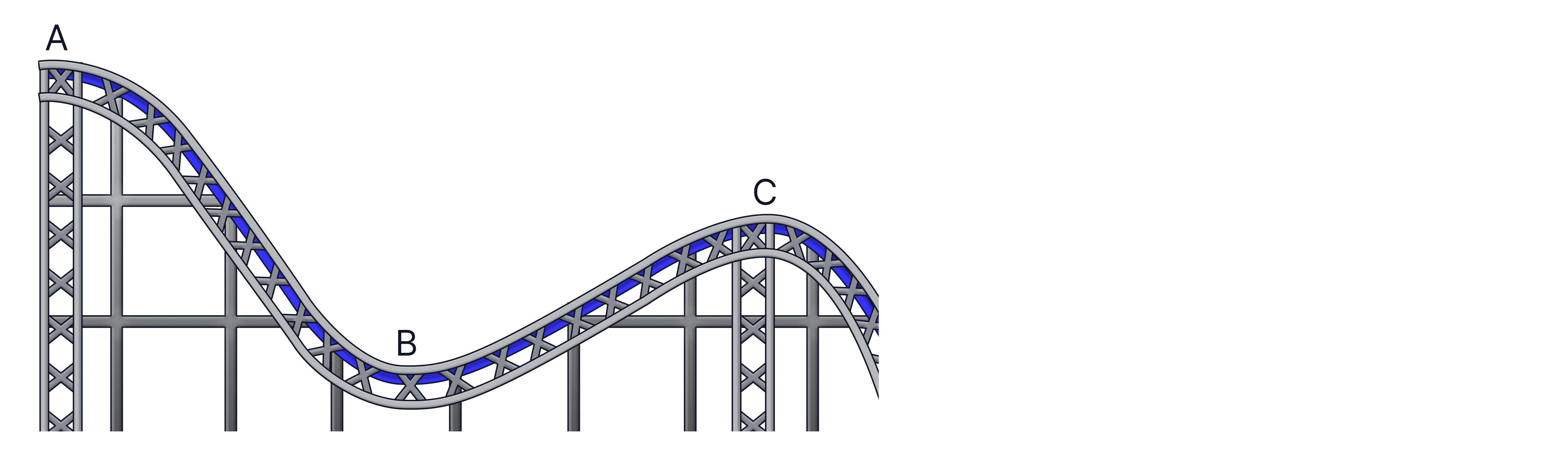
A rollercoaster has a maximum height of at point A and has a mass of . It is stationary at point A. Calculate the velocity at C, which is above the ground. Use g = .
Answer:
As the ride is not moving at point A, the ride only has gravitational potential energy. However, at point C, the ride will have both gravitational potential energy due to its height above the ground and kinetic energy due to its motion. Due to the conservation of energy, we will assume that all of the gravitational potential energy at A is converted into gravitational potential energy and kinetic energy at point C. The total energy is conserved.
First, we calculate the total gravitational potential energy at A, which will be transferred into gravitational potential energy, , and kinetic energy, , at point C.
This is not an accurate calculation as some of the initial total energy will be dissipated into the surroundings due to friction and air resistance. The actual speed at C will be lower than that calculated.
Practice Questions
Fill the gaps to show the transfer of energy.
A ball is thrown up in the air: Kinetic energy -> ________
A car starting: ________ -> ________
-> Check out Brook's video explanation for more help.
Answer:
Gravitational potential energy
Chemical energy -> kinetic energy
A ride starts above the ground. Total mass is . Calculate the speed of the ride at the bottom. Use .

-> Check out Brook's video explanation for more help.
Answer: