Power and Efficiency
Brook Edgar & Hannah Shuter
Teachers


Explainer Video
Power
All electrical appliances have a power rating. It indicates the number of joules of energy transferred to the device per second to operate it.
Power is measured in units of watts ().
Looking at the two devices below, we can see that the kettle requires more energy per second to operate. It has a power rating of , which means that it requires of energy per second. The hairdryer has a power rating of , which means it requires of energy per second.
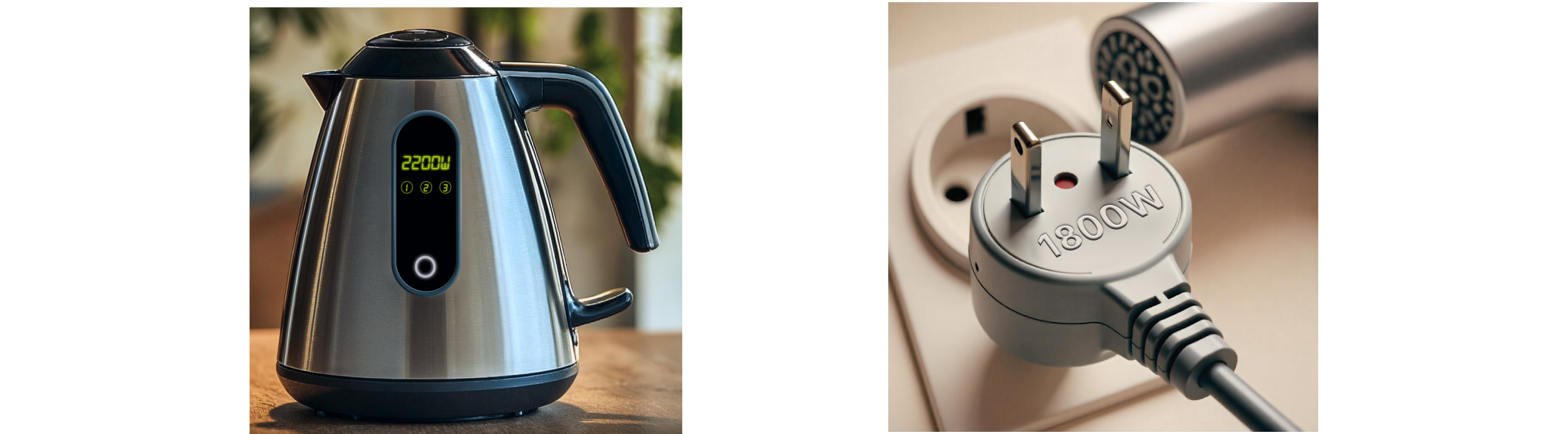
If the kettle were left on for two seconds, it would require of energy. For three seconds, of energy and so on. Energy is therefore calculated by multiplying the device's power by the time used.
On the physics equation sheet, this formula is presented as:
We can use this equation to calculate the power of a lawnmower that transfers of energy in seconds.

You are also provided with the equation, , as work done, , is also measured in the unit of joules, J, as it is energy transferred.
Worked Example:
Choose the correct method to calculate the power of an appliance that requires of energy to run in seconds.
Answer:
Here we are given the energy in joules , and the time in second. The only equation that allows us to calculate power with these two variables is, .
The answer is A.
*Don't forget your units!
Worked Example:
Choose the correct method to calculate the power of a light bulb that uses 1 kJ in 1 minute.
Answer:
Here we are given the energy in kilojoules , and the time in minutes . First, we need to convert our units, as we know that energy is always measured in joules and time in seconds.
The only equation that allows us to calculate power with these two variables is, .
*Don't forget you can not leave your answer as a recurring decimal in physics.
The answer is C.
Worked Example:
Calculate the work done by a man who cycles for hours using of power.
Answer:
Here we are asked to calculate the work done, and as we are given the time in hours , and the power in watts , we know that the only equation we can use here is, , as it is the only equation with all three of these physics terms in it.
First, we need to convert our units, as time is measured in seconds.
The work done by the cyclist is .
*Don't forget your final unit of work done!
Teacher tip: If you have forgotten how to rearrange equations, see the earlier pages on energy calculations. Remember that to get rid of something on the bottom, the opposite of dividing by 7200 is multiplying by 7200, and what we do to one side of the equation, we must do to the other.
Efficiency
Not all energy is transferred usefully!
LED lightbulbs have an efficiency of around , which means that of the energy input is used to emit light, only is wasted as heat. In contrast, an incandescent light bulb (a classic electric lightbulb) has an efficiency of , this means that a whopping of the energy input to the lightbulb is wasted as heat, only is useful.
Formula:
Efficiency is a ratio; it has no units. It can be expressed as a number (e.g. ) or as a percentage (), but the highest efficiency a system can achieve is , as this is when all of the energy input is converted into useful energy. However, in practice, this never occurs because some energy is always dissipated (i.e., transferred to the surroundings as heat or sound).
Some cars are more fuel-efficient than others. This means that for a given amount of fuel (chemical energy), one car can travel much further than another.

For example, my car, a Fiat 500, converts of chemical energy from fuel into of useful kinetic energy. Its efficiency can be calculated:
You are also given the equation,
This can be used when given data in watts, , the unit for power.

For example a large car has a total input power of and produces kinetic energy at a useful rate of . Its efficiency can be calculated:
We can see that my small Fiat is more efficient.
I could make my Fiat even more efficient by oiling the mechanical parts of the car. Lubricating the moving mechanical parts of my car reduces friction between them. When friction is reduced, less energy is wasted as thermal energy; as a result, a greater proportion of energy is usefully transferred into kinetic energy. Because the car becomes more efficient, less fuel is needed to travel the same distance, which saves money and reduces carbon dioxide emissions, helping to minimise the car's environmental impact.
Worked Example:
My microwave is actually only efficient. How much power does it supply to my dinner?
Answer:
Here, we are given the input power and the efficiency as a percentage. To calculate the useful power output, we use the equation,.
.
My microwave has a useful power output of .
Worked Example:
A large car moves at with a mass of . The total input energy is . Calculate the car's efficiency.
Answer:
We know that the only equation to calculate efficiency when given input energy is, , but we are not given the useful energy. We need to calculate the useful energy using the other information provided, which is the car's speed and its mass -> 2000 kg. The only energy we can calculate from this information is the car's kinetic energy, which is useful because it is the energy a car has when moving.
Now we can calculate the car's efficiency,
*This would be worth around 5 or 6 marks in an exam, as the question requires you to use two different physics equations.
Practice Questions
A lawnmower engine transfers of energy in . What is the power of the engine?
-> Check out Brook's video explanation for more help.
Answer:
The useful power output of a cyclist is . The efficiency of human muscle is around . Calculate the total power input of the cyclist.
-> Check out Brook's video explanation for more help.
Answer:
Teacher Tip: A quick trick when you want the term on the bottom of the equation is to switch it with what is on the other side of the equation.