Moments and COM
(Triple Only)
Brook Edgar & Hannah Shuter
Teachers


Explainer Video
Moments
Imagine trying to open a door. If you push near the hinges, it's really hard to get the door moving. But if you push near the handle (far from the hinges), it's much easier. You're applying the same force, so why is one easier than the other? This is due to moments.
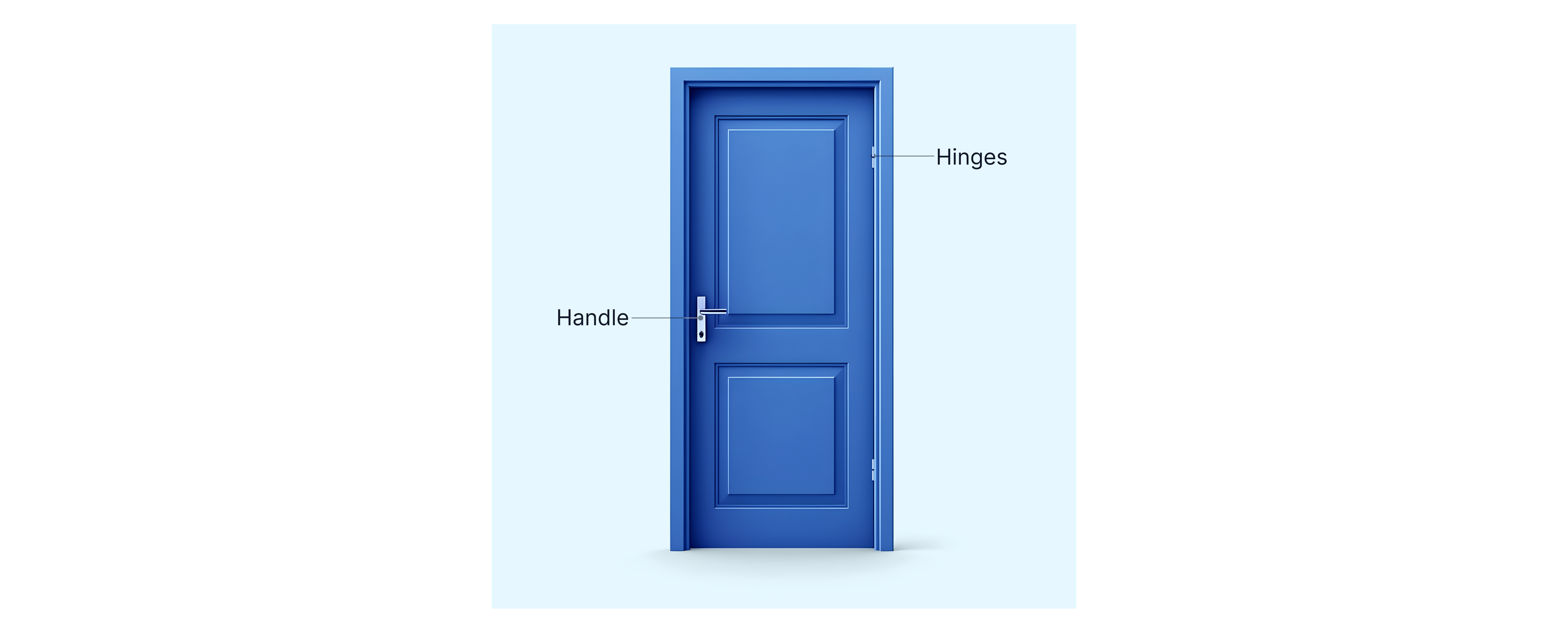
A moment is the turning effect of a force. When a force acts on an object that can rotate around a pivot (like a door around its hinges), it creates a turning effect. The bigger the moment, the bigger the turning effect.
Formula:
Example: I push a door at a distance of away from the hinges with a force of . If I wanted to calculate the moment I can use the above equation:
We describe moments as being "clockwise" or "anticlockwise" depending on which way they would turn an object. The example below would turn the lever clockwise:

Where as the example below would turn the lever anticlockwise:

The Principle of Moments
An object is in equilibrium when it's balanced - it's not rotating and it's not going to start rotating. All the turning effects cancel each other out.
When an object is in equilibrium, the sum of all the clockwise moments about is equal to the sum of all the anticlockwise moments about any point.
In other words: Total clockwise moments = Total anticlockwise moments or -
This is called the 'principle of moments'.
Example:

I want to find out how far away the boy is sat from the pivot of the seesaw, and I can use the principle of moments to do it. The seesaw is in equilibrium, so the total clockwise moments must equal the total anticlockwise moments. The girl is providing the anticlockwise moment, and I know both her force and distance so I can calculate the moment:
The moment of the boy will be the clockwise moment, and according to the principle of moments for the seesaw to be in equilibrium the moment of the boy should be equal to the moment of the girl:
Finding the Centre of Mass
The centre of mass is defined as the single point where we can consider all of an object's weight to act. It's also the point through which a force will have no turning effect.

For a symmetrical object, the centre of mass is where the lines of symmetry meet.
For more complicated objects that are not uniform, it might not be in such an obvious place, but it's always the point where the object would balance perfectly.
When calculating moments, the weight of an object acts through its centre of mass. So if you have a ruler balanced on a pivot, the weight of the ruler acts downward at the centre of mass (the middle of the ruler).
Worked Example:

Calculate the moment of the force about the pivot.
Answer:
The upward force is applied at a perpendicular distance of from the pivot (wheel). This creates an anticlockwise moment of about the pivot.
Worked Example:

Star weight is
Star distance from pivot is (left side)
Triangle distance from pivot is (right side)
Calculate the moment of the star about the pivot.
State the direction of this moment.
State the principle of moments.
Now calculate the weight of the triangle.
Answer:
The moment is anticlockwise.
For an object in equilibrium, the total sum of clockwise moments equals the total sum of anticlockwise moments.
Levers and Gears
Levers are simple machines that use the principle of moments to multiply up forces. They make it easier for us to do work - think of a crowbar being used to lift a heavy rock, or a bottle opener being used to pop off a bottle cap.
Let's say you use a lever where you apply your force from the pivot, and the load is from the pivot. That's a distance ratio of . Because moments must balance:
Your moment Load's moment
Your force Load's force
Load's force Your force .
So you've multiplied your force by . The further you are from the pivot compared to the load, the more you multiply your force.
Gears
Gears are another practical application of moments. Gears are toothed wheels that mesh together. When one gear turns, it makes the other gear turn too. They are used to transmit the rotational effects of forces from one gear to another. The clever thing about gears is that they can change both the speed of rotation and the size of the moment.
How Gears Work:
When two gears mesh together, the teeth push on each other. This creates forces between the gears. These forces act at the edge of each gear (at the teeth), at a certain distance from each gear's pivot (its centre).

Key facts about gears:
When gear A turns clockwise, gear B turns anticlockwise (opposite direction)
The gears exert equal and opposite forces on each other (Newton's third law)
A larger gear has its force applied further from its pivot, so it has a larger moment
A larger gear turns more slowly than the smaller gear it's connected to
Worked Example:

Given information:
Small gear: 25 teeth (connected to engine)
Large gear: 75 teeth (connected to wheel)
Both gears exert the same force on each other. Which one has a bigger moment? Explain why.
Which gear spins fastest? Explain your answer in terms of teeth on the gear.
Answer:
B, the larger gear has a bigger moment. Both gears exert equal and opposite forces on each other (Newton's Third Law). However:
B has a bigger radius/distance from pivot
Since , and force is the same but distance from the pivot is larger, the larger gear has a bigger moment
A, the smaller gear, spins faster as it has less teeth to cover same distance.
Gear ratio
For every one complete rotation of the B, A must rotate times, so A is spinning faster.
Practice Questions
A long uniform plank is supported at its left end. A weight hangs from the pivot.
State the equation for the moment of a force about a pivot.
Calculate the moment of the weight about the pivot.
-> Check out Hannah's video explanation for more help.
Answer:
A student uses a lever to lift a heavy rock. The student applies a downward force of at the end of a bar. The pivot is placed from the rock. Assume the system is in equilibrium.
Calculate the clockwise moment produced by the student's force.
The rock is on the opposite side of the pivot at a distance of . Calculate the upward force acting on the rock.
-> Check out Hannah's video explanation for more help.
Answer:
At equilibrium, total clockwise moments total anticlockwise moments, so moment due to the rock moment due to the student's downward force.