Force and Acceleration RP
Brook Edgar & Hannah Shuter
Teachers


Contents
Explainer Video
Methods
This practical is about testing Newton's Law -> . You could be investigating either:
-> how force affects acceleration
Independent variable (what I change) = resultant force
Dependent variable (what we measure) = acceleration
Control variable (what is kept the same) = mass
-> or how mass affects acceleration
Independent variable = mass
Dependent variable = acceleration
Control variable = resultant force
Equipment:
In either experiment, the easiest way to test the relationships is to use a trolley on a track.
To apply a force to the trolley, to move it along, we attach a string with masses attached to the trolley and hang it over a pulley. The force applied to the trolley through the tension in the string is found from the downward force of gravity exerted on the masses,
Worked Example:
A mass hangs over a pulley on a string attached to the front of a trolley. Calculate the force exerted on the trolly by the masses.
Answer:
The force exerted on the trolley will be due to the weight of the masses. The mass needs to be in , so first we need to convert ():
Force vs Acceleration
To see how force affects acceleration, we could either use a stopwatch and calculate the acceleration using our acceleration equations, or we could use a light gate that is connected to a computer that calculates the acceleration for us as long as we tell the computer the length of the trolley and the distance between the two light gates.
Stopwatch Version:

Set up your equipment as shown above, with a string attached to the front of a toy car that hangs over the edge of the table, over a pulley with masses attached. Measure and mark on the table a distance for the trolley to travel, around works well.
Hold the car at the start, then release it while starting your stopwatch
Stop the stopwatch when the trolley reaches the end of the marked distance
Remove masses from the weight stack (e.g. reduce from to , then , etc.), ensuring that you add the removed masses to the top of the toy car each time. This is to ensure the total mass of the system is kept constant. And repeat the steps above.
To calculate the acceleration of the trolley, you need to use the acceleration equation:
Formula:
The initial velocity of the toy car will be as it is held at rest, so we need to find the final velocity of the trolley in order to calculate the acceleration as the time will be the time recorded on the stopwatch. The final velocity = the average velocity. To find the final velocity, we need to find the toy car's velocity halfway through its journey, as this will equal its average velocity.
As the toy car continues accelerating at the same rate, its final velocity will be twice its average velocity. We can then use this value in our acceleration equation. You MUST remember that to find the final velocity, you must double the average velocity; this will not be on your equation sheet.
Light Gate Version:

Set up your equipment as shown above, holding the trolley in place, with a string attached to the front that hangs over the edge of the table and over a pulley, with masses attached to apply the force to move the trolley.
Attach a card to the top of the trolley, and measure its length, plugging this data into the computer
Measure the distance between the two light gates and plug this data into the computer. The light gates record both the time it takes for the trolley to pass through them (as it records the time that the light beam is broken for) and the time for the trolley to pass between the two light gates.
When you release the trolley, the computer calculates the initial velocity and final velocity of the trolley at each light gate using the equation, . It then calculates the trolley's acceleration between the two light gates using its change in velocity and the time of travel.
Repeat the steps above, changing the masses attached to the pulley each time, thus changing the force applied to the trolley, but ensuring to add the removed masses to the top of the trolley so that the total mass of the system remains constant.
Results
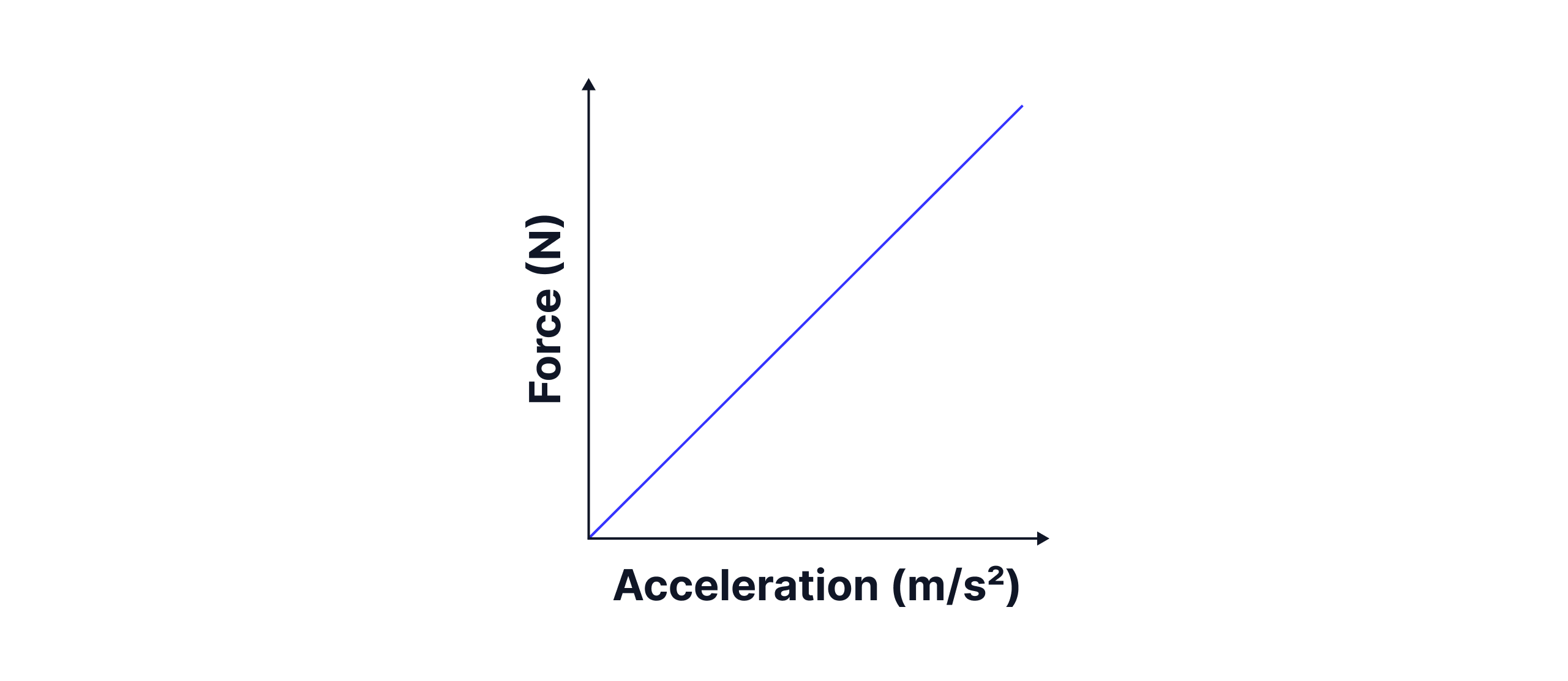
Plotting a graph of our results of force against acceleration, and drawing a line of best fit through our results, gives us a graph similar to the one below. The line of best fit passes straight through the origin, showing that force and acceleration are directly proportional, .
Worked Example:
A student carried out an experiment to see how the acceleration of a trolley depends on the overall force acting on it. The trolley was held at rest and then released so that it moved along a runway with constant acceleration. The time taken for the trolley to travel a known distance was measured.
Explain how the student could calculate the trolley’s acceleration using the measured distance and time.
Answer:
Calculate average velocity using:
Double the average velocity to find the final velocity
Calculate acceleration using: where the initial velocity is .
Worked Example:
A student investigates how the acceleration of a trolley depends on the resultant force acting on it.
The trolley moves along a runway and passes through two light gates connected to a data logger. The distance between the light gates is kept constant.
Describe how the student could use the light gates to show that the acceleration of the trolley is directly proportional to the resultant force acting on it.
Answer:
The acceleration is calculated from the change in velocity measured by the light gates over the time taken to travel between them.
The resultant force on the trolley is changed by removing hanging masses from the weight stack and adding them to the top of the trolley. This keeps the total mass of the system constant.
The student should then plot a graph of acceleration on the x-axis and force on the y-axis. If the graph is a straight line through the origin, this shows that acceleration is directly proportional to the resultant force.
Acceleration vs Mass
To see how mass affects acceleration, again, we could use a stopwatch or light gates. Here, we are going to use light gates because they reduce human error caused by starting and stopping the stopwatch.
Set up your equipment as shown above, holding the trolley in place, with a string attached to the front that hangs over the edge of the table and over a pulley, with masses attached to apply a constant force.
Attach a card to the top of the trolley, and measure its length, plugging this data into the computer
Measure the distance between the two light gates and plug this data into the computer.
The light gates record both the time it takes for the trolley to pass through them and the time for the trolley to pass between the two light gates.
When you release the trolley, the computer calculates the initial velocity and final velocity of the trolley at each light gate using the equation, . It then calculates the trolley's acceleration between the two light gates using the change in its velocity and the time of travel between them.
Repeat the steps above, changing the total mass of the system by adding masses to the trolley, using the computer and light gates to calculate the acceleration of the trolley for different masses.
Results
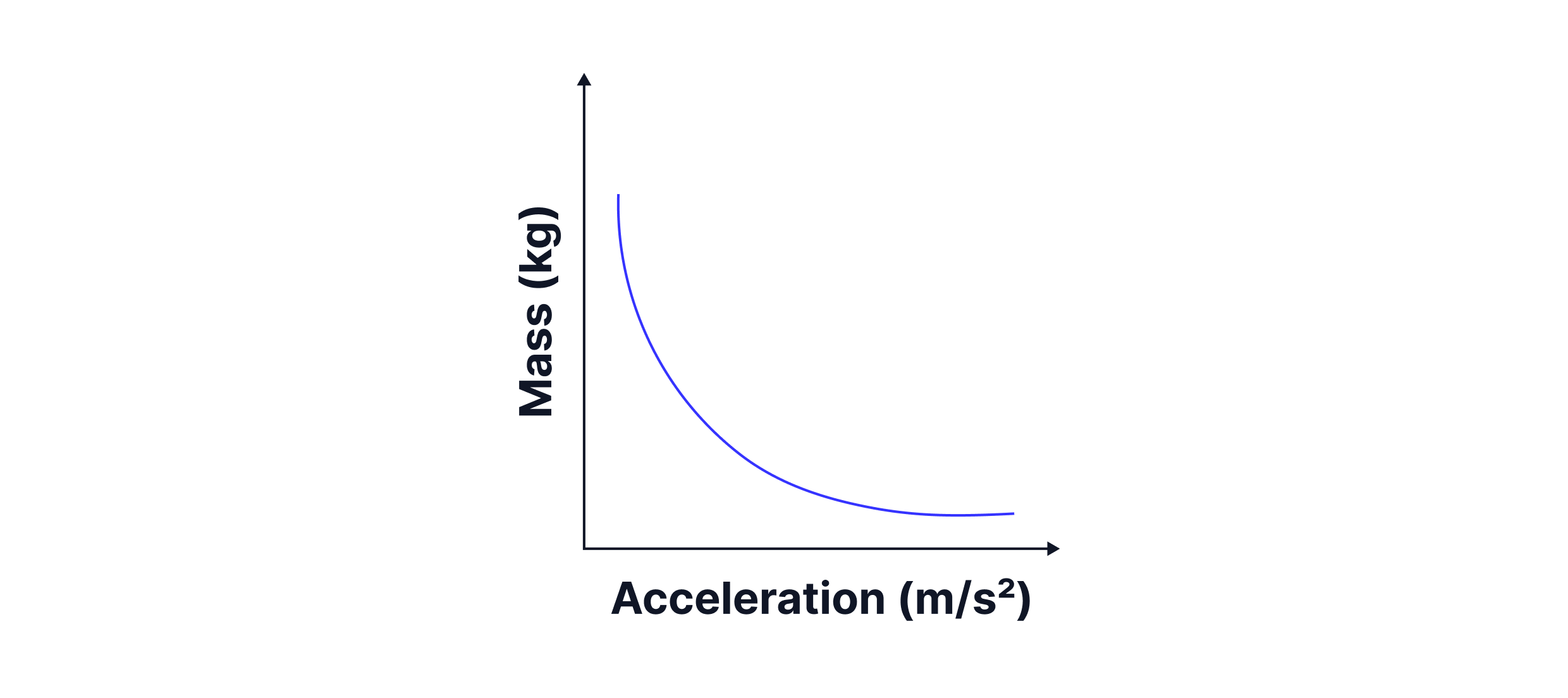
When a graph of mass against acceleration is plotted from our results, we get a graph like the one shown below. The curve shows that as the trolley's mass increases, its acceleration decreases. Mass and acceleration are inversely proportional.
Improving Your Results
Friction opposes the motion of the trolley, so using an air track will reduce the friction to almost zero, making the results more accurate.
Worked Example:
A student investigates how the acceleration of a trolley depends on its mass.
State the control variable in this experiment.
State the dependent variable in this experiment
For a mass of , the student recorded values of acceleration, . Calculate the resultant force acting on the trolley.
Answer:
The resultant force on the trolley
The acceleration of the trolley
As we are given mass and acceleration, we can use the equation, . But first we need to calculate the mean acceleration,
We will round this to to match the number of decimal places in the data.
Practice Questions
A student uses a light gate to measure the velocity of a trolley at two points apart. The velocity increases from to in this distance. Calculate the acceleration.
-> Check out Hannah's video explanation for more help.
Answer:
A student investigates how the acceleration of a trolley changes when additional masses are placed on top of it. The accelerating force is provided by a fixed hanging mass.
The trolley and added masses have a combined mass of . Calculate the acceleration.
The student increases the mass of the trolley system to while keeping the accelerating force at . Calculate the new acceleration.
-> Check out Hannah's video explanation for more help.
Answer: