Moments
(Triple Only)
Brook Edgar & Hannah Shuter
Teachers


Contents
Explainer Video
Moments
Imagine trying to open a door. If you push near the hinges, it's really hard to get the door moving. But if you push near the handle (far from the hinges), it's much easier. You are applying the same force, so why is one easier than the other? This is due to moments.
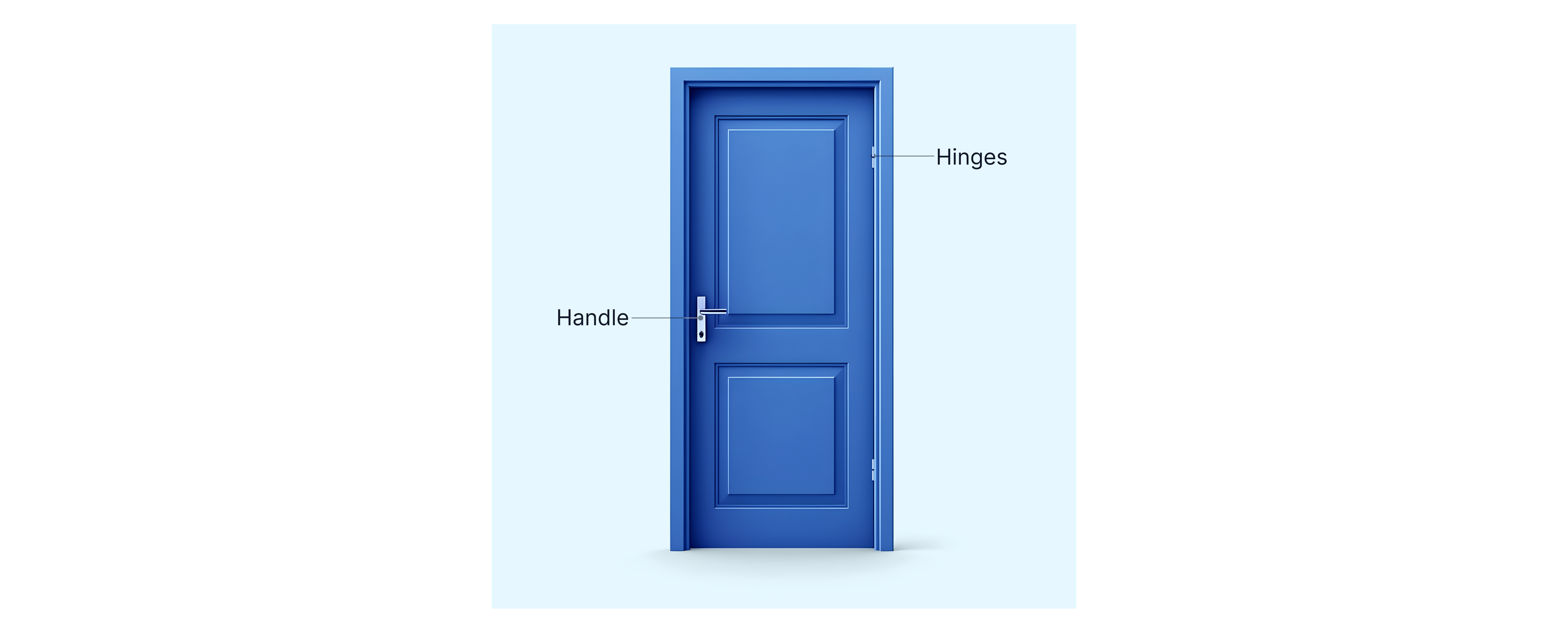
A moment is the turning effect of a force. When a force acts on an object that can rotate around a pivot (like a door around its hinges), it creates a turning effect. The bigger the moment, the bigger the turning effect.
Formula:
We can use the equation above to calculate the moment/turning effect I apply to a door if I push it away from the hinges with a force of .
We describe moments as being "clockwise" or "anticlockwise" depending on which way they would turn an object. The force below would tip the plank down, rotating it clockwise about the pivot (the point on which it rests).

Whereas the force below will pull the plank up, rotating the plank anticlockwise about the pivot.

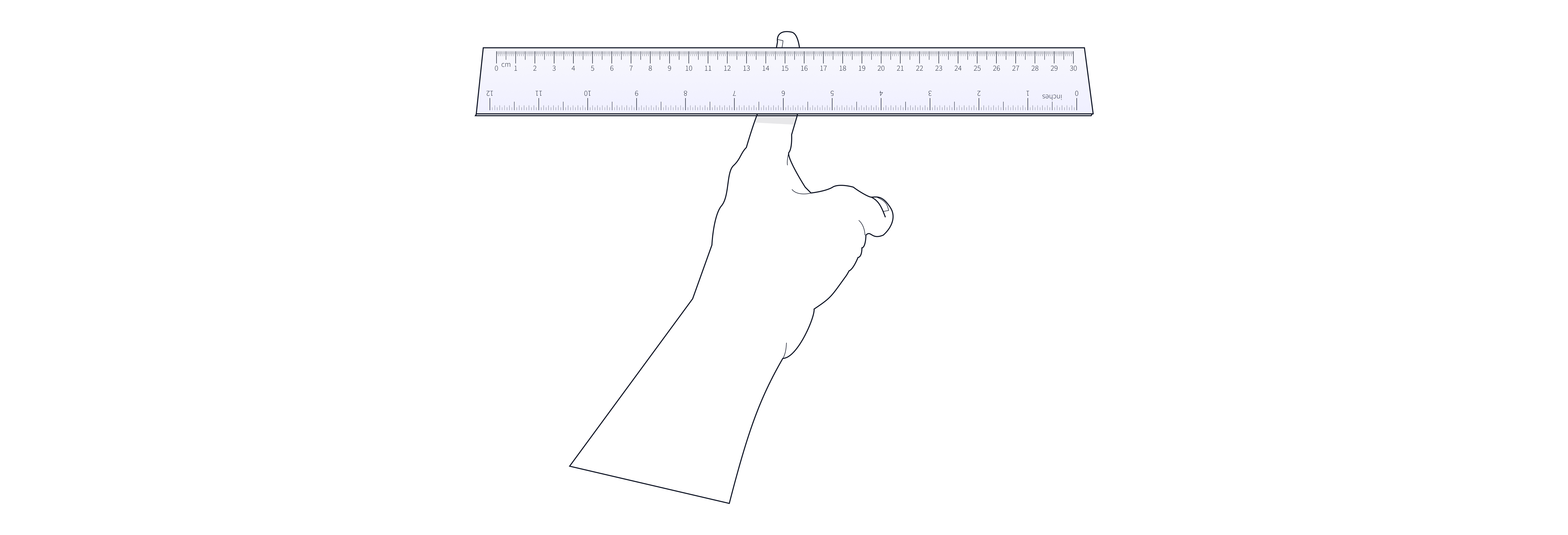
If the pivot were moved to the centre of the plank, the plank would be balanced. This is because the weight of the plank acts through its centre of mass. As the plank is a regular shape, its centre of mass will be right in the middle, so if we apply an upward force at this point, by placing the pivot there, the object will be balanced. This is because the object's weight has zero turning effect about the pivot, as the distance from the pivot is zero. We know this as if we had a ruler, we know that we could balance it by placing our finger (the pivot) at its centre - along.
For the keen-eyed among you, you may have noticed that the equation to calculate work done, and the equation to calculate moments, look the same, BUT they are in fact very different. When calculating work, the force and distance must be parallel to each other, but when calculating moments, the force and distance must be perpendicular to each other!
Worked Example:
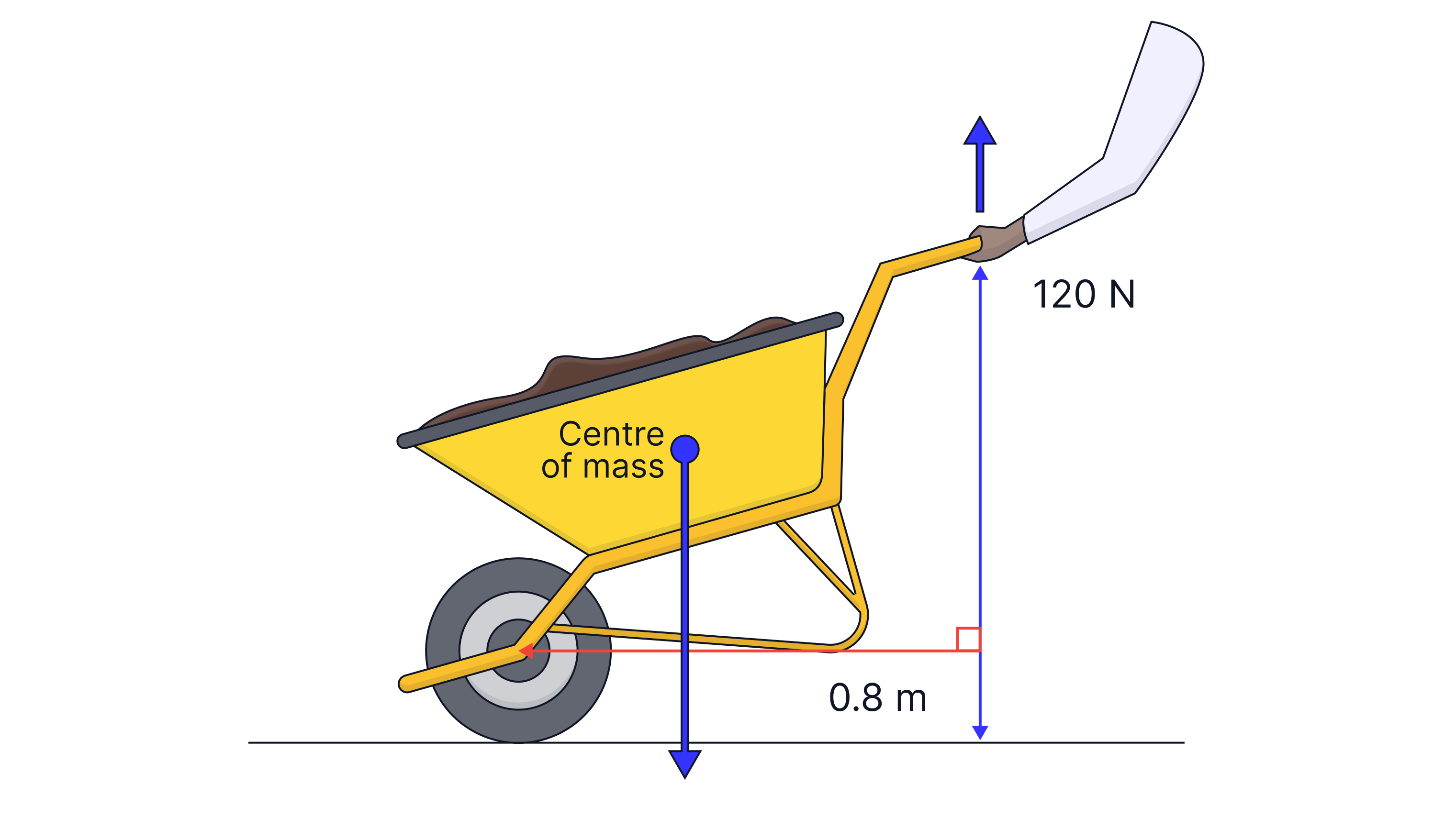
Calculate the moment of the force about the pivot.
Answer:
Remember, the pivot is the point around which the object can rotate/turn. In this question, the pivot is the centre of the tyre.
The upward force is applied at a perpendicular distance of from the pivot (wheel).
This creates an anticlockwise moment of about the pivot.
The Principle of Moments
The sum of all the clockwise moments is equal to the sum of all the anticlockwise moments about any point.
In other words: Total clockwise moments = Total anticlockwise moments.
This is called the 'principle of moments'.
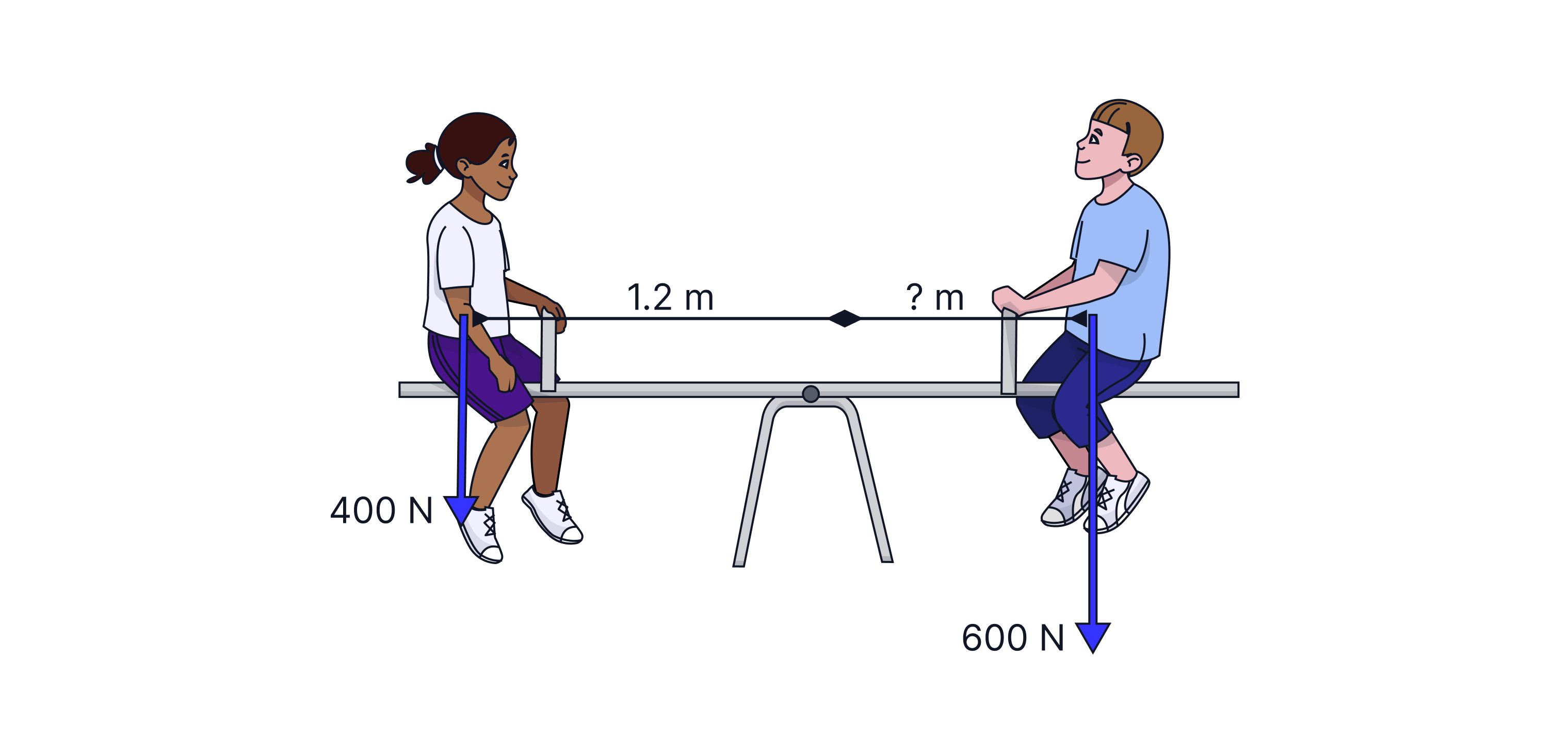
We all know from playing on see-saws when younger that as the boy is heavier, he will have to sit closer to the middle (the pivot) to balance the see-saw. But now we can calculate this distance using the principle of moments.
Total clockwise moments must equal the total anticlockwise moments.
The girl is providing the anticlockwise moment, and as we are given both her force and distance, we can calculate her moment:
The boy applies a clockwise moment. We want the see-saw to be in equilibrium/balanced. Therefore, the moment of the boy must = the moment of the girl.
Worked Example:
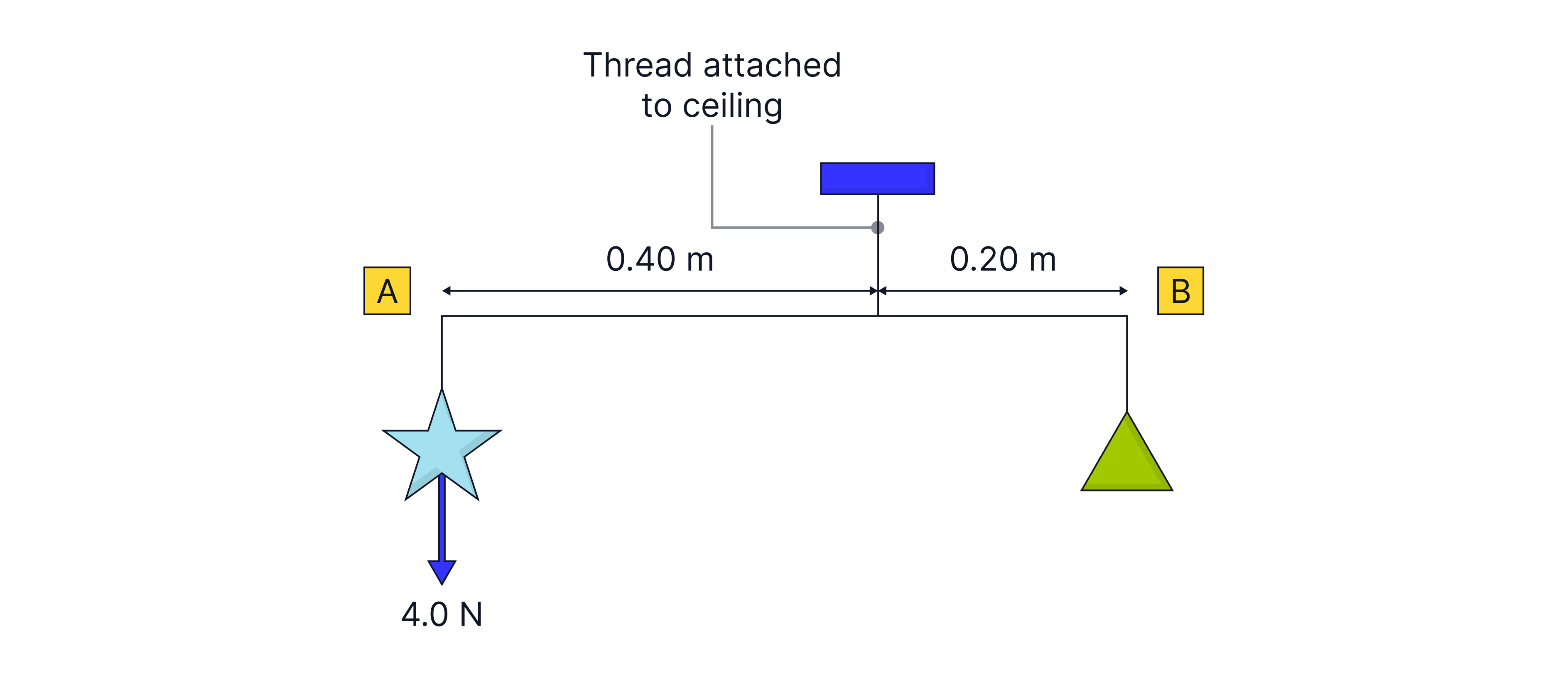
The weight of the star is
The distance of the star from the pivot (thread attached to the ceiling) is
The distance of the triangle from the pivot is
Calculate the moment of the star about the pivot.
State the direction of this moment.
State the principle of moments.
Now calculate the weight of the triangle.
Answer:
The moment is anticlockwise.
For an object in equilibrium, the sum of the clockwise moments must equal the sum of the anticlockwise moments. Therefore, in the example, the moment of the star must equal the moment of the triangle.
Remember, weight is the downward force of gravity, so the downward force exerted by the triangle is the triangle's weight.
Levers and Gears
Levers are simple machines that use the principle of moments to "multiply" forces. We use them to make our lives easier, so we can lift heavy objects with little force.
Let's say we want to lift this large boulder, which has a weight of . If we place it close to the pivot, away, by applying a small force of , away we can lift it.

This works on the principle of moments: the moment we apply at one end of the pivot must equal the moment applied at the other end. The moment we apply is,
So a moment if is applied at the other end by the boulder. As it is away from the pivot, we can show the force that is applied to lift it is,
As you can see, by using the principle of moments, our force was used to lift a much heavier object, heavier. The further away we apply the force from the pivot compared to the load, the more we multiply up our force. This same principle is used in bottle openers.
Gears
Gears are another practical application of moments. Gears are toothed wheels that mesh together. When one gear turns, it makes the other gear turn too. They are used to transmit the rotational effects of forces from one gear to another.
When two gears mesh together, the teeth push on each other. This creates forces between the gears. These forces act at the edge of each gear (at the teeth), at a certain distance from each gear's pivot (its centre).

Key facts about gears:
When gear A turns clockwise, gear B turns anticlockwise (opposite direction)
The gears exert equal and opposite forces on each other (Newton's third law)
A larger gear has its force applied further from its pivot, so it has a larger moment
A larger gear turns more slowly than the smaller gear it's connected to
Worked Example:

Both gears exert the same force on each other. Which one has a bigger moment? Explain why.
Answer:
The gear with teeth has a bigger moment. Both gears exert equal and opposite forces on each other (Newton's Third Law), but the gear with teeth has a bigger radius/distance from pivot.
Since , the force is the same but distance from the pivot is larger, so the larger gear has a bigger moment.
Practice Questions
A long uniform plank is supported at its left end. A weight hangs from the pivot.
State the equation for the moment of a force about a pivot.
Calculate the moment of the weight about the pivot.
-> Check out Hannah's video explanation for more help.
Answer:
A student uses a lever to lift a heavy rock. The student applies a downward force of at the end of a bar. The pivot is placed from the rock. Assume the system is in equilibrium.
Calculate the clockwise moment produced by the student's force.
The rock is on the opposite side of the pivot at a distance of . Calculate the upward force acting on the rock.
-> Check out Hannah's video explanation for more help.
Answer: