Hooke's Law
Brook Edgar & Hannah Shuter
Teachers


Contents
Explainer Video
Forces and Changing Shape
Hooke's law describes how elastic objects, such as springs, behave when stretched or compressed.
If you want to stretch, bend, or compress something, you need at least two forces working together. Think about stretching a spring. If you just pull on one end of a spring at rest on the ground, the spring will just move with you - it won't stretch. You need to hold one end fixed while you pull on the other end. These two forces, acting in opposite directions, would cause the spring to extend.

Elastic Deformation vs Inelastic Deformation
When you apply forces to stretch an object, two things can happen:
Elastic Deformation - This is when the object returns to its original length when you remove the force. Think of stretching a rubber band and then letting go - it springs back to its original size.
Inelastic Deformation (also called plastic deformation) - This is when the object does NOT return to its original length after you remove the force. It stays permanently stretched or deformed.
Worked Example:
State the difference between elastic deformation and plastic deformation.
Answer:
Elastic deformation is when the spring returns to it's original length after the force is removed.
Plastic deformation is when the spring doesn't return to it's original length after the force is removed.
Hooke's Law
The extension of an elastic object (like a spring) is directly proportional to the force applied, up until the limit of proportionality.
"Directly proportional" means that if you double the force, you double the extension. If you triple the force, you triple the extension. If you plotted a graph, a straight line of best fit through the origin would show you that the variables are directly proportional.
The "limit of proportionality" is the point where Hooke's law is no longer obeyed; the spring will still stretch, but the amount it extends is not proportional to the force applied.
Formula:
-> Extension (), is not the same as length. Extension is how much longer or shorter the spring has become. It is the change in length when the force is applied.
-> Spring constant () tells you how stiff a spring is. A higher spring constant means a stiffer spring - you will need a greater force to stretch it by the same amount. Springs have different spring constants depending on their uses.
A spring in a car's suspension system has a very high spring constant (it's very stiff) because it must support the car's weight.
The spring in a clicky pen has a much lower spring constant, as only a little force applied by your thumb is needed to compress it.
Example: My dog is pulling on her bungee lead. The bungee extends from to and has a spring constant of . I can calculate the force my dog is pulling with using Hooke's Law, provided that the bungee lead is being elastically deformed.
First, I need to find the extension of the lead:
Then I can use Hooke's Law:
Worked Example
Calculate the extension of a spring with of force applied, spring constant .
Answer:
Worked Example:
Calculate the force applied to a spring that extends by with spring constant .
Calculate the work done to the spring to get this extenstion.
Answer:
Worked Example:
When a force of is applied to a spring, it extends from to . Calculate the spring constant of the spring.
Answer:
Hooke's Law RP
To investigate Hooke's Law, to show that force is directly proportional to extension, , set up the equipment as shown below and follow the method:
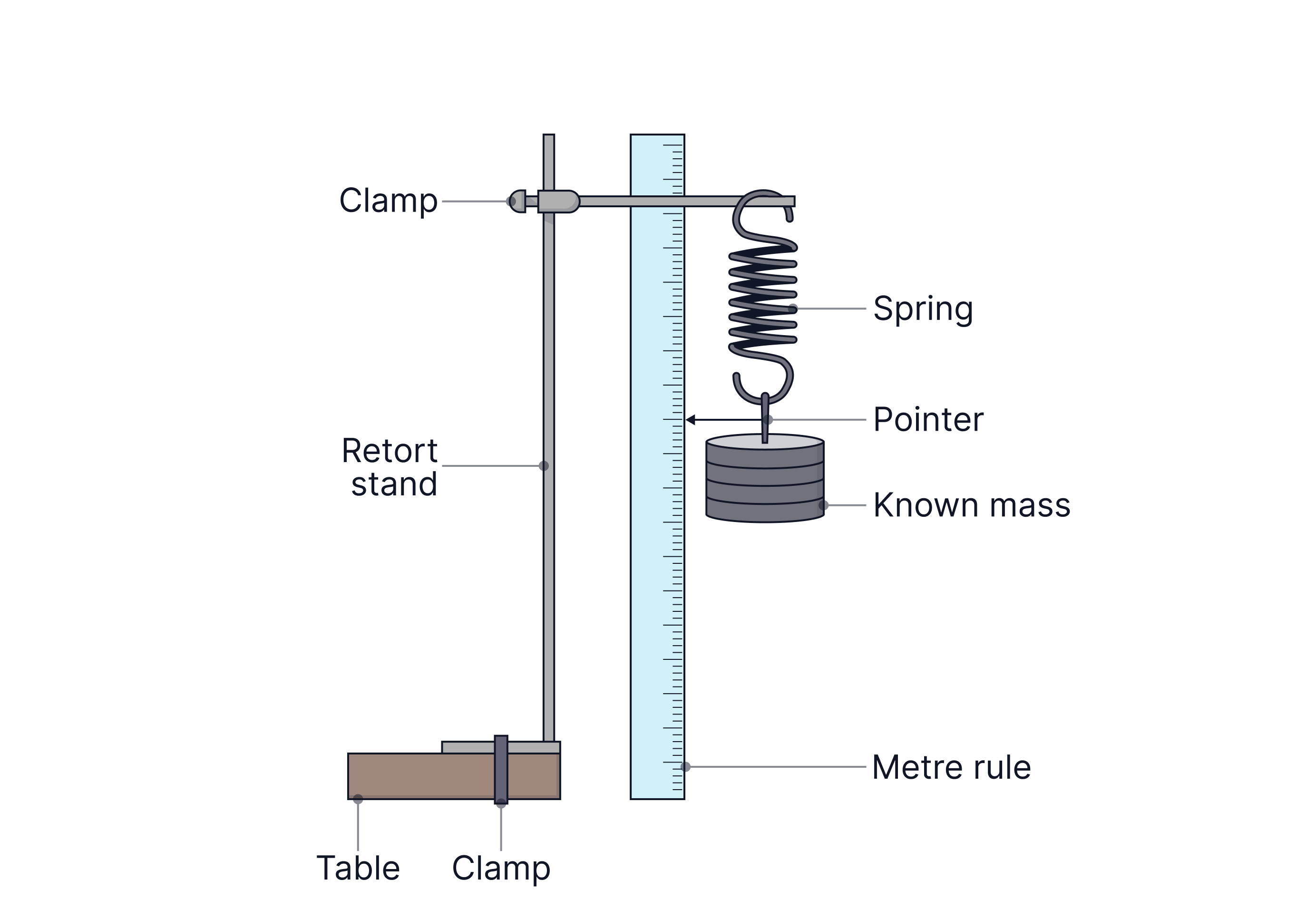
Measure the original length of the spring using a ruler
Attach a known mass to the spring
Measure the new length of the spring using a ruler (ensure to read from the bottom of the spring, from the pointer, at eye level, to avoid parallax error)
Calculate extension by subtracting the original length from the new length
Calculate the force applied to the spring using the equation, , where is the mass of the mass attached and is the gravitational field strength ()
Repeat all steps above by adding more masses to increase the force applied
Plot a graph of the results, plotting force against extension
Results
When the results are plotted, and a line of best fit is drawn through the data, we get a graph like the one below:

Initially, there is a straight line through the origin. This straight-line section is where Hooke's Law is obeyed -> force and extension are directly proportional.
The gradient (slope) of this line gives us the spring constant, , as . A steeper line, therefore, means the spring has a bigger spring constant (stiffer spring).
We can see that the line eventually curves as more and more force is applied to the spring. The point at which the line starts to curve is known as the limit of proportionality. This is the point at which the spring stops obeying Hooke's Law. The spring is no longer elastic, and is now known as plastic.
Worked Example:
Describe how to measure the extension of a spring in the Hooke's Law required practical.
Answer:
First, measure the unstretched length of the spring (initial length)
Add masses to the spring
Measure the new length of the spring (final length)
Calculate extension using .
Worked Example:
of mass is used to stretch a spring. Calculate the force this mass exerts.
Answer:
To calculate the force we need to find the weight of the masses. But first, we need to convert :
Worked Example:
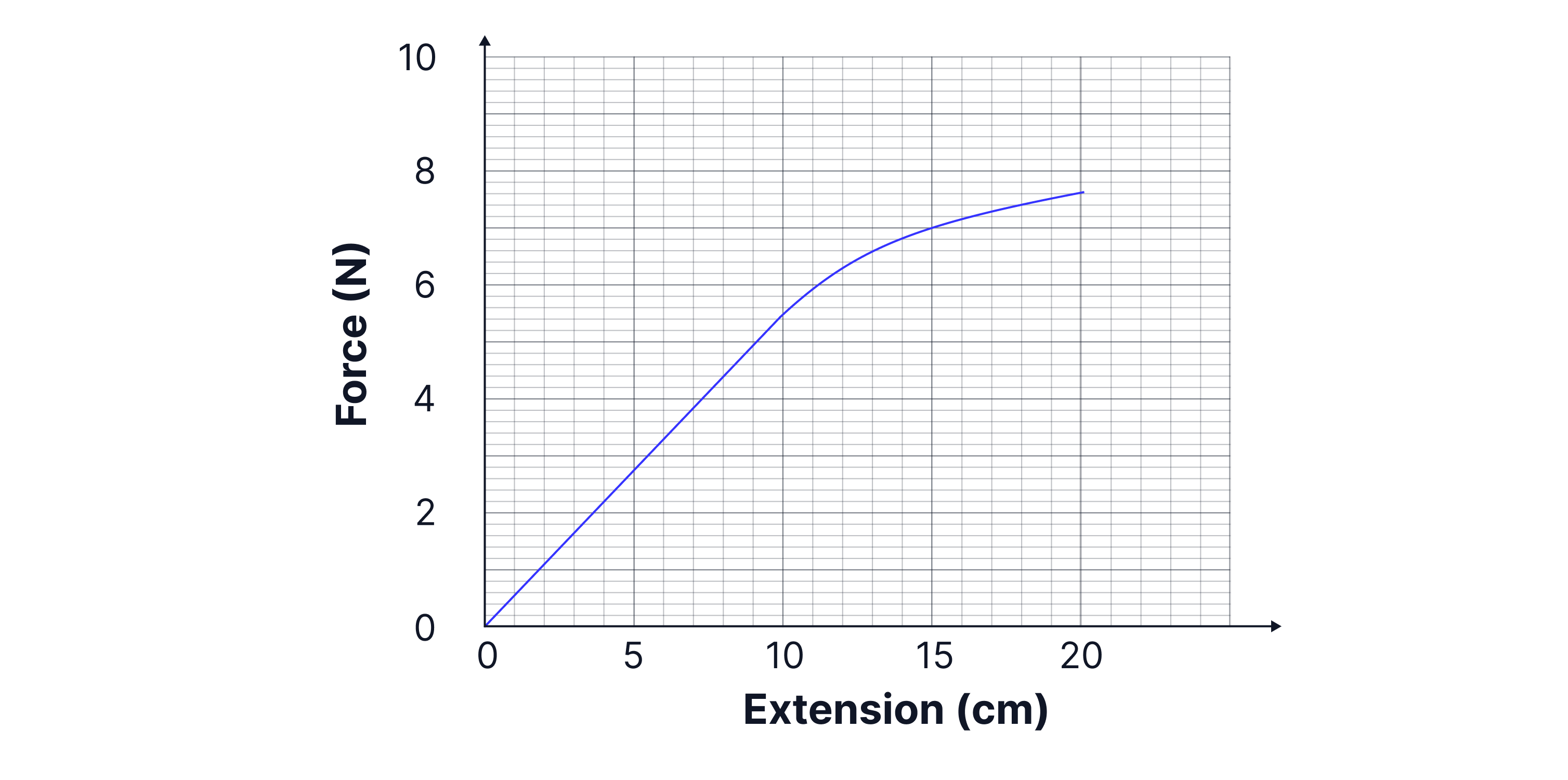
State the maximum force that can be applied to the spring to still obey Hooke’s law.
What is this point called?
Calculate the spring constant from the graph.
Answer:
is the point beyond which the extension and force are no longer directly proportional - this is the maximum force that can be applied to the spring so that it still obeys Hooke's Law. The line starts to curve after this point.
This point is called the limit of proportionality.
We need to take the gradient of the straight-line part of the graph, from . The units on the x-axis are in centimetres, so we need to convert this into metres.
Practice Questions
A student investigates the extension of a spring by hanging different masses from it. The spring obeys Hooke’s Law for the range used.
A load of produces an extension of . Calculate the spring constant.
Explain what is meant by the “limit of proportionality” for a spring.
-> Check out Hannah's video explanation for more help.
Answer:
It is the point beyond which extension is no longer directly proportional to force. Beyond this point the spring will not follow Hooke’s Law and the graph is no longer a straight line through the origin.
A spring with a spring constant of is stretched by .
Calculate the force applied to the spring.
Describe how a student could obtain accurate extension measurements of the spring.
-> Check out Hannah's video explanation for more help.
Answer:
Measure the original length of the spring, then measure the new length after each added load and calculate extension by subtraction. Use a ruler with millimetre resolution, ensure the ruler is vertical and at eye level.