Pressure
(Triple Only)
Brook Edgar & Hannah Shuter
Teachers


Contents
Explainer Video
What is Pressure?
Pressure on a surface is the force acting at a right angle to the surface per unit area -> it is a measure of the size of the force over a given area.
Formula:
Pressure is directly proportional to the force applied to a surface, . As the force increases, pressure increases. However, pressure is also inversely proportional to the area. As the area increases, the pressure decreases.
For example, if you press your finger onto a table, you're applying a force over the area of your fingertip. But if you press a sharp pencil onto the table, as the same force is concentrated on a tiny area, the pencil dents the table as the pressure is much higher.
-> If the area of your fingertip is , and the force applied is , the pressure would be:
-> If the area of a sharp pencil is , and the force applied is , the pressure would be:
We can clearly see from the maths that if the same force is applied to a smaller area, the force significantly increases.
Worked Example:
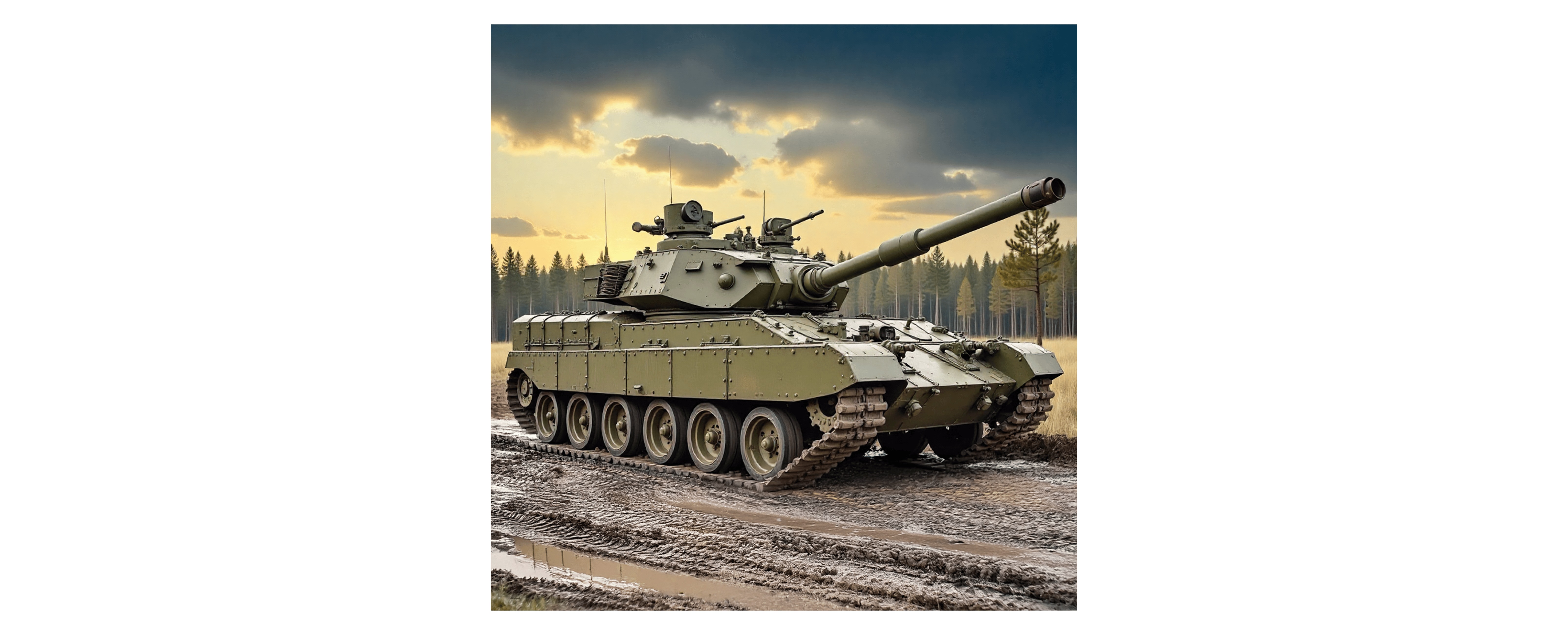
What is pressure?
Calculate the pressure of a tank weighing and tracks that contact of dirt.
3. How does increasing the area affect the pressure?
Answer:
Pressure is the force acting per unit area, acting perpendicular (at right angles) to a surface. It is calculated using the formula , where pressure is measured in pascals (), force in newtons (), and area in square metres ().
From the formula , pressure is inversely proportional to area. If the area increases while force stays constant, the pressure decreases.
Pressure in Fluids
A fluid is any substance that can flow, including liquids and gases.
Gas particles exert pressure on the walls of their container. For example, in a balloon, the gas particles move randomly and collide with the balloon's surface, thus exerting a force on the balloon at right angles to its surface. This force per unit area is pressure and keeps the balloon inflated.
Liquid particles exert pressure on the surfaces of substances. For example, imagine a ball submerged in a large beaker of water, as shown in the image below. The water particles collide with the surface of the ball, thus exerting a force on the ball at right angle to its surface, shown by the blue arrows. These collisions exert a force over a certain area of the ball, thus creating pressure.

We can see in the image above that the force arrows on the ball at the bottom are larger than at the top, indicating that the force per unit area on the ball is greater at the bottom than at the top. This is because pressure in a liquid increases with depth, as shown by the equation below:
Formula:
The pressure is directly proportional to height/depth in the water. At greater depths, there are more water particles above, all pushing down -> at greater depths, the weight of the water above, acting down, is greater, so the pressure is greater.
This difference in pressure between the top and bottom of the ball is known as upthrust. The larger pressure at the bottom of the ball, and thus the larger force per unit area on the bottom of the ball (shown by the larger blue arrows), creates a resultant force on the ball upwards. This is upthrust.
To prove with maths that there is a resultant force upwards on the ball, known as upthrust:
The top of the ball in the image above is below the surface. The density of water is . The pressure at teh top of the ball is,
The bottom of the ball is below the surface,
The pressure at the bottom is much larger than at the top. Therefore, the force acting on the ball at the bottom is much larger than at the top -> if we look at an area of of the ball, as , the force on the top of the ball is whereas, the force on the bottom is . This is a resultant force of, upwards, on the ball. This upward resultant force is called upthrust.
We can also see from the equation above that the denser the liquid is, the greater the pressure.
Factors That Influence Floating and Sinking
Whether an object floats or sinks depends on two forces: the weight of the object (acting downwards) and the upthrust from the fluid (acting upwards).
If upthrust weight: The object floats (or rises up through the fluid).
If upthrust weight: The object stays where it is (neutral buoyancy - like a submarine hovering)
If upthrust weight: The object sinks
Worked Example:
Honey in a jar has a weight of and the bottom of the jar has an area of .
Calculate the pressure applied by the honey on the bottom of the jar.
Calculate the mass of honey in the jar. Use g = .
Answer:
We are given the force of the honey and the area of the jar, so we can just use the equation,
We can calculate the mass of the honey as we know the weight,
Worked Example:
Calculate the pressure due to seawater at a depth of . Use as . Density of seawater = .
Calculate the depth a fish in the dead sea was at when experiencing . The dead sea has a density of .
Answer:
Worked Example (Stretch):
The bottom side of a box with a surface area of is submerged in water at a depth of. Use as .
Calculate the force on this surface. The density of water is .
Calculate the force on the top surface of the same box. The top surface is at a depth of .
Hence state the magnitude of the resultant force and name this force on this box.
Answer:
We cannot directly determine the force on the bottom side from the information given in the question. But, we can work out the pressure at a depth of , and then work out the force from that pressure
We can work out the force on the top of the box in the same way as we calculated the force on the bottom of the box. We can first work out the pressure at that depth and then work out the force on a surface at that depth:
This force is called upthrust.
Atmospheric Pressure
The atmosphere is a thin layer of air surrounding the Earth, about in depth. The atmosphere gets less dense as you go higher up, as there are fewer air particles in a given volume. This is why people who hike to high altitudes, like the top of Mount Everest, need to carry oxygen tanks.
Atmospheric pressure is created by air molecules colliding with surfaces. Every time an air molecule bounces off your skin, it exerts a tiny force. When you add up all the billions and billions of collisions happening every second, you get atmospheric pressure.

At sea level, there's a lot of air above you - the entire atmosphere is pressing down on you. But as you climb a mountain or go up in a plane, there's less and less air above you. Less air above -> less weight acting down -> less force per unit area -> lower pressure.
Think of it like being at the bottom of a swimming pool versus being near the surface. At the bottom, you have the whole depth of water above you creating pressure. Near the surface, there's hardly any water above you, so less pressure. The same principle applies to the atmosphere.
As you go higher:
The number of air molecules above you decreases -> becomes less dense
The weight of air above you decreases
Therefore, the atmospheric pressure decreases

At sea level, atmospheric pressure is about (or ). It's equivalent to having a weight of about pressing on every square centimetre of your body. You don't notice it because the pressure inside your body balances it out.
Worked Example:
Explain why the pressure on top of Mount Everest is lower than on the surface of Earth.
Answer:
The atmosphere gets less dense with increasing altitude/height above Earth's surface
At higher altitudes, there are fewer air molecules above a given point, which means there is less weight of air pressing down from above
Atmospheric pressure is caused by air molecules colliding with a surface. With fewer air molecules at higher altitudes, there are fewer collisions, resulting in lower atmospheric pressure
Practice Questions
A student places a rectangular block on a bench. The block exerts a force of on an area of .
Calculate the pressure the block exerts on the bench.
→ Check out Hannah's video explanation for more help.
Answer:
A container is filled with oil of density .
Explain, in terms of particles, why a fluid exerts pressure on the walls of the container.
A point in the oil is below the surface. Calculate the pressure at this depth.
Explain why the pressure at the bottom of the container is greater than at the top.
-> Check out Hannah's video explanation for more help.
Answer:
Fluid particles move randomly and collide with the container walls. These collisions exert a force on the walls, producing pressure.
There is a greater depth at the bottom, so the weight of fluid above that point is larger.