Weight
Brook Edgar & Hannah Shuter
Teachers


Contents
Explainer Video
Mass vs Weight
Mass is the amount of matter or "stuff" that an object contains. Think of it as how much material makes up an object. An elephant contains more matter than a mouse, so it has a greater mass. Mass is measured in kilograms .
Your mass never changes. Whether you're on Earth, the Moon or floating in space, your mass stays exactly the same because you are made of the same amount of matter wherever you go.
Although people often use the words interchangeably in everyday life, weight and mass are NOT the same thing in physics!
Weight is the downward force acting on an object due to gravity. It's measured in Newtons (). Gravitational force is an attractive force, so weight always acts towards the centre of the planet.
Unlike mass, weight can change depending on where you are. Your weight on the Moon would be much less than on Earth because the Moon has weaker gravity; it is a smaller object, so the force pulling down on you towards its centre is a lot less. However, your mass would be exactly the same. This is why, when astronauts go to the Moon, they seem to float for a while after jumping: there is a much smaller force pulling them down towards the Moon's centre than on Earth, so they do not come down as quickly.
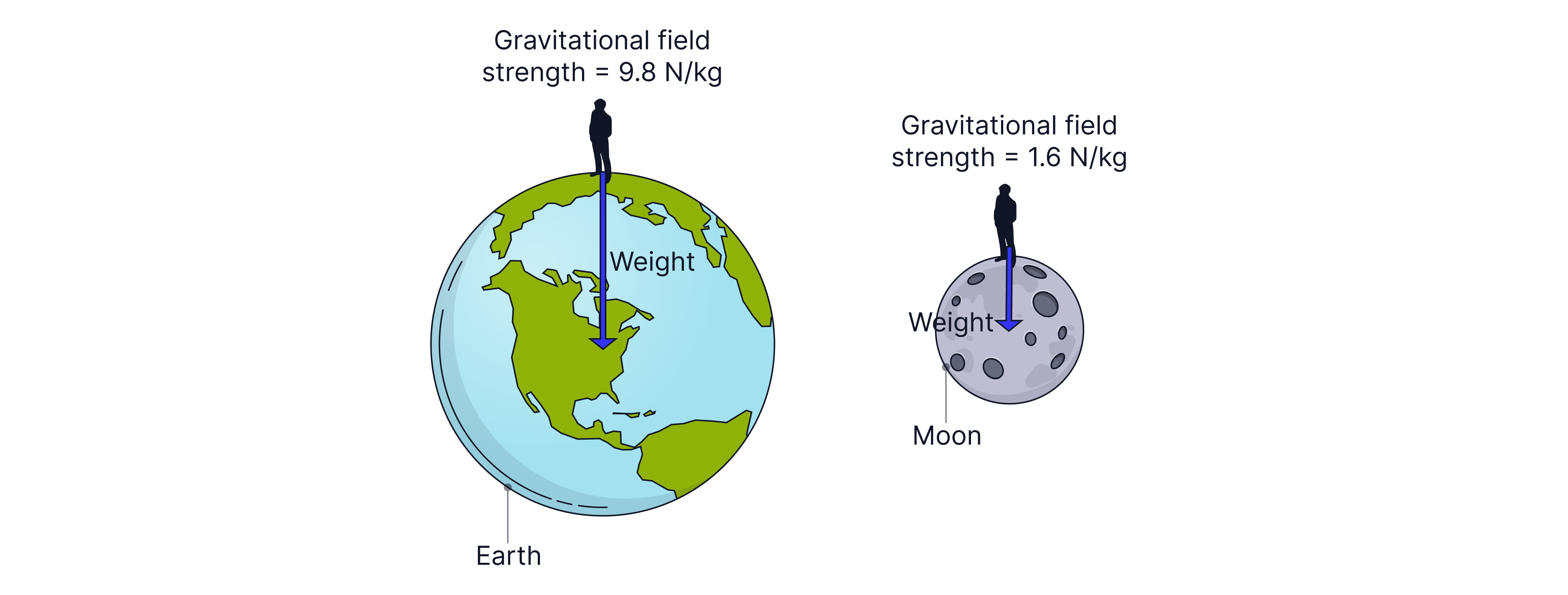
Weight can be calculated using the following equation.
Formula:
Gravitational field strength tells you how strong gravity is at a particular location. On Earth -> this means that every kilogram of mass experiences a downward force of Different planets and moons have different gravitational field strengths. For example, on Mars , as it is a smaller planet than Earth so there will be a much smaller force of acting on each kilogram of mass.
For example, my cat Erwin has a mass of . If I want to calculate his weight (or the force on him due to gravity) on Earth,
But, if Erwin went on a spaceship to Mars, his mass would remain the same, but his weight would be less,
Remember: Unit conversions! The standard unit of mass is - so if mass is in you need to convert it.
Worked Example:
A child has a mass of . On Earth . What is the weight of the child?
Answer:
Worked Example:
The value of on Earth is , find the following:
The weight of a puppy with a mass of .
The mass of a train with weight .
The mass of a cat with weight .
Answer:
Teacher tips: Remember to convert units and substitute numbers in before rearranging.
Worked Example:
On Mars, . What is the weight of an man on Mars.
Answer:
Centre of Mass
The centre of mass is defined as the single point where we can consider all of an object's weight to act. It's also the point through which a force will have no turning effect - so we can suspend an object by it's centre of mass and it won't move.

For a symmetrical object, the centre of mass is where the lines of symmetry meet - like in the sphere above, the centre of mass would be right in the centre.
For more complicated objects that are not uniform, it might not be in such an obvious place, but it's always the point where the object would balance perfectly.
Practice Questions
An astronaut on Earth has a mass of . The gravitational field strength on Earth is .
State the equation that links weight, mass and gravitational field strength.
Calculate the weight of the astronaut on Earth.
The astronaut travels to the Moon, where the gravitational field strength is . Explain what happens to their mass and their weight.
→ Check out Hannah's video explanation for more help.
Answer:
Mass stays the same at . Weight decreases because is smaller, so is smaller on the Moon.
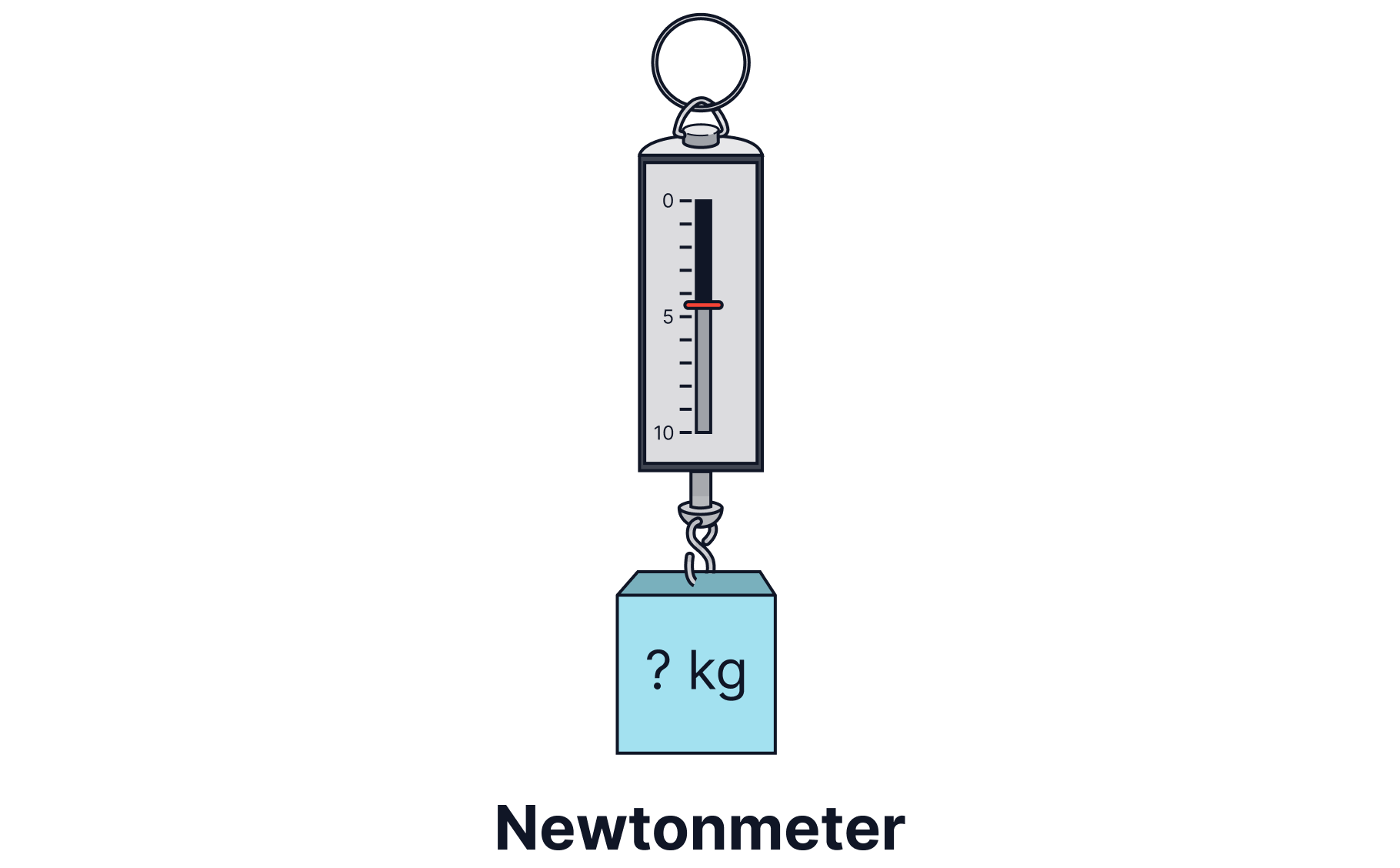
A student uses the newton-meter below to measure the weight of an object. Calculate the mass of the object on Earth. Use .
-> Check out Hannah's video explanation for more help.
Answer:
Common Errors and Exam Tips
Remember to always convert grams into kilograms ()
Mass doesn’t change (unless you’re eating more or going to the gym!), but weight does, depending on location (you will have a smaller weight on the Moon than on Earth as the Moon is smaller)
Remember that weight is measured in NEWTONS, , as it is a downwards force due to gravity