Distance-time Graphs
Brook Edgar & Hannah Shuter
Teachers


Contents
Explainer Video
Gradient of a line
Distance-time graphs are a way of representing an object's motion visually. They show how far an object has travelled (distance on the y-axis) over a period of time (time on the x-axis).
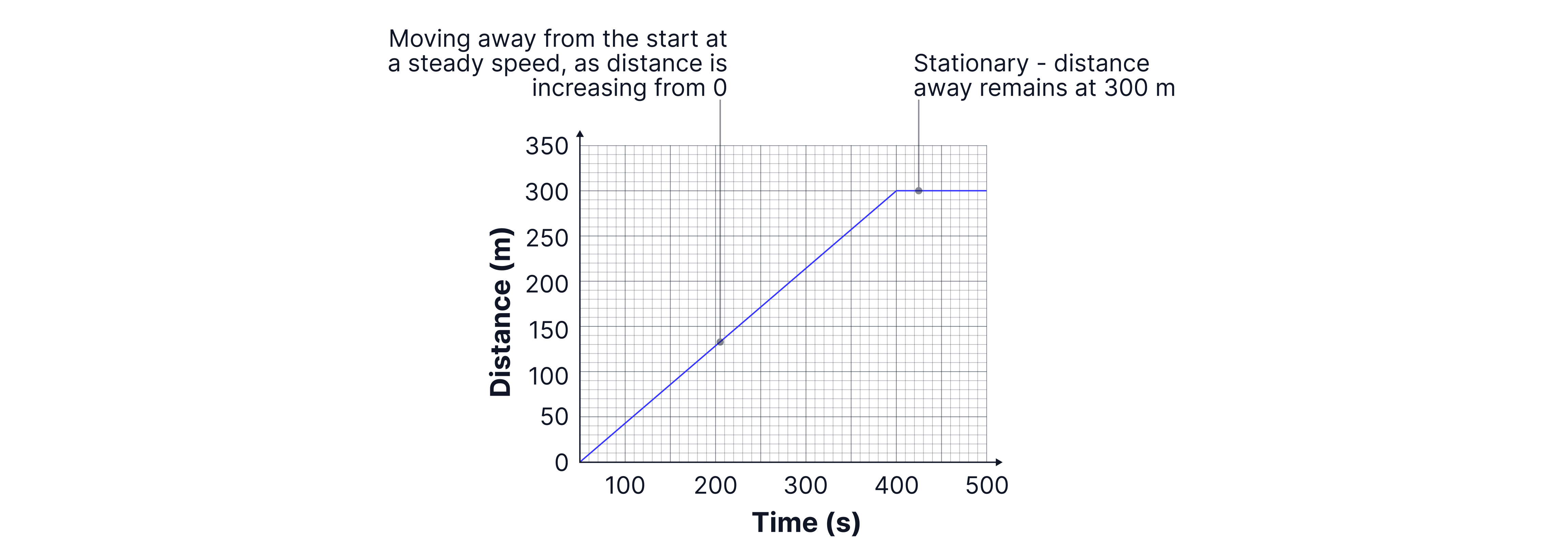
We can see in the graph above that as the distance is increasing at a constant rate for the first -> the gradient (slope) of the line is constant. This shows us the object is moving at a constant speed. We know that, speed = distance time, and because the gradient of a line is calculated by dividing the change in y-axis by the change in the x-axis, the gradient of the line = the speed.
Formula:
We can use this equation to find the object's initial speed (starting speed) from the graph above. The object increased in distance of over (starts moving at and stops at a time of is moving for a total of ).
For the last the distance has not changed, so the object is not moving. It is stationary.
Reminder: Before we dive into graphs, you need to understand some key terms that often get confused:
Distance is a scalar quantity - how far an object has moved in total, with no regard for direction. If you walk forward then back, you've travelled a total distance of .
Displacement is a vector quantity - it includes both the distance and the direction from start to finish, measured in a straight line. In the example above, your displacement would only be forward, because that's how far you actually ended up from where you started.
Speed is a scalar - it's just how fast something is moving, no direction involved. Speed is measured in metres per second . Speed = distance travelled by time taken.
Velocity is a vector - it's speed in a given direction. Velocity = displacement by time taken.
This is why the symbol on your equation sheet is used to represent speed as in A-level physics it is used to represent velocity.
Formula:
This can be rearranged to -> , speed = distance by time taken.
Note in your exam you are allowed to write , as this is how most teachers teach the equation and how it is represented in maths lessons. Speed = distance travelled by time taken.
Reading distance-time graphs
The gradient (slope) of a distance-time graph tells you the speed.
A horizontal line (flat, gradient = ) means the object is stationary - not moving at all. The distance isn't changing as time passes
A straight diagonal line means the object is travelling at a constant speed - the object is moving at a steady rate. The steeper the line, the faster the speed
A curved line means the speed is changing - the object is accelerating or decelerating
If the curve is getting steeper, the object is speeding up (accelerating)
If the curve is getting less steep (flattening out), the object is slowing down (decelerating)

Worked Example
Describe the object's motion and calculate the velocity at each stage between:

Answer:
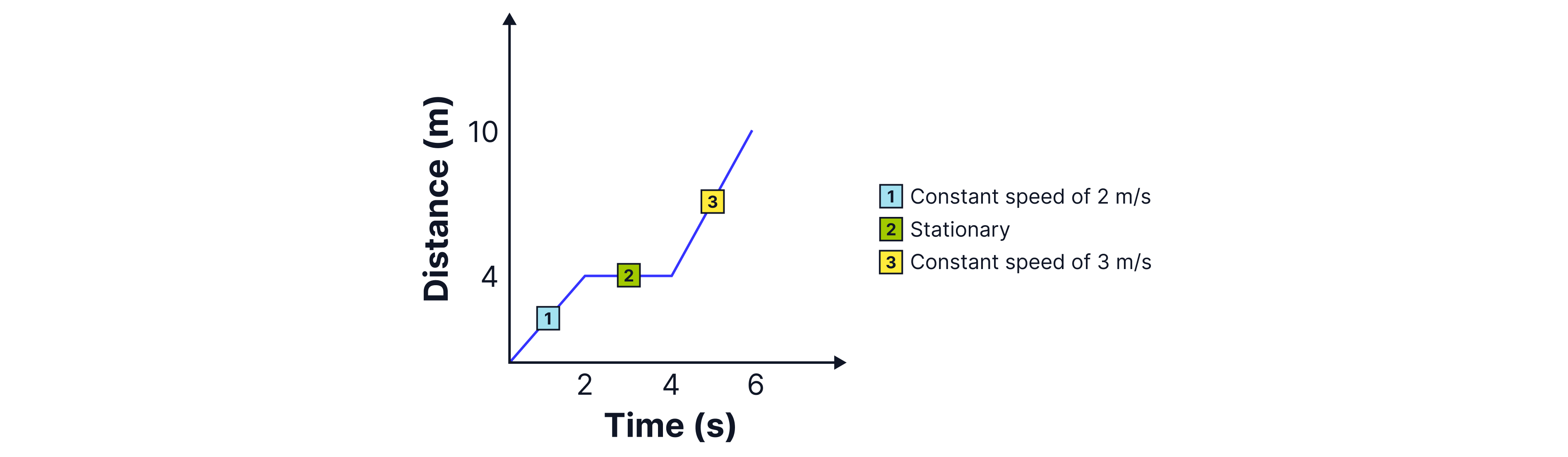
Between , the object is travelling at a constant speed,
Between , the object is stationary because the line's gradient is zero. The distance away never changes as time increases, so the object must not be moving.
Between , the object is travelling at a constant speed,
Teacher Tip: Note in section , the distance increased by as the section starts at a distance of and ends at a distance of . The change in distance, .
Drawing tangents for changing speed (HT Only)
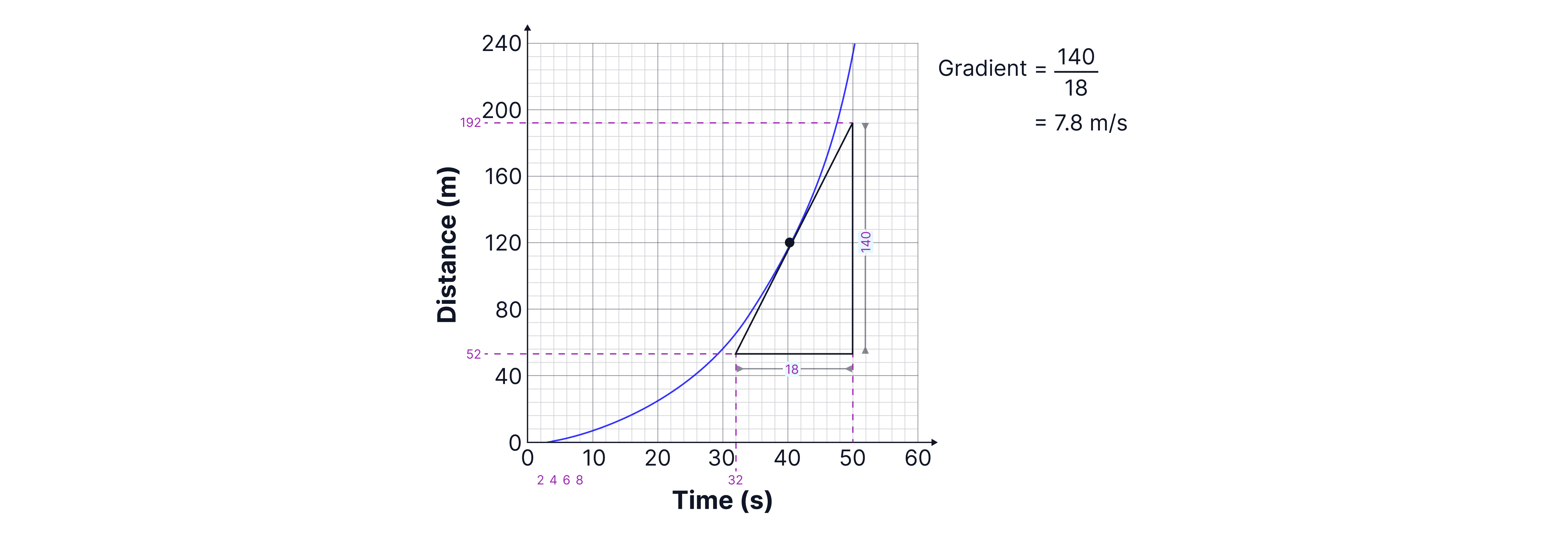
When an object is accelerating or decelerating, its speed is constantly changing. This is non-uniform motion, and on a distance-time graph would appear as a curved line. To find the instantaneous speed (the speed at one specific moment), you need to draw a tangent to the curve at that point and calculate its gradient.
A tangent is a straight line that just touches the curve at one point without crossing it.
Method to find instantaneous speed:
Place your ruler so it touches the curve at the point you're interested in
Adjust it so it has the same slope as the curve at that exact spot (not cutting through the curve)
Draw the tangent line - make it long enough to read values from
Calculate the gradient: pick two clear points on your tangent line, find the change in distance change in time
Average Speed
Average speed is calculated over a whole journey or section:
For the journey shown above, the average speed would be,
Typical Speed Values to Remember
You should be able to recall these typical values:
Walking: approximately
Running: approximately
Cycling: approximately
Speed of sound in air: approximately
These are useful for checking if your answers are realistic!
Worked Example:

1. Calculate the instantaneous velocity at seconds.
2. Calculate the average velocity.
Answer:
1. We need to draw a tangent to the curve at two seconds. We then find the gradient of this line. I chose to find the gradient of the tangent from to as these were easy values to see.
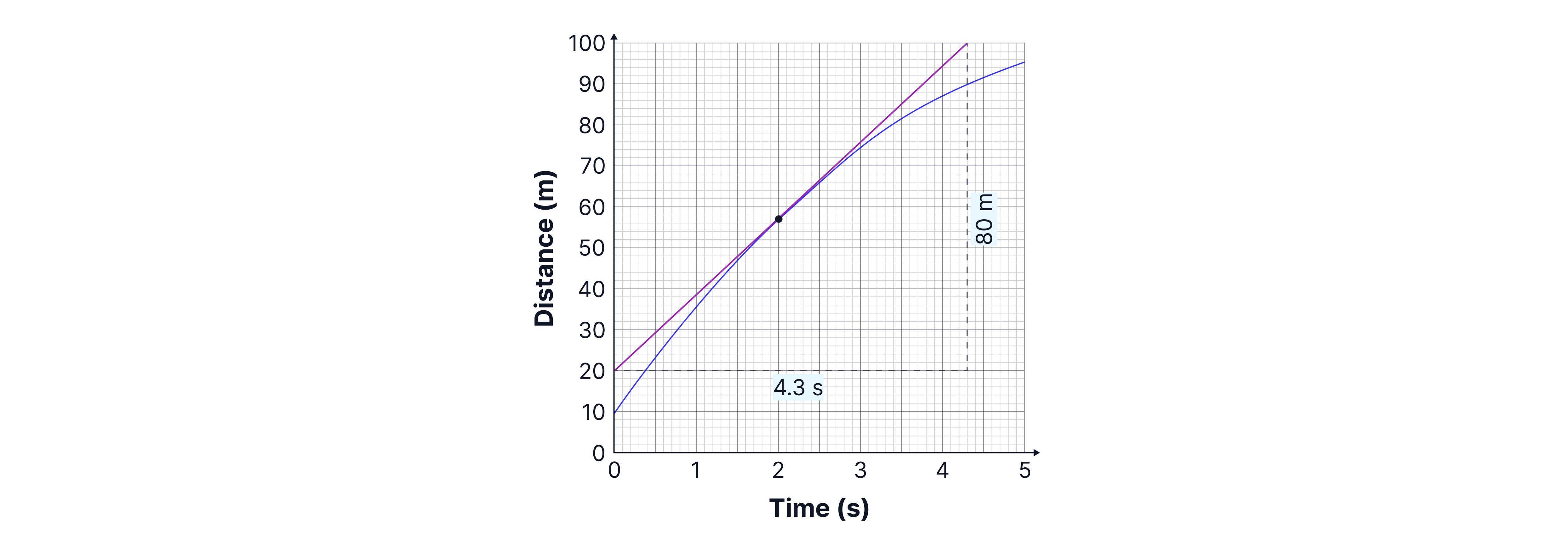
2. Average speed is the total distance travelled total time taken. The graph starts at zero and ends at five, so the total time is , and the distance starts at ten and ends at ninety-five.
Practice Questions
A student walks away from home. The distance–time graph for her journey is shown below.
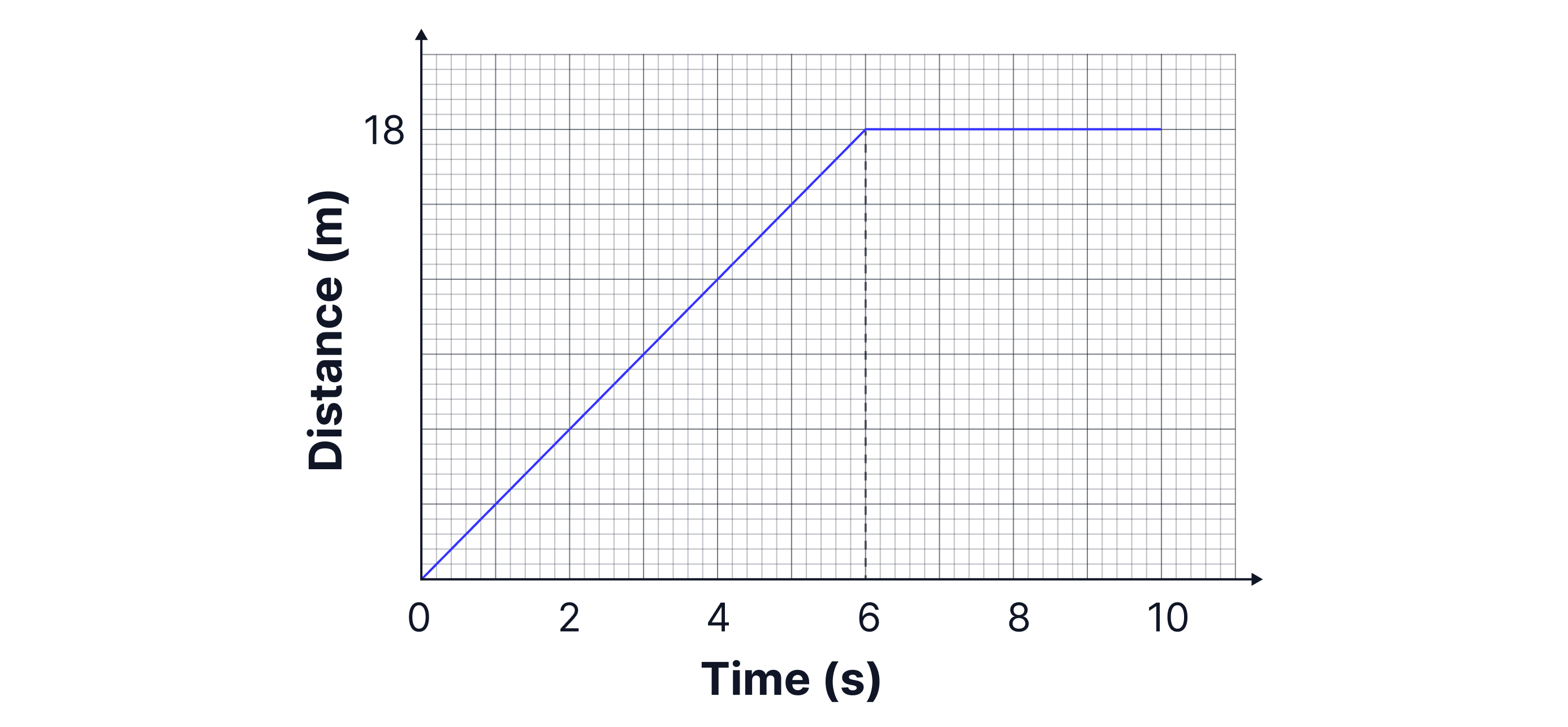
Describe the motion of the student between and seconds.
Describe the motion between and seconds.
If she is from home at seconds, calculate her speed during the first seconds.
-> Check out Hannah's video explanation for more help.
Answer:
Distance increases uniformly with time, the gradient is constant, so she is walking at a constant speed.
Distance remains constant in this interval (doesn't change), so she is stationary.
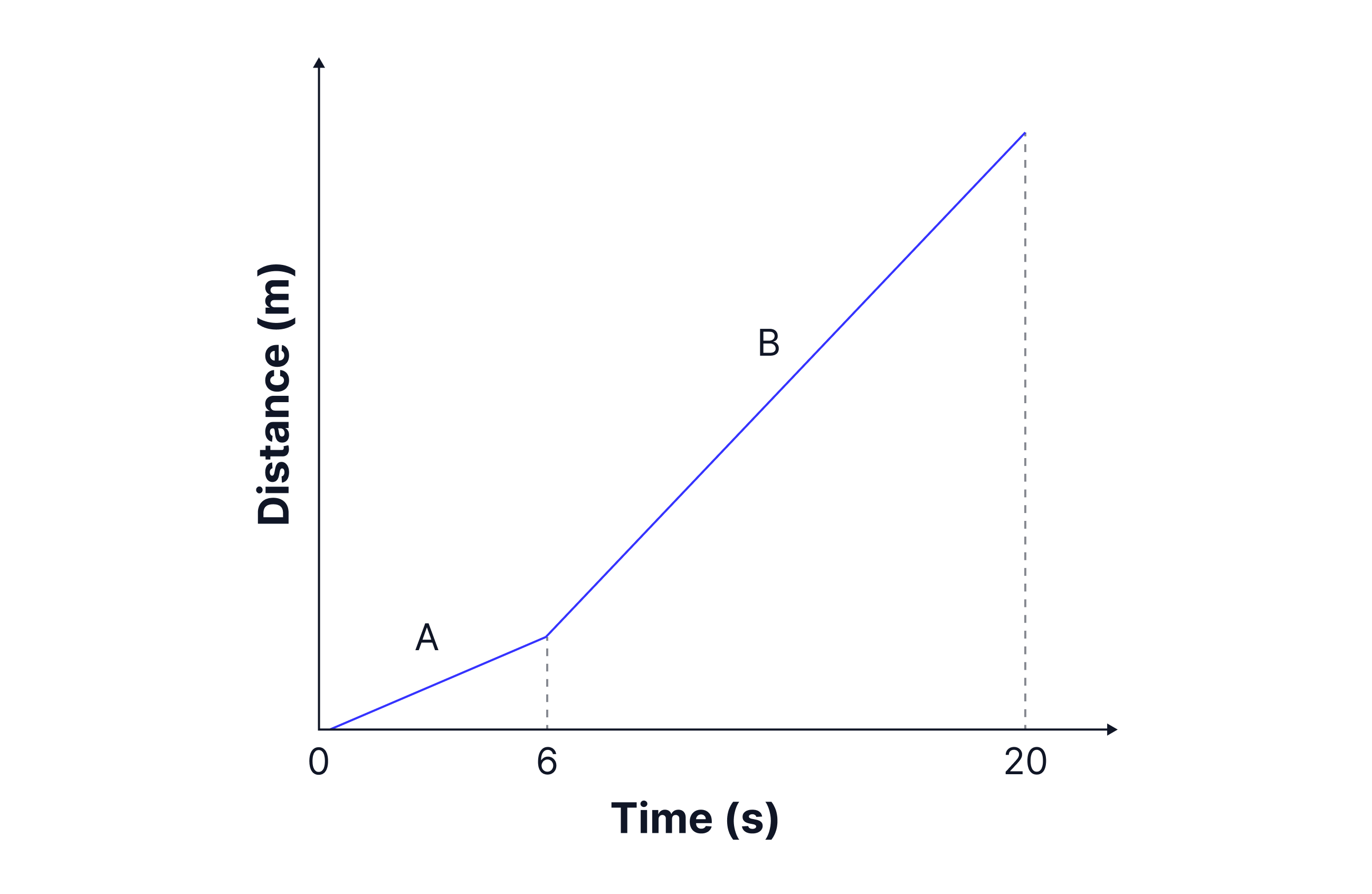
Compare the cyclist’s speed in section A and B.
The cyclist travels in section B. Calculate her speed in B.
-> Check out Hannah's video explanation for more help.
Answer:
The slope is shallower in section A so the cyclist is travelling at a lower speed than in B where the gradient is steeper so the cyclist is travelling faster.