Static Charge and Electric Fields
(Triple Only)
Brook Edgar & Hannah Shuter
Teachers


Contents
Explainer Video
Electric Charge
There are two types of charge: positive () or negative (). If two charged objects are brought close together, they can either attract or repel.
Like charges ( and or and ) will repel
Unlike charges ( and ) will attract
Charged objects can exert a force without touching - this means they exert a non-contact force.
Example: When we bring the charges below close together, A will repel because they are both negative charges. C will also repel because they are like charges, too. B will attract because they are oppositely charged.



Worked Example:
Two small spheres are brought near each other:
Sphere A is positively charged and sphere B is negatively charged. Describe the force between them.
Sphere A is positive and sphere C is also positive. Describe the force between A and C.
Answer
Unlike charges (positive and negative) attract so the force between A and B is attractive.
Like charges (positive and positive) repel so the force between A and C is repulsive.
Electric Fields
A charged object creates an electric field around itself. An electric field is a region where another charge will experience a force.
Field Line Rules
Positive charge: field lines point outwards.
Negative charge: field lines point inwards.
The closer the lines, the stronger the field, so the field is strongest near the charge.
We draw the electric fields around positive or negatively charged objects like this:

Example: If we wanted to tell which of the small negative charges below experiences the largest force of repulsion, it would be B, as the charges are very close together, where the field lines are most dense.

Worked Example:
A metal dome is negatively charged. Four students draw possible electric field patterns around the dome.
Which one of the following descriptions is correct?
Field lines are straight and point outwards from the dome.
Field lines are straight and point inwards towards the dome.
Field lines are circles around the dome.
Field lines are randomly drawn.
Answer:
The dome is negative, so electric field lines must point towards it, so the answer is B.
Remember: Positive people are givers so the field lines point out. But negative people are takers, so the field lines point in towards them.
Static Electricity
When certain insulating materials are rubbed against each other, electrons (small negative particles) can be transferred by friction. This causes the materials to become charged.
The material that gains negative electrons becomes negatively charged
The material that loses negative electrons becomes positively charged
If these two objects are then brought close together, they will attract towards each other as opposite charges attract.

Example: A student rubs their hair with a balloon. As they lift the balloon away from their head, some hair remains stuck to the now negatively charged balloon - we can explain why using ideas of electron transfer.
When the student rubs the balloon on their hair, friction causes electrons to be transferred from the hair to the balloon.
Because the balloon gains negative electrons, it becomes negatively charged. The hair loses negative electrons, so it becomes positively charged.
Opposite charges attract, so when the balloon is lifted away, the positively charged hairs are attracted to the negatively charged balloon, causing some strands of hair to stick to it.
Sparking
When a charged object creates a very strong electric field, it can remove electrons from air particles, so they are now charged. We can say the air has been ionised. The normally neutral air now contains free electrons and charged air particles, meaning it can carry a charge - it is now a conductor. Electrons can now move through the air, causing a spark.
Earthing
When an object is 'earthed', this just means that it loses any excess charge. It becomes neutral.
Worked Example:
A rod loses two electrons when rubbed with a cloth. State the charge that the rod now has.
Answer:
The rod has lost two negative electrons. When you get rid of negative things from your life, you become more positive. As the rod lost two negative electrons, it is then left with a charge of plus 2 -> +2.
Worked Example:
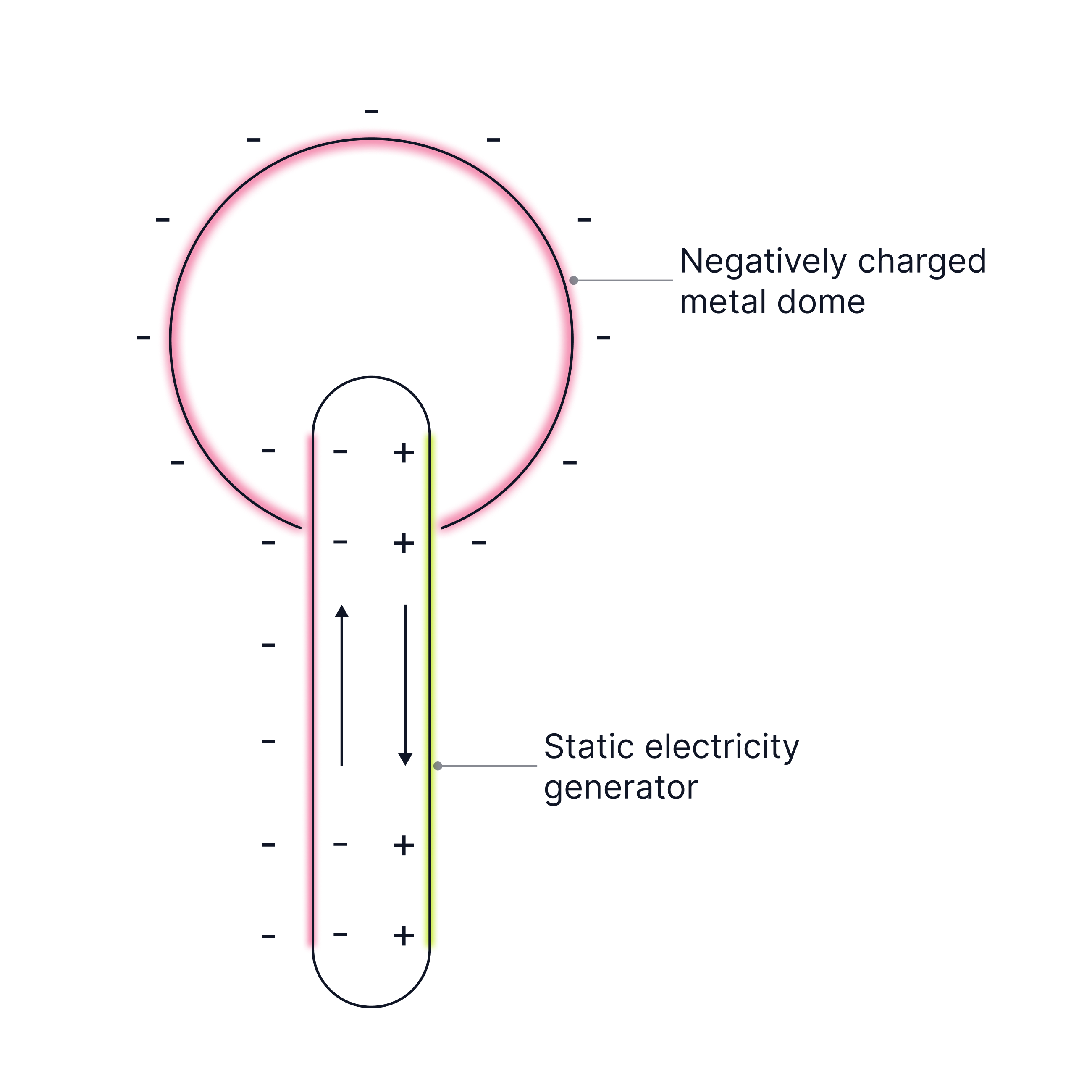
A student touches a negatively charged metal dome on a static electricity generator.
Explain what charge the student’s hair gains.
Explain why the hairs stand up and spread apart.
Answer:
The dome is negatively charged. When the student touches the dome, electrons move from the dome onto the student and onto the student's hair. Electrons are negative, so the hair also becomes negatively charged.
Each strand of hair now has the same charge (all negative). Like charges repel, so each hair repels the others. The repulsive force makes the hairs spread out and stand on end.
Worked Example:
A negatively charged metal dome is brought close to an earthed metal conductor.
A spark suddenly jumps across the gap.
Explain why a spark can jump across the gap when the conductor is close enough to the dome.
Answer:
As the earthed conductor moves closer, the electric field between the dome and the conductor becomes stronger. If the electric field is strong enough, it can ionise the air - stripping electrons from air particles. The air now contains free electrons and positive charges, so it becomes a conductor. Electrons can now move from the dome to the earthed conductor. This rapid movement of charge is seen as a spark.
Remember: It is only electrons that can be transferred/move!
Practice Questions
A student rubs a plastic rod with a dry cloth.
Explain how the rod becomes negatively charged when rubbed with the cloth.
The student brings the rod very close to a metal tap and a spark occurs. Explain why.
-> Check out Brook's video explanation for more help.
Answer:
The rod becomes negatively charged because it gains electrons.
The electric field becomes strong enough to ionise the air, allowing charge to jump as a spark.
A metal sphere is positively charged.
Draw the electric field around the sphere.
A small negative charge is placed near the sphere. State and explain what direction the force on the negative charge acts.
-> Check out Brook's video explanation for more help.
Answer:

The force acts toward the positive sphere because unlike charges attract.