Series Circuits
Brook Edgar & Hannah Shuter
Teachers


Explainer Video
Current
Electrical wires are made of metal. This is because metals have free electrons (aka delocalised electrons) that are free to move throughout the metal. When charges move, this is electricity. Electrons have a negative charge, making metals good conductors of electricity. 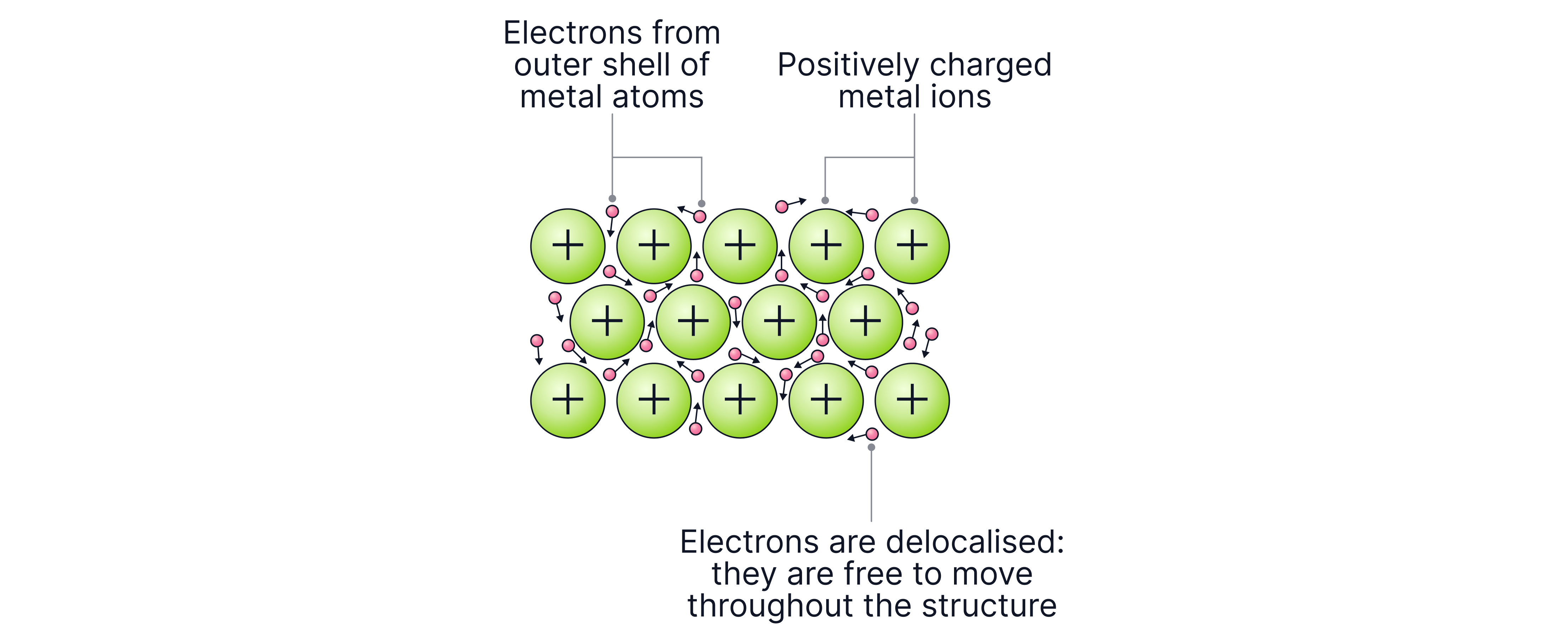
Two things are needed for electrons to flow:
An energy source.
A closed circuit
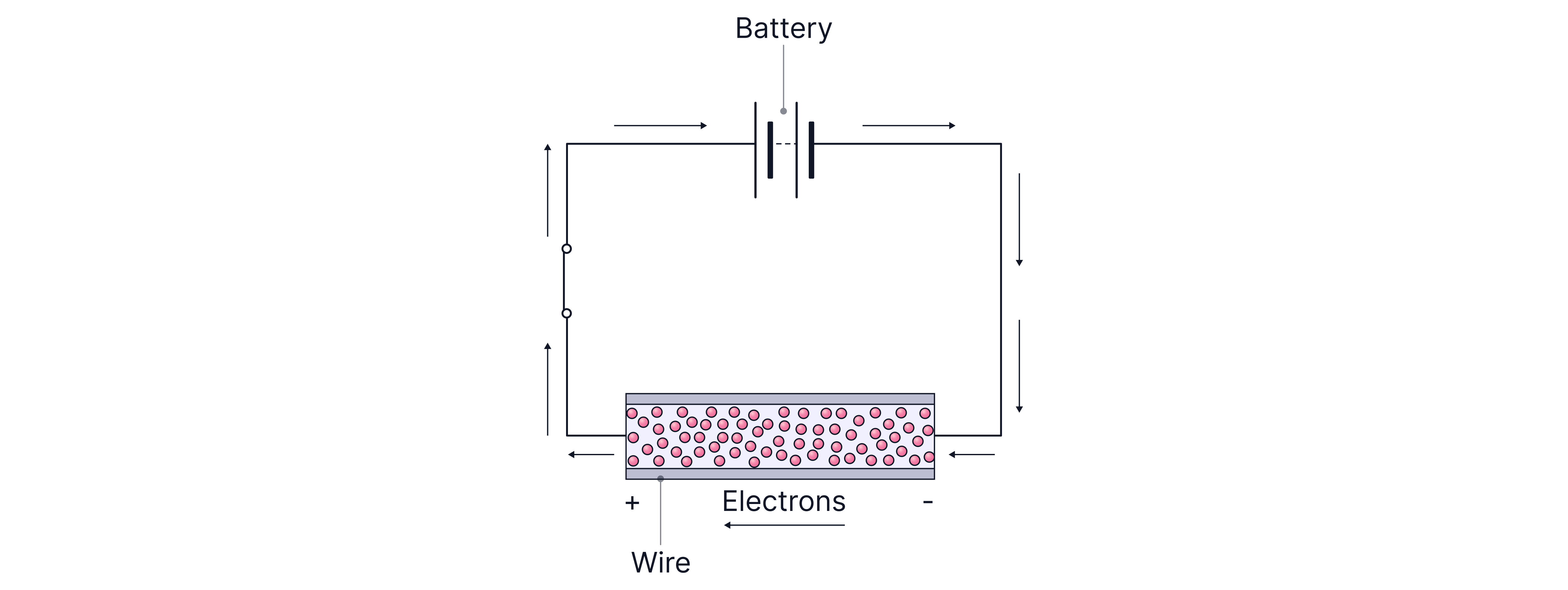
The most common energy source in a circuit is a cell. Batteries contain chemical energy, and two or more cells make up a battery, as shown below. A cell has two sides, a positive side (the longer side) and a negative side (the shorter side). The cell provides the energy to push (repel) the negative electrons in the wire away from the negative side and toward the positive side. Wires must be arranged around the cell in a closed loop so electrons can flow from one side to the other.
What is Current?
Current is defined as the rate of movement of charge. It is measured in Amperes, usually abbreviated to Amps, (A). Charge is measured in Coulombs, (C). Whilst current is most commonly carried by electrons, a current can be carried by any particle with a charge.
Formula:
We can rearrange this equation to give the definition of current as rate is ,
Example: If we wanted to calculate the current when of charge is moved down a wire in , we could use the equation . The charge () is and the time () is , so we can substitute these numbers into our equation, then rearrange:
Worked Example:
A current of flows through a heater for minutes.
Calculate the total charge that passes through the heater.
Answer:
First we need to convert minutes into seconds:
Then:
Worked Example:
A charge of flows through a wire when the current is .
Calculate how long the current flows for.
Answer:
Circuit Symbols
Circuit symbols are used to represent different components (equipment) in a circuit. They are used to make drawing circuit diagrams easier, saving you from having to draw an actual bulb. There are a set of circuit symbols that you must learn for your GCSEs:
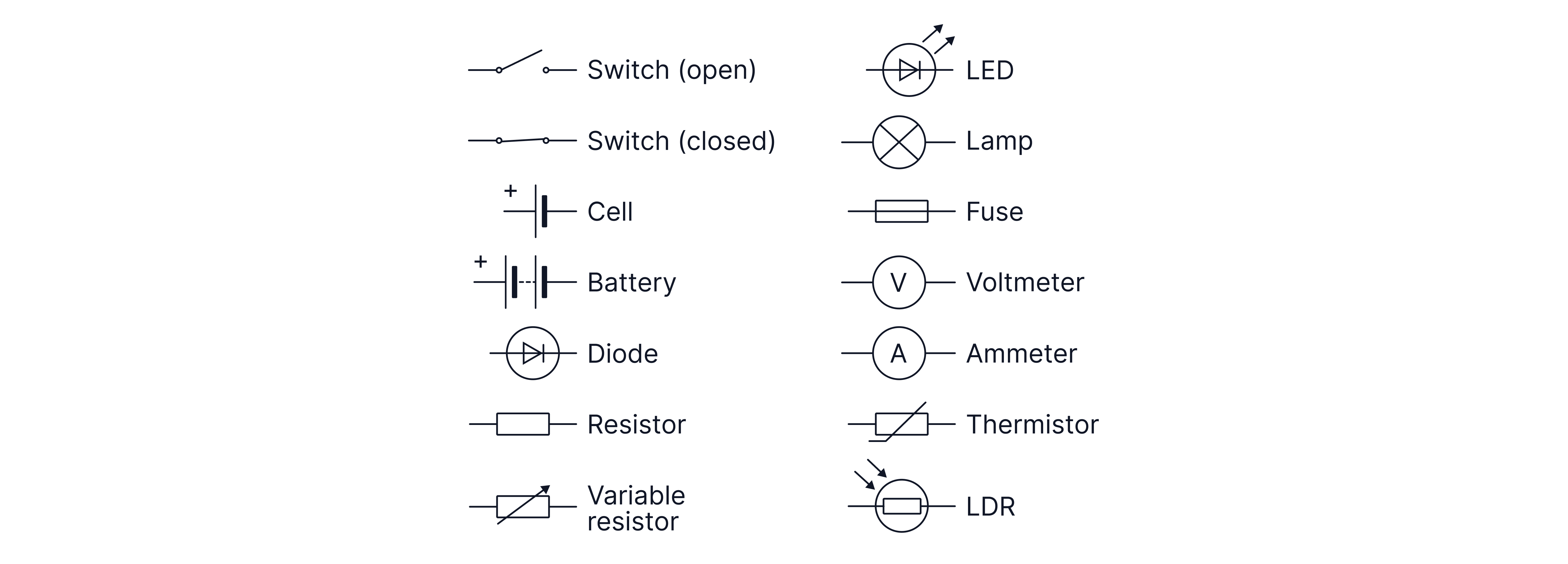
As noted previously, a battery is a group of cells connected together, as shown above. And a lamp can also be called a bulb.
We connect components together using wires. An example diagram of a simple circuit with a battery, an open switch and a lamp is shown below:

Straight lines are used to represent wires in the circuit, and they must always be drawn using a ruler. They form a complete loop from one side of the battery to the other, allowing current to flow. Note that the corners are all right angles, and no components are drawn at the corners.
On circuit diagrams, the direction of current is drawn going from the positive side of the cell to the negative, even though electrons move from the negative side of the cell to the positive, as mentioned before. This is because electricity was discovered before we knew about electrons. This movement of current is known as conventional current, drawn as shown below.

Worked Example:
Draw a circuit diagram with a cell, a closed switch and a bulb.
Answer

Worked Example:
Draw a circuit diagram with a cell, a lamp and a variable resistor.
Answer:

Teacher Tip: It does not matter what order the circuit symbols are put in.
Series Circuits
The simplest type of circuit is called a series circuit. The components in the circuit are connected one after another in a single loop. This means there is only one possible pathway for electrons to travel. As current is the rate of flow of charge, the current is the same everywhere in a series circuit. If of current flow out of the cell in one second, of current flow back to the cell in one second.
We can measure the current in a circuit using an ammeter - which is placed next to ("in series") with the component we want to measure the current through. The circuit below shows three ammeters connected in series with two lamps:

Potential Difference in a Series Circuit
Potential difference is a measure of the change in energy between two points in a circuit (it can be thought of as how much energy the electrons lose going through a component or gain from a cell/battery). Potential difference is measured in Volts, so it is sometimes referred to as "voltage".
Electrons must transfer their energy to move through components, and come back to the cell with no energy. In the below circuit, each electron would be given of potential (a physics word for "energy") from the cell. The electrons flowing to the lamp will still have of potential. They will transfer all of this energy as they move through the lamp (light gets emitted), as they need to return with zero energy -> leaving the lamp with of potential. This means the potential difference across the lamp ("over the lamp") would be .

We use a voltmeter to measure the potential difference in a circuit. Since we need to measure the potential of the electrons before and after the component, we have to connect a voltmeter across the component we want to measure. An example is shown below:
If there is more than one component in a circuit, electrons need to share their potential (energy) among the components. The potential difference over all the components should add up to the potential difference of the cell (they lose all their energy across the components that they gained from the cell).
Example:
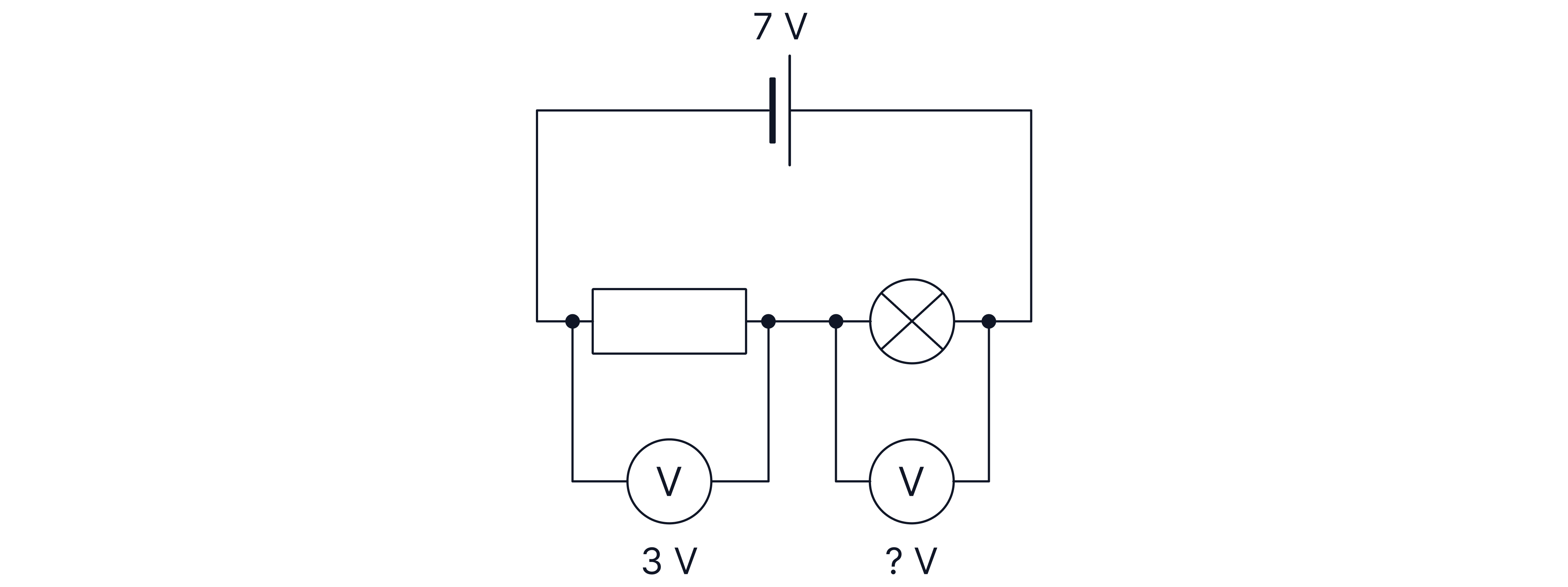
The potential difference across the cell in the above diagram is . If the potential difference across the resistor is then the potential difference across the lamp must be , as the potential difference over the lamp and the resistor must add up to .
If all of the components in a circuit are identical, then the potential difference will be shared equally among them, as equal amounts of energy will be transferred across them. However, in our example above, more energy was transferred across the bulb than in the fixed resistor.
We can also work out the potential difference if we know how much energy each unit of charge transfers.
Formula:
For example, if my phone charger transfers of charge to my phone battery whilst plugged into the mains, I can calculate the energy transferred. Uk mains provides a potential difference of .
Worked Example:
In a simple series circuit, a battery is connected to a lamp and an ammeter.
The ammeter reads .
State the current in the lamp.
Calculate how much charge flows through the lamp in minutes.
as the current has the same value everywhere in a series circuit.
First we need to turn minutes into seconds:
Then using:
Worked Example:
Calculate the potential difference across the lamp in the circuit below.
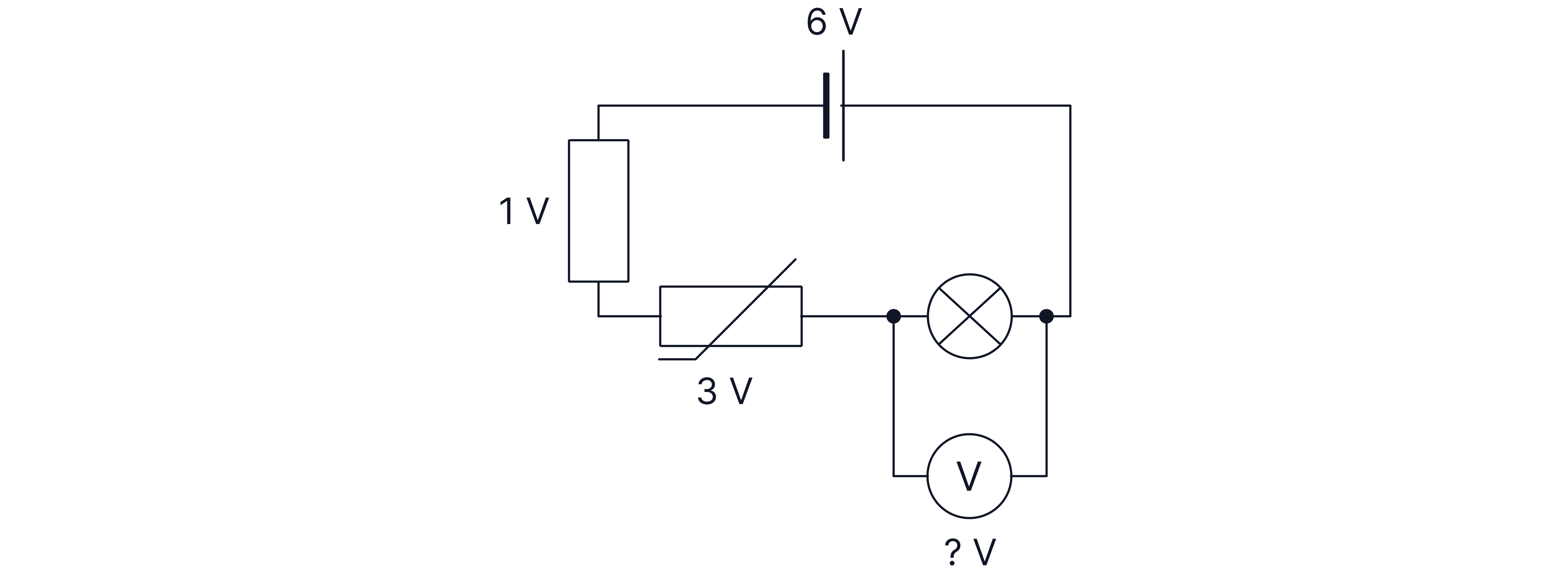
Answer:
The potential difference over all the components in the circuit has to add up to the potential difference of the cell, .
So the potential difference over the lamp will be .
Worked Example:
of energy is transferred to a TV which has a potential difference of . Calculate the amount of charge that has flowed.
Answer:
We need to first recall that the potential difference of anything plugged into the mains is , then apply the equation :
Practice Questions
Name the components shown below:

-> Check out Brook's video explanation for more help.
Answer:
Open switch
Resistor
Variable resistor
Thermistor
LDR/light dependent resistor
Bulb/lamp
Battery
LED/light emitting diode
of charge passes a bulb in . What does the ammeter read?
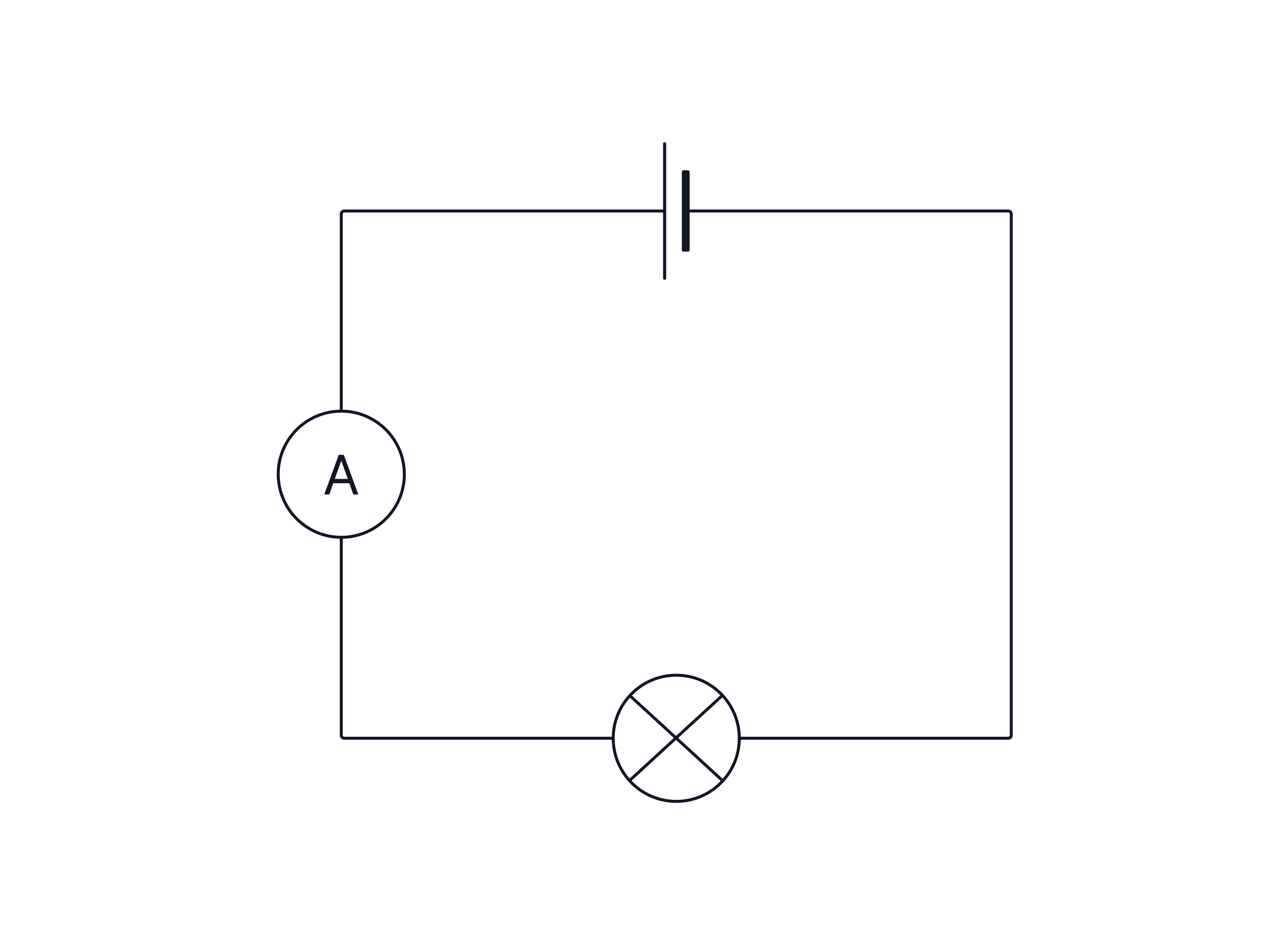
-> Check out Brook's video explanation for more help.
Answer: