Resistance
Brook Edgar & Hannah Shuter
Teachers


Explainer Video
Ohm's Law
Ohm's law tells us that for materials at a constant temperature, the potential difference, , and current, , are directly proportional to each other -> .
Directly proportional means that as one quantity increases, the other increases at the same rate - and vice versa. This means that if two variables (physics quantities) are directly proportional if:
-> When you double one, the other doubles or if you triple one, the other triples, etc
-> When you halve one, the other halves, or if you divide one by three, the other is divided by three also, etc
On a graph, we can tell if two variables are directly proportional if the graph:
Is a straight line (the gradient/slope is constant)
Passes through the origin (0,0)
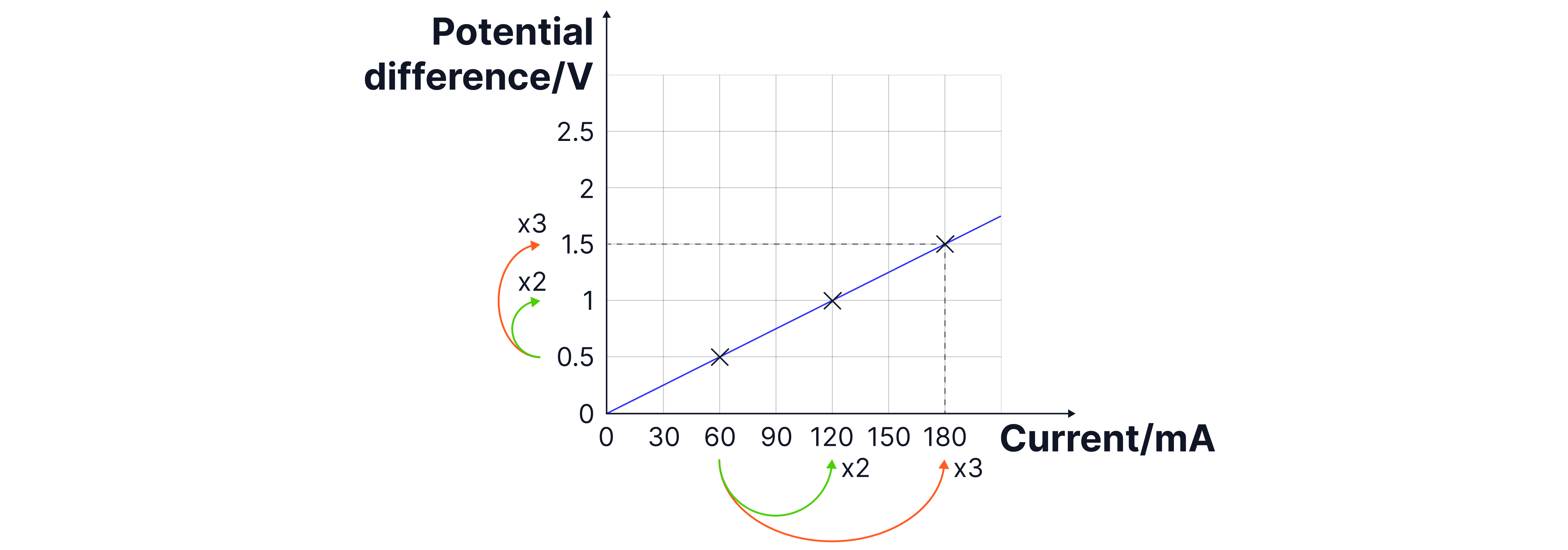
Here, we can see a directly proportional relationship as the graph is a straight line through the origin, but we can also prove this with maths.
-> When the potential difference is , the current is . If the potential difference is doubled to the current will also double to .
-> When the potential difference is trippled to , the current is also tripled to .
Worked Example:
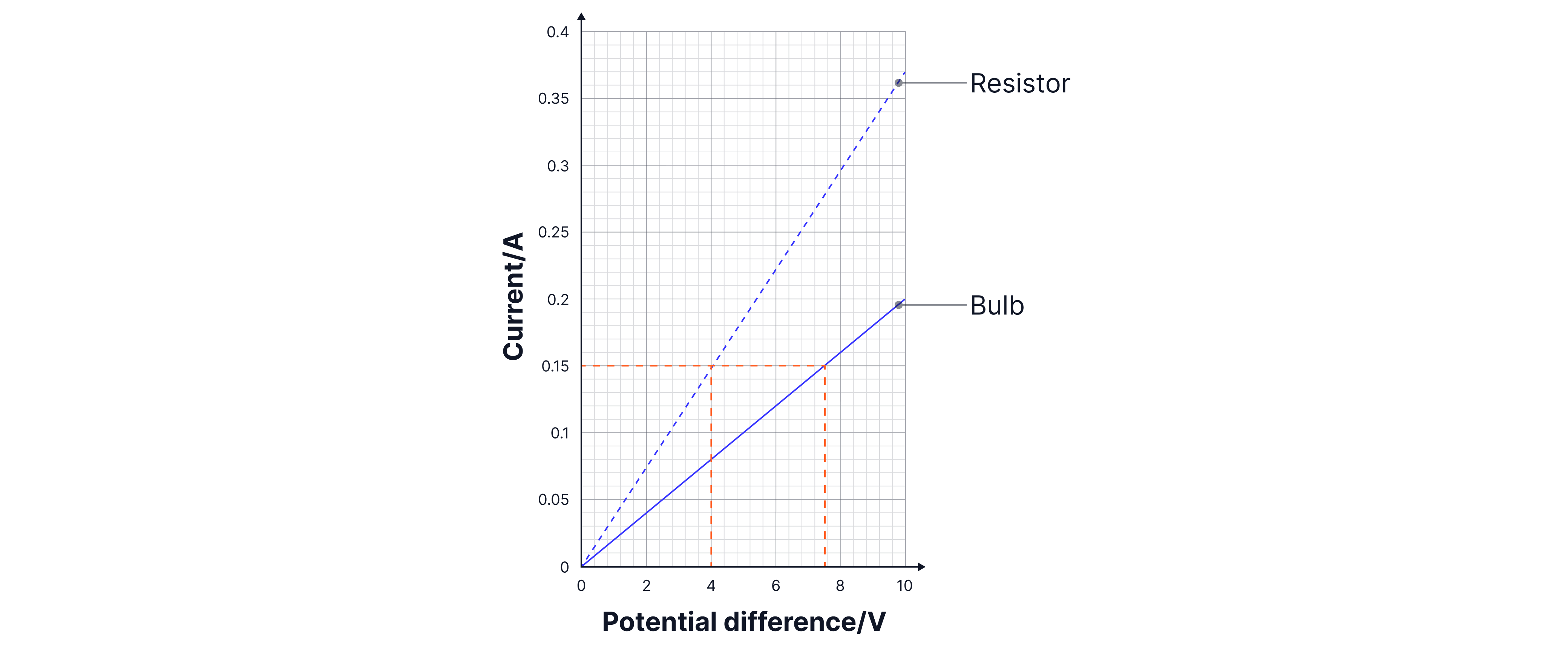
The graph shows the relationship between current and potential difference in a resistor and a bulb. When these components are placed in series in a circuit with a cell, the current in the circuit is .
State the relationship shown and use the graph to estimate the potential difference across the cell.
Answer:
The graph shows a directly proportional relationship between current and pd, as the graph is a straight line through the origin.
At the potential difference across the resistor is .
At the potential difference across the bulb is .
To calculate the total potential difference across the cell, we need to add the potential difference across the resistor and the bulb together as we learned already that the pd is split across components in a series circuit.
So the potential difference across the cell is .
Teacher Tip: On the x-axis between zero and there are five smaller boxes, this means that each small box represents, .
Resistance
Resistance is the ratio of potential difference to current in a component. This can be thought of as how much energy a coulomb of charge needs to move through a component per second. This is easiest to think about in terms of cycling. Cycling uphill: you are putting in lots of energy (high potential difference), but going slowly (low current) -> high resistance. Cycling downhill: you are not putting in much energy (low potential difference), but you are going fast (high current) -> low resistance.
Resistance is the opposition to the flow of current.
If the resistance of a circuit increases (harder for electrons to get through), the current will decrease. If the resistance of a circuit decreases (easier for electrons to get through), the current will increase. Resistance is measured in Ohms, written as .
Formula:
We can rearrange this to give us the definition of resistance, by dividing both sides by :
Example: If a bulb has a potential difference applied to it, and the current in the circuit is , we can use to calculate the resistance of the bulb:
Measuring Resistance
To measure resistance, we need to take measurements of both the current and potential difference, as, . We do this by using a voltmeter to measure potential difference, and an ammeter to measure current. For your exam, you need to know how to set a voltmeter and an ammeter up correctly to measure resistance. The voltmeter always goes in parallel with (across) the component it is measuring, the ammeter goes in series (next to).
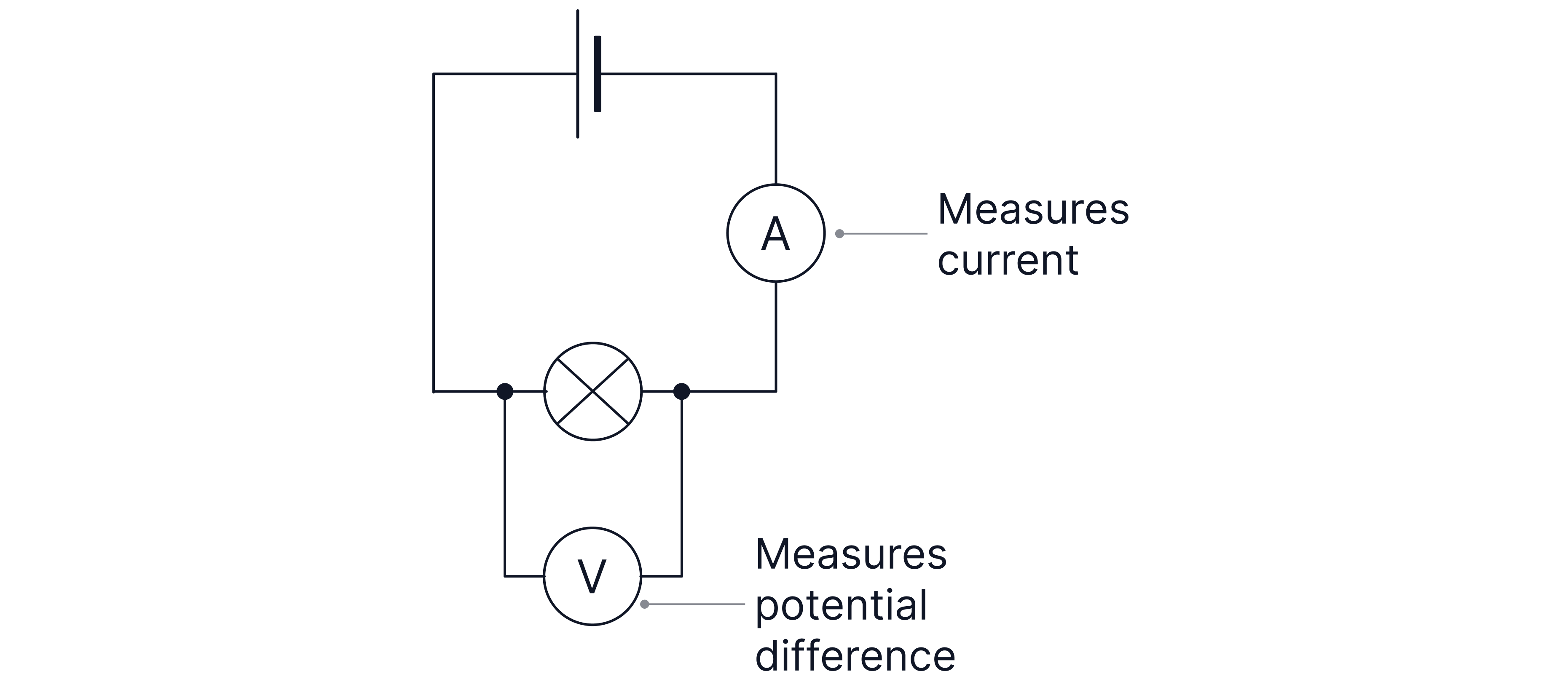
If we do the experiment as shown, we will only get one value of pd and current. To plot a graph to check if Ohm's law is obeyed for the bulb (that the current and pd are directly proportional), we need multiple values. To do this, we need to add a variable resistor to the circuit, which is used to change the resistance so that we can get multiple readings (more on this below).

Worked Example:
A resistor has a potential difference of applied to it.
Calculate the current in the resistor.
Answer:
*If you are struggling to remember how to rearrange equations, revisit the first few pages of revision notes in Topic 1 on 'Work Done' and 'Kinetic Energy' to remind yourself.
Worked Example:
A mystery component has a current of when a potential difference of is applied. Calculate its resistance.
Answer:
First, we need to convert into . We divide by , so becomes .
Teacher Tip: Remember a millipede has legs. There are . Therefore there are .
Worked Example:
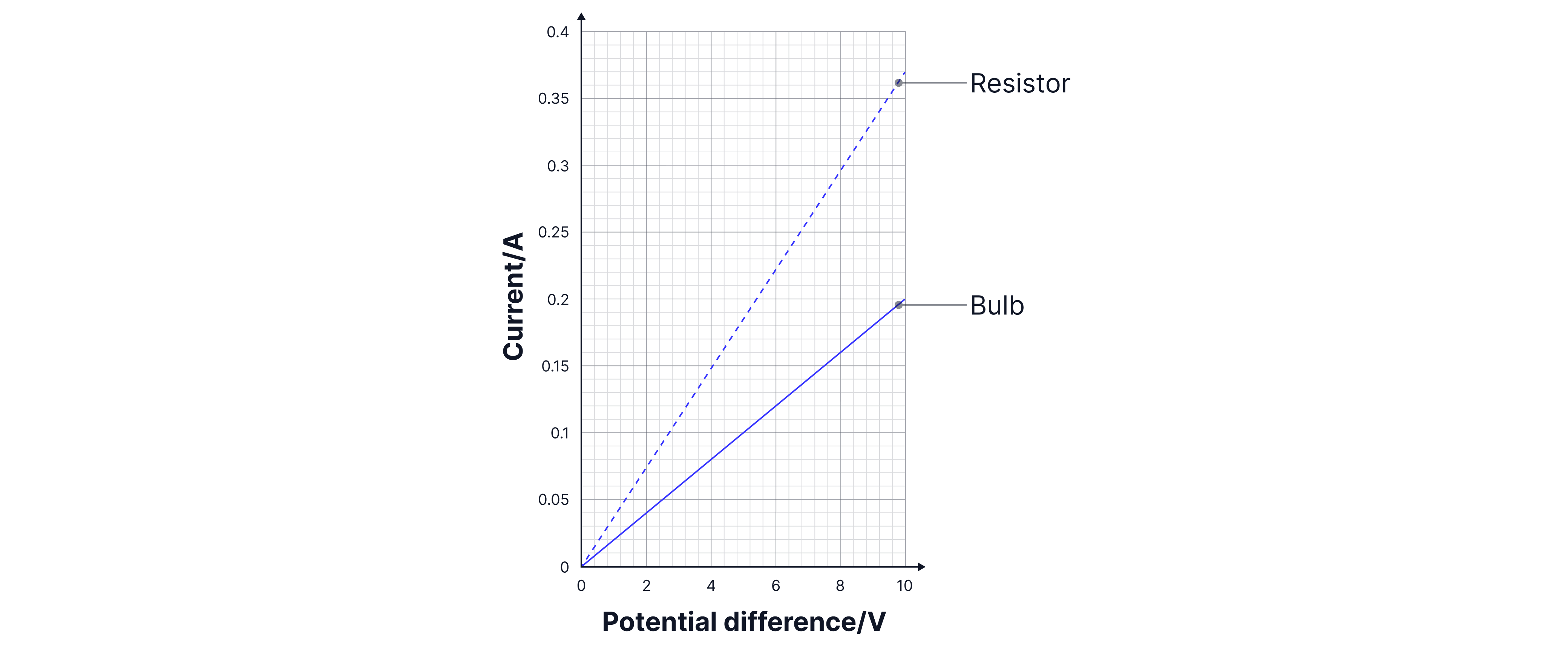
By choosing a suitable pair of values from the graph, calculate the resistance of the bulb and the resistor.
Answer:
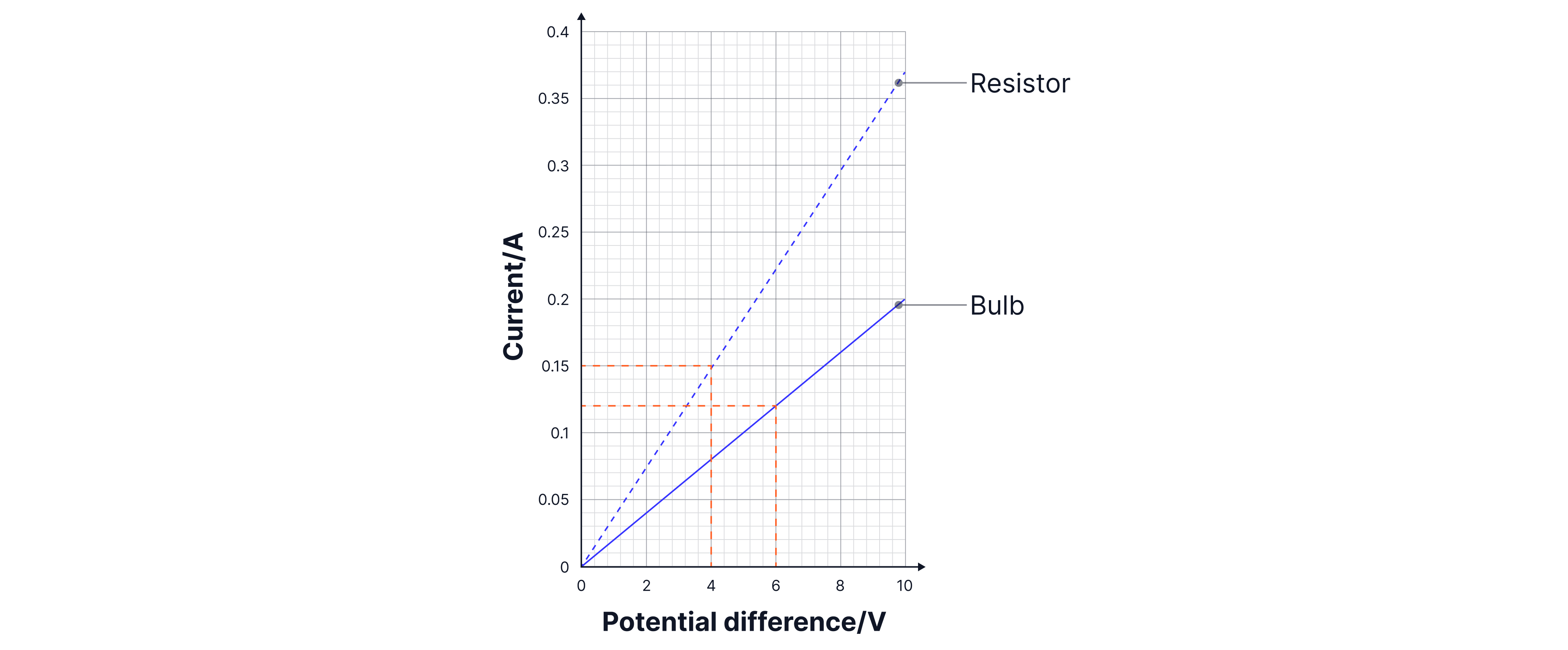
You can use any point on the graph you want; here I used and as they are easy to see.
For the resistor, when the current,
For the bulb, when the current,
Variable Resistors
Variable resistors are any component that can change their resistance. Some can have their resistance changed manually, but some change resistance if the temperature changes or if the amount of light incident on them changes.
Thermistors are resistors that respond to changes in temperature. As the temperature increases, the resistance decreases. If the resistance decreases -> the current increases.

Light-dependent resistors (LDRs) are resistors that vary their resistance in response to light intensity. As the light intensity increases (more light), the resistance decreases.
Worked Example:
At a temperature of , the current in the circuit is . The thermistor is then placed in hot water. Explain what happens to current in the circuit.

Answer:
The resistance of the thermistor will decrease as the temperature increases. This means that the current in the circuit will increase.
Worked Example:
An LDR is used to switch on a security alarm at night. It is powered by a supply.
When it is dark, an ammeter measures the current of going through an LDR.
Calculate the resistance of the LDR when it is dark.
State and explain what happens to the ammeter reading when it is bright.
Answer:
When it is bright, the light intensity increases. This means the resistance of the LDR decreases, so the current increases. This will increase the reading on the ammeter.
Worked Example:
A resistor is placed in series with a bulb, and a battery. The potential difference across the bulb is .
Calculate the current in the bulb.
State the value of the current in the resistor and hence calculate the potential difference across the resistor.
Answer:
We are given the resistance of the bulb and the potential difference of the bulb, so we can use the equation ,
The circuit is a series circuit -> the current is the same value everywhere in the circuit. Therefore the current in the resistor is .
The resistance of the resistor is , using we can calculate the potential difference.
Practice Questions
A student wants to find the resistance of a coin. Draw a circuit diagram showing the equipment the student should use.
-> Check out Hannah's video explanation for more help.
Answer:

Calculate the pd across a bulb connected in series to a cell. The Ammeter records and the resistance of the bulb is .
-> Check out Brook's video explanation for more help.
Answer: