Length of Wire - Required Practical
Brook Edgar & Hannah Shuter
Teachers


Explainer Video
Resistance and Length
The resistance of a wire depends on the material it is made from, it's temperature and the length of the wire. The longer the wire, the more resistance it has.
Resistance is the opposition to the flow of charge. It opposes the movement of electrons. As electrons try to move through the wire, they collide with metal ions. This is what resists or slows down the movement of the electrons. The longer the wire, the more metal ions that electrons collide with. When electrons collide with metal ions, they transfer thermal energy to the metal ions. This causes them to heat up and vibrate more, which also increases the resistance of the metal.
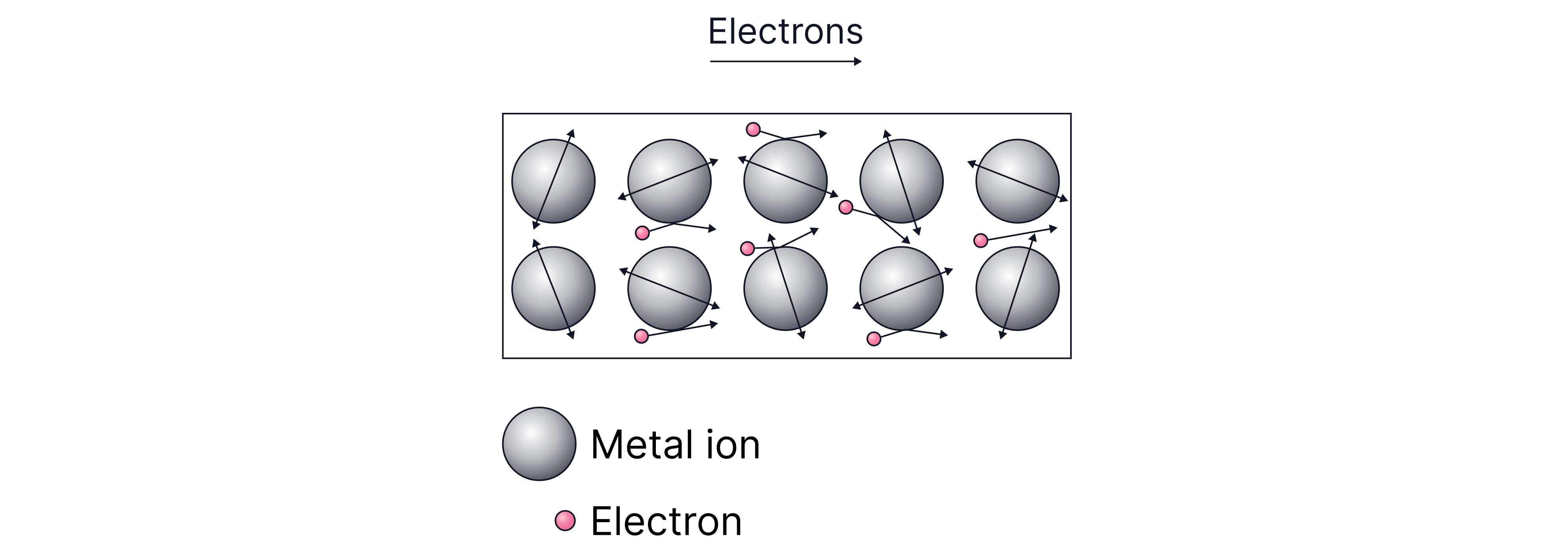
We can prove this in an experiment -> how varying the length of the wire changes the resistance. We cannot directly measure resistance, so we need to include an ammeter and a voltmeter in our experiment.
Independent variable - length of wire, measured with a ruler.
Dependent variable - current in the circuit, measured with an ammeter.
Control variable - potential difference of the supply, measured with a voltmeter.
Method
Set up the circuit as below. The wire should be as straight as possible, with no kinks which will affect our measurement of length.
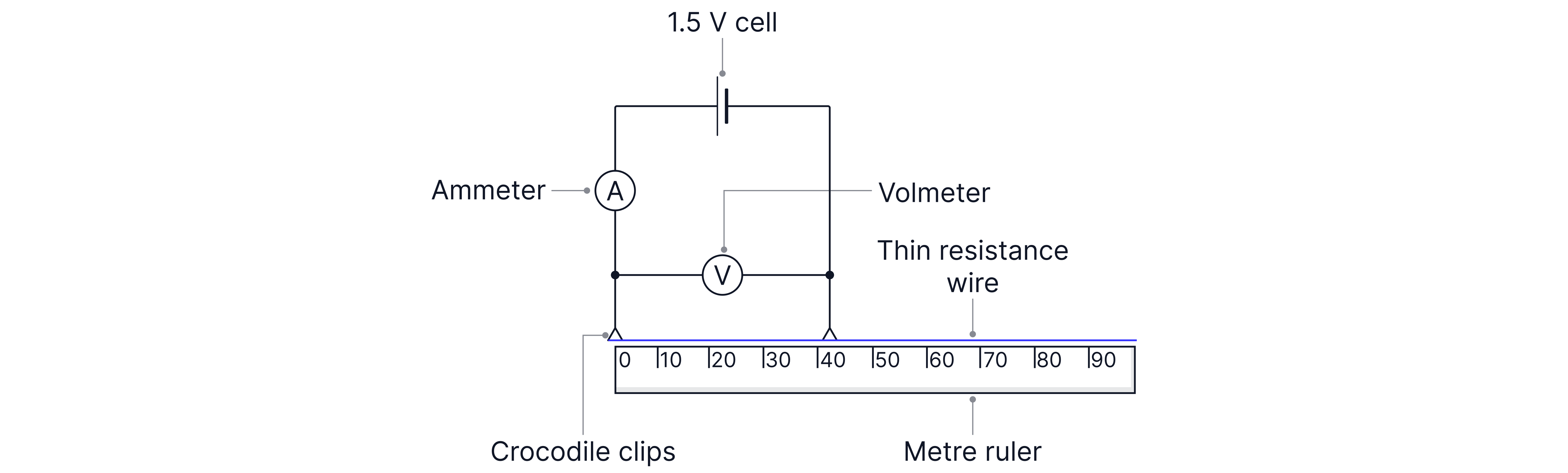
Use crocodile clips to change the length of the wire in the circuit.
For each length, measure the current with the ammeter and potential difference with the voltmeter.
Calculate resistance using:
Repeat for several different lengths.
Plot a graph of resistance vs length.
-> Note: When current flows through wires, they heat up. You can sometimes feel this when your phone has been on the charger for a long time. We don't want this to happen because the independent variable in this experiment is the length of the wire. We need everything else to be controlled. To prevent the wires from overheating, we should include a switch in our circuit to turn it off between readings, and we should use a low pd.
Wires heat up when current flows because electrons moving around the circuit collide with metal ions in the wire, transferring thermal energy to them. This will cause the metal ions to heat up, vibrate more and cause even more collisions, thus increasing the resistance. This would affect our results, which is why we need to minimise this.
Results
The results you record will look a little like the ones below:
Length of Wire / | Potential Difference / | Current / |
0.10 | 1.5 | 0.50 |
0.20 | 1.5 | 0.25 |
0.30 | 1.5 | 0.17 |
0.40 | 1.5 | 0.13 |
0.50 | 1.5 | 0.10 |
As you can see, we need to calculate the resistance of the wire. To do this, we can use the equation:
The resistances calculated would be:
We could then plot these on a graph of resistance of the wire/ (y-axis) against length of wire/ (x-axis).
The graph would look like this:
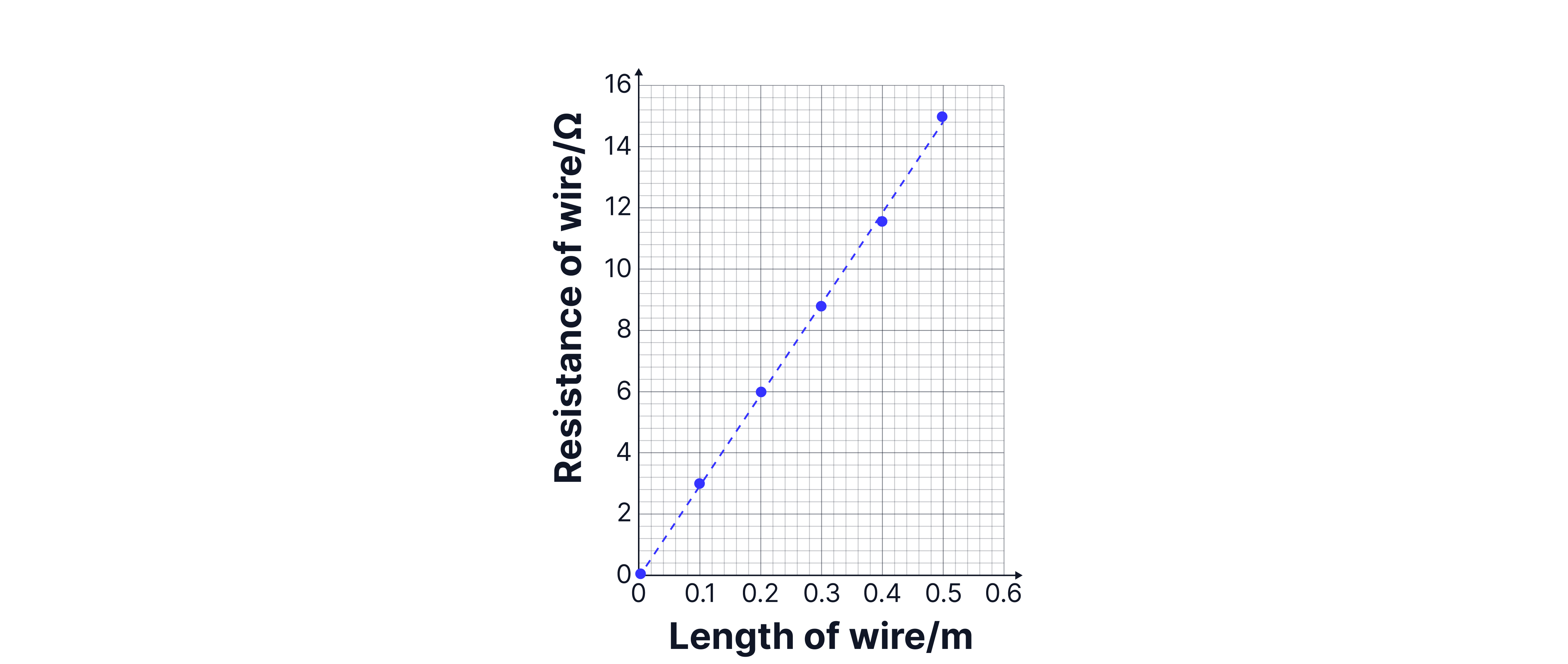
We can see that as the length of the wire increases, the resistance of the wire increases. They are directly proportional, because the line of best fit is straight and goes through the origin.
Worked Example:
Identify one main source of error in this investigation and suggest how it might be overcome.
Answer:
The wire may not be straight, leading to an inaccurate measurement of length. We could overcome this by clamping the wire tightly to a ruler to hold it straight.
Worked Example:
Explain why is it important we use a low potential difference.
Answer:
So the wire does not heat up and remains at a constant temperature.
Worked Example:
A student sets up the required practical above. The table below shows a section of their results:
Length / | Current / | Potential Difference / |
0.2 | 0.60 | 3 |
0.4 | 0.30 | 3 |
0.6 | 0.23 | 3 |
0.8 | 0.15 | 3 |
Use these results to prove that the resistance of a wire increases as the length increases.
Answer:
To calculate the resistance of the wire, you must use the equation :
It can be seen from the above results that as the length of wire increases, the resistance of the wire increases. Because as the length doubles the resistance also doubles, we could describe this data as directly proportional.
Rheostats
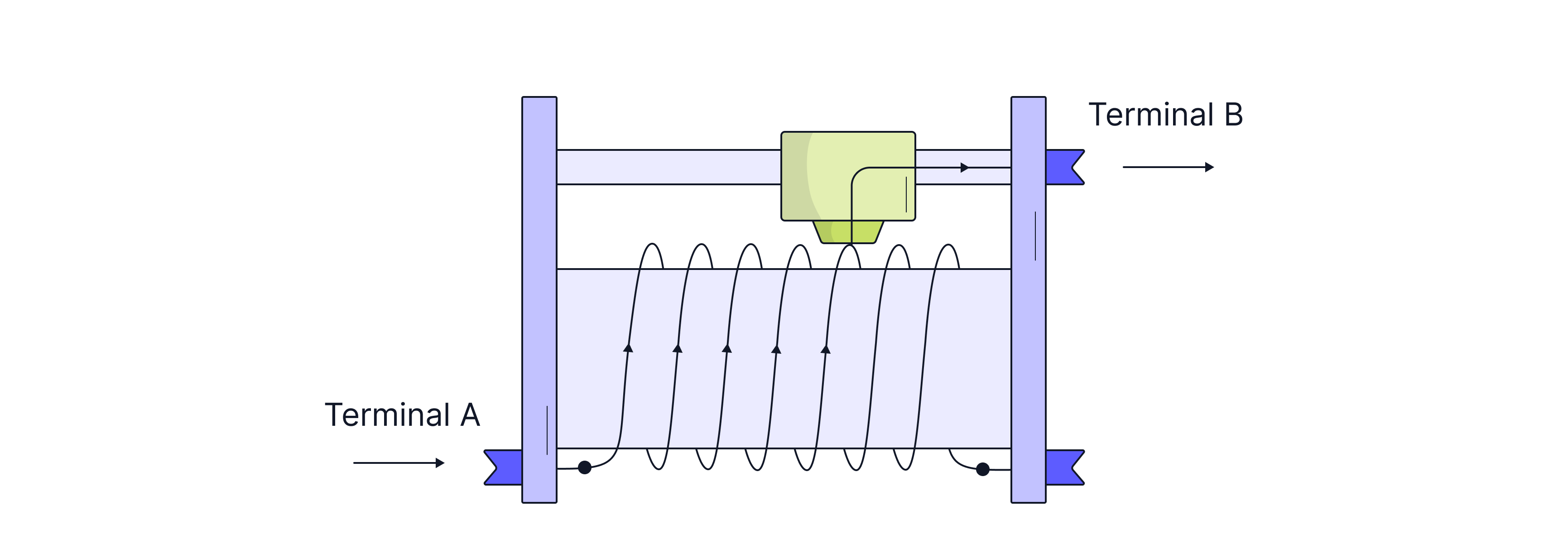
Rheostats are a specific type of variable resistor that use this relationship between resistance and length of wire. They consist of a long coil of wire with a slider in between the terminals - you can change the length of the wire, which changes the resistance of the wire. The longer the wire, the greater the resistance.
Practice Questions
Design an experiment to determine how the resistance of a circuit depends on the length of wire between two crocodile clips.
-> Check out Hannah's video explanation for more help.
Answer:
Independent variable - length of wire
Dependent variable - current in the circuit
Control variable - potential difference of the power supply
Set up the circuit as shown in the diagram.
Starting at a length of , record the potential difference and current in a table.
Increase the length by each reading until you reach
Calculate the resistance of the circuit for each reading using:
.
Plot a graph of length of wire (x-axis) against resistance (y-axis).
Accuracy tip - make sure you include a switch in your diagram so you can turn your circuit on and off in between readings to stop it getting hot.
A piece of resistance wire has a resistance of when its length is .
What would be the current in the wire if a potential difference of were applied across it?
-> Check out Hannah's video explanation for more help.
Answer:
to s.f