IV Characteristics
Brook Edgar & Hannah Shuter
Teachers


Explainer Video
I-V Characteristics
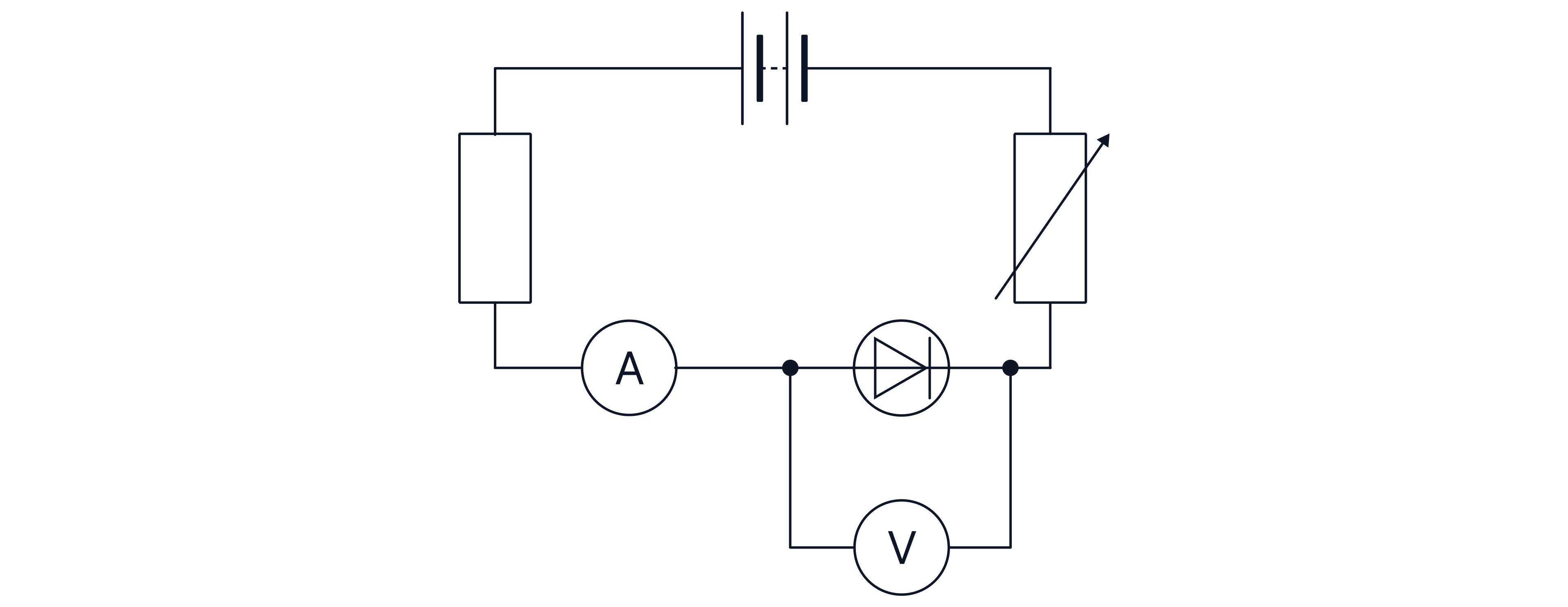
An characteristic graph tells us how the potential difference () across a component changes as we increase the current (). We can produce these graphs by making the circuit below and Dvarying the current in the circuit by using the variable resistor (changes the resistance and thus the current, high resistance = low current). We record the reults and plot them in a graph.

For a fixed resistor, the graph plotted looks like this:

The straight line through the origin shows us that potential difference and current are directly proportional. A fixed resistor is an Ohmic Conductor. It follows Ohm's Law that current and potential difference are directly proportional to each other as long as the temperature remains constant.
You can see negative values for current and pd on the graph. We obtain these values by reversing the connections on the power supply to reverse the current flow.
Light Bulbs
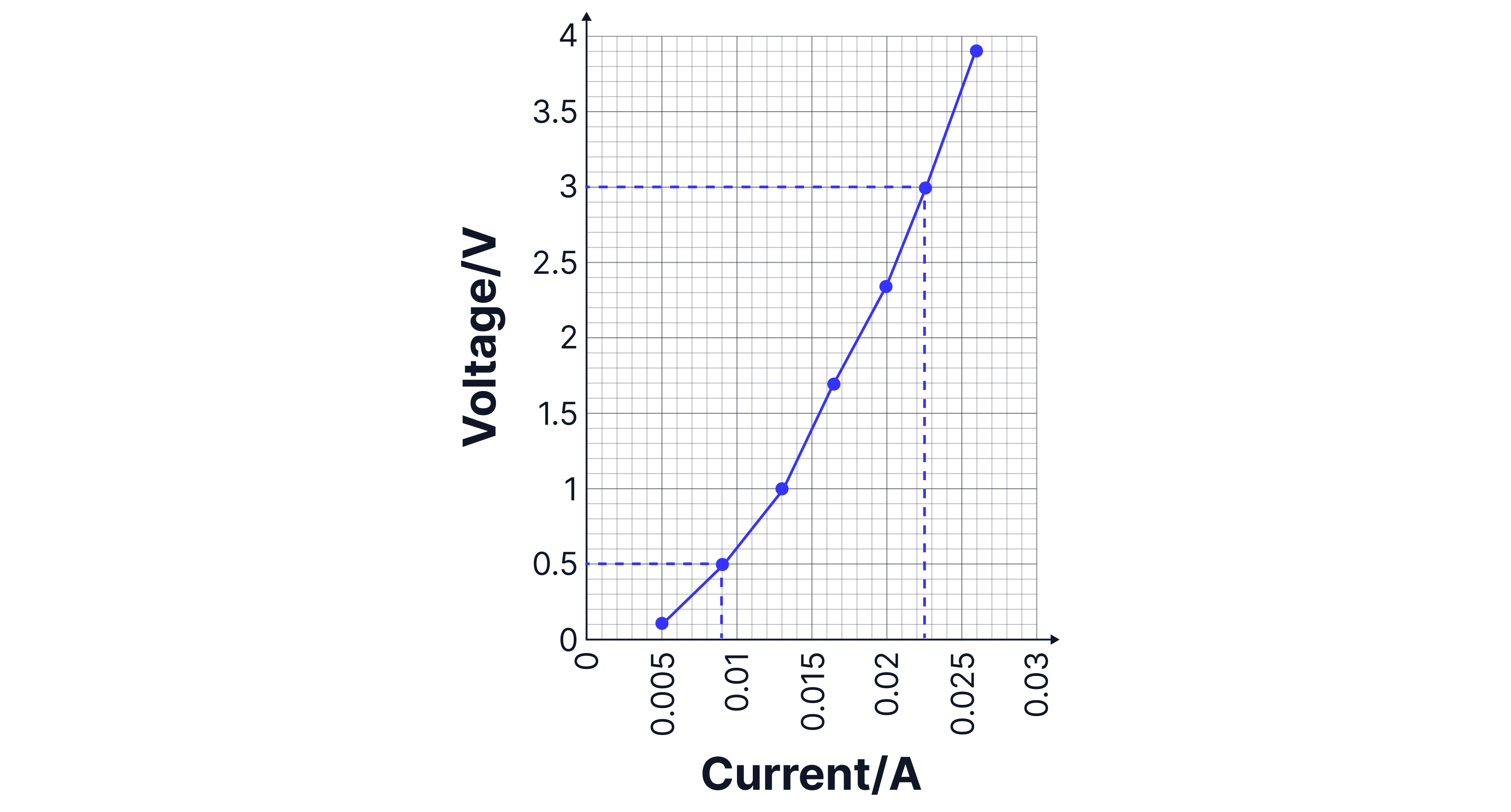
Light bulbs are an example of non-ohmic conductors -> they do not obey Ohm’s law. This is evident in the graph below. It is not a straight line graph through the origin. The current does not increase as fast as the pd. For a high pd, the current is lower than it otherwise would be for an ohmic conductor, as , the resistance increases.

This happens as at high pd the temperature of the filament wire inside the bulb increases. As the temperature rises, the metal ions vibrate more. These increased vibrations make it harder for electrons to pass through the wire because they experience more collisions with the vibrating ions. Because resistance is a measure of how difficult it is for current to flow, this increase in collisions means the filament's resistance rises as the temperature rises.

Diodes
Diodes are a specific type of non-ohmic conductor that allows current to flow in only one direction. They have a very high resistance in one direction, but much lower in the other. In the diagram below, current will flow as conventional current flows from the cell's positive terminal to its negative terminal through the diode. The diode 'lets' current flow through in the direction of the arrow. If the diode were turned around, current would not flow.

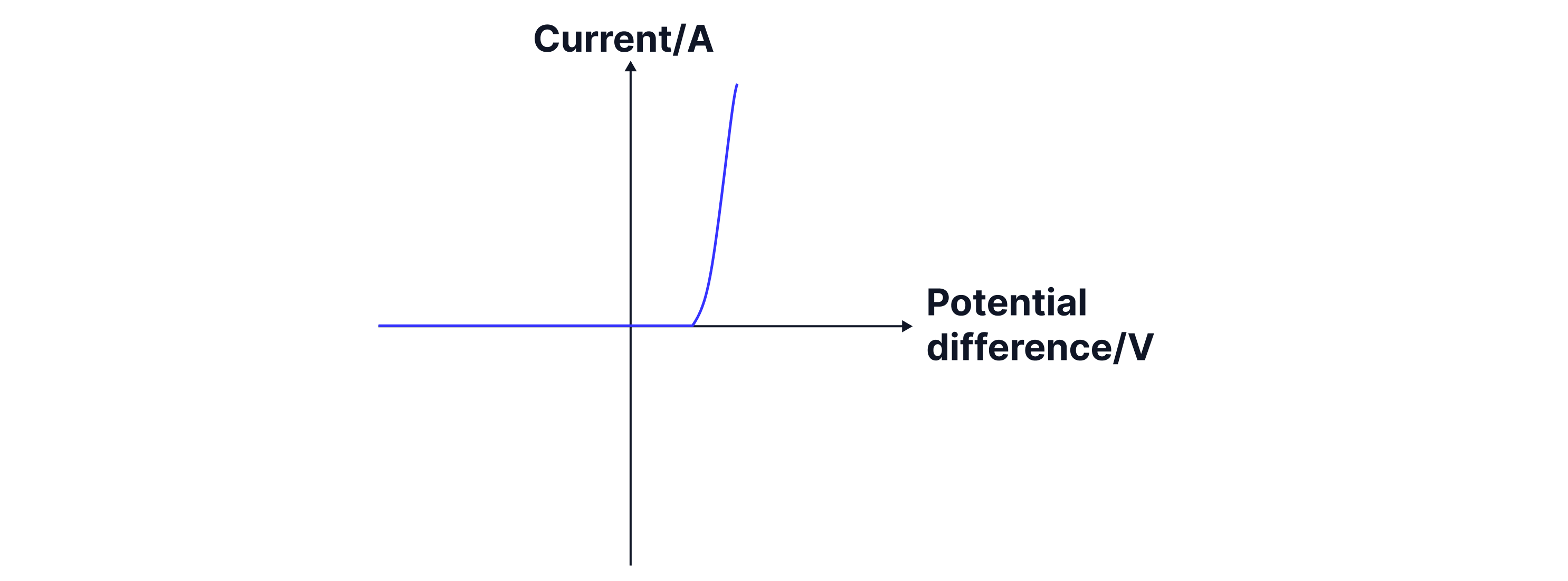
The graph for a diode shows that there is no current flowing in one direction (when the pd is negative -> when the cell connections are reversed), but current can flow in the other direction, the positive direction, once a certain pd is reached.

Worked Example:
State how the graph of a light bulb shows that it is a non-ohmic conductor.
Answer:
The graph is not directly proportional; it curves with a decreasing gradient as the potential difference increases. Therefore, it is not an ohmic conductor as it does not obey Ohm's law.
Worked Example:
Sketch the graph of a diode and explain its shape for negative and positive potential differences.
Answer:
A diode only allows current to flow in one direction. For positive values of pd, current can flow through the diode, but when the pd is negative, when the connection to the cell have been reversed, no current flows, the current is . The diode will not allow current to flow in this direction as its resistance is high.
Required Practical
You need to describe how to obtain the data to plot the graphs above. The method to obtain the graph for a fixed resistor is shown below.
If you want to produce the graph for a bulb or a diode you just replace the resistor with a bulb or diode in the circuit below.
Method

Set up a circuit as shown above. -> In your exam, draw the circuit above.
Record the current () from the ammeter and the potential difference () from the voltmeter.
Repeat to obtain at least six readings of the current and potential difference by changing the variable resistor to change the circuit's resistance and thus the current.
Reverse the connections to the cell so the current flows in the opposite direction.
Take six more readings of the current and potential difference in the opposite direction.
Plot a graph of current () against potential difference () to determine the characteristics of the component.
Practice Questions
Explain how a student should set up the following equipment to produce the graph below:
Equipment: diode, wires, ammeter, voltmeter, cell, variable resistor.
-> Check out Hannah's video explanation for more help.
Answer:
Set up the equipment as per the diagram.
Vary the resistance of the variable resistor to take six readings in the positive direction.
Reverse the connections to the cell and take five readings in the opposite direction.
Using calculations from the graph, show that the resistance of the light bulb increases as the potential difference increases.
-> Check out Hannah's video explanation for more help.
Answer:
The resistance of the light bulb increases at high potential differences.