Parallel Circuits
Brook Edgar & Hannah Shuter
Teachers


Contents
Explainer Video
Current in a Parallel Circuit
A parallel circuit consists of multiple branches. This means that the electrons have multiple paths to flow.
*Remember, conventional current flows from the positive side (the longer side of the cell) to the negative side in a complete loop.

The electrons all leave the cell and split at the first junction. Some will flow through the red path, and some through the blue. The current splits. At the junction on the right-hand side, the electrons meet up again and the current combines.
We can see this in the diagram below, where of current leaving the cell splits at the first junction. The amount of current in each branch depends on the resistance of the components in that path -> higher resistance = lower current. In this diagram, the bulbs in each path are identical, so the current splits exactly in half, takes the top path and flows through the bottom path. When the two paths meet again at the junction on the right-hand side the currents add together to give again, the original current from the cell.

We can write this rule in equation form as:
If we had a third branch we could add it as and so on. Within each branch, the current will be the same before and after the component - just as in a series circuit, as the electrons only have one path in this branch.
One of the advantages of parallel circuits is that if a component breaks in one branch, the whole circuit will not break as the electrons have got other pathways to flow through.
Example: We can use this rule to find the missing ammeter reading in the circuit below:

The current into and out of the cell is the same, so . The current in the first branch is , so and we need to work out .
Worked Example:
A set of fairy lights has a battery, bulbs and a switch.
Draw a circuit diagram showing the bulbs connected in parallel with the battery, with one bulb on each branch. Add a switch that can turn off all of the bulbs at the same time.
If a bulb blows (stops working), current cannot pass through it. When the switch is closed, explain what happens to the other bulbs.
Answer:
A pyramid of numbers diagram showing the population sizes at different trophic levels, where many individual producers (grass) support a smaller number of primary consumers (grasshoppers), which in turn support even fewer secondary consumers (frogs).
The other bulbs will still light as they are connected in parallel; current can still flow in a complete loop through the other paths. The bulbs will be brighter as there are fewer paths for the current to flow, so more current flows through each branch.
Worked Example:
Calculate the missing ammeter reading.
A circuit diagram showing a power source providing a total current of 0.2 A, which splits into a parallel arrangement of two bulbs where one branch carries 0.05 A and the other is marked with a blank for the remaining current.
Answer:
Using :
Potential Difference in a Parallel Circuit
In a parallel circuit, the potential difference across each branch is the same. This is because potential difference—defined as the energy transferred per coulomb of charge, —remains constant regardless of the path taken, as each coulomb of charge receives the same amount of energy from the power supply.
We can see this below, the cell provides . Each coulomb of charge leaves the cell with of energy, and we learned when studying series circuits that they must return to the cell with zero energy. If a coulomb of charge (electrons) takes the top branch, they have only one component to pass through, so they transfer all their energy across that component. The potential difference (difference in energy per coulomb of charge between two points in a circuit) is . If they take the middle path, they still have only one component to pass through, so they transfer all their energy through that component; the same goes for the bottom path. Therefore, the pd across each branch in a parallel circuit is the same.

We can write this in an equation as:
If there are two or more components along a branch, they will share the potential difference of the branch, just like in a series circuit.
Example: We can use this rule to work out what value the voltmeters at A and B in the circuit show:

We know that the potential difference across each branch will be the same as that across the cell. As if each coulomb of charge gains and must return to the cell with zero energy they must transfer all of their energy across the branch.
In the bottom branch, the resistor is the only component, so all energy per coulomb of charge is transferred across this one component. Therefore, the potential difference at B will be .
In the top branch, there are two components, a resistor and a cell. Each coulomb of charge must transfer six joules of energy across the entire branch. If they have two components to get through, they will lose some of their energy across the first component and some across the second. If the potential difference across the bulb is , the potential difference across the resistor will be , so voltmeter A reads .
Worked Example:
State the potential difference of each bulb in the circuit below.

Answer:
We know that the potential difference across each branch in a parallel circuit is the same, so the reading of each voltmeter would be the same as that across the cell, .
Worked Example:
Calculate the missing current and potential difference readings in the circuit below.

Answer:
For bulb , we know that the current as to be the same along the branch, so the current would be .
We know the current from the cell is , so we can find the current in bulb using :
Now we need to work out the potential difference of bulb . We know the potential difference over each branch has to be the same, so the total potential difference over both bulbs in the first branch must add up to make (same as in the second branch). Therefore, the potential difference of bulb is .
Worked Example:
Calculate the missing current and potential difference readings.
Answer:
The current does not come to a junction before bulb , so the current will be the same as that going in and out of the cell, .
Before getting to bulb , the current splits. Using :
The potential difference over bulb and bulb must add up to the potential difference over the cell, , so the potential difference at bulb is .
Practice Questions
The diagram below shows a circuit with two resistors. Three ammeters are being used to measure the current in different parts of the circuit.
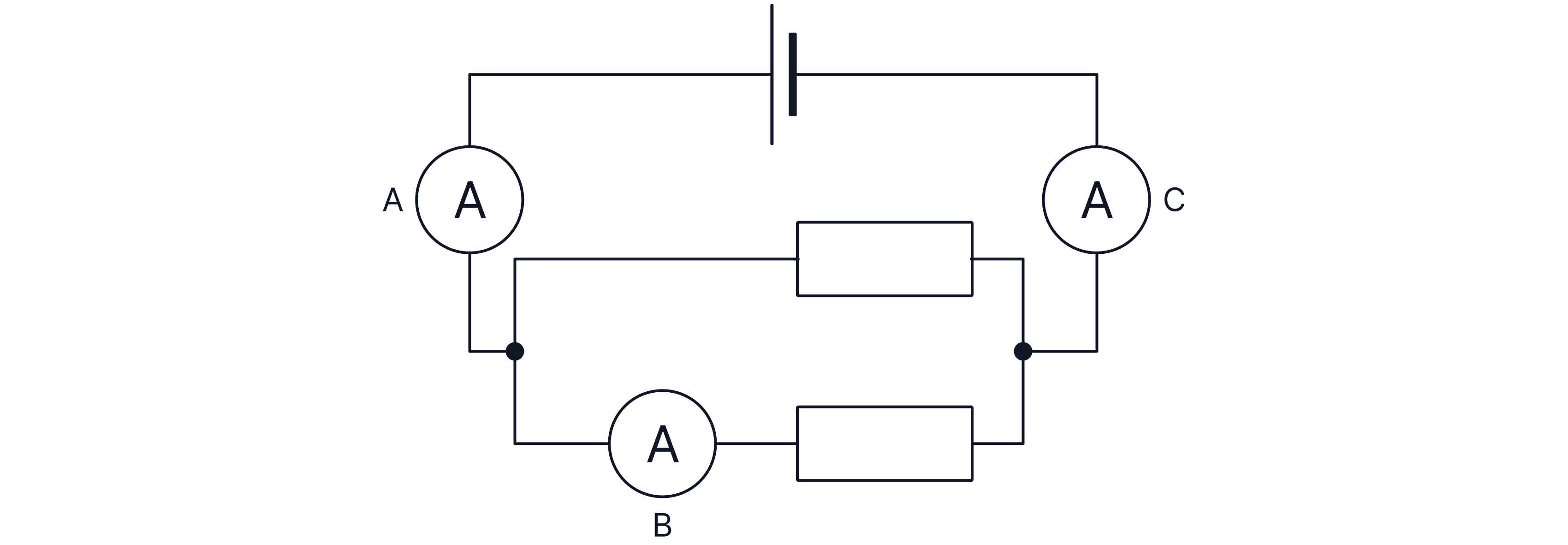
How does the reading on ammeter A compare to the other two readings?
The reading on A is greater than the reading on C and greater than the reading on B.
The reading on A is equal to the reading on C and equal to the reading on B.
The reading on A is greater than the reading on C and equal to the reading on B.
The reading on A is equal to the reading on C and greater than the reading on B.
-> Check out Hannah's video explanation for more help.
Answer:
D
The diagram shows the circuit used in a toaster using heaters which uses a power supply.
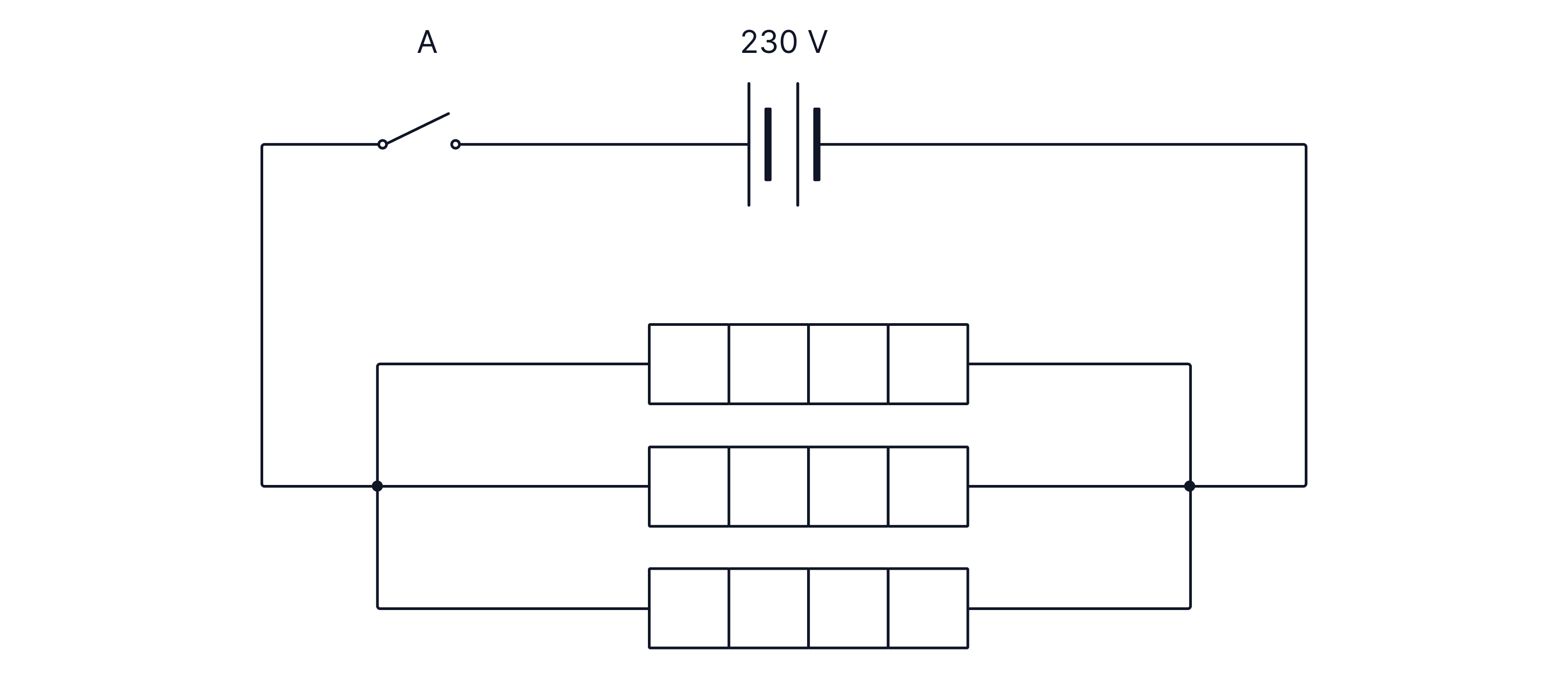
Explain the purpose of switch A.
Each heater has a resistance of .
Calculate the current through one heater when the potential difference across it is .
What is the current through the power supply when all switches are closed?
-> Check out Hannah's video explanation for more help.
Answer:
To switch all the heaters on and off.