Resistor Rules and RP
Brook Edgar & Hannah Shuter
Teachers


Contents
Explainer Video
Resistors in Series
If resistors are arranged in series (next to each other), as current only has one path to flow so must pass through all resistors, we add the resistances together to find the total resistance of the circuit:
Example: We can work out the total resistance of the circuit below by adding the values of the resistors together as they are in series:

The total resistance in a series circuit will always be bigger than the value of any one resistor.
Worked Example:
A combination of 3 resistors in series is shown below. Calculate the total resistance.

Answer:
The resistors are arranged in series, so we can just add them together using our rule for resistors in series:
Worked Example:
Calculate the total resistance of the circuit below:

Answer:
The resistors are in series, so we can just add the two resistances together.
Resistors in Parallel
At GCSE you do not need to know how to calculate the total resistance of resistors in parallel, however you need to know that if resistors are arranged in parallel, the total resistance will be less than the resistance of the smallest resistor.
This seems counter-intuitive, so let's imagine resistors like passport gates at an airport.
Imagine passengers having to go through three passport gates in a row. Each person must pass through all three gates, one after the other. This will take a long time as everyone needs to line up in a single file to get through, slowing everyone down. This is like a series circuit, where the three resistors are connected in series, so each electron must pass through all three.
But if the three gates were next to each other and passengers only needed to go through one gate, they could split up and use different gates simultaneously. This speeds things up; it is similar to a parallel circuit, where the three resistors are connected in parallel, so electrons can travel through only one resistor. This is why the total resistance is less than the smallest individual resistor.
 For example, in the circuit below, as the resistors are arranged in parallel, the total resistance is less than the smallest resistor.

The smallest resistor is , so the total resistance of the circuit is less than .
Worked Example:
Three resistors are now combined in parallel, as shown.

The total resistance is…
Greater than .
The average of , and .
Less than .
Answer:
The resistors are arranged in parallel, so we know the total resistance will be less than the smallest individual resistor, which in this problem is . So, the answer must be C.
Required Practical
At GCSE level, you’re expected to understand how to measure resistance in series and parallel circuits - even if you’re not required to calculate total resistance for parallel arrangements.
To measure resistance, you need to measure the potential difference across the component using a voltmeter and the current flowing through the component using an ammeter, then apply the equation:
The ammeter must be in series, and the voltmeter must be connected in parallel.

If the question is about resistors in series, you should add the resistors next to each other in between where the voltmeter is connected as shown below:

If the question is about resistors in parallel, you should add the resistors "on top" of each other, but still in between where the voltmeter is connected as shown below:

Once you've measured the current and potential difference to calculate the total resistance, apply the formula:
You then plot a graph with:
X-axis: Number of Resistors
Y-axis: Total Resistance
An example graph of resistors in series is shown below:

The graph shows a straight line through the origin, so we can say that total resistance and number of resistors in series are directly proportional.
An example graph for resistors is parallel is shown below:

If asked to describe this graph, we would say that as the number of resistors in parallel increases, the total resistance of the circuit decreases. It is a curve, with a decreasing gradient.
Remember: Turn your circuit off in between readings. This will stop your circuit from overheating.
Worked Example:
State the measurements required to determine the resistance of this circuit, and explain how the equipment should be correctly positioned.

Answer:
Measure:
Potential difference with a voltmeter.
Current with an ammeter.
Use the equation to calculate the resistance.
The ammeter should be placed in series with the resistors, the voltmeter should be in parallel across all the resistors, for example:

Worked Example:
Describe the relationship between resistance and number of resistors in the graph below and determine the arrangement of the resistors:

Answer:
As the number of resistors increases, the total resistance increases. It is a straight line that goes through the origin. The graph shows a directly proportional relationship. This means that the resistors must be arranged in series.
Practice Questions
A bulb of resistance is connected in series with a variable resistor set to .
What is the total resistance of this combination?
If this combination is connected in series to a power supply of 5 V, what is the current through each component?
-> Check out Hannah's video explanation for more help.
Answer:
A student carries out an experiment and their results are shown in the graph below.
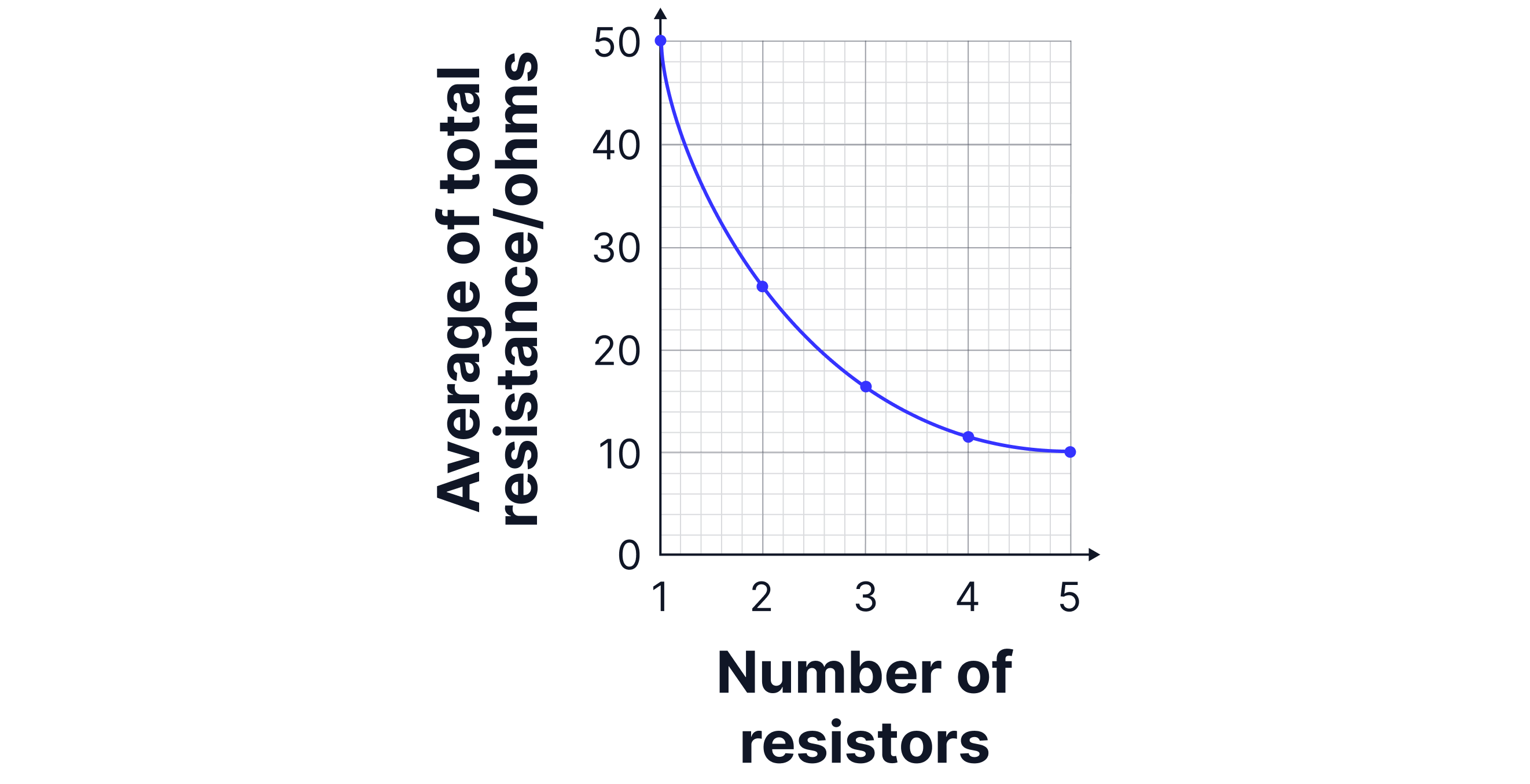
What is the resistance of a single resistor?
Explain why increasing the number of resistors in parallel causes the total resistance to decrease.
-> Check out Hannah's video explanation for more help.
Answer:
As you increase the number of resistors in parallel, you are increasing the number of pathways for the electrons to flow down. This increases the overall current, so decreases the resistance.