National Grid
Brook Edgar & Hannah Shuter
Teachers


Explainer Video
UK Electricity Supply
There are two different types of current, alternating current and direct current.
Direct current (DC) is produced by batteries and power supplies. The current only flows in one direction, from the positive end of the battery or power supply to the negative end (conventional current).

In an alternating current (AC), the current continuously changes direction. In the UK, alternating current comes out of the socket when you plug a device in (sometimes called mains electricity). The frequency of the UK mains is , which means the current changes direction times every second.

The mains supply in the UK has an average potential difference of , you are expected to know these values for your exams.
Worked Example:
The graph below shows the variation in potential difference.
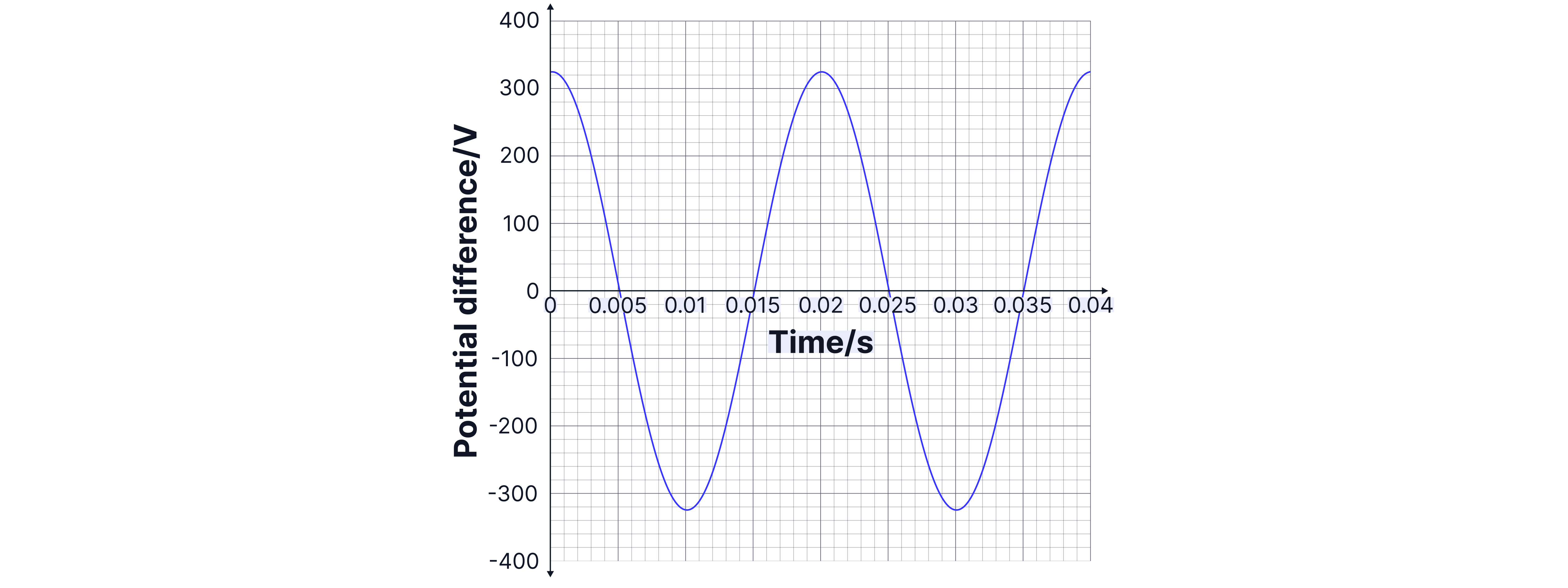
Explain whether this supply is an alternating current or a direct current.
State the maximum and minimum value of the potential difference.
Answer:
Alternating current, because the pd has both negative and positive values, so the current is flowing in both directions.
The maximum value read from the graph is , the minimum value is .
Worked Example:
The picture below shows a label from a kettle manufactured in a different country. State if the kettle can work in the UK.

Answer:
Yes.
The UK mains supply is . The label tells us that the kettle can work at potential differences from .
The UK mains supply has a frequency of - the label tells us the kettle will work at or at , so the kettle will work properly in the UK.
Worked Example
Describe the difference between alternating current and direct current? Give an example of a source of each type in your answer.
Answer
Alternating current - the current changes direction repeatedly. Mains electricity in the UK uses alternating current.
Direct current - the current flows in one direction only. Batteries use direct current, the current always flows from the positive terminal of the cell/battery to the negative (conventional current).
Worked Example
A heater that is plugged into the mains has a resistance of . Calculate the current through it.
Answer
First, we need to convert into . We do this by multiplying by 1000:
.
Then we need to recall the potential difference of the UK mains supply, which is .
Then we can substitute into the equation:
The National Grid
The National Grid is the network of transformers, pylons, and cables that transport electricity from power stations to homes, schools, offices, and other buildings across the country.
Electricity is generated in power stations using either:
Renewable sources like wind, solar, and hydroelectric power.
Non-renewable sources such as coal, gas, and nuclear energy.

Once electricity is generated at power stations, it passes through a step-up transformer. This increases the potential difference to around . This is done as a higher potential difference = a lower current -> and a lower current means less energy is lost due to heating in the cables. We can use the equation below to understand this.
Formula:
A step-up transformer has two sides. One side receives electrical power from the power station, and the other side is connected to power cables. Assuming 100% efficiency, the power (energy transferred per second) going into the transformer equals the power out. A step-up transformer increases the pd, so for power to stay the same, , the current must decrease. As the pd is higher on the side of the transformer connected to the cables, the current in the cables will be lower.
Low currents reduce the amount of energy lost as heat in the cables. Think of your phone charging for a long time, the wires eventually start to heat up - we don't want this to happen in the cables transmitting electricity across the country, as this is wasted energy and thus money. A lower current means there will be fewer collisions between electrons and metal ions in the cable. The transmission of electricity is more efficient because less energy is lost due to heating in the cables.
As an example, electricity is produced in a power station at a current of and a potential difference of , and is connected to a step-up transformer that increases the potential difference to . Using the equation, we can calculate the current in the cables connected to the other side of the transformer.
Power entering the transformer:
As the transformer is 100 % efficient, the same power leaves the transformer.
Here we can see that the current in the cables will be extremely low, at , preventing the cables from overheating.
-> When electricity reaches the area where it will be used, it goes through a step-down transformer. This reduces the potential difference to a safe level (typically ) for use in homes and businesses.
Worked Example
Electricity leaves a power station at with a current of . It is passed through a step-up transformer to increase the potential difference to .
Calculate the current in the transmission cables after the transformer.
Answer
First, we need to calculate the power of the electricity entering the transformer:
(multiply by )
Since the power entering the transformer is the same as the power exiting the transformer, we can use this power to find the current in the transmission cables:
(multiply by )
Worked Example
A local substation in a town receives electricity from high-voltage cables at and uses a step-down transformer to drop the pd to for UK homes. The substation supplies of power to the local area, calculate:
The current in the high-voltage cables carring the electricity to the substation ( side).
The current in UK homes ( side).
Answer
(multiply by )
(multiply by )
Practice Questions
The diagram shows a circuit consisting of a diode, a resistor and an AC current source.
Explain why the current in the resistor will be DC and not AC.
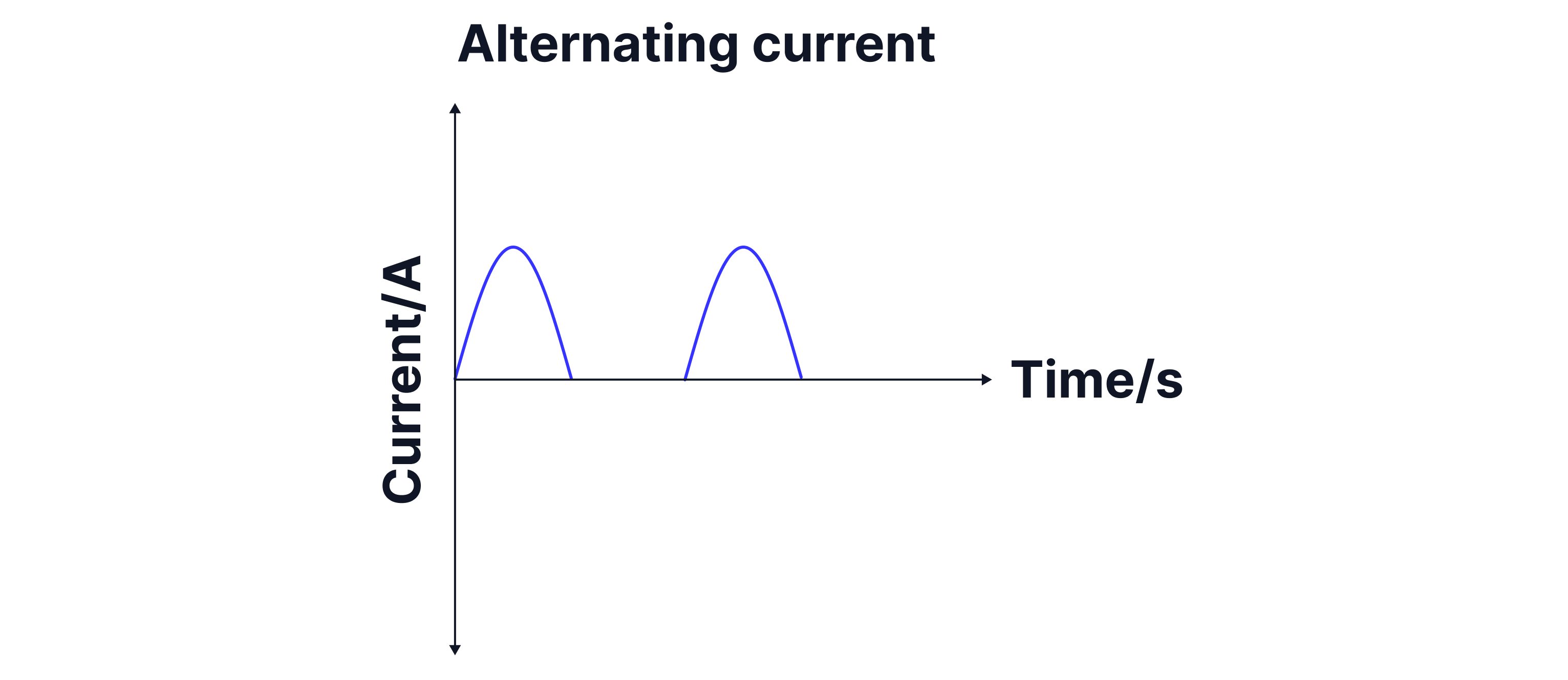
Sketch a graph showing how the current in the resistor varies with time.
-> Check out Hannah's video explanation for more help.
Answer:
Because the diode will only allow current to flow in one direction.
Electricity generated in power stations is transmitted across the UK using the National Grid.
Explain why electricity is transmitted at a high potential difference through the National Grid. Include references to energy loss and current in your answer.
-> Check out Hannah's video explanation for more help.
Answer:
Electricity is transmitted at high potential difference, so that the current is low. This reduces the energy lost as heat in the long cables.