Terminal Velocity
Brook Edgar & Hanna Shuter
Teachers


Contents
Explainer Video
Terminal Velocity
Terminal velocity is the maximum speed that an object falling through a fluid eventually reaches.
All objects reach this maximum speed and then stop accelerating, continuing to fall at a constant speed. Think of a ball dropped from the top of a building. Initially, the object accelerates due to gravity, but as the speed of the ball increases, the opposing force of air resistance increases until the resultant force on the object becomes zero (due to , if the resultant force is zero the acceleration is zero). The ball has reached its maximum speed and now continues to fall at a constant speed as it is no longer accelerating. The ball has reached terminal velocity.
The Forces Involved
When any object falls through a fluid (and remember, air is a fluid!), two main forces act on it:
-> Weight (W)
This is the non-contact force that pulls the object downward due to gravity. It's always constant for an object with a given mass.
Formula:
-> Air Resistance or Drag
This is the contact force pushing upwards against the falling object. The faster the object moves, the greater the air resistance (if travelling through air) or water resistance (if travelling through water) becomes. Air resistance depends on the object's speed, surface area, and shape.
The Three Stages of Falling
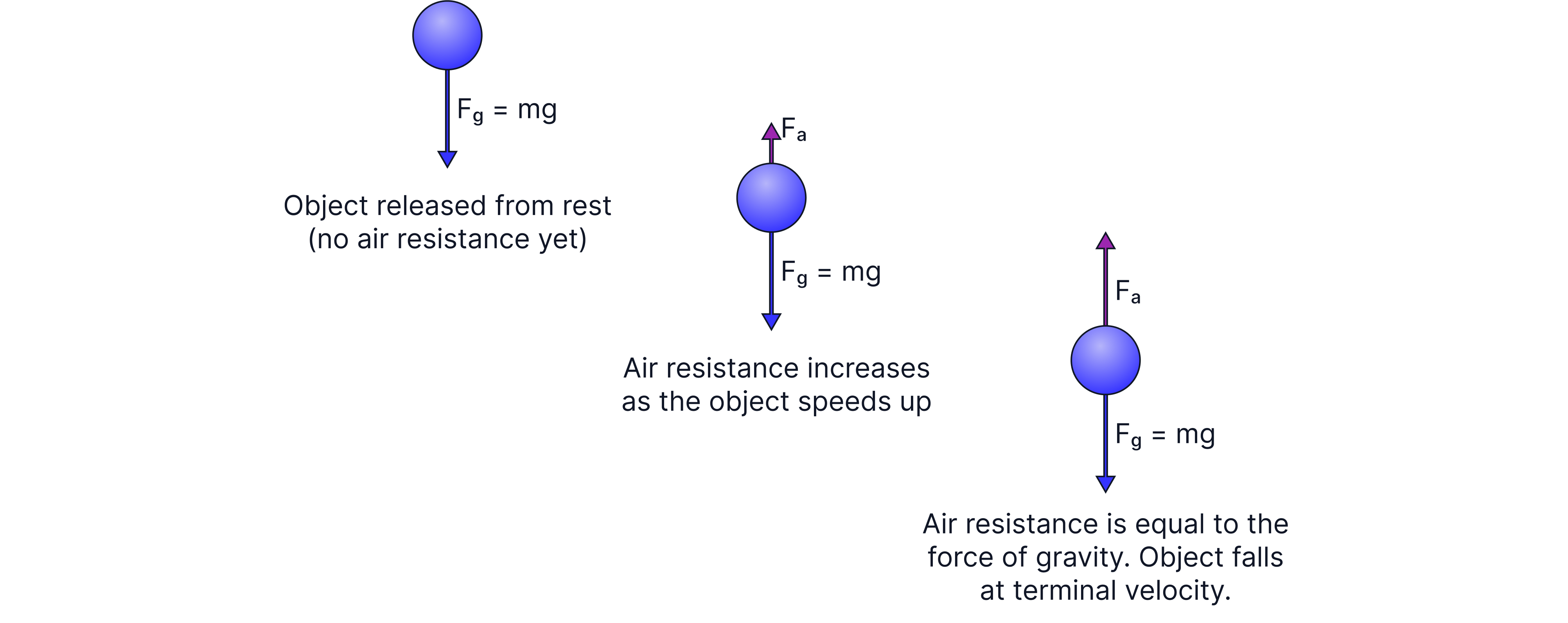
Initial acceleration: When an object first starts falling, its velocity is zero, so air resistance or water resistance is zero or very small. The only force acting on the object is weight pulling the object downwards. This means there's a large resultant force downwards, so the object accelerates rapidly according to Newton’s Second Law, .
Decreasing acceleration: Air resistance (or water resistance) depends on velocity, so as the object speeds up, the drag force increases. The downward force, weight, stays the same, as the object's mass does not change, but the upward force (air resistance) increases. This means the resultant force (the difference between the downward and upward forces) is decreasing, leading to a decrease in acceleration -> . *Note the object is still accelerating, it is still increasing in speed, but as the acceleration has decreased, the rate of increase in speed decreases.
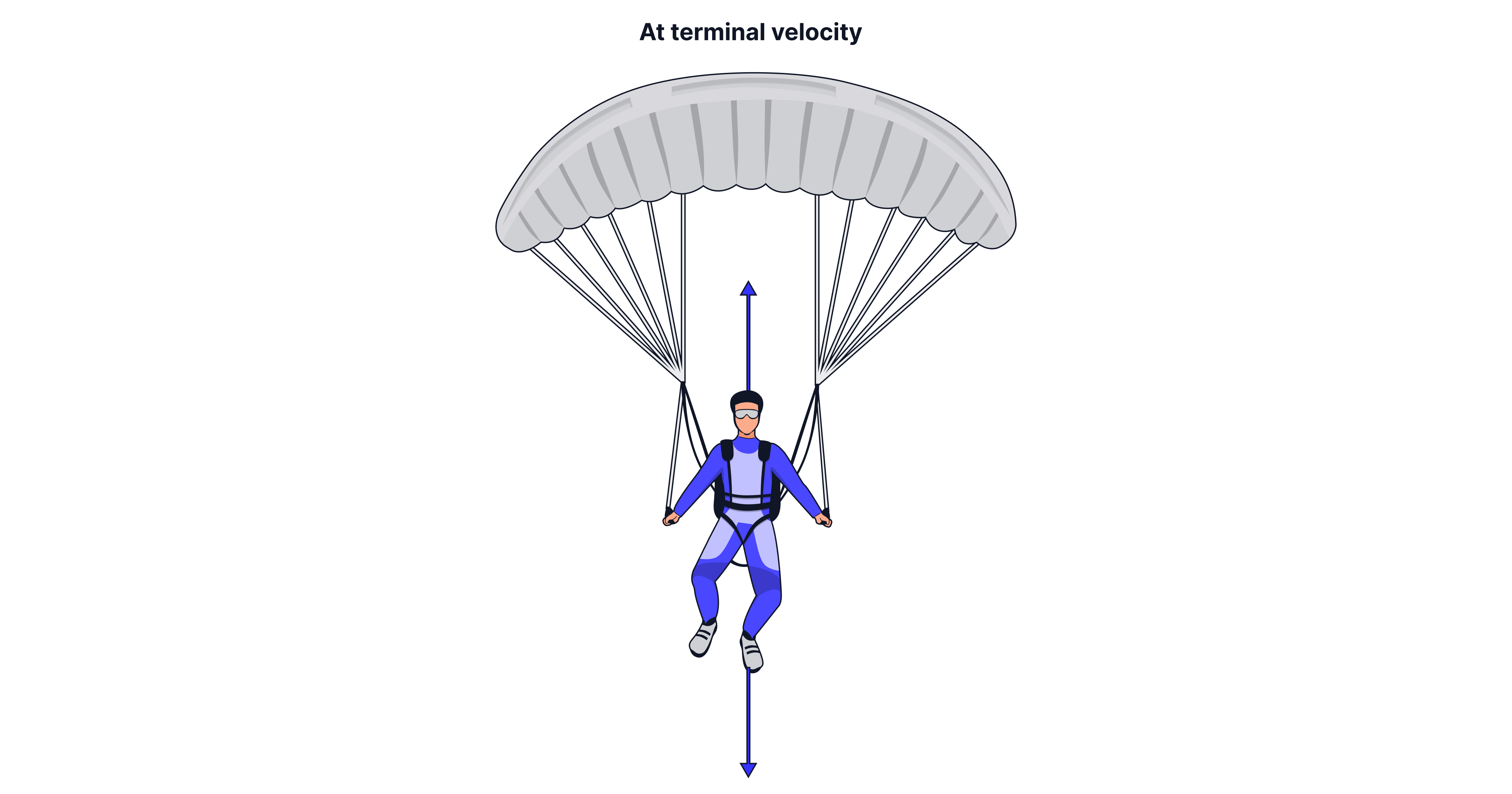
Terminal velocity: Eventually, air resistance (or water resistance) becomes equal to weight. The forces are now balanced, giving a resultant force of zero. By Newton's First Law, if the resultant force is zero, there's no acceleration. The object continues to fall at a constant, maximum velocity. This is the terminal velocity.
Worked Example:
A marble is dropped above a basin of water.
Describe how the forces acting on the marble change as it falls through the air.
When it enters the water, the marble’s speed decreases to a constant value. What name is given to this constant value of speed?
Explain why the marble’s speed decreases, and why it reaches a constant value.
Answer:
As the marble falls through the air, the downward force of gravity remains constant, but the upward force of air resistance increases with the marble's speed until they balance, and the marble falls at a constant speed.
Terminal velocity
When the marble enters water, the downward force of gravity remains the same, but as it moves from air to water, the upward drag force on the marble increases because water is denser than air. There is a resultant force on the marble upwards, so the marble decelerates - falling at slower and slower speeds. As the marble's speed decreases, the upward force of water resistance decreases until it equals the marble's weight. The resultant force is then zero, and the marble falls at a constant speed.
Factors Affecting Terminal Velocity (Triple only)
Mass: Greater mass means greater weight, which means the object will fall for longer before the upward force of air or water resistance becomes large enough to balance it; therefore, heavier objects will reach higher terminal velocities.
Surface Area: A greater surface area results in more air or water resistance at any given speed. The upward force of air or water resistance will equal the downward force of weight sooner, so the object accelerates for less time; therefore, objects with larger surface areas reach slower terminal velocities. Think of a feather being dropped vs a ball of the same mass: the feather takes a lot longer to fall because it has a larger surface area; it falls at a much slower speed because it accelerates for less time before the upward force of air resistance equals the downward force of gravity.
Shape: Streamlined shapes (like a sports car) experience less air resistance than flat shapes (like a bus), as they have effectively reduced their surface area. They will accelerate longer before the forces balance, so they will reach higher terminal velocities. This is why skydivers can control their fall rate by changing body position (falling headfirst vs falling on their stomach).
Fluid Density: Denser fluids exert greater drag, so the object accelerates for a shorter time as the forces balance sooner. They reach terminal velocity at lower speeds.
Worked Example:
In 2012, Felix Baumgartner set a world record for the highest skydive in history by jumping from a balloon 39 km above the surface of the Earth.
At this height, the density of the air is much lower than at sea level.
Explain why jumping from this height allowed Felix Baumgartner to reach much higher speeds than jumping from a lower height.
Answer:
When he jumps out, the only force acting on him is the downwards force of gravity - his weight. He continues to fall at increasing speeds until the upwards force of air resistance becomes equal to his weight. As there are fewer air particles high above the surface of the Earth, the force of air resistance is smaller there-> there are fewer air particles hitting him. He can then accelerate for longer, reaching higher and higher speeds until the upward force of air resistance becomes big enough to balance his weight. If he jumped from a lower height, as there are more air particles, the upward force of air resistance would equal the downward force of weight much sooner, meaning that he would accelerate for less time and thus reach lower speeds.
Velocity-time graph (Triple only)
Terminal velocity appears very clearly on velocity-time graphs as a horizontal section, since the speed is constant. Here's what a typical skydiver's velocity-time graph looks like:
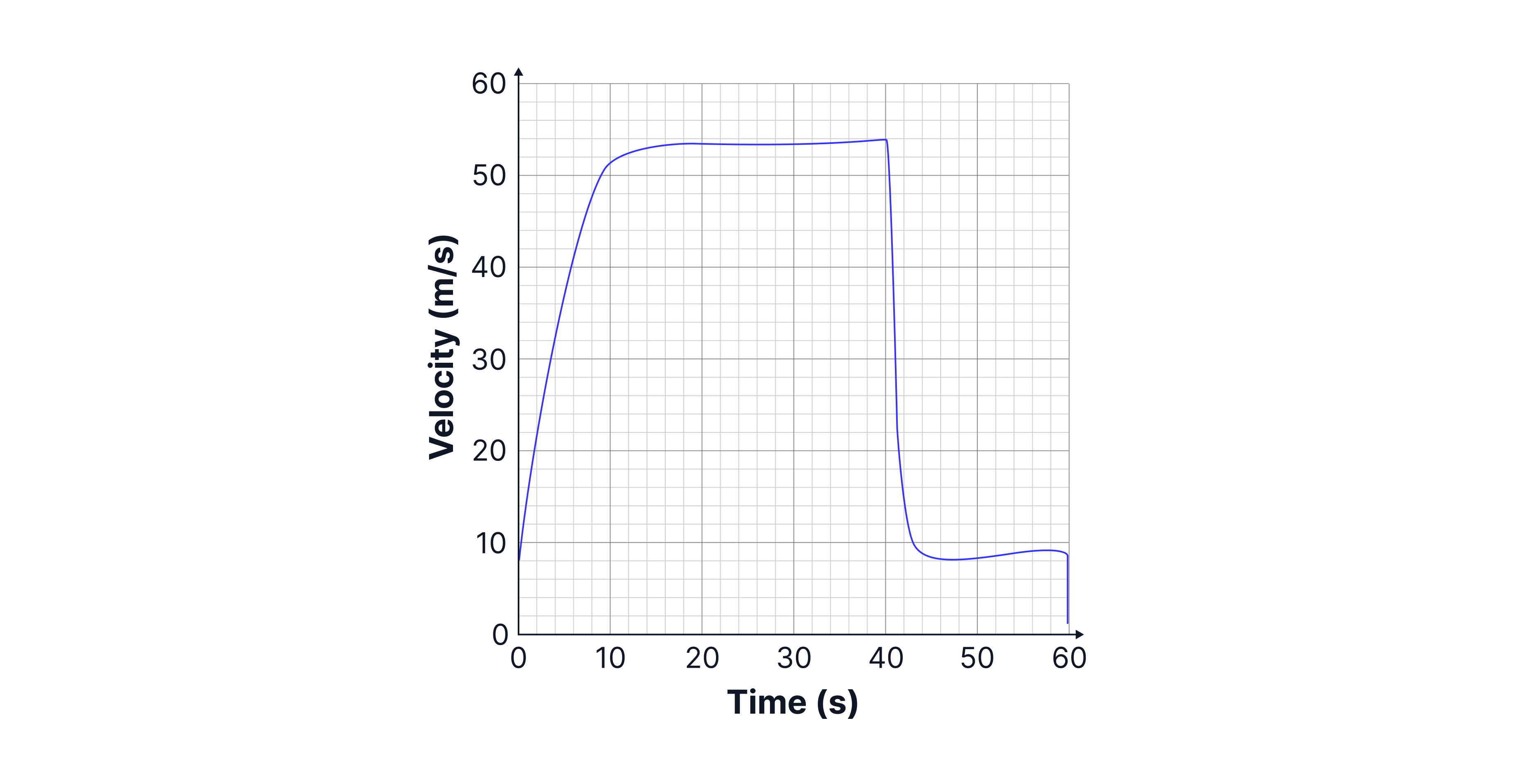
Positive gradient from : Jumped out of plane at . Steep curve initially as acceleration is high as there is a large resultant force downwards due to their weight. Curve becomes less steep and gradually flattens out -> this shows decreasing acceleration as air resistance increases, as the skydiver's speed increases, the resultant force decreases, so the acceleration decreases (note the velocity still increases as the skydiver is still accelerating but just at a decreasing rate).
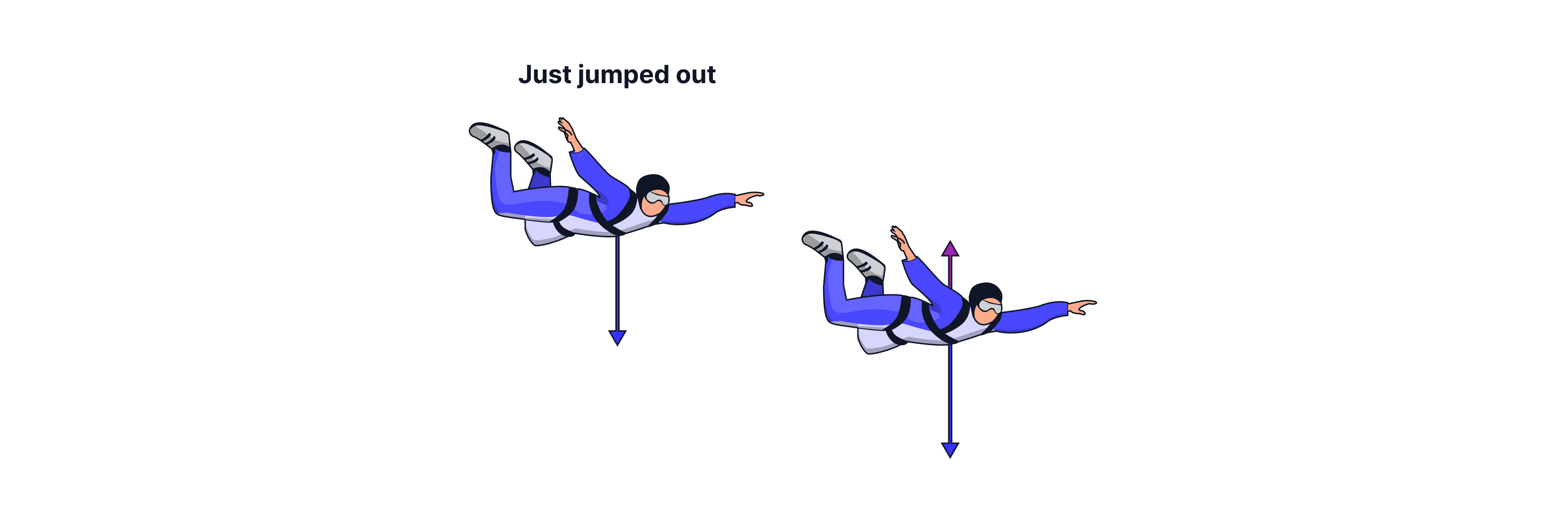
Horizontal line from : Terminal velocity reached. The graph is horizontal, showing constant velocity (gradient , so acceleration ). The two forces (weight and air resistance) are equal, there is no resultant force, so according to the equation , the acceleration must also be zero.

Sudden steep negative gradient at : The velocity drops sharply. They are decelerating, which means there must be a greater upward force than downward force. The upwards force of air resistance increases suddenly as the parachute is opened. The large surface area of the parachute creates a large space for air particles to make contact with. The force of air resistance increases and becomes temporarily larger than the downwards force of weight, creating a resultant force upwards, so the person decelerates (slows down).
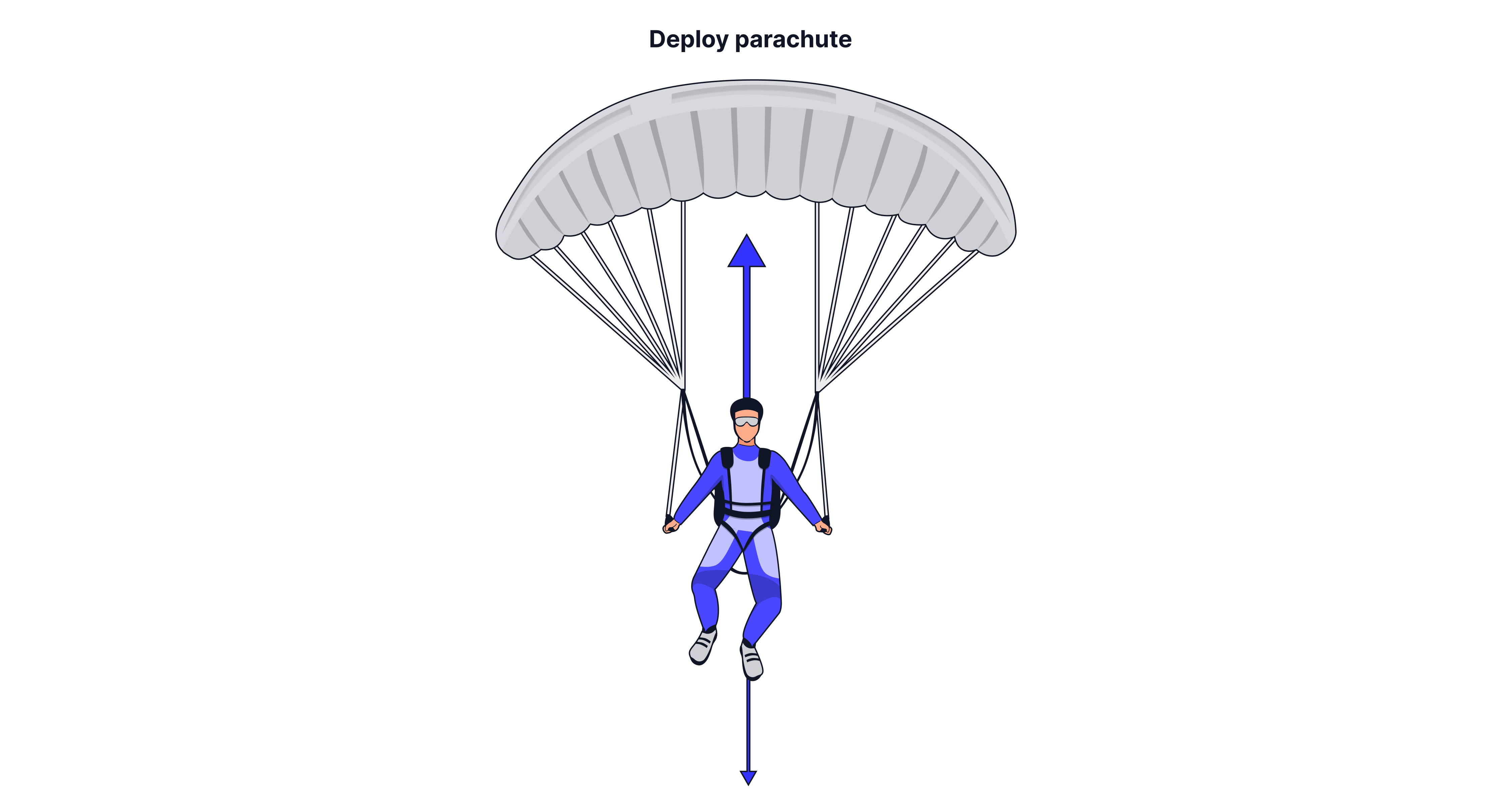
Horizontal line at lower velocity at : Terminal velocity reached again. As the skydiver's speed decreases, the force of air resistance decreases until it becomes equal to the downwards force of weight again. The skydiver continues falling, but at a much slower, constant speed that is safer for landing.
Practice Questions
A small steel ball is dropped from a hot-air balloon.
Explain why the ball accelerates immediately after it is released.
Explain why the ball reaches a terminal velocity.
-> Check out Brook's video explanation for more help.
Answer:
Initially weight is the only force acting on the ball, so there is a resultant downward force causing acceleration.
Air resistance increases with speed. When air resistance equals weight, the forces balance and terminal velocity is reached.
A skydiver falls at a constant speed before opening a parachute. Explain why her velocity decreases rapidly after this point.
-> Check out Brook's video explanation for more help.
Answer:
Opening the parachute greatly increases the surface area, so the air resistance increases. Air resistance becomes much greater than weight, producing a large resultant upward force causing rapid deceleration.