The benefits of collaborative learning vs private tutoring
For decades, there’s been an assumption that if you want your child to excel academically, you need to get them a private tutor.
The theory goes: One teacher + one child = full attention + faster progress. The thought-process is logical, and for many families it works well.
But a growing body of research - and a good dollop of real-world results data - suggests that learning collaboratively alongside other students, can outperform 1:1 teaching in ways that private tutoring simply cannot replicate. Not because individual attention doesn’t matter, but because other people do too.
Here is what the evidence actually says, where private tutoring still has genuine strengths, and how to think about the choice for your own child.
What is "collaborative learning"?
Collaborative learning is not just "putting children in a room together", but a structured learning approach where students work through material together, discuss ideas, ask questions in front of others, and learn partly from watching how their peers think.
Done properly, it looks like live, teacher-led lessons where students can see and respond to explanations in real time, ask questions openly, and benefit from hearing questions they might not have thought to ask themselves.
Done badly - unstructured group work with no teacher guidance - it can be a waste of time. The distinction between the two is important which is why the research that’s been done on the pros and cons of collaborative learning has focussed on it.
Is collaborative learning more effective than 1-to-1 tuition?
The most rigorous UK evidence on the effectiveness of collaborative learning vs 1:1 tuition was done by the Education Endowment Foundation (EEF), a highly respected, independent education research body.
Its ‘Teaching and Learning Toolkit’ finds that collaborative learning approaches lead to approximately five additional months of progress per year on average, based on a review of 212 studies, with the strongest gains seen in Science (as high as 10 months) and smaller gains in literacy (around three months).
Two things are worth flagging though.
-
First, the EEF describes the security of this evidence as low. That doesn’t mean the finding is wrong, but it does mean that the results their studies uncovered varied a lot, and some of the strongest results came from commercially-run programmes without independent evaluation, so should be treated with some caution
-
Second, the EEF is specific about what makes collaborative learning work: small groups of three to five students, clear shared goals, and - most importantly of all - active teacher facilitation. Its researchers note that "pupils need support and practice to work together, it does not happen automatically", and warn that without proper structure, group work can actually widen the gap between higher and lower-attaining students, rather than closing it
That’s an important caveat for any parent to weigh up, because it suggests the real question is not whether to choose between group learning or private tutoring, but instead ask yourself "how well-structured is the group learning, and how good is the teacher running it?".
Where private tutoring is effective
There are situations where 1:1 tutoring has an edge.
A private tutor can move at exactly your child's pace, spend an entire class on a single sticking point, and tailor every explanation to how that one child learns best. For a child who needs intensive, individually paced catch-up on a specific gap, or who finds any group setting - even those where the group is remote - overwhelming, 1:1 tutoring can be valuable. However, that should be set against the perceived increase in pressure some students report from their own private tutoring experiences. Every family and every child is different, and there is no single right answer here.
The trade-offs, in practice, tend to be cost and consistency. Private tutoring in the UK typically costs somewhere in the region of £60 to £100 an hour - working out at around £8,000 per year for each subject.
It’s also important to note that quality can vary a great deal from tutor to tutor. No qualifications are required to become a private tutor and there’s no regulatory body overseeing quality in the UK. The private tutoring market is, in effect, a ‘lawless Wild West’.
The benefits of learning with peers
Setting both cost and quality questions aside for a moment, there are several well-documented benefits to learning alongside other students that 1:1 tutoring cannot offer.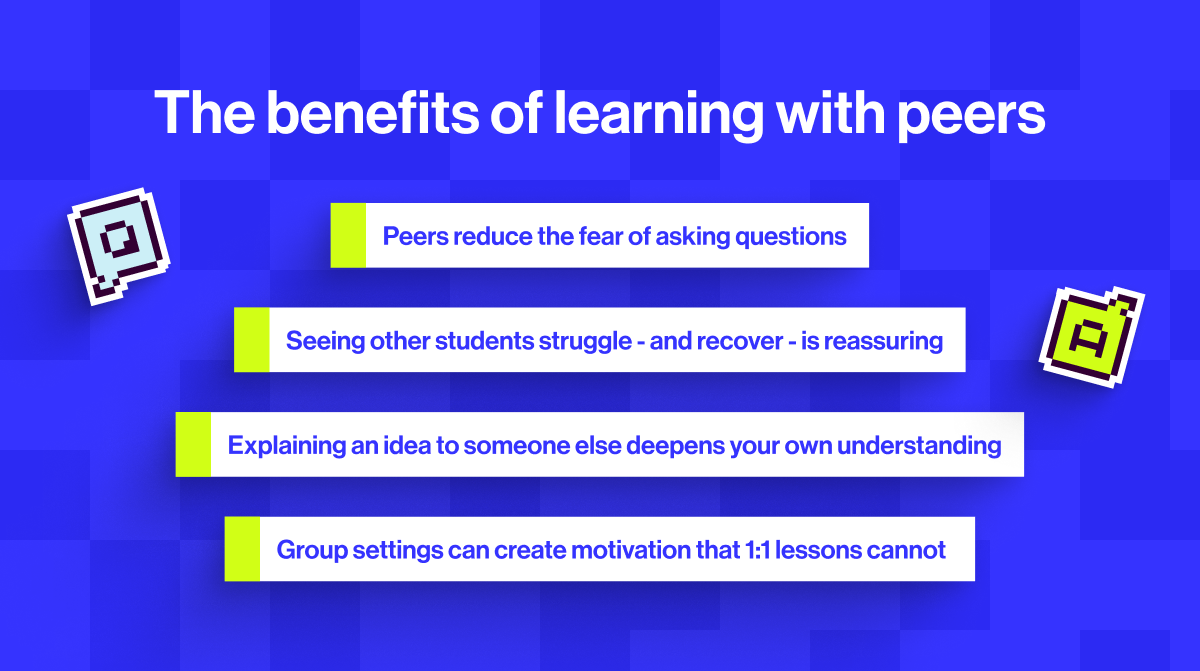
Peers reduce the fear of asking questions
Many students are more anxious about looking silly than they are about the subject itself. In a private tutoring setting, every question is under direct, individual scrutiny. In a well-run group setting - especially one where participation can be anonymous, like in MyEdSpace’s online lessons - students ask more questions, not fewer, because the spotlight is not fixed on any one person. On average MyEdSpace students engage 20-30 times each lesson.
Explaining an idea to someone else deepens your own understanding
This is one of the more consistently observed effects in learning science: when students articulate an idea out loud, even informally in a group chat or discussion, they often process it more deeply than when they simply receive an explanation.
Seeing other students struggle - and recover - is reassuring
Part of what makes exams stressful is the sense that everyone else understands something, while you don’t. In group settings, students see classmates asking the same question they were embarrassed to ask, or getting something wrong and then working through it. That helps to normalises struggle as an integral part of learning, reducing anxiety and fears of falling behind irrecoverably.
Group settings can create motivation that 1:1 lessons cannot
A shared class, a shared teacher, and a sense of everybody working towards the same goal (often an exam), can build a kind of accountability and momentum that is much harder to sustain in a one-to-one, tutor-student relationship
How learning online maximises the benefits of collaborative learning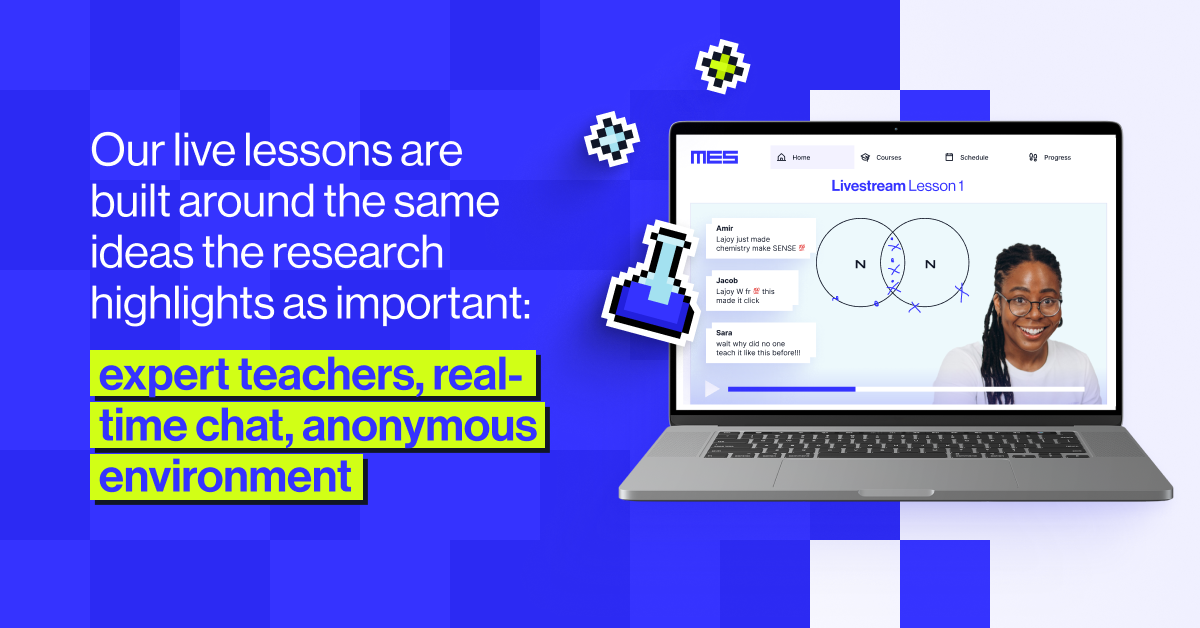
At MyEdSpace, our live lessons are built around the same ideas the research highlights as important: expert teachers leading structured lessons, real-time chat so students can ask and answer questions as they go, and a cameras-off, anonymous environment specifically designed to lower the barrier to participation.
The results our students go on to achieve in exams - especially when compared to national averages - proves it’s an approach that works.
For example, in 2026 our GCSE students achieved grades 7 to 9 at more than double the national rate (45% versus 22% nationally), and in GCSE Maths specifically, almost one in four achieved a grade 8 or 9, against roughly one in ten nationally. At A-level, 3 in 4 of our students achieved a B or above, compared with only 61% nationally.
Individuals learn differently
It’s important to remember that every child - every person - learns differently. A child who thrives on structure, peer energy, and low-pressure participation may get more out of collaborative, teacher-led group lessons. Meanwhile, a child who needs highly individualised, slow-paced, one-on-one support for a specific gap may do better with a private tutor, at least for a period.
For many families, the deciding factor ends up being a combination of fit and cost. If you’re weighing up the two, our related articles on how online group learning compares with 1:1 private tutoring and what private tutoring actually costs, and the alternatives go into more depth on both.
Whatever approach you choose, we wish you the best of luck with the year ahead.
Try before you buy
Whether your child is getting started with Year 5, preparing for the 11+, heading towards their KS2 SATs in Year 6, or moving through KS3 in Year 7, Year 8, and Year 9, starting their GCSEs in Year 10 or preparing for exams in Year 11 or making that final step-up into Year 12 and their A-levels, which finish off Year 13 - now is the time to establish the habits that will bring success.
We've handpicked elite UK teachers and created lessons with them that give your child the academic advantage.