Plant Cells
Laura Armstrong & Joe Wolfensohn
Teachers


Recall Questions
This topic builds on GCSE knowledge of plant cell structure, including the names and functions of organelles found in plant cells and the differences between plant and animal cells.
Name three structures found in a plant cell but not in an animal cell
Cell wall, chloroplasts, large permanent vacuole.
What is the function of the cell wall in a plant cell?
The cell wall provides structural support and maintains the shape of the cell. It is fully permeable, allowing substances to pass through freely.
State the function of chloroplasts
Chloroplasts are the site of photosynthesis, where light energy is used to convert carbon dioxide and water into glucose and oxygen.
Topic Explainer Videos
Check out these @myedspace_biology videos that explains plant cells then read the study notes below. Once you've gone through them, don’t forget to try out the practice questions!
What is a plant cell?
Plant cells are eukaryotic cells - like animal cells, they contain a true, membrane-bound nucleus and a range of membrane-bound organelles. However, plant cells have several additional structures not found in animal cells: a cell wall, chloroplasts, a large permanent vacuole, and plasmodesmata.
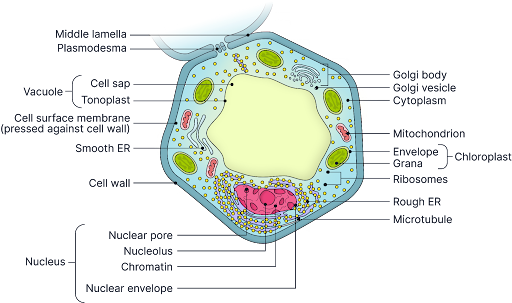
The structure of a plant cell
Shared structures with animal cells
Plant cells contain all of the following, which function in the same way as in animal cells:
-
Nucleus (with nuclear envelope, nuclear pores, nucleolus, and chromatin)
-
Mitochondria (double membrane, cristae, matrix, 70S ribosomes)
-
80S ribosomes in the cytoplasm
-
Rough and smooth endoplasmic reticulum
-
Golgi apparatus (cisternae, vesicles)
-
Lysosomes (though less prominent than in animal cells)
-
Cell surface membrane
-
Cytoskeleton (microfilaments, intermediate filaments, microtubules)
The cell wall
-
Found outside the cell surface membrane.
-
The cell wall is made of cellulose microfibrils - long, unbranched chains of beta-glucose joined by 1,4 - glycosidic bonds, arranged in parallel bundles.
-
Cellulose microfibrils give the cell wall high tensile strength - it resists stretching forces without breaking.
-
The cell wall is fully permeable - it does not control which substances pass through (unlike the cell surface membrane, which is partially permeable).
-
Between adjacent cell walls lies the middle lamella - a layer that cements neighbouring cells together.
-
cements neighbouring cells together.
Chloroplasts
-
Surrounded by a double membrane (chloroplast envelope - an outer and inner membrane).
-
Inside is a system of flattened membrane sacs called thylakoids. Stacks of thylakoids are called grana (singular: granum). Grana are connected by lamellae (unstacked thylakoid membranes).
-
The thylakoid membranes contain chlorophyll and other photosynthetic pigments, and are the site of the light-dependent reactions of photosynthesis.
-
The fluid-filled space surrounding the thylakoids is called the stroma. It contains enzymes for the light-independent reactions, as well as chloroplast DNA and 70S ribosomes.
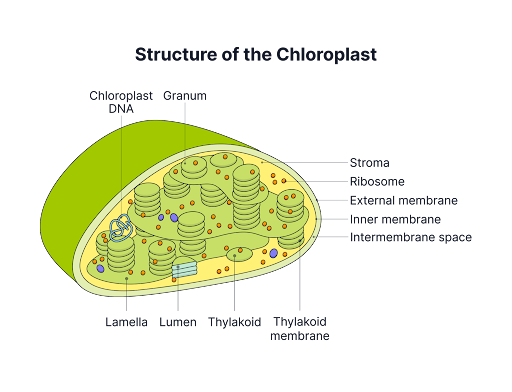
Diagram of the structure of a chloroplast.
The large permanent vacuole
-
A large, fluid-filled compartment occupying much of the volume of a mature plant cell.
-
Filled with cell sap - a solution of water, mineral ions, sugars, and other solutes.
-
Surrounded by a single membrane called the tonoplast, which controls the movement of substances into and out of the vacuole.
-
Functions: maintains turgor pressure (rigidity) in the cell; stores water, ions, and waste products.
Plasmodesmata
-
Narrow channels that pass through the cell walls of adjacent plant cells.
-
Function: allow direct communication and transport of water, ions, small molecules, and even proteins between neighbouring cells, bypassing the need to cross membranes.
Absence of centrioles
-
Most plant cells do not contain centrioles.
The Endosymbiotic Theory
The endosymbiotic theory proposes that mitochondria and chloroplasts were once free-living prokaryotes that were engulfed by a larger host cell and, instead of being digested, formed a mutually beneficial (endosymbiotic) relationship. Over time, the engulfed prokaryotes became permanent components of the host cell - the organelles we recognise today.
Evidence supporting the theory
-
Both mitochondria and chloroplasts have a double membrane. The inner membrane is thought to be derived from the original prokaryote's cell surface membrane; the outer membrane is thought to be derived from the host cell's membrane.
-
Both organelles contain their own circular DNA - not associated with histone proteins. This is structurally identical to prokaryotic DNA.
-
Both organelles contain 70S ribosomes - the same size as prokaryotic ribosomes - rather than the 80S ribosomes found in the eukaryotic cytoplasm.
-
Both organelles are similar in size to free-living prokaryotes (approximately 1–10 µm).
Key Terms
-
Cell wall: a rigid layer of cellulose surrounding the cell surface membrane of plant cells, providing structural support.
-
Cellulose: a polysaccharide made of beta-glucose monomers joined by 1,4-glycosidic bonds; gives the cell wall tensile strength.
-
Middle lamella: a calcium pectate-rich layer between the primary cell walls of adjacent cells that holds them together.
-
Chloroplast: a double-membrane-bound organelle that is the site of photosynthesis; contains thylakoids, grana, and stroma.
-
Thylakoid: a flattened membrane sac within the chloroplast; stacks of thylakoids form grana.
-
Stroma: the fluid-filled matrix of the chloroplast, containing enzymes for the light-independent reactions, DNA, and ribosomes.
-
Tonoplast: the single membrane surrounding the vacuole; controls movement of substances into and out of the vacuole.
-
Vacuole: a large, fluid-filled organelle surrounded by the tonoplast; maintains turgor pressure and stores solutes.
-
Plasmodesmata: channels through plant cell walls lined by the cell surface membrane, allowing direct cytoplasmic connection between adjacent cells.
Exam Tips
-
When asked to identify structures in a labelled diagram, take care to distinguish between the vacuole (the whole organelle, filled with cell sap) and the tonoplast (the membrane surrounding it). If the label line points to the membrane, the answer must be tonoplast.
-
Do not describe chlorophyll as a distinguishing feature of plant cells. Examiners specifically noted that chlorophyll is a molecule, not a cellular structure. The correct answer is chloroplasts. You will not receive the mark for writing "contains chlorophyll" instead of "contains chloroplasts."
-
Remember that chloroplasts (like mitochondria) contain their own DNA and 70S ribosomes. Examiners found that some candidates were unaware of this.
Practice Questions
Which of the following correctly describes a structural difference between chloroplasts and mitochondria?
A) Chloroplasts have a double membrane; mitochondria have a single membrane.
B) Chloroplasts contain 70S ribosomes and circular DNA; mitochondria do not.
C) Chloroplasts contain a system of internal membrane sacs (thylakoids); mitochondria have internal membrane folds called cristae.
D) Chloroplasts are found only in plant cells; mitochondria are found only in animal cells.
Answer: C
Rationale:
The defining internal membrane feature of chloroplasts is the thylakoid system (organised into grana), whereas mitochondria have cristae. A is wrong - both organelles have a double membrane (envelope). B is wrong - both chloroplasts and mitochondria contain 70S ribosomes and circular DNA; this is true of both. D is wrong - mitochondria are found in both plant and animal cells.
The figure shows a transmission electron micrograph of a mesophyll cell from a leaf.
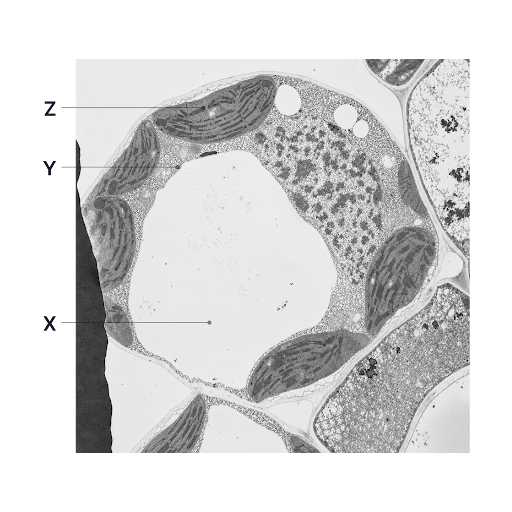
(i) Identify the structures labelled X, Y, and Z. [3]
(ii) Explain how the structure of the cell wall enables it to carry out its function. [3]
(iii) A student states that chloroplasts and mitochondria both show evidence of having evolved from free-living prokaryotes. Give two features of chloroplasts that support this statement. [2]
Model answer:
(i)
-
X is the (large permanent) vacuole.
-
Y is the tonoplast (the membrane surrounding the vacuole).
-
Z is the chloroplast.
(ii)
-
The cell wall is composed of cellulose microfibrils - cellulose being a polymer of β-glucose monomers linked by 1,4-glycosidic bonds.
-
The parallel arrangement of these microfibrils, held together by hydrogen bonds between chains, gives the wall high tensile strength, meaning it resists stretching or pulling forces.
-
The cell wall is fully permeable, allowing water and dissolved substances to pass through freely, so it does not impede the movement of substances into or out of the cell.
(iii)
-
Chloroplasts contain their own circular DNA, which lacks histone proteins - closely resembling the DNA found in prokaryotic cells.
-
Chloroplasts contain 70S ribosomes, which are the same size as prokaryotic ribosomes, rather than the 80S ribosomes found in the eukaryotic cytoplasm.
-
Chloroplasts are capable of replicating independently by binary fission, in the same way that prokaryotes reproduce.
More Practice
Try to answer the practice questions from the TikTok videos on your own, then watch the video to see how well you did!