Mass spectrometry
Lajoy Tucker
Teacher

Contents
What is Mass Spectrometry?
Mass spectrometry is an analytical technique that identifies compounds by measuring the mass-to-charge ratio (m/z) of ions formed from molecules.
How Mass Spectrometry Works:
1. Ionisation: Sample molecules are bombarded with high-energy electrons (electron impact ionization).
2. Acceleration: Ions are accelerated through an electric field.
3. Deflection: Ions are separated based on their m/z ratios in a magnetic field.
4. Detection: Ions are detected and recorded as peaks on a mass spectrum.
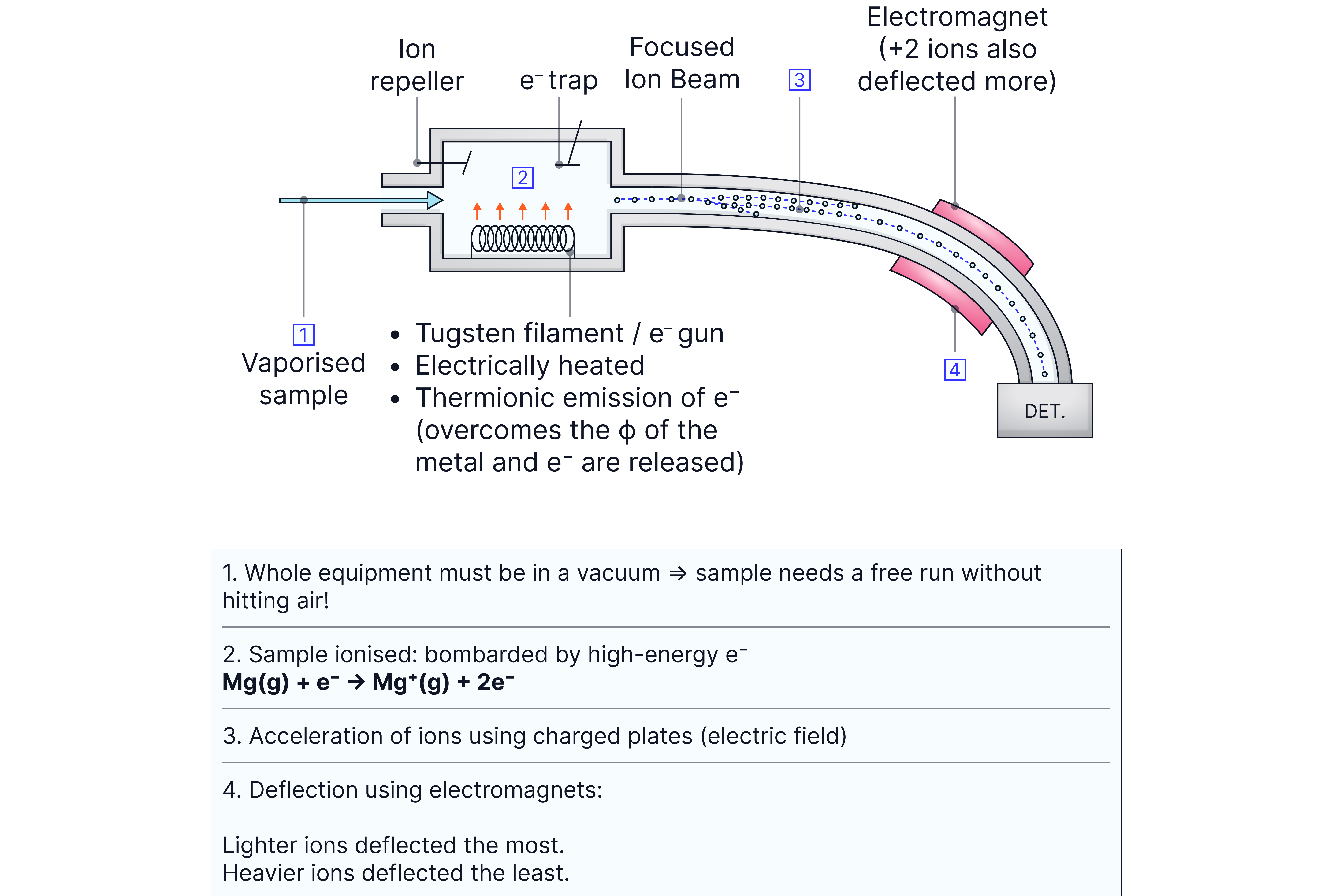
We measure m/z ratios rather than just masses because the technique separates ions based on their mass-to-charge ratio. Since most ions have a +1 charge, m/z effectively equals the mass.
Purpose of Mass Spectrometry in Organic Analysis
Mass spectrometry can be used to determine the molecular formula of a compound by using:
• Precise relative atomic masses (to 4 decimal places)
• The accurate molecular mass (Mr) from the molecular ion peak (M⁺) in a high-resolution mass spectrum
Key Features of Mass Spectra
The Molecular Ion Peak (M⁺)
• The molecular ion is the species formed when a molecule loses one electron, but no atoms:
M → M⁺ + e⁻
This peak appears at the highest m/z value (excluding minor isotopic peaks) and represents the molecular mass of the compound.
Important: Some molecules don't show clear molecular ion peaks because the molecular ion is unstable and fragments immediately.
The M+1 Peak (Isotope Peak)
• M+1 peak appears one mass unit higher than the molecular ion
• Caused by ¹³C isotopes (1.1% natural abundance)
• Rule of thumb: M+1 peak height ≈ 1.1% × number of carbon atoms
• Example: C₄ compound shows M+1 peak at ~4.4% of molecular ion peak
The Base Peak
• The base peak is the most abundant ion in the spectrum (assigned 100% relative abundance).
This is often NOT the molecular ion peak.
Usually represents the most stable fragment ion.
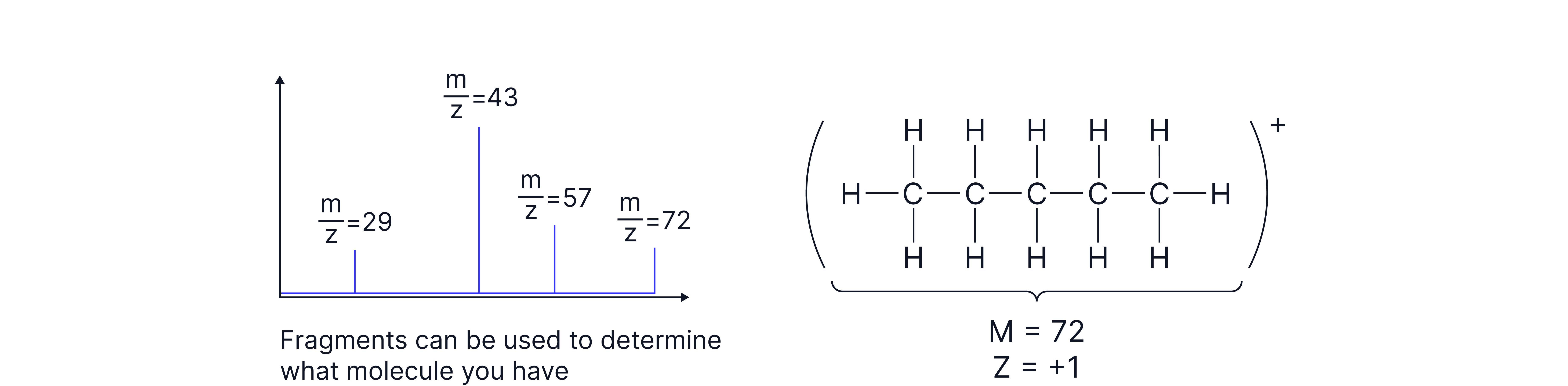
Fragmentation Patterns (not assessed by AQA)
When molecular ions break apart, they form fragment ions. Common losses include:
• -15: Loss of CH₃ (methyl group)
• -29: Loss of CHO (aldehyde group) or C₂H₅ (ethyl group)
• -31: Loss of OCH₃ (methoxy group)
• -45: Loss of COOH (carboxyl group)
Determining Molecular Formula with High-Resolution Mass Spectrometry
Why High-Resolution is Essential?
High-resolution MS can:
• Differentiate between compounds with similar integer masses (e.g. C₂H₄O vs. CH₄N₂)
• Identify molecular formulas to 4 decimal places, allowing accurate deduction.
• Avoid ambiguity: Many compounds have the same integer molecular mass, but precise atomic masses allow accurate identification
Step-by-Step Method:
1. Obtain the molecular ion peak value from the spectrum
2. Use a list of possible empirical formulae (consider C, H, O, N, halogens)
3. Add up the accurate relative atomic masses for combinations
4. Match to the given precise molecular mass (within ±0.0005 tolerance)
5. Check: Does the formula make chemical sense?
Reference Table of Precise Atomic Masses
Atom | Precise Mass (u) |
|---|---|
H | 1.0078 |
C | 12.0000 |
O | 15.9949 |
N | 14.0031 |
F | 18.9984 |
Cl | 34.9689 |
Example Calculation:
Given M⁺ = 60.0211, what is the molecular formula?
Try C₂H₄O₂:
• C (12.0000 × 2) = 24.0000
• H (1.0078 × 4) = 4.0312
• O (15.9949 × 2) = 31.9898
• Total = 60.0210 ✓ (within tolerance ±0.0005)
Answer:
C₂H₄O₂ (ethanoic acid or methyl ethanoate)
Worked Examples
Example 1: Standard Calculation
A molecular ion peak appears at m/z = 88.0524. What is the likely molecular formula?
Try C₄H₈O₂:
• C = 12.0000 × 4 = 48.0000
• H = 1.0078 × 8 = 8.0624
• O = 15.9949 × 2 = 31.9898
• Total = 88.0522 ✓
Answer:
C₄H₈O₂ (e.g. ethyl ethanoate or butanoic acid).
Example 2: Distinguishing Similar Masses
Explain why accurate atomic masses are needed when using mass spectrometry to determine a molecular formula.
Answer:
Because many compounds have similar integer molecular masses, only precise atomic masses allow accurate identification and avoid ambiguity between potential formulae.
Example: C₂H₄O and CH₄N₂ both have integer mass of 44, but:
• C₂H₄O: Precise Mr = 44.0262
• CH₄N₂: Precise Mr = 44.0375
High-resolution MS gives precise values to 4 d.p., so only one matches exactly.
No answer provided.
Practice Questions
Question 1
A molecular ion peak is observed at m/z = 46.0419. Suggest a molecular formula and show your calculation.
Try C₂H₆O:
• C = 12.0000 × 2 = 24.0000
• H = 1.0078 × 6 = 6.0468
• O = 15.9949 × 1 = 15.9949
• Total = 46.0417 ✓
Answer:
C₂H₆O (ethanol or dimethyl ether).
Question 2
The molecular ion peak for a compound is 74.0368. Which of the following is a likely molecular formula?
A. C₃H₈O₂
B. C₂H₆O₂
C. C₄H₁₀O
D. C₃H₆O₂
Sample calculation for D:
C₃H₆O₂:
• C = 36.0000
• H = 6.0468
• O = 31.9898
• Total = 74.0366 ✓ (Closest match)
Correct answer: D
Common Student Mistakes to Avoid
1. Confusing molecular ion with base peak: The molecular ion might not be the tallest peak!
2. Forgetting other elements: Always consider N, F, Cl if C, H, O don't work.
3. Arithmetic errors: Double-check decimal place calculations.
4. Ignoring chemical sense: Make sure your formula could actually exist.
5. Wrong tolerance: Only accept matches within ±0.0005.
No answer provided.
Connections to Other Techniques
Mass spectrometry works best when combined with:
• IR spectroscopy: Identifies functional groups.
• NMR spectroscopy: Determines structure and connectivity.
• Melting/boiling points: Helps distinguish between isomers.
Real-world applications:
• Drug testing and forensic analysis.
• Environmental monitoring • Protein identification in biochemistry.
• Quality control in pharmaceutical industry.
No answer provided.
Key Tips for Success
• Remember: MS gives molecular formula, NOT structure (isomers have same formula) • Always show working: Full calculations earn method marks
• Check your answer: Does the formula make chemical sense?
• Practice calculations: Speed and accuracy come with repetition
• Link to other topics: Refer back to Atomic Structure (3.1.1) for more on Mass Spec fundamentals
No answer provided.