Percentage Atom Economy
Lajoy Tucker
Teacher

Introduction & Definitions
Percentage Atom Economy:
A measure of the proportion of atoms in the reactants that are converted into the desired product(s).
Note: The total of all reactants is the same as that of the products due to the law of conservation of mass.
Importance:
Used to assess the efficiency and sustainability of a chemical process.
Higher atom economy = less waste, more sustainable and cost-effective.
Basic Principles
Atom economy is based purely on the balanced chemical equation (not on experimental yield).
It does not depend on reaction conditions or experimental success.
It focuses on how many of the atoms in the reactants end up in the desired product.
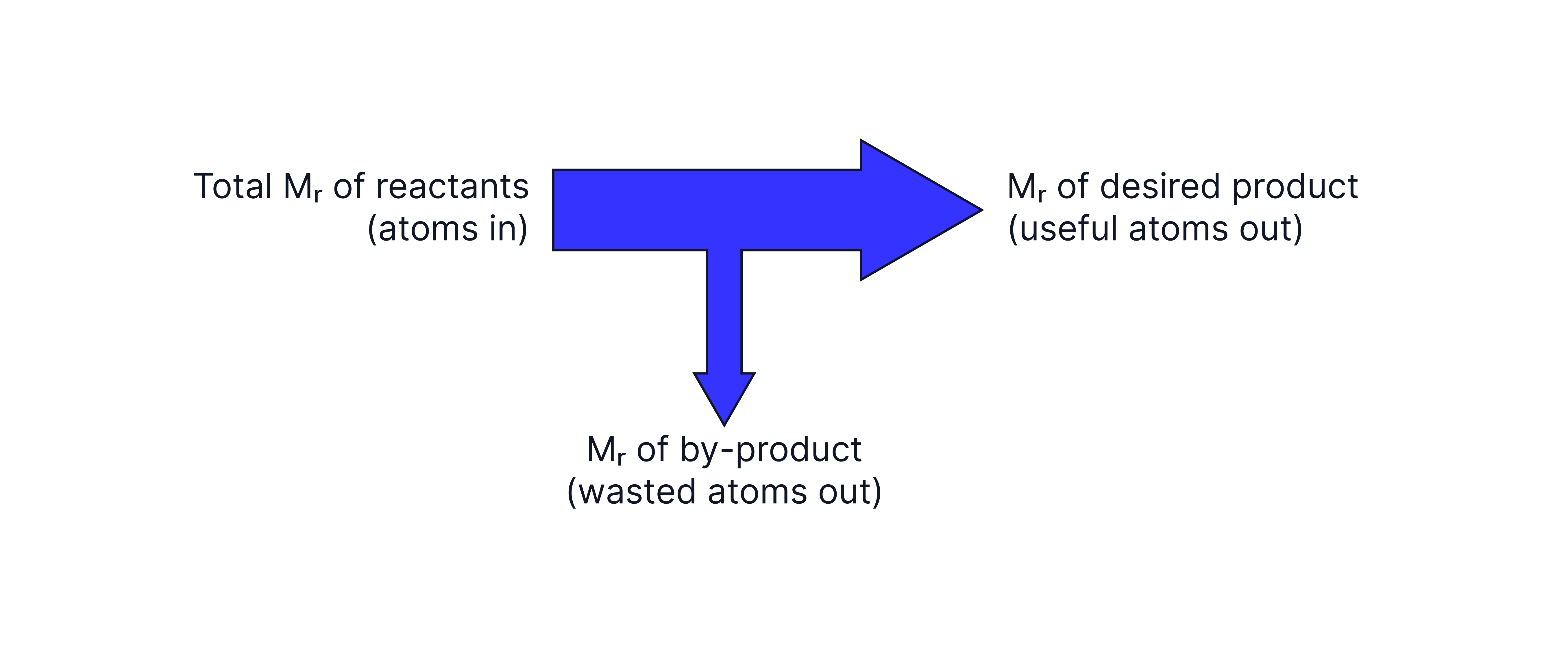
No answer provided.
Explanations
Why Atom Economy Matters
Economic: Less waste means lower disposal costs and higher profits.
Environmental: Less pollution and waste production.
Ethical: Green chemistry principles promote sustainability and minimal resource use.
Choosing Reactions
Reactions with fewer by-products and only one main product tend to have higher atom economy.
Addition reactions generally have 100% atom economy, since all atoms become part of the product.
Substitution and elimination reactions usually have lower atom economies due to by-products.
Worked Examples
Example 1 – High Atom Economy Reaction
Reaction:
values:
= 28.0
= 18.0
= 46.0
Addition reaction → No waste, high efficiency.
No answer provided.
Example 2 – Lower Atom Economy Reaction
Companies may sell or find alternative uses for waste-products for processes with low atom economy. This reduces both the environmental and economical impact of waste materials.
Reaction:
Desired product:
values:
= 58.5
= 106.0
= 36.5
Total of reactants = 106.0 + 2(36.5) = 179.0
Less efficient due to waste products
Note - that the Mr values must be multiplied by the coefficients to account for the total atoms in and out.
No answer provided.