Principles of NMR
Dr. Davinder Bhachu
Teacher

Contents
Principles of NMR Spectroscopy
What is NMR?
Nuclear Magnetic Resonance (NMR) Spectroscopy is an analytical technique used to determine the structure of unknown molecules by studying the environment of certain atomic nuclei, typically hydrogen-1 and carbon-13 .
The Basic Principle
NMR is based on the phenomenon that some atomic nuclei have spin (they act like tiny magnets). When placed in a strong magnetic field, these nuclei can absorb radio wave energy and change their spin state.
Nuclei with an odd mass number (like and ) have nuclear spin and can be detected using NMR.
When exposed to radio frequency radiation in a magnetic field, these nuclei resonate - they absorb energy and flip their spin.
The amount of energy needed depends on the chemical environment of the nucleus.

Chemical environments
By measuring the strength of the magnetic field that must be applied, NMR spectroscopy gives information about the local environment of specific atoms in a molecule.
A “different environment” means that an atom is bonded to different atoms or groups of atoms.
e.g. for ethanol.

The NMR Spectrum
The NMR machine generates a spectrum where:
Each peak corresponds to nuclei in a unique chemical environment.
The position of the peak is the chemical shift (δ) measured in ppm and depends on the electronic surroundings of the nucleus.
Chemical shifts are provided in the data booklet.

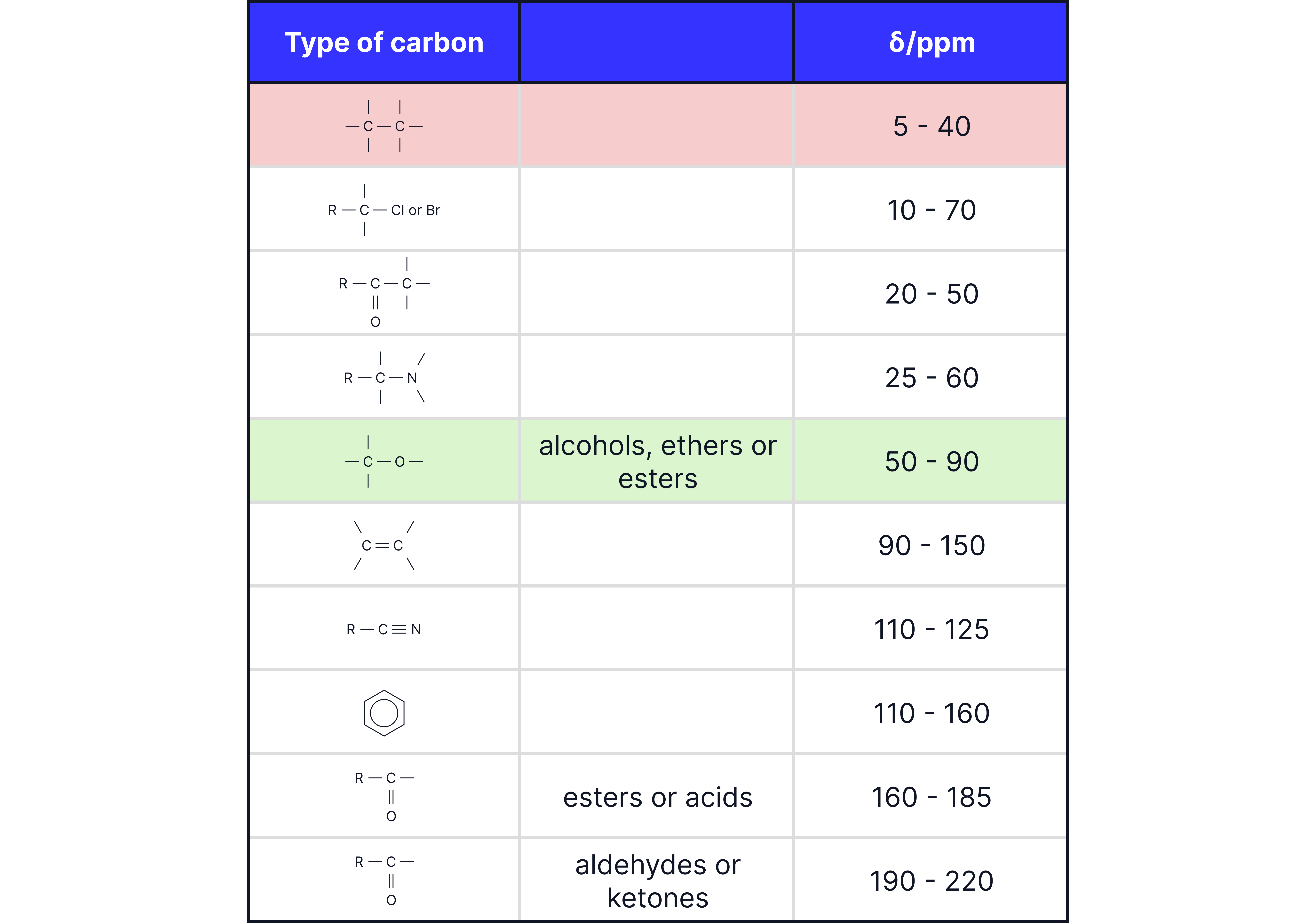
Two carbon environments so two peaks in spectrum.
Reference Peak
All chemical shifts are measured relative to the reference peak at produced by a standard called TMS (tetramethylsilane) with formula .
This peak is often removed from the final spectrum.

TMS is used as a standard as:
It produces a strong single peak ( in the same environment).
Its peak is found at the far right of an NMR spectrum (away from other signals).
It is volatile (easy to remove).
It is inert (so will not react with samples being analysed).

Solvents
Samples are dissolved in a solvent before entering the spectrometer.
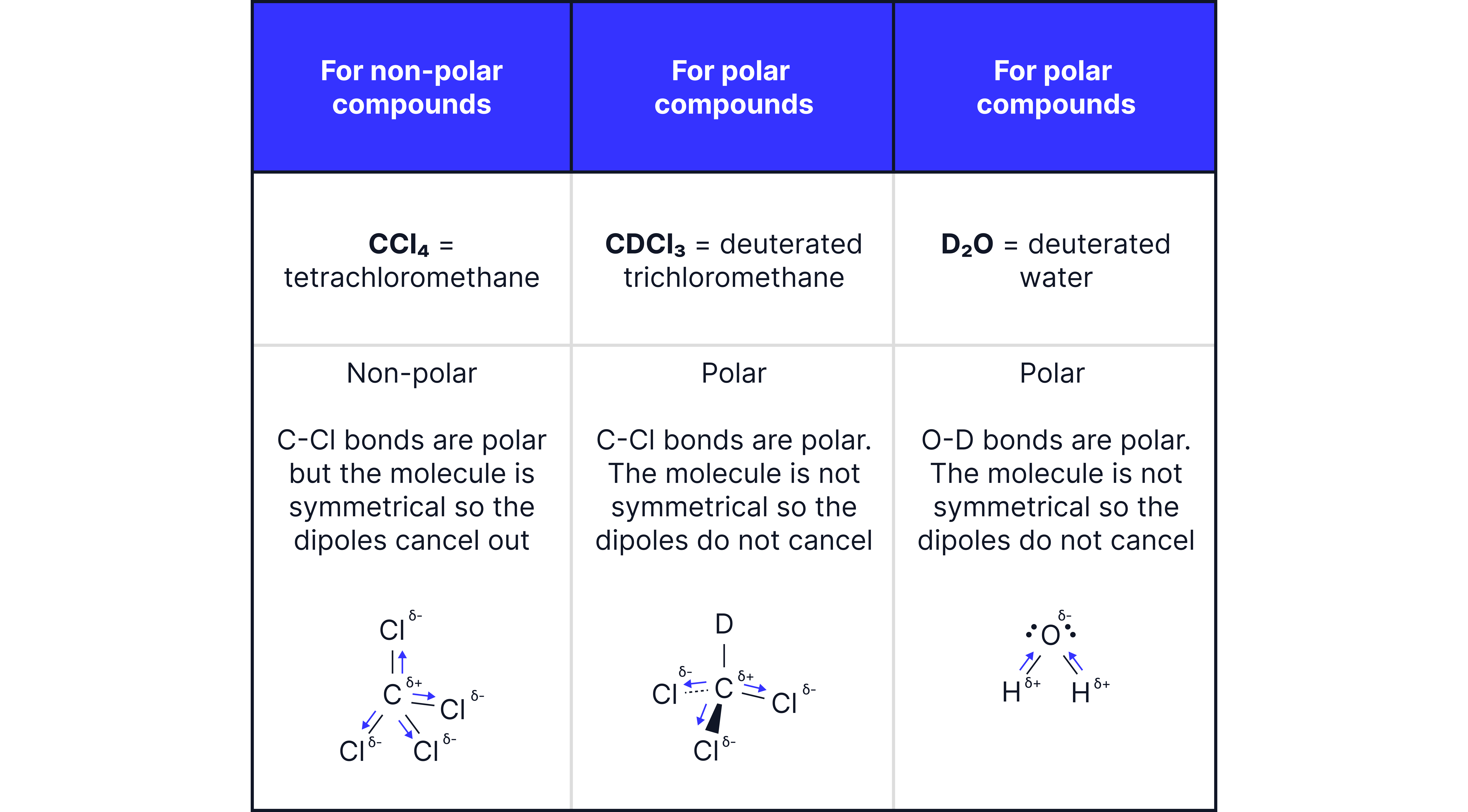
Solvents should be unreactive and not contain any atoms as this would mask the spectrum of the sample.
Deuterium (D) is an isotope of hydrogen with a mass number of 2. This even mass number makes it NMR inactive.
Like dissolves like and so polar solvents are used to dissolve polar samples and vice versa.
Typical solvents:
Practice Questions
Question 1
Determine the number of signals expected (excluding TMS) in the NMR spectra of the following compounds.
a)
b) 
c) 
Answer
a) 4
b) 2 (look out for symmetry!)
c) 6
Question 2
Suggest a suitable solvent to use in the analysis of a non-polar organic compound.
Answer